Wednesday, April 10, 2019

April 10, 2019--My Roy Cohn

As so many things have continued to close in on Trump, it is no surprise that he might be pining for, as he put it, "his" Roy Cohn.

Cohn, as you likely recall, is best known for having been Senator Joseph McCarthy's chief counsel during the years McCarthy had Washington and the rest of the country in thrall as he pursued, by mainly nefarious means, communists who, without verifiable evidence, the senator claimed had infiltrated the highest echelons of our government. 

Communists who did so, he alleged, included the Secretary of State as well as President Truman and even the beloved Republican President Eisenhower. They were suspicious and in this unhinged way McCarthy was decidedly bipartisan--communists and their sympathizers were everywhere. 

As difficult as it may be to imagine more than 60 years later, considering the preposterousness of the senator's claims, McCarthy was trusted by nearly half the population and some feel, if he had run for president, might very well have been elected.

Roy Cohn was McCarthy's go-to person when it came to engaging in the most slanderous of activities. He was McCarthy's enabler, pressing him to up the ante, to probe deeper into the government, to make things up if that were necessary, which it generally was since the hundreds, perhaps thousands McCarthy maligned and whose lives were shattered were innocent, including one of my uncles who was purged from his teaching job at Weequahic High School in Newark because his parents were Russian immigrants.

After McCarthy fell, drinking himself to death, Cohn returned to New York City where he became the fixer for many prominent and wealthy New Yorkers, particularly members of the high-end real estate community.

This included the young and flamboyant Donald J. Trump, who was engaged at the time in so many nefarious activities, including being in bed with members of the Mafia, that he needed a virtual full-time lawyer to defend him from literally hundreds of lawsuits.

When hauled before the court, Cohn famously advised Trump that rather than play defense or cop a plea, he should turn things on their head, and relentlessly, in return, attack, attack, attack. And when he wanted something, he should relentlessly sue everyone and everything that could be included in the litigation. 

It is difficult to quantify just how many times Trump was sued and in return countersued, but surely over the years it has been thousands of times.  

Any of this sounding familiar?

What we are seeing today comes right out of the Roy Cohn playbook. But with Cohn no longer around, he died of AIDS in 1986, we can understand, considering the many-faceted pressures Trump is experiencing, that he would plaintively ask, "Where is my Roy Cohn?"

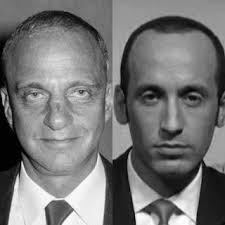
But, with Cohn gone he has little choice but to rely on the increasingly ridiculous Rudy Giuliani to represent him to the media, and, for help with strategic thinking, such as it is, his youthful policy aide, Stephen Miller. 

A Roy Cohn clone, even in appearance, if ever there was one.

Trump and Miller share one policy obsession--immigration. And so when he learned of Miler's views about the borders, it was love at first sight since building the  wall that Mexico would pay for was essentially what Trump's 2016 campaign was all about. 

Before coming to the White House, Miller was Senator Jeff Sessions' chief of staff and while working for the Alabaman, who saw nothing but evil in all forms of immigration--legal as well as illegal--Trump realized he was just the person, after all else failed (including declaring a national emergency which is currently stalled in the courts), to turn the mess over to.

Miller also represents what is dearest to Trump: his views about the limitlessness of presidential power.

Disturbingly, in February 2017, Miller said, "The powers of the president will not be questioned." 

Note the totalitarian syntax. The only thing missing is a German accent.

In Miller, Trump has finally found his Roy Cohn.


Labels: , , , , , , ,

Thursday, January 17, 2019

January 17, 2019--Dotty

Between June 2015 and now in hundreds of postings, I have struggled to understand the Trump phenomenon. 

As unlikely as his candidacy was, and how except on FOX and late night radio it was thought of as more a joke or an egotistical act of self-branding than a political force, the grinding process did reveal it had enough power to propel Trump to the White House where he sits as the nation's 45th president.

Though many of my friends and regular readers criticized me, often severely, accusing me of "normalizing" Trump rather than dismissing and deriding him outright, claiming that by taking him seriously I was contributing to legitimatizing him and his presidency. And, by doing so, I was overlooking his totalitarian, fascistic inclinations.

If we would wake up one morning with tanks in the streets and everyone in the White House wearing black shirts and jackboots, it would be because people like me were aiding and abetting his worst instincts, too casually certain he would be brought down by our mockery and constitutional system of checks and balances. We survived Charles Lindbergh and Joe McCarthy. So not to worry, they claimed I was saying. At least not too much.

I responded as over the months all the other Republican presidential candidates fell by the wayside--16, 17 of them--and Trump inexorably crept into the lead, got nominated, and, though a series of relentless one-man hate-filled rallies (Nuremberg?), defeated the inevitable candidate, Hillary Clinton. Observing this I said it was dangerous not to take Trump seriously and thereby ignore the opportunity to understand what was going on in that part of the country about which I and my friends and readers did not know enough about to take seriously.

I added, at our peril. If we don't figure out Trump's political power we will remain susceptible to him and other Trumps.

But, spending half the year in rural Maine, a part of fly-over America, I encountered many wonderful people who were enthusiastic Trump supporters and over many long breakfasts came to learn a great deal about Trump's appeal. 

Yes, much of it was fueled by fear and some of it, sadly, racism; but his appeal was also the result of his grim optimism. Many people believed that he and he alone could a restore an America where too many felt left out by professional elites who knew better than the people themselves what was good for them. For these people, and there were many, Trump alone would bring about a return to their lost America. With him as president they would no longer be looked down upon as deplorables. They would be in charge

No matter that his vision was mostly ahistorical fiction but it did tap into a stream of hope and belief. Both essential to successful presidential aspirants of all ideological persuasions. 

The differences are about what constitutes the hope--a white America or a socialist America. Then there is the belief, a powerful human propensity, belief itself, that affects us all. About this particularly we need to learn more. It above everything it drives our thinking and behavior.

That is what I was attempting to do. To learn from his followers. And to do so I needed to be genuinely inquisitive and respectful. I needed to do a lot of listening. Above all, I needed to be open to changing my views when that seemed appropriate.

This did not prove difficult as I liked my coffee companions so much. They were not defined by just their political views. And, hopefully, neither was I.

But many of my non-Maine friends found me to be a Trump enabler. I struggled with that.

Then recently, after daily revelations about Trump's felonious behavior--including the incredible speculation by the FBI, not cable news polemicists, that Trump may be an "asset" or agent of Russia's, everything changed. I no longer wanted to "learn" more about Trump and his appeal. I just wanted to see the end of him. And, as much as possible, his followers. I didn't want to discuss politics with anyone who could simply write that off as fake news.

When I saw something a Trumpian friend, Dotty, who tweeted that she didn't care that he might by a Russian operative--I was distraught. She wrote, "I don't care what he says or does He's the president we need now to assure our survival." When I saw that I thought there is no hope of reaching any understanding with someone like that--fortunately maybe only 25 percent of the population--there is nothing any longer worth learning from Dotty. But I know I have to search for a way to remain her friend.  


Labels: , , , , , ,

Tuesday, May 22, 2018

May 22, 2018--Advice From Eleanor Roosevelt

Obviously written in a hurry so that Jon Meacham, as a scholar, could weigh in indirectly and dispassionately about the threat to American democracy posed by the Trump presidency, the resulting book, The Soul of America: The Battle for Our Better Angels, is at best half satisfying. 

As if it were an extended term paper, where quality and grades are measured by how many quotes and footnotes can be crammed in (we all remember those kinds of assignments), by that standard the book is a success for the Pulitzer Prize winning historian--in 272 pages it includes at least 500 quotations and many hundreds of footnotes. The bibliography is longer than the index.

Weighed on an actual scale, Soul of America earns an A+.

It is about how if we think these times are dangerous, let history show (and Meacham does in a bumpy narrative of stitched-together chapters) that we suffered worse--the Civil War, the Depression, the McCarthy era, isolationism, and the reign of the Ku Klux Klan and Jim Crow among others--and because of our better angels we overcame. 

Message re Donald Trump delivered.

But in case the message is unclear, he ends with advice derived from history about how to resist and act.

For example, Meacham urges Americans not to despair but rather "enter the arena," "resist tribalism," "respect facts and deploy reason," and above all "keep history in mind."

In regard to resisting tribalism he quotes Eleanor Roosevelt, progressive conscience of her husband, Franklin Roosevelt--
Ever practical, Eleanor Roosevelt offered a prescription to guard against tribal self-certitude. "It is not only important but mentally invigorating to discuss political matters with people whose opinions differ radically from one's own. For the same reason, I believe it is a sound idea to attend not only the meetings of one's own party but of the opposition. Find out what people are saying, what they are thinking, what they believe. This is an invaluable check on one's own ideas . . . . If we are to cope intellectually with a changing world, we must be flexible and willing to relinquish opinions that no longer have any bearing on existing conditions."
Meacham adds--"If Mrs. Roosevelt were writing today, she might put it this way: Don't let any single cable network or Twitter feed tell you what to think. Wisdom generally comes from the free exchange of ideas, and there can be no exchange of ideas if everyone on your side already agrees with one another."

Labels: , , , , , , , ,

Tuesday, December 20, 2016

December 20, 2016--Trumpian Times

With exactly one month to go before Donald Trump is inaugurated, there is already evidence that "the system" is working." As it has during our entire history.

Yes, I know, but keep reading.

This may not please born-in-America radicals who, right or left, want to see the system overthrown and replaced by their own version of libertarian or authoritarian utopias. But we have weathered various forms of dangerous times and one way or the other came out the other side. Changed, but fundamentally intact.

The latest concerns about the strength of the system involves worry that with Trump as president democracy is threatened. In Sunday's New York Times Review section, Steven Levitsky and Daniel Ziblatt wrote--
Donald Trump's election raised a question that few Americans ever imagined asking: is our democracy in danger? With the possible exception of the Civil War, American democracy has never collapsed. . . . Yet past stability is no guarantee to democracy's future survival.
They calm down a bit and then conclude--
American democracy is not in imminent danger of collapse. If ordinary circumstances prevail, our institutions will most likely prevail, our institutions will most likely muddle through a Trump presidency.
This leaves the implication that though collapse is not, in their word, "imminent," if there is a crisis of 9/11 proportions, they wonder out loud what a president "with authoritarian tendencies" will do.

This concern/fear conforms to what I continue to hear from progressive friends.

For example I was stopped at the elevator the other day by a neighbor who we know to be totally rational and unflappable. A very successful  commodities trader. He leaned uncharacteristically close so as not to be overheard--though there was no one in sight--and in whispers shared his dystopian vision of what an unfettered Donald Trump will bring down upon us. It didn't take him very long to evoke reminders of strongmen such as Mussolini and Hitler.

I must admit, I tuned him out not wanting to have my day spoiled or my opinion about his rationality impeached.

And then when I returned from doing a raft of chores there were three emails from friends equally agitated. One concluded with fear about what that "psycho facist" is planning for America.

I tapped out a few things in response but had no illusion that there was anything I could say that would help him get through this. Except, I suppose, agree, though I suspect not even that would help.

Another friend just today wrote about her fear that the promiscuous Republican Congress will "roll over" for whatever Trump wants to do, including ending Social Security and Medicare, both of which she and her husband depend upon. "If the Electoral College or federal courts don't stop him--and I mean soon-it will be the end of the system and we will begin to look like Syria."

Since she is an American history buff, here's a portion of what I wrote back to her--
You know even more than I that the so-called "system" was designed by our Founders to include all sorts of checks and balances to assure that the United States would never be headed by a monarch, dictator, or tyrant. Having lived under that sort of rule, they made sure that the Constitution limited the power of the presidency by assigning most authority to Congress and the states. 
Though since the mid 20th century more power than ever has accrued to the president, Congress, with the assistance of the increasingly powerful federal courts, still can undo anything they deem to be overreaching or unconstitutional. 
Franklin Roosevelt discovered this when Congress refused to go along with his plan to "pack" the Supreme Court. He didn't like their decisions to curtail some of his favorite New Deal programs. FDR was very popular but Congress ultimately limited his authority. 
When in the 1950s, Senator Joseph McCarthy was amassing power due to his unfettered pursuit of alleged Communist infiltration of the federal government, just when it looked as if he might win the Republican nomination for president and even the election, the press and a bipartisan coalition of members of Congress stepped in to censure him and in that way pushed back successfully to thwart his demagogic appeal. 
And of course there was Richard Nixon who turned the federal government into a criminal enterprise. Eventually he was impeached and forced to resign the presidency.  
I could go on but want at the end to mention evidence that Congress, under the control of Republicans, even before Trump is sworn in, is moving to investigate the Russian hacking of the recent election. Something Trump does not want Congress to do. Ignoring him, they are making plans to proceed. Among other things, it's also a muscle-flexing signal to him not to take them for granted.
So, my friend, try to keep one eye on history and the other on Trump because he may need to be resisted when he moves beyond talk and Cabinet nominations and begins to actually do things. Until proven otherwise, I'm betting on the "system" to prevail.

Labels: , , , , , ,

Monday, March 30, 2015

March 30, 2015--GOP Clown Car: The Minstrel Show

Considering that he's been widely featured in the news after becoming the first Republican to officially enter the race for the 2016 presidential nomination, I should probably write something about him. But there's nothing that unusual about Senator Ted Cruz as a candidate--the GOP has a long tradition of welcoming demagogues into leadership positions.

Recall, his spooky lookalike, Senator Joseph McCarthy, who, back in the 1950s, was for some years the nation's most powerful Republican. He snooped around ferreting out alleged Communists who had supposedly infiltrated Democratic ranks, making things up when the evidence was thin, ranting that there were thousands of actual Communists in government whereas there were just a handful.

Like his political alter ego, Cruz played the Red card when by innuendo he accused Barak Obama of being influenced by the Harvard Law School faulty which, he slimed, was substantially made up of Communists while Obama was there as a student.

What is interesting about Cruz is the nature of his demagoguery and his craven pandering to a Republican base which he pretends to represent. It is ironic that he has grabbed this representational mantle for himself considering that he has at least as elite an eastern establishment Republican patina as the president-in-waiting, Jeb Bush. Cruz actually has more elitist credentials--he went to Princeton as an undergraduate and was a top student at Harvard Law School whereas poor Jeb attended only the more utilitarian University of Texas and has no advanced degrees.

It will be quite a Svengali act for Cruz to pull this one off--to fool enough Tea Party folks that he's a man of the people.

As evidence of his bona fides, last week on the CBS Morning News he spoke about his musical conversion (he's all about conversions). With faux sincerity, he told about how though earlier he was a fan of "classic rock," after 9/11 since the "rock community" "didn't stand up," whereas country musicians did, he became and is now a devotee of all things country. I guess he missed all the concerts and benefits organized for first responders by the "rock community." Too isolated in that Harvard cocoon I suppose.

But today I am writing about another familiar Republican presidential archetype--the candidate who is the star of his own political minstrel show where, as a black men, he behaves in ways and says things openly about blacks that racist white Republicans talk about only in private. And by his very being gives credibility to what hard-working white folks in their hearts know to be true about lazy black folks.

He is neurosurgeon Ben Carson who, though barely paid attention to by the mainstream media, somehow still manages to come in sixth in lists of people most admired by Americans. Just below George W. Bush and slightly ahead of Stephen Hawking.

He is best know for leading a team of surgeons in 1987 in a 20-hour operation to separate Siamese twins joined at the head and then in 2013 for appearing at the National Prayer Breakfast and, with President Obama on the dais just ten feet away, delivered a speech in which he criticized Obama's health care and economic policies, dissing him to his face.

The next day he was embraced by Rupert Murdock's Wall Street Journal in an editorial titled, "Ben Carson for President." This based on a 15 minute speech at a congressional breakfast.

From that day forth he has been a Republican darling, and now, having given up his practice and making the rounds as a paid-for-play speaker articulating a vision for American that for all intents and purposes would eliminate our social safety nets and not give away our treasure to people (read of color) who are too lazy to support themselves and their families. He also delivers on rightwing hot social issues, as a "scientist," questioning evolution and comparing homosexuality to beastiality.

I call this a minstrel show because it is a performance pitched exclusively to the emotions of resentful and bigoted whites put on by the very kind of person (of color) who is the butt of the stereotyping.

Dr. Carson is at least the third in a string of such self-denogating African-American Republican presidential aspirants.

First, in 1995, there was Alan Keyes, a give-'em-hell talk show host who was best known for his violent opposition to abortion rights and his untutored ways. This alone would have been enough to excite the William Kristols of the world who at all times have an eye open for people they can benignly promote who speak to the subliminal fears and urges that can be used to manipulate the behavior of the Republican base. No matter Keyes was caught illegally paying himself out of campaign funds. Actually, perfect. This only confirmed that "they" cannot be trusted to responsibly handle money. There is that tendency, isn't there, they snicker, for "them," when money's around, to act "Nigger Rich."

Herman Kane was next and much, much more entertaining. Not only didn't he know what he was talking about when it came to economics (9-9-9) but when it came to foreign policy matters he appeared to be map-phobic. He not only couldn't see Russia from his house, he didn't even know how to locate it on the map. For country-club GOPers he was a living stereotype. "Them" himself.

And now comes along Ben Carson, another token gift to Republicans. He brings race front and center into the "debate." First, who better to excoriate Obamacare, seeing it as basically a program that the doers are taxed to provide for the takers, which he quickly translates into a form of economic redistribution from whites to blacks. To make this point explicitly, Carson frequently likens it and other Democrat-supported social programs to "slavery," with Obama, in this ironic case, the nation's chief plantation owner.

Among other things, a black man--Carson--holding a black man--Obama--who is also a Democrat as responsible for slavery, or its reintroduction, is a brilliant form of racist jujitsu that absolves Republicans of any responsibility for attempting to suppress minority voting rights or roll back Civil Rights legislation.


Labels: , , , , , , , , , , , ,

Tuesday, September 17, 2013

September 17, 2013--The Walmartization of Higher Education

Tenure as we know it is a relatively new thing.

In the 19th century, professors served at the pleasure of trustees and university presidents. And they could be terminated with little cause. Major donors could and at times did pressure university administrators to fire certain individuals or prohibit the hiring of others, mainly those they felt would interfere with the religious principles of the institution.

Courts rarely intervened in dismissals; but, nonetheless, a de facto tenure system existed and professors, if they did not get far out of doctrinal line, could expect to have their jobs for life.

During the early years of the 20th century, the American Association of University Professors (AAUP), a quasi faculty union, began to pressure colleges and universities to adopt practices that provided lifetime employment protection for senior professors.

The AAUP contended that this was necessary to shield faculty from being dismissed for their views--political as well as religious. Though there were relatively few cases of these kinds of firings, it proved to be a potent argument; and so by the 1950s virtually all institutions of higher learning implemented a tenure system that assured continuous employment after, typically, a seven-year probationary period.

During the McCarthy era, when there were indeed witch hunts to root out alleged Marxists and communists, many, under the protection of tenure, were able to claim that their private views--and even those they articulated in class--were an expression of "academic freedom." Though there were situations where colleges caved into pressure, for the most part few tenured professors, even during that dark period, were dismissed. Many felt intimidated, but very few were purged.

In more recent years, in some quarters, tenure has come under attack. For a number of reasons--

First, it can be used to protect incompetents. After receiving tenure, professors are for all intents and purposes free not to keep up with their disciplines, teach from yellowing notes, and spend little time outside the classroom with students. At even prestigious institutions many tenured faculty are rarely on campus--teaching two to three days a week--do little meaningful research, and shun committee assignments and other collegial and campus citizenship responsibilities. Tenure makes them effectively untouchable, even unsupervisable.

Tenure also makes it difficult for institutions to flexibly deploy resources into new fields and disciplines and makes it almost impossible to phase out departments where enrollments, because of market forces, have shrunk dramatically.

To invest in more programs in computer science, it may be necessary to phase out courses in classical languages; to build capacity in molecular biology, it may be necessary to scale back offerings in biochemistry. With tenured classicists and traditionally-trained biologists, institutions are locked into rigid academic structures which, if they cannot be reformed, place severe limits on an institution's ability to keep up with the times or break new intellectual ground.

And the AAUP and faculty unions claim that without tenure colleges would dangerously reduce the number of expensive full-timers and replace them with much-lower-cost part-time adjuncts. As a result, it is asserted, teaching quality will decline.

This is half true--

Many places in fact have dramatically shifted teaching responsibilities to adjuncts. It is not unusual for at least half of all freshman and sophomore courses to be taught by graduate assistants and part-timers. Cost savings are indeed considerable. But, and this is significant, there is growing evidence that adjunct faculty are more effective in the classroom than tenured faculty.

For example, the New York Times recently cited a study which showed that part-time faculty are more effective in the classroom than full-timers.

The study was based on data from more than 15,000 students at Northwestern University. The results revealed that there was "strong and consistent evidence that Northwestern faculty outside the tenure system outperform tenure track/tenured professors in introductory undergraduate classrooms."

This appeared to be true in almost all subject areas and was especially evident for "average and less-qualified students." These conclusion were based primarily on how likely students were to take additional courses in the discipline and comparisons about the grades students received in subsequent courses. Again, in most instances, students taught by adjuncts reported that they had richer experiences and performed better than those taught by tenured faculty.

Rather than face the challenges this and similar studies have exposed, the AAUP attempted to change the subject. Anita Levy, a senior program officer at the association, said:
My worry is that a study like this can be used to justify hiring more contingent faculty who won't have due-process protection or job security and might not even have offices. It's part of the just-in-time, Walmartization of higher education.
A few points--

Adjunct faculty do have due-process. If they feel they have been dealt with illegally they in fact have recourse to legal remedies. In addition, why should they or any ineffective faculty member have "job security"? And just having private offices does not guarantee that faculty members will set aside more than two hours a week for office hours or use them appropriately.

Labels: , , , , , , , ,