Thursday, September 05, 2019

September 5, 2019--At Moody's Diner

A friend asked me to repost this. It appeared first on May 31, 2016 and is set in one of Maine's iconic diners.

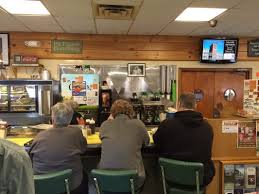
Down at the end there were two seats at Moody's counter. Moody's in Waldoboro is a Maine diner legend. In season, a slice of their blueberry pie is worth a detour.

And so is the turkey salad, at least according to Rona. I agree as long as we also order some well-done French fries.

It was perfect timing, therefore, to find ourselves in the vicinity when in the mood for a turkey salad on rye and maybe a slice of pie.

"Let me make room for yuh," a bulky man who looked about 45 said, "I'll move down one seat and cozy with Shauna here. My lady," he winked.

Excited just to be there, I uncharacteristically said, "No need for that. It's chilly out and you look like someone good to cozy with."

"You mean I'm fat?" he said, pretending, I happily saw, to be offended.

"No, only . . ."

"It's OK. I just playin' with yuh," he said to assure me, deciding to stay perched on the stool next to where I lowered myself. "Truth is, I am fat and a lot older than I look." He pulled his tee shirt up to show me his considerable belly. "Shouldn't be eatin' this corn bread." He held it up for me to see, crumbles falling onto the countertop. "But they give it to yuh if you order the chili. Which I recommend."

"We're here for the turkey salad," Rona joined in with an extra-friendly smile.

"And the French fries," I said, "Well done."

"And a slice of blueberry pie," Rona added to make sure he understood we weren't dieting and that he wasn't the only one eating a lot.

"I know what you're thinking," he paused then added, "A grease monkey."

"No, I . . ."

"That's OK. No need to pretend with me. 'Cause that's what I am. No shame in that." He held up his hands so I could see the full extent of the grease that covered his hands and forearms like a second skin.

"Workin' on his transmission," he said nodding toward another over-size person at the very end of the counter. He too was woofing down a huge bowl of chili and didn't look up in acknowledgment. He kept stirring the bowl to distribute the corn bread he had crumbled on the chili as a topping.

"Where you guys from?"

"From three places really," I said. But for the next five months we have a place down at the Point, Pemaqud Point."

"Nice out there," he said, "What about the other two?"

Rona looked at me as if to say, "You need to be talking about this over-privileged lifestyle to someone who's an auto mechanic?"

Picking that up, I stammered, "Well we . . . I mean . . ."

"I'm cool with that," he said with a wave, "Shauna and me are thinkin' about our version of the same thing. I'm doin' pretty well and we have a nice house here in Nobleboro and a little place not far from the water--a lake actually--in Kissimmee."

"Florida?" I said, "Not that far from Orlando?"

"Right you are," he said, and slapped me hard on the back. "For the winters. It gets real cold up here and I have no love for snow. Never did, never will. But all my family's here. Been here nine generations. One of the first families. I mean of white people. When my great, great, great whatever showed up from England there were plenty of other families around. But not white ones, if you get my meaning."

"I do," I said, "There were lots of Indians around. From what I've read, they had no problem with feeding themselves what with giant oysters that you needed two hands to lift and, standing on the shore, fish you could scoop up out of the water. No need for nets or anything."

"There are lots of stories about that that were passed down in my family. Some been written down in dairies from the early 1600s. One so extensive and detailed that it's down there in the Smithsonian collection."

"Wow," Rona said.

"Pretty good for a grease monkey," he said thumping his now puffed-out chest. "And if you're wonderin', there are two governors, Maine governors in my family--Benjamin Ames and Joshua Chamberlain. You wouldna guessed that about me, would yuh?"

"I wouldn't have thought that about anyone," I said, feeling good about taking what he said in stride and not stereotyping him. "I mean, how many people have two governors in their families?"

"Mitt Romney's kids, for example," he said, "And to be fair and balanced, Mario Cuomo's."

"And that dopey Brown family in California," the fellow at the end of the counter mumbled, still shoveling in his chili. "Governor Moonbeam."

"I guess it's not so rare," I said.

"You're being silly," Rona said, "Even though these are good examples it's still very unusual."

"No need to give him a hard time, ma'am. We're just getting to know each other. By the way, my name's Dana," he said, thrusting his right hand at me. As I reached to take it, he pulled it back, "Look at me, covered all in transmission fluid and I'm thinkin' to shake hands with you who are about to eat a sandwich." He began to wipe his hand on his shirt. I kept my hand extended toward him and finally he took it and we shook hands, smiling broadly at each other.

"I guess that makes us friends," he said looking me straight in the eye.

"I'm Steve," I said, "And this is Rona."

She reached across my chest with an extended hand and without hesitating Dana took it, saying, "Nice to be your friend, Ro, Ro . . ."

"Na, Rona," she said.

"Like Jaffe and Barrett?" he asked.

"Yes, but hardly anyone knows those Ronas anymore," Rona said.

"The novelist and gossip columnist," he said. "I seem to remember readin' some of her stuff. Rona Jaffe, I mean. Wasn't she ahead of her time? Wrote a lot of racy stuff from a female perspective?"

"I'm ashamed to say," Rona said, looking down, "that I've never read anything of hers. But, yes, I think you're right. Sort of a Helen Gurley Brown type."

"I think better than that," he said, "She was a real writer. More like an Erica Jong."

"Sounds right," Rona said.

"Changin' the subject," he said, "You folks followin' the election?"

By then our sandwiches and fries had arrived and rather than risk spoiling our lunch and the thus-far warm conversation, not wanting to get into a harangue or argument, we both took big bites to fill our mouths so we couldn't be expected to talk.

"Minimally, whatever you think, it's been entertainin'. Seems these days no one pays attention to anythin' serious unless it's entertainin'. I mean Trump, hate 'em or love 'em, is fun to follow. I mean, to tell you the truth, I'm more in the 'hate 'em category,' but almost every night when I tune in to Fox and MSNBC he's good for some laughs."

Releived, still with a full mouth, I nodded.

"He's like one of those fools in Shakespeare. He speaks his mind and because no one in the media at least takes him seriously but  have to admit that some of what he says is true, politically incorrect, he gives folks permission to laugh at things they don't feel comfortable saying out loud or in public. It's kind of embarrassed laughter. You feel a little guilty admitting you are paying any serious attention to him but can't help yourself and laugh at what he has to say. Which I suppose is what a lot of entertainment is about. Comedy at least."

"I agree with all of that," I said after swallowing my half-chewed turkey salad, "So, who . . ."

"Can't say I have a dog in that fight. At least not yet. Maybe never will. Sad, but I'm feelin' I don't trust any of 'em. I mean, you can't believe a word Trump says. He sometimes contradicts himself twice in the same sentence. I've seen him do that. And, he's not wrong to call her Crooked Hillary 'cause that's what she is. I mean she's smart and all that and has a big resumé but tell me one thing she's said about herself that you believe?"

"She does have that problem," Rona said.

"Forget all the stuff when she was the First Lady. That's old news, though there's plenty of smoke from that time. I'm talking about where her and Bill's money comes from. Goldman Sachs? Give me a break. And all that hanky-panky with their foundation--forget her continuing to put up with his philandering--and the email business. To me that's a big deal. A very big deal. Everyone knows she's lyin' about that. She knew what she was doin' and put a whole lot a people at big risk. Then I fear if she wins she'd be looking' for an opportunity to show how macho she is once she's commander in chief. I have problems with all of that. Also what Trump would do with the military really scares me. So . . ."

"So what about Bernie?"

"Another liar. Different kind. I agree with him about the rigged economy and government but the lies he tells are about being able to carry out any of his policies if by some miracle he gets nominated or, God help us, wins. He knows practically nothin' about the world. Only a little more than Trump, and there is no chance of getting Medicare for all through Congress much less free college tuition. First of all the federal government doesn't have any power to tell the Univeristy of Maine what to do and even if he could get all he wants it would, what, double the deficit. I'm not antigovernment like most of the knuckleheads around here, like old Jim over there, but I do care about controlling spending and worry about the deficit. What is it, 19 trillion?"

Jim had finished his chili and was now listening to what Dana had to say.

"So, like I say, I have no one to vote for. If Ralph Nader was running' maybe . . . But he's a jerk. 'Cause of him we got George Bush. W, not HW. That puppy has a lot to atone for."

"At the moment, I'm with you," I said with a shrug and sigh, "At the moment, I'm considering not voting in November. Maybe that'll change. Maybe there'll be a real miracle and Hillary will be indicted and someone like Joe Biden would get in the mix and somehow get nominated and . . ."

"Now you're talkin'," Dana said, "He's my man! Flaws and all. He can also be a jerk. But that sort of makes him authentic. And wasn't he right about the Middle East? Iraq for example? Let it become three separate countries? But that's for another day. Got to get back to Jim's transmission. Next time we're all here, I'll tell you about my meetin' Ronald Reagan."

"Really? Where?" I really wanted to hear about that.

"At the White House."

"Fantastic!"

"I was among a group invited there to get our Silver Stars from the president. I told you I'm older than I look. It was one of the highlights of my life. Not that I thought that much about Reagan. Irangate and all that. Hey, I'd love to hang out more with you guys but a transmission awaits. I'm here with Shauna every day. Down at the end of the counter. So if you and Miss Rona want to stay friends, you know where to find me."

With that, he hoisted his considerable body off the stool and shuffled toward the cashier. Rona and I got up as well and followed after him so we could get in a couple of more handshakes.


Labels: , , , , , , , , , , ,

Thursday, August 25, 2016

August 25, 2016--Down At the End of Mary's Lunch Counter

"Those are my parents," he said, nodding in the direction of the couple sitting at right angles to him down at the end of Mary's lunch counter. "My mother and father. I'm six-two but she's only four-nine and he's just an inch taller. I can't explain me. My two brother are both under five feet."

He didn't look at her but was sitting next to Rona with me on her other side. We were sharing a turkey salad sandwich.

"Genetics," she said. "There's no other explanation."

"'S'pose so," he said. "Makes for a lot of confusion. I thought they weren't my folks when I shot right by them. Made them feel good though. To have a normal son. Me? I was fully grown at 12 and was the tallest person in the school. Including the teachers. The kids thought I was a freak of nature. Not a lot of fun there. So I never did get much education. Or much luck for that matter."

"Sorry to hear that," Rona said. "You look fine to me."

"Bag-a-bones, that's me. Can't hardly eat no more." Mindlessly, he stirred his hash and eggs together, making a desultory mess of them.

He was painfully underweight but Rona said, "Better to be thin than the alternative."

"You got that right." For the first time he perked up and scooped a forkful of the mix he had made. "Haven't been able to eat a thing for more than a year now." Deflated again, he lowered his fork.

"Sorry to hear that," Rona repeated herself.

"Since my wife was diagnosed."

"Sorry to . . ."

"Was as rough as anything you could imagine. It was rapid spreading. Took her in less than six months. That was about half a year ago."

"You're so young. She must have been . . ."

"Thirty-six. Just getting started. One good thing, we didn't have kids. Must have been related to her condition. I was quite an eater before that. When the doctor told us what was going to happen, I stopped cold turkey. Pardon the pun. Juice and soup kept me going. Not that I wanted to. But for Sally . . ."

"Really rough," Rona said.

"You don't know the half of it. What it did to her. And me." He resumed staring at his food. His mother gestured for him to eat.

"Now they want me to eat. Twenty years earlier, I was living with them. I was just a kid. They hid food from me. Had a chain with a lock 'round the fridge. Some life. If you can call it that."

So his parents couldn't hear, Rona whispered, "A lock on the refrigerator? I never . . . " She caught herself now that what had been happening with him was becoming apparent.

"Yes, that's right." Rona hadn't said anything. "From the look of me now you'd never guess. Right?"

"I don't. I mean. It could be." Rona didn't know what to say.

"Six-fifty." For the first time he looked at her and smiled. "That was me. Six-two with parents who were almost midgets weighing six-fifty."

"Well, I . . . "

"Nothing to be upset about or feel badly about. That was me then and this is me now."

He picked up his T-shirt to let the hanging flaps of his now emaciated stomach come into view. "That's the last of that me," he said, pointing, "I may need surgery. But to tell you the truth, what with . . ."

He broke off and returned to playing with his food.


Labels: , , , , ,

Wednesday, July 06, 2016

July 6, 2016--Midcoast: Rona

The day after the 4th we got a late start and didn't get to the Bristol Diner until about 9:30. On the way over, we speculated about how busy it might be. Probably packed," I said. "What with people still visiting and some departing, I'll bet we'll have to wait for seats at the counter. Forget a booth."

"Maybe one of our friends will be there and we'll be able to squeeze in with them. But I predict," Rona said, Rona who hates to predict anything--even the outcome of the Kentucky Derby, said, "My guess is it won't be that busy. It's past the breakfast hour."

"During holidays breakfast hour can be any time, including 2:00 in the afternoon."

"That's true," Rona acknowledged.

It turned out to be packed and we had to wait 10 minutes for a booth. It would have been much longer because the new waitress was overwhelmed and to help move things along, including making space for us, Rona cleared the table and toweled it off.

We sat for at least another 10 minutes before the waitress could get us a couple of cups of coffee. And then 10 minutes more before she got around to taking our order. Also in an attempt to move things along we both ordered the same thing--Deb's terrific budget burrito. We took a pass on asking for anything exotic, like what Rona on the way over said she was in the mood for. If Deb had made potato pancakes, then Rona was interested in one with a poached egg on top. If not, sautéed spinach and mushrooms over a toasted English muffin. Rona has taken to ordering these so often that they're coming to be known as a Rona.

Deb was cooking. She is well-known for being able to juggle at least half a dozen orders simultaneously but this morning she too seemed backed up.

"Is everything OK?" Rona asked Deb.

"She's new," Deb said empathetically, "and is having trouble entering orders into the computer. The one that then sends the order to me so I know what to cook. That's what's slowing things down. Plus, we've had a very busy morning and probably could have used another girl. To help with the customers and to wash dishes. Look at that stack?"

Rona did and got right up off her seat and made her way to the sink. For the next two hours she cleared tables and washed dishes.

I sat alone with my burrito but happy to do so because with Rona's dishwashing and expediting everyone was getting their orders more or less on time and the vibe in the diner went from slight annoyance to a more-familiar happy buzz.

During those two hours something else happened--

We knew a few people who were there having breakfast and one or two noticed I was alone--which in itself is unusual--and that Rona seemed to be working for Deb. Yet more unusual.

At first, by this they were discombobulated but quickly figured out that Rona had not taken a dishwasher job--though doing so is one of her on-going fantasies--but rather had simply pitched in to help.

Then, as more and more customers poured in, some now having to line up to wait for a place at the counter or a booth, a number of people who were just two in a four-seater booth, shifted themselves to the counter and a few began to help buss tables. One or two running stacks of dirty dishes back to Rona at the sink in the kitchen.

It was as if the entire place, likely inspired by Rona's example, took responsibility to help Deb and her new hire get through the morning and make it easier for people to place orders and get seated without having to wait longer than absolutely necessary.

After her "shift," by 11:00 when breakfast was no long served and just before the lunch rush, Rona, all sweated up but exhilarated, emerged from the kitchen and said, "I think I'm done. Let's go to town to get the paper."

"That was terrific," I said, feeling good about Rona, "And I'm sure . . ."

Deb had also come out from the kitchen and finished my thought, "I can't tell you how much I appreciated that. We were at the tipping point. Actually past it, and you pulled us back."

"Thanks," Rona said, "To tell you the truth I've always wanted to do that. I really enjoyed it. And look what everyone else did--shifting to the counter to make room for larger groups, bussing tables, generally helping to clean up. That's what I love about this town. How people pitch in."

"I don't take it for granted," Deb said. "I really don't."

"One more thing," Rona said.

"Anything," Deb said and she meant it.

"What time do you want me tomorrow?"

"It's your lucky day," Deb said smiling, "We're closed on Wednesday. Enjoy your day off."

Deb

Labels: , , , , ,

Tuesday, May 31, 2016

May 31, 2016--Midcoast: At Moody's Diner

Down at the end there were two seats at Moody's counter. Moody's in Waldoboro is a Maine diner legend. In season, a slice of their blueberry pie is worth a detour.

And so is the turkey salad, at least according to Rona. I agree as long as we also order some well-done French fries.

It was perfect timing, therefore, to find ourselves in the vicinity when in the mood for a turkey salad on rye and maybe a slice of pie.

"Let me make room for yuh," a bulky man who looked about 45 said, "I'll move down one seat and cozy with Shauna here. My lady," he winked.

Excited just to be there, I uncharacteristically said, "No need for that. It's chilly out and you look like someone good to cozy with."

"You mean I'm fat?" he said, pretending, I happily saw, to be offended.

"No, only . . ."

"It's OK. I just playin' with yuh," he said to assure me, deciding to stay perched on the stool next to where I lowered myself. "Truth is, I am fat and a lot older than I look." He pulled his tee shirt up to show me his considerable belly. "Shouldn't be eating this corn bread." He held it up for me to see, crumbles falling onto the countertop. "But they give it to yuh if you order the chili. Which I recommend."

"We're here for the turkey salad," Rona joined in with an extra-friendly smile.

"And the French fries," I said.

"And a slice of blueberry pie," Rona added to make sure he understood we weren't dieting and that he wasn't the only one eating a lot.

"I know what you're thinking," he paused then added, "A grease monkey."

"No, I . . ."

"That's OK. No need to pretend with me. 'Cause that's what I am. No shame in that." He held up his hands so I could see the full extent of the grease that covered his hands and forearms like a second skin.

"Workin' on his transmission," he said nodding toward another over-size person at the very end of the counter. He too was woofing down a huge bowl of chili and didn't look up in acknowledgment. He kept stirring the bowl to distribute the corn bread he had crumbled on the chili as a topping.

"Where you guys from?"

"From three places really," I said. But for the next five months we have a place down at the Point, Pemaqud Point."

"Nice out there," he said, "What about the other two?"

Rona looked at me as if to say, "You need to be talking about this over-privileged lifestyle to someone who's an auto mechanic?"

Picking that up, I stammered, "Well we . . . I mean . . ."

"I'm cool with that," he said with a wave, "Shauna and me are thinkin' about our version of the same thing. I'm doin' pretty well and we have a nice house here in Nobleboro and a little place not far from the water--a lake actually--in Kissimmee."

"Florida?" I said, "Not that far from Orlando."

"Right you are," he said, and slapped me hard on the back. "For the winters. It gets real cold up here and I have no love for snow. Never did, never will. But all my family's here. Been here nine generations. One of the first families. I mean of white people. When my great, great, great whatever showed up from England there were plenty of other families around. But not white ones, if you get my meaning."

"I do," I said, "There were lots of Indians around. From what I've read, they had no problem with feeding themselves what with giant oysters that you needed two hands to lift and, standing on the shore, fish you could scoop up out of the water. No need for nets or anything."

"There are lots of stories about that that were passed down in my family. Some been written down in dairies from the early 1600s. One so extensive and detailed that it's down there in the Smithsonian collection."

"Wow," Rona said.

"Pretty good for a grease monkey," he said thumping his now puffed-out chest. "And if you're wonderin', there are two governors, Maine governors in my family--Benjamin Ames and Joshua Chamberlain. You wouldna guessed that about me, would yuh?"

"I wouldn't have thought that about anyone," I said, feeling good about taking what he said in stride and not stereotyping him. "I mean, how many people have two governors in their families?"

"Mitt Romney's kids, for example," he said, "And to be fair and balanced, Mario Cuomo's."

"And that dopey Brown family in California," the fellow at the end of the counter mumbled, still shoveling in his chili. "Governor moonbeam."

"I guess it's not so rare," I said.

"You're being silly," Rona said, "Even though these are good examples it's still very unusual."

"No need to give him a hard time, ma'am. We're just getting to know each other. By the way, my name's Dana," he said, thrusting his right hand at me. As I reached to take it, he pulled it back, "Look at me, covered all in transmission fluid and I'm thinkin' to shake hands with you who are about to eat a sandwich." He began to wipe his hand on his shirt. I kept my hand extended toward him and finally he took it and we shook hands, smiling broadly at each other.

"I guess that makes us friends," he said looking me straight in the eye.

"I'm Steve," I said, "And this is Rona."

She reached across my chest with an extended hand and without hesitating Dana took, saying, "Nice to be your friend, Ro, Ro . . ."

"Na, Rona," she said.

"Like Jaffe and Barrett?" he asked.

"Yes, but hardly anyone knows them anymore," Rona said.

"The novelist and gossip columnist," he said. "I seem to remember readin' some of her stuff. Rona Jaffe, I mean. Wasn't she ahead of her time? Wrote a lot of racy stuff from a female perspective?"

"I'm ashamed to say," Rona said, looking down, "that I've never read anything of hers. But, yes, I think you're right. Sort of a Helen Gurley Brown type."

"I think better than that," he said, "She was a real writer. More like an Erica Jong."

"Sounds right," Rona said.

"Changin' the subject," he said, "You folks followin' the election?"

By then our sandwiches and fries had arrived and rather than risk spoiling our lunch and the thus-far warm conversation, not wanting to get into a harangue or argument, we both took big bites to fill our mouths so we couldn't be expected to talk.

"Minimally, whatever you think, it's been entertainin'. Seems these days no one pays attention to anythin' serious unless it's entertainin'. I mean Trump, hate 'em or love 'em, is fun to follow. I mean, to tell you the truth, I'm more in the 'hate 'em category,' but almost every night when I tune in to Fox and MSNBC he's good for some laughs."

Releived, still with a full mouth, I nodded.

"He's like one of those fools in Shakespeare. He speaks his mind and because no one in the media at least take him seriously but  have to admit that some of what he says is true, politically incorrect, he gives folks permission to laugh at things they don't feel comfortable saying out loud or in public. It's kind of embarrassed laughter. You feel a little guilty admitting you are paying any serious attention to him but can't help yourself and laugh at what he has to say. Which I suppose is what a lot of entertainment is about. Comedy at least."

"I agree with all of that," I said after swallowing my half-chewed turkey salad, "So, who . . ."

"Can't say I have a dog in that fight. At least not yet. Maybe never. Sad, but I'm feelin' I don't trust any of 'em. I mean, you can't believe a word Trump says. He sometimes contradicts himself twice in the same sentence. I've seen him do that. And, he's not wrong to call her Crooked Hillary 'cause that's what she is. I mean she's smart and all that and has a big resumé but tell me one thing she's said about herself that you believe?"

"She does have that problem," Rona said.

"Forget all the stuff when she was the First Lady. That's old news, though there's plenty of smoke from that time. I'm talking about where her and Bill's money comes from. Goldman Sachs? Give me a break. And all that hanky-panky with their foundation--forget her continuing to put up with his philandering--and the email business. To me that's a big deal. A very big deal. Everyone knows she's lyin' about that. She knew what she was doin' and put a whole lot a people at big risk. Then I fear if she wins she'd be looking' for an opportunity to show how macho she is once she's commander in chief. I have problems with all of that. Also what Trump would do with the military really scares me. So . . ."

"So what about Bernie?"

"Another liar. Different kind. I agree with him about the rigged economy and government but the lies he tells are about not being able to carry out any of his policies if by some miracle he gets nominated or, God help us, wins. He knows practically nothin' about the world. Less than Trump, and there is no chance of getting Medicare for all through Congress much less free college tuition. First of all the federal government doesn't have any power to tell the Univeristy of Maine what to do and even if he could get all he wants it would, what, double the deficit. I'm not antigovernment like most of the knuckleheads around here, like old Jim over there, but I do care about controlling spending and worry about the deficit. What is it, 19 trillion?"

Jim had finished his chili and was now listening to what Dana had to say.

"So, like I say, I have no one to vote for. If Ralph Nader was running' maybe . . . But he's jerk. 'Cause of him we got George Bush. W, not HW. That puppy has a lot to atone for."

"At the moment, I'm with you," I said with a shrug and sigh, "At the moment, I'm not planning to vote in November. Maybe that'll change. Maybe there'll be a real miracle and Hillary will be indicted and someone like Joe Biden would get in the mix and somehow get nominated and . . ."

"Now you're talkin'," Dana said, "He's my man! Flaws and all. He can also be a jerk. But that sort of makes him authentic. And wasn't he right about the Middle East? Iraq for example? Let it become three separate countries? But that's for another day. Got to get back to Jim's transmission. Next time we're all here, I'll tell you about my meetin' Ronald Reagan."

"Really? Where?" I really wanted to hear about that.

"At the White House."

"Fantastic!"

"I was among a group invited there to get our Silver Stars from the president. I told you I'm older than I look. It was one of the highlights of my life. Not that I thought that much about Reagan. Irangate and all that. Hey, I'd love to hang out more with you guys but a transmission awaits. I'm here with Shauna every day. Down at the end of the counter. So if you and Miss Rona want to stay friends, you know where to find me."

With that, he hoisted his considerable body off the stool and shuffled toward the cashier. Rona and I got up as well and ran after him so we could get in a couple of more handshakes.


Labels: , , , , , , , , ,

Tuesday, April 12, 2016

April 12, 2016--Rhonda's Biscuits Concluded

It took awhile for our breakfasts to arrive.

We were sitting diagonally across from Rhonda and had a clear line of site and so could watch her carefully and deliberately cook one order at a time. Unlike other short-order cooks, she took her time.  First, she scrupulously scraped and wiped the grill, then in a mixing bowl, she cracked and beat with a fork two eggs. Two at a time even if she was making eggs for a party of two (like us) or four (like the folks at the table all with biscuits) where more commonly the chef would scramble on the grill all four or even all eight eggs, and then divide them into portions when they were done.

"I can see why this place is so crowded," I whispered to Rona, "Even now, close to 11:00, it's still full. Probably people have been here since 8:30 waiting for their orders to be completed."

Rona punched my arm to shush me. "Keep your voice down," she said, "We're strangers here."

"I'm just finding this fascinating," I said and took to just observing what would happen next.

When Rhonda had four plates with eggs and bacon and grits ready to turn over to the waitress who was hovering patiently, two at a time she brought them to where we were perched on our stools, sipping at our coffee, and slid open a large stainless steel drawer, looked around--it felt like mainly at us--and extracted carefully, one biscuit at a time which she in turn gently placed on each of the plates. Blocking us so we couldn't see what else might be in that draw she slid it shut and only then was she ready to turn the steaming dishes over to Ellie, the waitress, who caught our eye and shrugged, as if to say, "What can you do. It's a living."

Mr, Harris, next to us at the counter said, "Next time you're round these parts I recommend the catfish. Uh, uh," he said and slowly patted his mouth with his perfectly-folded napkin. "If I hada thought, I woulda offered you a taste. I'm 92--don't say I don't look that old 'cause I know I do." He smiled.

"You don't look . . . ," I said but he cut me off before I could finish. At most he looked 75.

"Been coming here for years. Every Saturday morning. Like clockwork. I have to be patient too. Don't take it personal. We're off the interstate here and don't get that many strangers passing though who are in a hurry. I don't mean you're strangers or anything like that," he added quickly. "Old Rhonda takes her good time and treats us all like equals."

He made a point of that as he was the only black person in the teeming restaurant.

A middle-age woman interrupted him as she was heading toward the cash register and said, with what looked like a small bow, "How nice to see you, Mr. Harris. It must be Saturday again," she chuckled. "And how is Mrs. Harris?" She din't pause to hear the answer, "And I trust your granddaughter is doing well at school."

"Yes, thank you, everyone is well."

"What courses is she taking again? I'm losing my memory, wouldn't you know." She sighed.

"She's in her final year and then it will be time for her to do her internship. Still says she wants to be a surgeon. I keep telling her that's not an easy thing for a girl. I mean, a woman. But she's determined. Stubborn too. Just like her mother."

"Well, next time you talk to her, please tell her I was asking about her." Then she turned to us and said, "A lovely family. The best people in town."

"Don't forget your umbrella," Mr. Harris said.

"See what I mean about my memory," she said to Rona.

"What medical school is she at?" I asked.

"Up in Baltimore. I can never remember its exact name. We just call it Hopkins. I know . . ."

"Johns Hopkins," I said. "Half the time I call it John Hopkins. I forget the Johns part. But it's a wonderful place. Good for her."

Another diner who had finished his breakfast was waiting for the women who claimed to be losing her memory to move along so he could say a few words to Mr. Harris.

"My Sally knew you'd be here," he said, pulling on the peak of his Redskins cap. "She said you'd be here like clockwork and there you be."

"Lovely woman, that Sally," Mr. Harris said half-turned toward us. "I trust her treatments are going well."

Sally's husband sighed, "Good as can be expected, I s'pose. It's all in His hands." He looked up toward the ceiling.

"And the doctors, too," Mr. Harris said, reaching out to touch him on the arm.

"She and I too really 'preciate all your concern and how every Sunday you and yours remember to send over a big basket of fruit. You know how she loves fruit. It's 'bout the only thing she enjoys these days. Poor thing." He wiped at his eyes.

Mr. Harris struggled up from his stool and embraced him. "You'll be fine," he whispered, still hugging him and patting his back. "Now, you've go to be strong for her."

"I will do my best," he said, "And thank you again for everything. I'll see you next Saturday. Same time, same place." And with that he headed for the front door

After Sally's husband left, Mr. Harris turned fully to Rona and softly said, "She is a lovely woman. Been good all these years to our family. She was a teacher in the high school where my granddaughter went. She was the one who encouraged her to take all those science courses while many of the others there suggested she be realistic and forget about being a doctor and train instead to be a nurse and stay in town and work in the hospital. And now she's . . . she's struggling against the odds. But if being a good person means anything, there's a better place waiting for her."

By then we were ready to leave, said goodbye to Mr. Harris, and with the check began to make our way to the cash register where Ellie was waiting.

"Hope you enjoyed your breakfast," she said.

"I loved everything," I said, "The food and everything else," I gestured back to where we had been sitting and toward Mr. Harris."

"Isn't he somethin' special? You'd never know how old he is."

"He is remarkable," Rona siad. "How everyone stopped to talk with him."

"Every Saturday he's always here. If you forget, his sittin' over there havin' his fried fish reminds you of that."

Rona was busy extracting cash from her wallet, "Maybe next year on our way south, we'll drive down route 310 and . . ."

"Be sure to do that, honey. We'd love to see you. We'll all be here. And if it's a Saturday . . ."

". . . Mr. Harris'll be having his catfish."

"Sure as the day is long. So be sure to stop by to see us, yuh hear."

We both nodded. And then, as we were about to say something, over her shoulder, Rhonda, still at the grill, working on a couple of sunny side eggs, called to us, "Make sure you do that. Next time you all can have all the biscuits you want."

Labels: , , , , ,

Monday, April 11, 2016

April 11, 2016--From the Road: Rhonda's Biscuits

In Rocky Mount, NC, where we overnighted on our drive north, the weather forecast for the next driving day--to get us to Reston, VA, called for pockets of heavy rain and winds gusting to 35 miles per hour.

We needed to cover 250 miles and the thought of driving for hours along traffic-clogged I-95 in such a storm, with crosswinds buffeting tractor trailers from lane to lane, sounded scary. To the point where we thought that maybe we should stay put for the day and hope for better driving weather.

But the longer on-route forecast wasn't much better. In fact, Saturday night-Sunday all day sounded even stormier and more dangerous. Perhaps enough so that roads along the way might be blocked by fallen trees or precautiously closed to all but emergency traffic.

None of this sounded attractive.

Rona said, feeling more intrepid than I, "Why don't we get going and see how we do. We can always bail out and find a place to hole up."

"I'm game for that," I said, "In truth driving in this kind of weather is not my favorite thing but I'm eager to make progress and hit the City no later than Sunday afternoon when traffic at the Holland Tunnel and in the City itself is manageable. After three months in more laid-back South Florida, arriving near the City on a busy work day is a bit much for me."

"Why don't we look for a road north that parallels I-95? I'm sure there is one that might be less trafficked."

"Sounds like a plan. In fact, there is such a road. Route 301 that was the principal north-south route before I-95 was built. We did some driving along it yesterday for a blue-highway change of pace and it was fine."

As so we packed up, turned on the GPS and headed out.

"I'm not that hungry," Rona said, "Why not drive for awhile and see what we find. Off the interstates we always seem to stumble on interesting places."

"No Dunkin for me today," I said, "And no Cracker Barrel."

"They're OK in a pinch, I suppose. But I think we can do better."

And we did, two hours later, at Logan's Diner in Emporia, Virginia.

It didn't have the traditional look of a road-food place. A bit glitzy for us. Too newly renovated looking, but by then we were hungry enough to, if necessary, settle for coffee and a couple of eggs and toast at Cracker Barrel.

But the first hint that Logan's might turn out to be special was the fact that at 10:30--late for our favorite kinds of morning places--every seat in all the booths were full of what appeared to be local folks and there were just two stools left at the end long counter, which we quickly took possession of.

"I'll bet they have good country ham," Rona whispered. "We are after all just above the state line in southern Virginia."

"And biscuits," I said, "I'd be happy with just a couple and a cup of coffee."

"I think we can do better than that," she said, nodding toward the very elderly man next to whom we were now sitting. He was meticulously working on what appeared to be two perfectly fried catfish.

"I'll have coffee," Rona said to the cheery waitress, Ellie her name tag read, who had approached us with a steaming pot even before we could get fully settled. "And I think we're ready to order. It's raw out there and we are starving."

"You've come to the right place, dear" she said, smiling broadly. "Take your time. We've got nothing but time here. You look as if you've been battling the rain and wind all morning."

"True," Rona said, "More that two hours, "It's been . . ."

"This here coffee'll fix you right up," she said. "And," sliding two menus across the counter, said, "If you take a look you'll see you've come to the right place." She reached over to refill our neighbor's cup. "I'm sure Mr. Harris here will vouch for Rhonda's cooking." She winked and nodded toward to the sturdy woman working the grill.

The coffee was just what we needed and by the time the waitress returned to take our order, Rona said, "We'll both have a couple of soft scrambled eggs. My husband will have a side of country ham, which I'm sure he'll be willing to share."

"It is quite generous," Ellie said, nodding again in Rhonda's direction.

"And if you have 'em, I'd like some grits with butter and my husband will have a couple of biscuits. They look wonderful." Rona looked over toward a table packed with four townspeople, all with eggs and biscuits.

"Grits we can do," she said now leaning toward us and in a conspiratorial whisper adding,"but I don't know about them biscuits." Then, almost inaudibly, said, "I mean two."

"I realize it's late for breakfast," I said, "Do you have whole grain toast? I'm fine with that."

"Honey, that's not the problem." I looked at her quizzically. She was almost head to head with me and shrugged, again in Rhonda's direction, who was carefully lowering a couple of breaded catfish into the deep-fat frier.

"I don't want . . . ," I stammered.

"Here's what I'm thinkin'," she said so softy that only Rona and I could hear. "You both have her eggs, you have the ham, you honey have the grits, and then each of you have a biscuit. One," she said for emphasis.

Not really understanding but even hungrier by them as the smell of Rhonda's cooking permeated Logan's, I said, "I'm good with anything. Even one of Mr. Harris' catfish." He heard me and nodded, carefully wiping his fingers with a perfectly folded napkin.


To be concluded tomorrow . . .


Labels: , , , , , , ,

Friday, June 19, 2015

June 19, 2015--Best of Behind: The Jam Garage

A companion piece to "The Dump," this was first posted June 14, 2010--

After establishing a relationship with the town dump, next on our list of settling-in priorities was a visit to the Jam Garage.

This probably requires some explanation.

Wherever we are we are addicted to finding an indigenous place to go for breakfast. Half the reason we bought this cottage on the Midcoast of Maine was because of the Bristol Diner. A tiny hole-in-the-wall kind of establishment right across the road from the town hall, which, even before we entered it for the first time, had the look which conveyed the promise that we would encounter a diverse, very local clientele. And that, with a little luck, the people we would meet would be friendly and welcoming. So that we could have some instant social life and learn about the area in addition to finding good coffee and whatever the chef might throw together.

Well the chef-co-owner, Doug, does a lot more than throw things together. What he prepares for breakfast and lunch is blue-plate exceptional. Saturday morning, for example, I had one of his legendary egg dishes. This one scrambled eggs saturated with chopped sautéed asparagus (still crunchy), browned onions, sprigs of fresh thyme, and melted-in layers of Parmigiana cheese. All accompanied by a side of perfect hash-brown potatoes and a homemade biscuit. Um, um.

And the people—the wait staff and the regulars, which we quickly became—are as fine as the eats. There is Doug himself. Of west coast origin he is in Bristol now fresh from a stint of living in Alaska, and is not only a gifted chef but an accomplished artist and wit. Both are in evidence on the walls and diner’s chalkboard. “We Don’t Serve Fast Food” one sign proclaims, “We Serve Good Food As Fast As We Can.” And in case one day you are looking for soup at lunch, Doug, on another sign, tells you that the Soup of the Day is “No Soup.” But he will also let you know that they do have soupspoons for the daily chili.

His art is also on display. Currently, intricate ink line drawings that appear to have been influenced by what he must have seen and experienced among the native people in Alaska and the northwest. Mysterious and haunting stuff.

Crystal McLain, the other co-owner, is the place’s guiding spirit. And I mean both “guiding” and “spirit” literally. When in attendance, she is the diner’s impresario. When not there, she is pursuing her rapidly budding career with an ever-growing clientele as a licensed massage therapist. But to just encounter her at the diner is like receiving a massage of good cheer, ever-resilient optimism, and doses of wisdom that belie her years. And she makes sure, in her impresario way, that everyone feels paid attention to and gets to know each other. Shyness is not acceptable behavior when Crystal is in attendance and gliding between and among the three booths, two tables, and the six or seven stools at the counter.

It is not an uncommon occurrence that the10 to 12 of us who might be there at any time are all together engaged in a conversation that might be about the state of lobstering, the local primary elections, the latest show at the Farnsworth Museum, the Celtic-Lakers series, or the affects of social networking on American culture. All conversations from last Saturday morning.

And engaged in that conversation might be, as it was then, a former successful New York City accountant, John, who now with his son runs an international manufacturing company that produces world-class manways (look it up) and seems to have read pretty much everything important; Rod, a retired school superintendent from Ohio, who the other day had a lot of insight to share about the plague of bullying; a former contractor, Al, who specialized in the design and construction of huge spaces who now does lots of things, very much including producing books of his photos that do a remarkable job of capturing the beauty of this place and the lives of the people who work the waters (his latest, just published, is about Muscongus Bay); a former employee of a locally-owned telephone company, Ken, who has the driest wit around (and there is a hot contest here for that coveted title); a South Bristol women with roots that go back more than 300 years who, though she does not have the most worldly goods, doesn’t pursue them or keep score that way, but has devoted her life to the care of others and does so with so much generosity of spirit that if the encyclopedia needs an illustration for the Golden Rule a picture of Lynn would do very nicely; and then of course Rona and me, hanging out, sharing the conviviality. Fully welcomed by these wonderful people and the many others who make their way to the Bristol a few mornings a week. They make us feel part of their community, as if we have lived here all our lives.

We by now are fully ensconced and settled in there every day at the counter or in one of the cozy booths. So if you are in the neighborhood (and I recommend it) be sure to stop by. Doug has lots of good coffee waiting and the best hash ever, which I could go on about at some length but will restrain myself.

But what does any of this have to do with the Jam Garage?

Though all the food at the Bristol, as you’ve seen, is to write about, the jam, in little plastic punnets, though Smuckers, is, well, still Smuckers.

I don’t blame Doug. He keeps his prices affordable and those little things are cost-effective, control portions, and are easy to clean up. Homemade jam in jars or pots is more than anyone is entitled to expect. Thus, thankfully, about five miles from here, there is Simply Delicious Jams where we get incandescent homemade preserves. These are found just down the Pemaquid Harbor Road (of if you’re not at the moment nearby, you can order them on line via jamlady@earthlink.com). I recommend the Marion Blackberry. The self-titled Jam Lady sells them unattended from her garage. Thus, the Jam Garage.

On beautiful display she has Maine Wild Blueberry, distilled from those ubiquitous late summer local delicacies; Maine Strawberry and Maine Strawberry-Rhubarb (my second favorite); Old Fashioned Peach (I lied, this is my second favorite); Pure Raspberry (Rona’s choice); and, among a few others, Blackberry-Pomegranate (a little exotic for me in these climes). They range in price from $5.00 to $7.00 a mason jar and you pay by the honor system. There’s a box to stuff the bills into and in a large bowl there are a couple of fistfuls of quarters for change. Just perfect.

We began going there a couple of years ago and quickly became addicted to the jams that we take with us to the diner where they are an ideal accompaniment to Doug’s biscuits, muffins, and, especially the blueberry, to his steaming stacks of pancakes.

But the Jam Garage is not just about jam. There is something else about the place that draws us. Set in a meadow that lopes gently to Lockhart Cove, it also partakes, in that rural splendor, of the magic of theater. Like a stage set, the jams appear each day as if by magic. The door rolls up with no stagehand or jam-maker in sight like a proscenium curtain set in motion by a timer switch that must be secured within the house; and the lighting is so dramatically designed, as it would be for some screen ingénue, to show off the jams’ best side. Even if they were not so delicious, rather simply delicious, the setting and the lighting alone would cause one to stop and try a jar of Patriots Blend, which is, as the brochure puts it, concocted from “New England’s two native berries—Blueberries and Cranberries—with a hint of Orange.”

Also intriguing, though we have made our way through enough of the Jam Lady’s jam to bring us back there at least a dozen times, we have never caught site of her of anyone else. Which is a surprise because her acres of meadows and gardens and berry patches are in perfect order. Just like the garage and the jams and her house and everything in sight. This unattendedness, the sense of peace it instills, only contribute to the illusion that the jams are products of artifice and nature—they are there like the grass and trees and bushes and wild flowers and the air and breezes off the cove. But also, like the gardens, tended to and shaped by the hand of man. Or in this case, woman.

We are thus left to imagine her and her life.

She must of course be from a long-established family. Going back at least a hundred years; or perhaps like Lynn from South Bristol, her people were among the original settlers. Thus the Jam Lady’s recipes must have been passed down across many generations. Maybe even the local Indians, who for the most part were friendly, taught her ancestors some of their ways. How to cultivate the wild berries so as to assure a bountiful crop year after year and thus could serve as a carbohydrate staple in their diet and thereby help fend off the inevitable scarcities that are a consequence of the long and harsh Maine winters.

And then, considering the homestead’s location near some of the best fishing grounds in early America, some great, great great-grandfather would have taken to the sea to fish for the bountiful herring or another relative from the distant past would have taken up ship building. Around these parts then, and still, some of the new country’s best wood-hulled boats—schooners then, lobster boats and cruising yachts now—were constructed from the native oak and spruce and hickory.

Maybe a great, great-uncle had taught in one of the area’s first normal schools or been pastor of the South Bristol Congressionalist Church. Or a great aunt had been a nurse in the Second World War and another had been the town’s first female lawyer.

Rona and I build up quite an imaginative head of steam while contemplating that Jam Garage. Something special for sure happened there, well before there were garages, and is, we are convinced, continuing until at least today.


Labels: , , , ,

Friday, March 20, 2015

March 20, 2015--Betty Carol's (Concluded)

There were not just a few folks squeezed together at a table by the window. The rest of the place was bustling. There were about ten tables and all but one, which we slipped into, were full. And opposite an open kitchen, along a counter, there were six stools, five of which were occupied. There was also a line at the counter of at least six men waiting to pick up takeout food.

The grill was sizzling and at least half the people were talking simultaneously so the place had a homey buzz. And the aromas emerging from the kitchen incited our appetites, which on their own were quite advanced.

"Are you sure it's almost ten o'clock Rona whispered. "I mean, look at this place. Lumberton seems to be quite a small town and it feels as if half the people who live here must be having breakfast."

"And, it looks as if they all know each other."

There was lots of cross table talk as well as joshing and back slapping at the counter. Black and white together, though at the tables white folks appeared to be sitting primarily with other white folks and the same was true for the black customers. But there was enough cross-race byplay to make it feel far from segregated. I was reminded of the fact that Greensboro, where the lunch-counter sit-in movement began in the 1960s, was not that distant.

"How far we've come," I said to as if myself. But I know Rona heard me, understood, and nodded.

"Let's order," she said. "I'm starving and could go for some eggs and grits."

"Me too," I said. "And I see they have country ham. My favorite. All for $4.75. You can't beat that price."

"Don't get used to it," Rona said, "We're headed to Manhattan where, if we go to Balthazar for breakfast, half a grapefruit costs $11.00."

"Maybe more," I said."We were there three months ago and there's inflation to consider." I was attempting to make a joke.

"Let's just enjoy ourselves," Rona said, "and for once not think about the cost of things."

By then one of the waitresses came by with a steaming pot of coffee. With a smile she poured two cups and said she'd be back in a minute to take our orders. And as promised, she was and we both ordered scrambled eggs, grits, country ham, and homemade biscuits.

Looking over at the table behind Rona I ogled the stack of biscuits. The man who had ordered them winked as if to assure us that we chosen wisely. And um, um did we ever. The eggs came perfectly scrambled, floating on top of a large plate of anything-but-instant grits; and a sliver of country ham, just as leathery as I like it, accompanied it on a second dish with our own stack of biscuits.

Everything was delicious and as we gobbled the food the waitress returned repeatedly to refill our cups. Though it was easy to see that we were not locals, in fact from the location of Betty Carol's and the fact that Lumberton has few if any tourist or historic sites (I learned later that it was the setting for David Lynch's Blue Velvet) anyone unfamiliar had to be from out of town. But, as a sweet courtesy she asked, "Are you from here?"

"Not really," Rona said. "We're from the city. I mean, New York City."

"Now that's some place to be from," she smiled broadly. "I think about getting up there one of these days. I have family in New York."

"Where's that?" I asked.

"Never been there but my mother says right by the capital."

"That would be Albany."

"That's what she thinks. She's never been there neither. It's just somethin' we time-to-time think about doing. Helps keep us going."

"Well, if you do visit, try to work in a few days in New York City. It's not that far from Albany," Rona added.

"They say things up there cost a lot." I thought again about the $11.00 grapefruit.

"True enough. But if it's . . ."

"Be right by, honey. They're makin' a racket over there. Can't pour 'em coffee fast enough. If that was me, you'd have to carry me out a here, what with all that caffeine. But I'll be right back."

While she was serving the men at the counter, the stream of people coming in for takeout didn't abate, though it was getting close to the time they shut down breakfast and switch to a buffet lunch. Having noticed that, Rona and I had wondered if we should stop eating our breakfast and also think about lunch. I had gone to the bathroom and needed to skirt by where they were cooking fried chicken and okra for the buffet. I had reported to Rona what was in the works.

"All you can eat for only seven dollars," I said.

"There you go again talking about the cost of things. Can't we just . . ."

Before she could finish her thought our waitress returned, still smiling. "All the fellas are askin' 'bout you. Specially when I told them where you're from. Jackie over there, the one dressed like Snoop Dogg--the one standin' by George-Willie--he has been tryin' to make things happen for himself here but there's nothing going on but this." She swept the room with a broad gesture. "Which is not big enough for him."

"What does he do?" Rona asked. I saw that he did in fact look a lot like Snoop Dogg. Minimally he was inspired by him.

"A musician," she sighed. "All the boys here are either musicians or playing basketball. Hoping they'll get a ticket out a here. Though as you can see, folks seem pretty happy to be in this place. Not just at Betty Carol's but in this town too. We do our complainin' but it's not such a bad place to be. Look around. People from all walks get along. Mind you, it's not perfect. What place is? But life's good here. Still, I understand. I have a couple of boys myself and all I hear about are LeBron James and Jay-Z. A lot of these boys don't want to work timbering or in one of the plants or do healthcare work. They have big dreams. Though I tell my boys it's the quality of life that counts. Family first but then there are all these fine folks here who have figured out how to live together. To my mind that counts for something.'"

"It does for me too," I said. "Those are good values."

"You folks plannin' on staying for lunch? Horace over there he makes some mean fried chicken."

"I'm all full up," Rona said. Her dish looked as if she has scraped it. "Maybe we'll take some with us to nibble on the road."

"Sounds good to me," the waitress said, all excited. "By the way, my name's Mary." She reached out to shake both our hands as we also introduced ourselves. "You prefer white or dark?"

"How 'bout a mix of both?" I said.

"Perfect choice," she said. "I'll have it for you in a minute. In the meantime, can I pour you some more coffee?"

"I've had more than my quota," I said, covering my cup with my hand.

"By the way," she said, "today's my 45th birthday. I know I don't look it," she laughed, "Gettin' to know you is my favorite present."

Back in the car, Rona said, "What did you mean about no one having any teeth? That wasn't very nice. They all looked fine to me. Mostly quite spiffy. Including that Snoop fellow. He had the Dogg's act down perfectly."


Labels: , , , , , , ,

Thursday, January 09, 2014

January 9, 2014--The 2040 Diner

We had just placed our order at one of our favorite on-the-road places, the 2040 Diner in Fredericksburg, Virginia--eggs and grits for Rona, and the $7.95 county ham special for me--when the owner plopped an overflowing plate of eggs and sides on the counter and himself on a stool.

"That looks good," Rona said, sipping her tea.

He turned in our direction, not responding, looking annoyed by her interrupting what must be a daily ritual.

I thought, "Here we go. We're already in trouble."

"Is that lemon you're squeezing on your eggs?" Rona asked, ignoring his ignoring us.

Without turning he nodded and grunted something indecipherable.

"I've never seen that before."

I mouthed to Rona to "Cool it."

But she persisted, "I never tried that. I love lemon and maybe I'd also like it on eggs."

"Very Grek," he said with a thick accent, squeezing another half lemon all over everything on his plate.

"Grek?" Rona said.

"Grek," he turned fully in our direction, "Grek, Greek. Dot's me. Grek."

"The lemon is very Mediterranean," Rona smiled at him.

At that, with effort, he lifted himself off the stool and lumbered in our direction, hunched over with his arms dangling at his side.

"Lemon we have with everything in Grek." His accent thickened as he neared us.

I was beginning to feel nervous. We were the only customers. 8:30 is often a quiet time in diners that cater mainly to locals--late for those headed to work, too early for older folks, and too off the tourist route for travelers. Usually, exactly our favorite kind of place.

But at the 2040 I was beginning to feel threatened. The two waitresses, who looked as if they had worked there for decades, watched, smiling, which partially reassured me.

"You Brooklyn?" he asked.

"What?" I finally joined in, thinking that might ease the situation. He stood pressing his huge stomach against our table, still with his arms dangling and swinging simian-like.

"Brooklyn? From dare?"

"Yes," Rona chirped, the caffeine in her tea taking hold. "Both of us." She included me in her sweeping gesture.

He glared at me and pointed, laboriously hoisting one of his thick arms. "Him too?"

"Yes, he and me. We were both born there. Are you also from Brooklyn?"

"Grek," he said.

"So how did you know we--"

"Sound just like your mayor. Bloom. Both you and him." He dismissed me with a wave of his massive hand.

"Bloomberg," I said, taking a chance by correcting him.

"No gut."

"He's not our mayor anymore," Rona informed him. "As of January 1st we have a new one. De Blasio."

"De who?"

"Bill De Blasio."

"What kind of name dat?"

"I'm not sure," Rona said. "Maybe Italian?" I nodded.

"Where does he stand on guns?" His accent miraculously gone. "Not like Bloomberg I hope."

"I assume--" I cut myself off, stunned by the change in the way he spoke and not clear where this might be headed.

"He doesn't understand us." What happened to all the Grek business, I wondered. He sounded like someone more from Virginia than Athens.

"In what way?" Rona asked, eating away at her eggs and grits as if not noticing. I was feeling substantially relieved and took to enjoying the wonderful country ham.

"He should come here and talk to people. Real people. Then he would see."

"I think he's not--"

"He is," he corrected me before I could finish.

"Is what?" I was feeling bolder with him backed off from us. But I was still thinking about his disappearing accent.

"Take my son, for example," the taller of the two waitresses said.

"Your son?" Rona said.

"Yes. He has a gun. Most of his friends do."

"I assume," I stammered, "To me it depends on how old he is. I mean from my perspective. But what do I know about these things. I'm just like Bloomberg. From New York. The city. Brooklyn."

"Exactly," she said, having wandered over to us.

"I mean, if I may ask, how old is he? You don't have to tell me, of course."

"I know that." She smiled a bit condescendingly in my direction. I deserved that, I acknowledged. "If you must know, he's eight."

"Eight?" Rona could not hide her surprise. 

"I know what you're thinking but you don't know my boy. Or his grandfather."

"Who is?" Rona ventured.

"He works for Homeland Security."

"Really? What does he--"

"He teaches marksmanship. Trains their best people to become snipers."

"Really? That's amazing," I said.

"To tell you--"

She interrupted Rona. "I think I know what you're thinking. That this is a terrible thing to do and--"

"Not really. I mean I know--"

"That in the real world," she completed Rona's thought, "as awful as it is, it's necessary. Don't you think? I don't need to spell out all the situations where we need them. Snipers. There's no other way to describe them. That's what they do. So we should call them what they are. And are proud to be. To help keep us safe. You remember those Somali pirates?" We both nodded. "Well, my father teaches Navy Seals too."

There was no need to say more. "His grandfather taught him, my son, all about guns. Starting at six."

"Not to--"

"No not to become a sniper," she and Rona laughed together. "But how to handle and respect them. Guns."

"To tell you the truth," Rona said. "This is not something or a world that I know anything about. I guess I'm OK with people having guns. I mean--"

"Among other things, it's in the Constitution," the owner rejoined the discussion. "The Second Amendment says--"

"We coud debate that all day," I said, "The history and meaning of it."

"You mean about the 'well regulated militia' part?" He said, now directly to me.

"That and other things," I said. "But at the moment I'm just enjoying your eggs and wonderful ham. Every year when we're here I can't wait to have some."

"Let's just agree," he offered,  "that things are often more complicated than they seem."

I couldn't disagree about that.

"Like, for example," the waitress said, "how few people from where you're from could learn from my father how to defend us."

"Fair enough," Rona said, "But there are many ways to do that. Not everyone has to . . . . There are other things that need to be done. And people from Brooklyn and other places are helping as well. In their own ways. About things they know how to do."

"One thing, for sure we all agree about," he said, "is that there are some bad guys out there and we have to figure out ways to keep people safe. There are probably other things we could agree about. Like privacy, for example. On the other hand," he caught himself, "considering where you're from, maybe not."

"It might surprise you," I said, finishing my ham, "but for a New York liberal I'm no so liberal about privacy and some of the things the N.S.A. does."

"And it might surprise you that I voted for Obama. Twice. And she did to,"he pointed toward the waitress who was refilling the coffee pot.

"Just once," she winked. "The second time, I didn't vote at all. A plague on all their houses," she said.

"While I'm holding this can I heat up your cup?"

"I'd love some," I said.

Labels: , , , , , , , , , , ,