Monday, August 31, 2020

August 31, 2020--Dukakis Redux

The Republican convention behind him, Trump immediately took to the road.

First stop, all in one day, New Hampshire then Louisiana and Texas hit hard last week by Hurricane Laura. This was not going to be his Katrina.

Then, he announced, that on Tuesday, tomorrow, he plans to visit Kenosha, Wisconsin where Jacob Blake was shot in the back seven times by local police. 

God knows what he'll say and do while there.

Next, he'll probably make his way to Portland, Oregon, where over the weekend a Trump supporter was shot and killed during a confrontation between far-left and far-right demonstrators. Trump's visit will likely be inflammatory.

All the while where was Joe Biden and what was he up to as Tump was making these telegenic stops?

In his basement, delivering a speech remotely to the American Legion convention.

Oh yes, he also announced he'll resume in-person campaigning after Labor Day.

After Labor Day? What's wrong with today? What was wrong with last week?

Does he want to be president? Is he aware of what his absence from the campaign trail suggests about his 77 year-old stamina? 

Trust me, nothing good.

This reminds me of Michael Dukakis's ill-fated 1988 run for the presidency. His opponent was the not-very-popular or charismatic George H.W. Bush, Ronald Reagan's vice president. 

For a while Dukakis's's strategy seemed to be working. A few months before Election Day he built a 17-point lead in the polls. And so, what did he do? Sat on his lead while he effectively stopped campaigning, he said, so he could concentrate on his day job--governor of Massachusetts. And I assume, practice his inaugural speech. 

But every once in a while Dukakis did get out to participate in a campaign stunt. The best known of these was his ride in a military issue 68-ton M1-A1 Abrams Tank. 

Pictures of the diminutive governor with his head barely visible above the armor plate made H.W. by comparison look like a super hero. And from the minute pictures of this began to circulate, Dukakis's poll numbers began to plummet and a few months later George H.W. Bush was the one measuring drapes for the Oval Office.

(Of course it didn't help that Republicans played the race card when  they circulated pictures of the very black menacing murderer, Willie Horton, who Governor Dukakis ordered released on weekend furlough and while free committed armed robbery and rape.)

Unless Biden gets mobilized, a few weeks from now I suspect that he and Trump will be in a statistical dead-heat and who knows where things will wind up. 


Labels: , , , , , ,

Tuesday, January 14, 2020

January 14, 2020--Jack On Iran

"I know you don't want to talk with me. I get under your skin. But this won't take long. I'll talk, you listen. You don't have to say a word.

That sounded like a good deal to me and so I said, "OK," put the phone on speaker, and continued to sip my coffee.

"So, all right, here's the dope on Iran. I assume you're following what's going on there." He paused to lure me in. I remained silent. "I know from things you've written that you think Trump's various ways of tormenting the Iranians is a wag-the-dog thing. To lure them into a confrontation. Increasing economic sanctions, pulling out of the arms control deal, and most recently taking out their number two--Soulman or whatever he's called. Was called."

Under my breath I said, "Soleimani."

"I heard that, "Jack said, "and stand corrected. I'm assuming you and your friends think Trump doesn't have a big-picture strategy, that everything he does is impulsive, self-serving, and political. And his moves in the Middle East will result in a potentially big war that will drive a further wedge between us and the Arab world."

That about summed up my position. Though Iran isn't an Arab country.

"Actually," Jack said, "I think some of that is true and not attractive."

Attractive? I thought that didn't begin to scratch the surface.

"But when it comes to Iran what Trump's been up to has been very smart. And is working. You'll find out how well come November."

He raced on. "Take a look at what's going on there. In Iran for months there have been street demonstrations that are aimed at toppling the current regime. Many hundreds of the protesters have been killed by the Revolutionary Guard--they don't mess around--and more than a thousand are already in prison. Trump's people have been trying to find ways we can help them as have other countries in the area. Saudi Arabia, for example.

"The economic sanctions have been working. Iran is pretty much broke. They're having trouble selling their oil to China and Japan. Inflation is out of control. A lot of the young Iranians are well educated but there are no good jobs for them. They're among those protesting. But the protests also includes even poorer rural people. In fact they appear to be among the leaders of the revolt. They traditionally side with the religious leaders. But not this time. 'It's the economy, stupid, works for them as well." 

Jack said, "Some who are experts say the regime may be vulnerable to being overthrown. That would be a big deal since many Iranians seem to have good feelings about America. If this was to happen it could be a game changer.

"But your people, who reluctantly admit Soleimani was a bad guy and it's good he's gone are beating up on Trump for not consulting with Congress and abusing his power as commander in chief. Ignoring the War Powers Act which was passed when Nixon was president and the Vietnam War still had two more bloody years to go.

"The Democrats are missing the political point so let me tell you about Grenada. You remember Grenada?"

"Grenada?" Unable to stifle myself, in frustration I shouted in response to his seeming non sequitur.

"How back in 1983 President Reagan invaded that small Caribbean country because it was allegedly taken over by Communists and that could threaten the region, The invasion was over in what seemed like a couple of hours. They didn't have a real army and couldn't defend themselves. Reagan did this to tell the world not to mess with us. That he was willing to use our military to protect our interests.

Jack said, "I see similar things going on with Iran. After being criticized for incendiary rhetoric--mainly Tweets--he has consistently backed off. Threatening but not acting. So like Reagan, with Iran he's putting on display his willingness to use force.

"He bombed Soleimani but when he spoke publicly about it didn't take a victory lap or turn up more heat. In fact he did the opposite. For him what he said was pretty moderate.

"So here's the bottom line--as a result Trump gets to look tough (I bet the North Koreans have taken note of that) and like Reagan doesn't make a big mess. And then of course he will reap the political rewards."

"We'll see," I said, now fully engaged, "Iran has 80 million people and a pretty advanced military, and so . . ."

Jack cut me off, "Don't forget what's goining on in the streets. The ayatollahs, who are corrupt, have made things worse for themselves, shooting down that plane and lying about it."

"There are these demonstrations, you're right about that, but the military there as you said doesn't mess around so we can expect to see the protesters squelched."

"We'll see," Jack said, "One final thing, the New York Post yesterday, on page one, had a picture of the demonstrators being careful not to step on Israeli and American flags that were neatly spread out in the road. And they were not shouting 'Death to America,' but rather 'Death to Supreme Leader Khamenei.'"


Labels: , , , , , ,

Thursday, September 05, 2019

September 5, 2019--At Moody's Diner

A friend asked me to repost this. It appeared first on May 31, 2016 and is set in one of Maine's iconic diners.

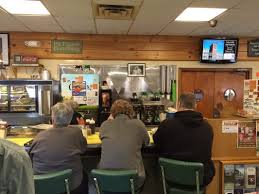
Down at the end there were two seats at Moody's counter. Moody's in Waldoboro is a Maine diner legend. In season, a slice of their blueberry pie is worth a detour.

And so is the turkey salad, at least according to Rona. I agree as long as we also order some well-done French fries.

It was perfect timing, therefore, to find ourselves in the vicinity when in the mood for a turkey salad on rye and maybe a slice of pie.

"Let me make room for yuh," a bulky man who looked about 45 said, "I'll move down one seat and cozy with Shauna here. My lady," he winked.

Excited just to be there, I uncharacteristically said, "No need for that. It's chilly out and you look like someone good to cozy with."

"You mean I'm fat?" he said, pretending, I happily saw, to be offended.

"No, only . . ."

"It's OK. I just playin' with yuh," he said to assure me, deciding to stay perched on the stool next to where I lowered myself. "Truth is, I am fat and a lot older than I look." He pulled his tee shirt up to show me his considerable belly. "Shouldn't be eatin' this corn bread." He held it up for me to see, crumbles falling onto the countertop. "But they give it to yuh if you order the chili. Which I recommend."

"We're here for the turkey salad," Rona joined in with an extra-friendly smile.

"And the French fries," I said, "Well done."

"And a slice of blueberry pie," Rona added to make sure he understood we weren't dieting and that he wasn't the only one eating a lot.

"I know what you're thinking," he paused then added, "A grease monkey."

"No, I . . ."

"That's OK. No need to pretend with me. 'Cause that's what I am. No shame in that." He held up his hands so I could see the full extent of the grease that covered his hands and forearms like a second skin.

"Workin' on his transmission," he said nodding toward another over-size person at the very end of the counter. He too was woofing down a huge bowl of chili and didn't look up in acknowledgment. He kept stirring the bowl to distribute the corn bread he had crumbled on the chili as a topping.

"Where you guys from?"

"From three places really," I said. But for the next five months we have a place down at the Point, Pemaqud Point."

"Nice out there," he said, "What about the other two?"

Rona looked at me as if to say, "You need to be talking about this over-privileged lifestyle to someone who's an auto mechanic?"

Picking that up, I stammered, "Well we . . . I mean . . ."

"I'm cool with that," he said with a wave, "Shauna and me are thinkin' about our version of the same thing. I'm doin' pretty well and we have a nice house here in Nobleboro and a little place not far from the water--a lake actually--in Kissimmee."

"Florida?" I said, "Not that far from Orlando?"

"Right you are," he said, and slapped me hard on the back. "For the winters. It gets real cold up here and I have no love for snow. Never did, never will. But all my family's here. Been here nine generations. One of the first families. I mean of white people. When my great, great, great whatever showed up from England there were plenty of other families around. But not white ones, if you get my meaning."

"I do," I said, "There were lots of Indians around. From what I've read, they had no problem with feeding themselves what with giant oysters that you needed two hands to lift and, standing on the shore, fish you could scoop up out of the water. No need for nets or anything."

"There are lots of stories about that that were passed down in my family. Some been written down in dairies from the early 1600s. One so extensive and detailed that it's down there in the Smithsonian collection."

"Wow," Rona said.

"Pretty good for a grease monkey," he said thumping his now puffed-out chest. "And if you're wonderin', there are two governors, Maine governors in my family--Benjamin Ames and Joshua Chamberlain. You wouldna guessed that about me, would yuh?"

"I wouldn't have thought that about anyone," I said, feeling good about taking what he said in stride and not stereotyping him. "I mean, how many people have two governors in their families?"

"Mitt Romney's kids, for example," he said, "And to be fair and balanced, Mario Cuomo's."

"And that dopey Brown family in California," the fellow at the end of the counter mumbled, still shoveling in his chili. "Governor Moonbeam."

"I guess it's not so rare," I said.

"You're being silly," Rona said, "Even though these are good examples it's still very unusual."

"No need to give him a hard time, ma'am. We're just getting to know each other. By the way, my name's Dana," he said, thrusting his right hand at me. As I reached to take it, he pulled it back, "Look at me, covered all in transmission fluid and I'm thinkin' to shake hands with you who are about to eat a sandwich." He began to wipe his hand on his shirt. I kept my hand extended toward him and finally he took it and we shook hands, smiling broadly at each other.

"I guess that makes us friends," he said looking me straight in the eye.

"I'm Steve," I said, "And this is Rona."

She reached across my chest with an extended hand and without hesitating Dana took it, saying, "Nice to be your friend, Ro, Ro . . ."

"Na, Rona," she said.

"Like Jaffe and Barrett?" he asked.

"Yes, but hardly anyone knows those Ronas anymore," Rona said.

"The novelist and gossip columnist," he said. "I seem to remember readin' some of her stuff. Rona Jaffe, I mean. Wasn't she ahead of her time? Wrote a lot of racy stuff from a female perspective?"

"I'm ashamed to say," Rona said, looking down, "that I've never read anything of hers. But, yes, I think you're right. Sort of a Helen Gurley Brown type."

"I think better than that," he said, "She was a real writer. More like an Erica Jong."

"Sounds right," Rona said.

"Changin' the subject," he said, "You folks followin' the election?"

By then our sandwiches and fries had arrived and rather than risk spoiling our lunch and the thus-far warm conversation, not wanting to get into a harangue or argument, we both took big bites to fill our mouths so we couldn't be expected to talk.

"Minimally, whatever you think, it's been entertainin'. Seems these days no one pays attention to anythin' serious unless it's entertainin'. I mean Trump, hate 'em or love 'em, is fun to follow. I mean, to tell you the truth, I'm more in the 'hate 'em category,' but almost every night when I tune in to Fox and MSNBC he's good for some laughs."

Releived, still with a full mouth, I nodded.

"He's like one of those fools in Shakespeare. He speaks his mind and because no one in the media at least takes him seriously but  have to admit that some of what he says is true, politically incorrect, he gives folks permission to laugh at things they don't feel comfortable saying out loud or in public. It's kind of embarrassed laughter. You feel a little guilty admitting you are paying any serious attention to him but can't help yourself and laugh at what he has to say. Which I suppose is what a lot of entertainment is about. Comedy at least."

"I agree with all of that," I said after swallowing my half-chewed turkey salad, "So, who . . ."

"Can't say I have a dog in that fight. At least not yet. Maybe never will. Sad, but I'm feelin' I don't trust any of 'em. I mean, you can't believe a word Trump says. He sometimes contradicts himself twice in the same sentence. I've seen him do that. And, he's not wrong to call her Crooked Hillary 'cause that's what she is. I mean she's smart and all that and has a big resumé but tell me one thing she's said about herself that you believe?"

"She does have that problem," Rona said.

"Forget all the stuff when she was the First Lady. That's old news, though there's plenty of smoke from that time. I'm talking about where her and Bill's money comes from. Goldman Sachs? Give me a break. And all that hanky-panky with their foundation--forget her continuing to put up with his philandering--and the email business. To me that's a big deal. A very big deal. Everyone knows she's lyin' about that. She knew what she was doin' and put a whole lot a people at big risk. Then I fear if she wins she'd be looking' for an opportunity to show how macho she is once she's commander in chief. I have problems with all of that. Also what Trump would do with the military really scares me. So . . ."

"So what about Bernie?"

"Another liar. Different kind. I agree with him about the rigged economy and government but the lies he tells are about being able to carry out any of his policies if by some miracle he gets nominated or, God help us, wins. He knows practically nothin' about the world. Only a little more than Trump, and there is no chance of getting Medicare for all through Congress much less free college tuition. First of all the federal government doesn't have any power to tell the Univeristy of Maine what to do and even if he could get all he wants it would, what, double the deficit. I'm not antigovernment like most of the knuckleheads around here, like old Jim over there, but I do care about controlling spending and worry about the deficit. What is it, 19 trillion?"

Jim had finished his chili and was now listening to what Dana had to say.

"So, like I say, I have no one to vote for. If Ralph Nader was running' maybe . . . But he's a jerk. 'Cause of him we got George Bush. W, not HW. That puppy has a lot to atone for."

"At the moment, I'm with you," I said with a shrug and sigh, "At the moment, I'm considering not voting in November. Maybe that'll change. Maybe there'll be a real miracle and Hillary will be indicted and someone like Joe Biden would get in the mix and somehow get nominated and . . ."

"Now you're talkin'," Dana said, "He's my man! Flaws and all. He can also be a jerk. But that sort of makes him authentic. And wasn't he right about the Middle East? Iraq for example? Let it become three separate countries? But that's for another day. Got to get back to Jim's transmission. Next time we're all here, I'll tell you about my meetin' Ronald Reagan."

"Really? Where?" I really wanted to hear about that.

"At the White House."

"Fantastic!"

"I was among a group invited there to get our Silver Stars from the president. I told you I'm older than I look. It was one of the highlights of my life. Not that I thought that much about Reagan. Irangate and all that. Hey, I'd love to hang out more with you guys but a transmission awaits. I'm here with Shauna every day. Down at the end of the counter. So if you and Miss Rona want to stay friends, you know where to find me."

With that, he hoisted his considerable body off the stool and shuffled toward the cashier. Rona and I got up as well and followed after him so we could get in a couple of more handshakes.


Labels: , , , , , , , , , , ,

Tuesday, April 18, 2017

April 18, 2017--Presidential Daddy Problems

Since John F. Kennedy almost all of our presidents and aspirants to the presidency have had Daddy problems.

This struck me again recently when watching Donald Trump, pose in the Oval Office to sign an executive order to gut one more Obama initiative. This one I think having to do with environmental protection regulations.

President Trump has not given much attention to making the White House office his own. The shelves are deplete of books with the exception of an impersonal row or two of leather bound volumes purchased by the foot. Probably an ornamental set of Dickens novels. His desk has a messy stack of papers and files but no visible tchotchkes. And on the credenza behind his desk where all presidents array at least a dozen pictures of their families (even Nixon did this!), on Trump's credenza there is just one picture--a severe black-and-white photo of his Germanic-looking father, Frederick. And, yes, there is also a stack of souvenir golf balls. I assume one from each of his 17 courses.

When thinking about presidents and their fathers, there are reasons to begin with Barack Obama. His Daddy problem stemmed from the fact that he essentially didn't have one. I believe he met his Kenyan father just once when he was 10 years old. The title of his first book, Dreams From My Father, says it all. In fact, it could serve as the title of books by at least a dozen of our presidents--how they each were either in search of their fathers or coveted their involvement, love, and acknowledgement. In Barack's case all of this was missing and that contributed to the kind of adult and president he became.

Of presidents Kennedy had a pathologically involved and controlling father. From early on Father Joe unrelentingly prepped his sons for public life. His oldest boy, Joe Junior, was slated to become president and when he was killed in action in World War II Joe Senior's attention immediately turned to second son Jack, who he pushed to get into politics (JFK was reluctant) and for whom he then behind the scenes bankrolled his career and, it is generally agreed, not only promoted his various runs for office, but in 1960 spread enough money around to assure his winning the nomination and then conspired with political bosses in key states, including bribing them, to fix the vote count to assure his son's election to the presidency.

And once elected, Joe Kennedy, out of public view, played a major roll in influencing policy. It is now also fully known that President Kennedy on a daily basis sought his father's guidance and was powerfully motivated to please him and seek his approbation. Some biographers even say that JFK's hawkish inclinations were in large part to demonstrate manhood to his philandering Daddy.
Joseph and John F. Kennedy
Lyndon Johnson succeeded Kennedy. His father was a major player in the Texas state legislature but a poor businessman. So much so that when his finances collapsed the Johnson family lived for decades in dire poverty. Sam Johnson was a very severe man and never showed son, Lyndon, much affection or offered encouragement or praise. Robert Caro, Johnson's remarkable biographer, writes at length about how LBJ sought to please his father even well after he died. Much of what Johnson did was an attempt to make up for his father's failure and ultimately to surpass him.

Then there was Richard Nixon. No one had a more clinical Daddy problem than young Dick. There is no evidence that his censorious father ever praised him for any of his accomplishments. Quite the contrary. Dick was also raised in virtual poverty--his father's various business schemes for the most part failed and he took his frustrations out on his children, especially the bright, hardworking, and eventually successful son. Desperate for his father's praise and encouragement, he pushed himself beyond sensible or legal limits and brought himself down in the process. The disparagement and constant criticism he felt from his father was a large part of what motivated Dick--to show by his dogged success that he was worthy.

Jimmy Carter's father, according to his biographers, was also a withholding patriarch for whom his son, Jimmy, could never do enough to win his affection or praise. One even goes so far as to say that Carter's propensity to laugh without seeming motivation when speaking in public was the result of a lifetime of accumulated anger. Much of it derived from his father's severity. It was, in a manner of speaking, a nervous laugh that attempted to obscure the frustration and anger he felt from an unhappy, caustic childhood relationship with his Daddy.

Ronald Reagan's father was a lifelong alcoholic who moved his family from town to town across the Midwest in an attempt to find work and change his luck. He was unsuccessful in many ways--never able to provide for his family, establish a sustainable relationship with his wife, or provide emotional support for his children. Son Ronald was so wounded by his upbringing, though he was a great storyteller, that he barely mentioned him. It was as if these memories were so painful that he excised his father from the narrative of his life in an attempt to get out from under the memories of his gnawing presence.

Both Bush presidents, though they achieved the ultimate political prize, never felt they were worthy of their fathers' love or pride. George H.W. Bush's father, Prescott, was a successful financier and later, when elected to the U.S. Senate, was held in high esteem by his congressional colleagues. To him, his children could never do or accomplish enough to earn his fulsome praise. No matter how much George achieved it was never enough. Like many presidential fathers he was emotionally aloof from his boys, never making them feel appreciated or affirmed.

Bill Clinton's biological father died three months before Bill was born. His mother some years later remarried and Bill took his stepfather's name. But the marriage to his mother did not last and after she divorced him, he drifted out of young Bill's life. So in many ways Bill Clinton was fatherless and many who have studied his life and written about him claim that the emotional void that was the result of this unsatisfying family life helps explain his undisciplined nature as a politician, family member, and man.

George W. Bush, son of the 41st president, also felt his father's emotional coolness and thus tried desperately to please him. Many say that his decision to invade Iraq and overthrow Saddam Hussein was to "finish the job" his father left unresolved when he had American troops come to the aid of Kuwait, which had been invaded by Iraq, and to surpass him as a wartime president. Also, some historians feel that his turning to Dick Cheney to serve as his vice president and cede to him so much of the power of the presidency was the result of Bush's impulse to seek substitutes for his biological parent, in the hope that they would offer him the affirmation he so desperately needed.

Other than as a curiosity should any of this interest or concern us?

It could well be that so many of our presidents having Daddy problems of this kind is a problem.

Seeking acknowledgement to salve fragile self-esteem may in the first instance be what motivated most of them to seek the power of the presidency. Not the desire to protect and improve the lives of those who elected them. If emotionally compromised as a result of the influences of their fathers, it also may be that allowing unresolved intra-psychic issues to influence decision making, particularly in crisis situations, gets in the way of their using their best, most rational judgement. We do not benefit by our presidents, when stressed by the consequences of dangerous decisions, to be so emotionally influenced.

One can only wonder what Frederick "Fred" Trump (ne Drumpf) might right now be thinking as his son attempts to deal with the North Korean threat. It could be that son Donald's boundless ego and insecurity are more on display and influencing his decision-making than any of his predecessors.

I would feel better about the situation if President Trump had a full array of family pictures on his Oval Office credenza, not just the one of Fred. Especially pictures of his children and grandchildren because what he decides and authorizes will affect them and their generation more than Trump himself or those of us who have already had full lives.

Fred and Donald Trump

Labels: , , , , , , , ,

Monday, July 25, 2016

July 25, 2106--A True Independent

I pretend to be, but in reality am not a political Independent.

Yes, back years ago, I voted for Jacob Javits who was a "liberal" Republican senator from New York. And at the presidential level, after a failed four years of Jimmy Carter's presidency, in 1980, conveniently not remembering, I may have held my nose and voted for Ronald Reagan.

About that one, I have regrets.

But in every other election cycle, I voted as a pretty much party-line Democrat.

When I think about myself as an independent, I am not referring to how I vote but rather that I like to think about myself as independent-minded.

So this cycle, at the risk of alienating my liberal friends, in the spirit of independent thought, I have been struggling to understand the Trump phenomenon and contending here and elsewhere that he ran one of the most remarkable primary campaigns in history and that he is smart and politically skilled enough to have tapped into the zeitgeist that derives from and motivates many millions of disaffected Americans.

Though never intending to vote for Trump, I have been attempting to remain independent-minded enough to make the distinction between my voting plans while taking note of his ability to understand what is motivating alienated voters. I have also tried to alert those of us who are not among his supporters to the forces churning within our culture, forces not well enough understood by the liberal elites.

For example, just the other day, as an example of out-of-touchness, David Brooks in his column in the New York Times rather hysterically claimed that only Ted Cruz among Republicans has the chutzpah and cojones to tell the faithful the truth--that Trump has taken the Republican party hostage and will turn it into a "cult of personality." Brooks pined for the GOP party of "Lincoln, TR, and Reagan."

He forgot to mention that it is also the party of Nixon and George W. Bush. In fact, it is more their party than either Lincoln's or Brooks.'

Clearly, though describing himself frequently as an Independent, Brooks among most others has his mind fully made up, not to be confused by historical inconveniences.

In fact, surveys show that most who claim to be Independents are anything but, and conclude that only between and 5 and 10 percent truly are. They are the only ones struggling to figure out which candidate to vote for--Trump or Clinton. The rest of us are committed to one or the other and there is almost nothing that could happen between now and November that would convince us to switch affiliations.

As Trump horrifyingly but insightfully boasted, he could shoot someone on Fifth Avenue and still win the nomination. And Hillary could have said, "I could break the law about passing along top secret documents via my private e-mail server and also be nominated."

So how intrigued Rona was the other morning when we stopped at a local market to pick up a copy of the New York Times.

Passing the paper to her, Kate said, "I am in a quandary about the election and for the first time may not vote."

"Really?" Rona said.

"Really. I like some things about Hillary and some things about Trump. But then there are enough things about each of them that I don't like that I may stay home on Election Day."

"Are you a registered Republican or . . ."

"Neither," she said, "I'm an Independent."

"We'll talk more later," Rona said. "We're rushing to meet someone. But to tell you the truth, you may be the first legitimate Independent I've ever met. Everyone else I know may say they are but aren't."

"That's me! Kate smiled.

Back in the car, after reporting this brief exchange, Rona said, "That was such an unusual way to talk about the election. How there are things she likes about both candidates."

"Very unusual," I said. "Do you think we know any liberals who consider themselves Independents saying anything like that about Trump?"

"Or for that matter any Trump people having anything positive to say about Clinton?"

"I can't wait to talk more with Kate as November approaches. Very interesting."

Labels: , , , , , , , ,

Monday, May 23, 2016

May 23--Fear On the Left

Again we're being inundated with nuanced columns as well as rantings all claiming that if Donald Trump figures out how to get elected president, this assures that fascism is coming to America.

This concern is mainly from pundits on the left but not exclusively. For example, neo-con Robert Kagan, one of George W. Bush flacks who contributed significantly to bringing preemptive war to Iraq, in a recent column in the Washington Post, summed it up in his title--"This Is How Fascism Comes to America."

In addition to worthwhile insights, Kagan's speculation is that Trump's supporters are so riddled with fear and rage that they do not care about traditional policies or politics (they have no interest, for example, in reforming the Republican Party) and in their fear-stoked blindness are wanting to turn the government of the United States over to a crypto-fascisit who has no policies to present but only the promise that as a classic fascist strongman he will eliminate the deepest threats to America--immigrants, Islamic terrorists, economic stagnation, and the like. Just as Mussolini did in Italy in the 1920s.

Kagan goes even further, comparing a potential Trump presidency to the Reign of Terror during the French Revolution and with a whiff of innuendo suggests that Trump's supporters seem apocalyptically like those attracted to Stalin--
They [their followers] praise the leader's incoherent speeches as the beginning of wisdom, hoping he will reward them with a plum post in the new order. There are those who merely hope to survive. Their consciences won't let them curry favor so shamelessly, so they mumble their pledges of support, like the victims of Stalin's show trials, perhaps not realizing that the leader and his followers will get them in the end anyway.
With Trump we're apparently so far along the road to fascism that we should already be worrying about show trials. What a fevered imagination Kagan has.

Not to be outdone, former governor of Massachusetts, Bill Weld, running for vice president on the Libertarian ticket, is so worried about Trump's immigration policy that he crossed a big line during his first interview last Thursday. According to the New York Times he worried that "I can hear the glass crunching on Kristallnacht in the ghettos of Warsaw and Vienna."

Godwin's Law in full flower.

Here's what I do not understand--

Why do many progressives feel it is permissible for critics to label Trump supporters as so paralyzed by fear that they are willing to turn their lives over to a potential autocrat while at the same time not acknowledging their own fears?

It is true that many Americas are fearful. Understandably. A glance at hot spots and threats around the world validate that as do economic dislocation and uncertainty in the homeland. But then the Kagans and Welds of the world are just as fear-plagued. About different things of course, but they are fear-driven nonetheless.

And much of this fear, both on the right and left, is not objectified, but speculation-based. Which is fine, but it should be labeled as such. Again, on all sides.

We do not in fact know what a Trump presidency would be like nor for that matter Hillary Clinton's. Presidents and Supreme Court justices once in office have a long history of surprising us.

Take Dwight Eisenhower as one example. He was represented in the liberal media as a bumbler uninterested in the presidency, more interested in playing golf with his chums than leading or governing. But, among other things, at the height of the Cold War, at least eight times his cabinet and the Joint Chiefs pushed for a preemptive nuclear attack on the Soviet Union. Thankfully, eight times Eisenhower demurred. And at the end of his eight years in office, this former Allied Supreme Commander warned about the growing power of the "military-industrial complex." A warning still well-worth heeding.

Ronald Reagan was also thought to be a lightweight. Showing no interest in policy much less specifics,  whatever one otherwise thinks of him, he was a transformative president. Barack Obama during the 2008 campaign said that and was roundly criticized by fellow Democrats, with Hillary Clinton leading the charge.

Harry Truman and Lyndon Johnson, two vice presidents who assumed the presidency, also were misunderstood and underestimated. Who thought at the time that the haberdasher from Independence, Missouri would turn out to be a forceful and effective leader and who knew that LBJ, a political operative from South Texas (and a corrupt one at that) would transcend his background and public record to become the most progressive president of his or perhaps any era.

Before rushing to judgement this time, it might make sense to defuse the rhetoric and take Donald Trump on on the issues where he is severely deficient and vulnerable. It is hardly necessary to give into one's own fears, and out of that, make up fantasies about "the road to fascism." Things are bad enough as it is.

Robert Kagan

Labels: , , , , , , , ,

Friday, March 11, 2016

March 11, 2106--Gut Check

In a wise column in Wednesday's New York Times, "Only Trump Can Trump Trump," Tom Friedman finally came around to understanding the Trump political phenomena.

He wrote--
Donald Trump is a walking political science course. His meteoric rise is lesson No. 1 on leadership: Most voters do not listen through their ears. They listen through their stomachs. If a leader can connect with them on a gut level, their response is: "Don't bother me with details. I trust your instincts." If a leader can't connect on a gut level, he or she can't show them enough particulars. They'll just keep asking, "Can you show me the details one more time?"
Friedman could have added that there were a number of earlier presidential candidates who also connected viscerally with voters and, while running for office, offered few details. 

It is a distinguished list--

Franklin Roosevelt, Dwight Eisenhower, John Kennedy, and Ronald Reagan.

Two Democrats and two Republicans.

FDR famously said that he didn't have all the answers, all the specifics about the ways in which he would take the lead to bring America out of the Great Depression. That he would try many things, that he would experiment and then see what worked, expand on that, and abandon the rest. That's more or less how he governed. 

Ike said it was "Time For A Change" after 20 years of Roosevelet and Truman and that was pretty much it.  All he needed to do was connect to people's guts. Which he did. His campaign button said--"I Like Ike." That was enough.

JFK also connected at the gut level. He promised to close the missile gap. He incorrectly, probably deceitfully, pointed to "the fact" that the Soviet Union had more and bigger and better missiles than we. Voters didn't press him for details, and he didn't offer any. But in any case they went on to elect him because they connected with him emotionally and trusted him to do the job.

Ronald Reagan specified even fewer things. People simply liked him and that was sufficient to move them to trust him. They believed he would bring "morning" back to America. Sort of, make America great again. And to his admirers he did.

On the other hand, it doesn't always work--Barry Goldwater's campaign slogan in 1964 was, "In Your Guts You Know He's Right." When a Democrat button appeared, mocking his, "In Your Guts You Know He's Nuts," that helped assure that Goldwater lost 44 of 50 states.

The other day on Morning Joe, a very frustrated Bob Woodward unsuccessfully pressed Trump to be specific about one of his most effective appaluse lines--how he would get Mexico to pay for the border fence.

Trump refused to, saying there are five ways he had in mind. That was it. Woodward, a scion of the Washington Establishment and master of the traditional ways in which to categorize political behavior, was unrelenting, visibly turning red as he asked again and again. Trump didn't budge. "Trust me," he in effect said. "Elect me president and then I'll show you what I'll do."

I suspect that despite that lack of specificity, not one Trump supporter switched allegiance  to Ted Cruz or, for that matter, Hillary Clinton. They both have 15-page, single-spaced proposals about what they would do about illegal immigrants. But no one is listening to them with their ears. Clinton and Cruz are having trouble connecting with voters at the gut level because your gut can turn you off as well as on.


Labels: , , , , , , , ,

Monday, November 30, 2015

November 30, 2105--The Legacy Business

I know, all recent presidents do it toward the end of their second terms--play the legacy game.

Nancy Reagan put Ronnie under pressure to focus on arms control during his last years in office to counteract the perception that he was a rigid, unrepentant Cold Warrior. He was so good at being flexible with the leadership of the Soviet Union that he was able to strike a series of arms control agreements with Mikhail Gorbachev that contributed a few years later to the collapse of the USSR and the end (at least until now) of the Cold War.

George W. Bush, stung by increasing criticism of of his Middle East policy, jettisoned one of the leading public faces of that failed war policy--Defense Secretary Donald Rumsfeld--and committed himself to pulling all combat troops out of Afghanistan and Iraq. He saw that to be an essential ingredient of his legacy, also pushed along to do so by his wife.

Which brings us to Barack Obama--the inheritor of various failed Bush policies, from a collapsed economy, out-of-control deficits, and Bush's unfulfilled pledge to withdraw our combat troops from the region, something Obama more or less carried out as part of his own legacy-building agenda.

Obama, in fact, has been thinking about his legacy from almost day one.

He did not want to go down in history as just "the first African-American president." He cared at least as much about substance. Thus Obamacare was a major accomplishment unto itself but also prime-cut legacy material--he uniquely was able to bring about a dramatic expansion of healthcare coverage, an unachieved goal of all presidents from at least Harry Truman days. As Joe Biden said at the time, "This is a f ***king big deal."

So that legislative achievement may make the first paragraph of his Wikipedia entry.

The same legacy claim was made when he appointed Sonia Sotomayer to the Supreme Court, the first Hispanic to serve.

Then, more recently, with his presidential clock counting down, Obama and his people began to think even more overtly about his legacy.

The nuclear deal with Iran is claimed to be his capstone foreign policy achievement and a big legacy item. Ditto for the recent Trans-Pacific Partnership trade deal. And even yesterday's headline on page one of the New York Times about the current climate summit was titled, "Obama's Legacy at Stake in Paris Talks on Climate Accord."

Not, the "World's Future at Stake in Paris Climate Talks."

That would be the more appropriate headline considering the nature of the problem--not Obama's legacy but the fate of Earth.

So, enough with the legacy business. We have serious issues to face. Including the defeat of ISIS/ISIL/IS/ or Daesh

In legacy terms this is not going well for Obama who just a day before the Paris massacre declared "ISIL contained."

Again, in legacy terms, it is sadly understandable that he was reluctant to appear too upset by the situation in the Middle East and now Europe. He doesn't want to rise of ISIL to creep onto the first page of his Wiki entry much less future histories of his presidency.

Labels: , , , , , , , , , ,

Tuesday, August 04, 2015

August 4, 2015--The Southernization of America

Anyone interested in understanding the conservative resurgence or revolution, if you will, should turn off Fox News and read Godfrey Hodgson's prescient, 1996 eyeopener, The World Turned Right Side Up: A History of the Conservative Ascendancy in America.

If you are interested in the intellectual roots, he does a good job of summarizing the contributions of serious economists such as Friedrich Hayek; pseudo-serious novelists such as Ayn Rand; polemicists like William F. Buckley, Kevin Phillips, and Irving Kristol; evangelical religious leaders such as Jerry Falwell; and political figures including Barry Goldwater and of course Ronald Reagan.

All of this is familiar ground for anyone paying attention to the cultural and political shift rightward, but nowhere all pulled together as well as by Hodgson.

For me, noteworthy is Hodgson's insight--or at least his clear statement--of how the ideology and politics that followed on in the South, transforming it from the Democrats' Solid South, after the Civil Rights Acts of 1964 and 1965 were signed into law, and quickly became solidly conservative and Republican. The South at that time became the South that we now know and live with, continuing today to shift inexorably to the right.

Nothing that new about that. But what is new is Hodgson's perception that much of the North shortly thereafter--certainly by 1980 when Ronald Reagan became president by picking off millions of so-called Reagan Democrats--became southernized.

This happened in two stages--first there was the dramatic population shift of northerners to the former Confederate States and thereby their accruing electoral power. Reallocation of members and redistricting meant more seats in the House of Representatives for conservatives at the expense of liberal states such as New York and Pennsylvania; and, as Texas and Florida passed New York to become the second and third largest states, there was a dramatic increase in the South's number of votes in the Electoral College. With the South also becoming solidly Republican that made it much more difficult for Democrats to control Congress much less the White House.

The second stage, the result of Reagan's appeal to traditional blue collar Democrats and his election and reelection, subsequently turned a number of blue states into purple states (Pennsylvania is a good example) and over time threatened to turn a few northern purple states to red states.

Perhaps the most dramatic example of that transformation, and perplexing to progressives because of its role in the history of the emergence of the Progressive Movement, is Wisconsin, where Scott Walker managed to get elected governor three times, largely by acting as if Wisconsin were South Carolina.

As in the South he appealed to hawkish hyper-patriotism, belief in American exceptionalism, evangelical impulses, anti-affirmative action forces, a desire to limit government of all kinds, dog-whistle racism, and above all attacks on unions. Thus, Wisconsin has tipped to the right and now culturally and politically could become a permanent part of the emerging conservative majority.


Labels: , , , , , , , , , , , ,

Wednesday, June 17, 2015

June 17, 2015--Schmoozing With Congress

Again on Sunday, Maureen Dowd (who my 107-year-old mother calls Maureen Shroud) in the New York Times castigated Barack Obama for his unwillingness to deal directly with Congress. To work them, schmooze with them. How he has disdain for them, remains aloof, and thus is unable to get even widely-supported legislation passed, including last week to give him and future presidents more flexibility in Asian trade policy.

She wrote--
The president descended from the mountain for half an hour on Thursday evening, materializing at Nationals Park to schmooze with Democrats and Republicans at the annual congressional baseball game.
It was the first time he had deigned to drop by, and the murmur went up, "Jeez. Now? Really?" 
Obama has always resented the idea that it mattered for him to charm and knead and whip and hug and horse-trade his way to legislative victories, to lubricate the levers of government with personal loyalty. But, once more, he learned the hard way, it matters.
I am reading James Patterson's Restless Giant: The United States from Watergate to Bush v. Gore, and a large section of it is devoted to Ronald Reagan and his presidency.

Reagan may not have been the sharpest tack but he was among the most effective presidents in getting his agenda enacted by Congress, even though during his eight years in office, for the most part, both houses were controlled by Democrats. Fiercely partisan ones at that. Tip O'Neill, for example, was Speaker of the House during Reagan's tenure and there was no stronger partisan than old Tip.

He disagreed with almost everything the president stood for, but made many deals with him when they met regularly at the White House after office hours, trading stories and sharing a bottle of fine Scotch.

No fan of Reagan, Patterson reports that during his first 100 days in office, even while recovering from a very serious assassination attempt, Reagan amazingly met 69 times with 467 members of Congress, in addition to lobbying many more on the phone.

No one yet has added up Obama's meetings with members of Congress, but I wouldn't be surprised to learn that during his first six-and-a-half years as president he has had fewer than 69 meetings and met with and spoken personally with fewer than 100 members.

Patterson writes that--
Though Reagan rejected major changes in his [legislative] plans, his actions indicated . . .  that he was far from the inflexible ideologue that critics had described.
Yes, the tax cuts he enacted with bipartisan support added exponentially to the national debt, tripling between 1980 and 1989 from $914 billion to $2.7 trillion, in many ways he was a successful president--the economy improved and he proved adept at foreign policy, very much including getting along famously and doing serious business with Soviet General Secretary Mikhail Gorbachev.

Clearly schmoozing works.


Labels: , , , , , , , ,

Thursday, April 09, 2015

April 9, 2015--Running Against Washington

It is tempting to do so. Pretty much everyone thinks that "Washington" is broken and that to run against it as a presidential aspirant is a smart political idea.

Ronald Reagan did so successfully ("Government is not the solution to our problem; it is the problem") as did Jimmy Carter, George W. Bush, and Barack Obama. And now we have Scott Walker, Ted Cruz, Rand Paul and other Republicans proclaiming that they are outsiders (though at least two thus far are government employees, U.S. senators) and will either get the government to work, get it off our backs, or promise to do a combination of both.

I was reminded of this when reading, in The New York Review of Books, about David Axelrod's political memoir, Believer: My Forty Years in Politics.

In 2008, in a debate before the New Hampshire primary Axelrod recalls Hillary Clinton, by implication criticizing Barack Obama, declaring that she had been fighting for change all her life and "We don't need to be raising the false hopes of our country about what can be delivered."

Axelrod, and through him his candidate, seeing the political opening, jumped on her claim that it is difficult to bring about real change. He writes--
I recognized the opportunity that Hillary handed us. She was too much a part of the system in Washington ever to change it--and without changing the politics in Washington, real solutions to big problems would never come.
This may be a good way to win nominations and even get elected but it is a terrible approach to governing.

Like it or not, if we are to have a government (and even Tea Party people want some government--their Medicare, their Social Security, their military, their border police, their courts, their jails, their tax cuts) the only way for it to function is through various forms of bipartisan deal making. Deals between the President, his (or her) administration, and Congress, whichever party controls it.

Hillary was right--you have to be part of our system to get anything done. Forget changing it. And maybe she'll get a chance to try to function the old fashioned way. She may be boring, less than likable, and past her prime, but when she was a senator she did work this way and was able to get quite a lot accomplished.

The three presidents who got more of their agenda approved than any of their successors (whether or not you like their policies) were able to figure out ways to work with Congress. Franklin Roosevelt, Lyndon Johnson, Ronald Reagan. Privately, very privately, for the most part they expressed little respect for specific members much less the system itself. But they held their noses and figured out ways to work with Congress, including, if they could, through intimidation.

To get things done, the lessons of history suggest, those willing and adept at working the system do better than those who claim to be outsiders. It's not sexy but it works.

Labels: , , , , , ,

Wednesday, January 07, 2015

January 7, 2014--The Football

"You military?" he asked. I had never seen him before.

Rona and were having a sandwich and salad at the Marriott Courtyard in Florence, South Carolina. It had gotten foggy and was promising to thicken so we decided not to venture forth for dinner in unfamiliar territory so far south of the Mason-Dixon Line.

He was friendly and so I said, "Can't say that I am . . . or was."

"From the look of you, no offense, I knew it had to be was. I'm army myself. But from the look of me I know you're also thinking was." He was wearing a cap that proclaimed ARMY and I was thinking was.

"S'pose you don't know the Springer boys?"

"Can't say I do . . . or did," I said wondering what this was about.

"Went to the Academy. Both of 'em. Twins. Fine boys. Must be retired by now. Not such boys anymore. Like you and me." He chuckled, looking off in space. "Naval Academy. God, I wish one of these years before I pass we'd beat those guys. How many years it's been?" He stroked his chin trying to answer his own question. I wasn't quite sure what he was trying to figure out. "Must be 13, 14. That's how long it's been. I'm talking football. But I'm just an enlisted man. So whats it matter to me. To the Springer boys, commanders both of 'em, well, that's another thing altogether."

Sensing this was going to be a rambling monologue, I tried to pay attention to my sandwich.

"One flew transports. You know them C-20s. Big suckers. The other, Earl, well he flew fighters. From carriers. I think the last time he was on the Ticonderoga. Out there offa Vietnam. Just like the fog we got here tonight, his last night it was so foggy that when his instruments failed he had to find that rolling deck on his own and just barely made it. From that day on never flew again. Sort of cracked him up. Not even commercial for ten years after they discharged him. Honorable and all that. Flew a bunch of combat missions. He paid his dues. Suppose I did too."

"Glad to know he's OK," I squeaked, still working on my food.

"But his brother Jack, after the war, well, he had a different assignment." I didn't ask what it was. But he clearly wanted me to know, "With the football."

"With the what?" That piqued my interest.

"Not the one you're thinkin' about."

"To tell you the truth I'm not thinking about anything much having to do with football or footballs just my sandwich. But I am interested in what you're referring to since I think I may know about it."

"Well, the one I'm thinking about is the one for the atomic codes." I did know about that and nodded. "There's a heavy leather and I assume lead-lined briefcase, weighs about 30-40 pounds, that they call the football that has the codes to launch a nuclear attack that's always where the President is at. The Commander in Chief. 'Cause he's the only one has the authority to launch. There's a military man assigned to carry that football 24/7 wherever the President is. And they have another one for the Vice President because of, you know, what might happen. Though I'd hate to think of that Biden fellow with those codes."

"I'm not sure I agree about that," I said, with a mouthful of tuna salad.

"No need for us to get political," I was pleased to hear, "But let's get back to that Springer boy Jack. He had charge of the third one. Not many folks know there are two much less three footballs."

"I know about the two for the President and VP but this is the first I'm hearing about the third. It's for--?"

"It's for the Strategic Air Command in case the President and Vice President are taken out at the same time, God help us."

"Ugh," I said, "This'll ruin my night's sleep."

"Jack and the rest of his crew had that third football up in one of the airborne command posts. Just in case. Quite something, no?"

"Indeed," I said.

"Which was why I asked if you in the first place if you knew the Springer boys."

This was making less and less sense to me. About all the footballs I was in fact interested, but why he just started to talk with me about this I had no idea.

"You want to hear my favorite football story?"

"I assume we're not talking the Army-Navy game?"

"Not football but the football."

"Shoot. I mean, sure."

"Well, my second-favorite one was when Reagan got shot. Terrible thing. Loved that man. He always carried the codes on a card in his suit jacket pocket. Well, when he was in the hospital they had to cut his clothes off him and that card got lost in the shuffle. No pun intended. When one of his aides thought to ask about it they couldn't find it. You know how busy the ER is. No one knew where it was for some time. But then it turned up in one of his shoes. Scary, no?"

"This whole business scares me," I admitted, "And your favorite?" I was about ready to head up to the room. It had been a long day of driving.

"That one involved Nixon back in '73 when he was President and had the football trailing after him. He was at Camp David meeting with the Soviet leader Brezhnev, I think it was."

"It was. Leonid Brezhnev."

"Not my favorite person, but you know Nixon, always wanting to be with foreign leaders. Especially those Russians."

"That was him at his best."

"Well, that Brez fellow he loved cars. Especially American muscle cars. So Nixon gave him a present of one. Using taxpayer money of course. A big guzzler Lincoln Continental. Nixon handed him the keys and that Russian was so excited that he hustled Nixon into the car, in the passenger seat, and then he jumped in on the other side and drove away at a mile-a-minute clip." My new friend slapped his thigh he was so amused. "Well, you can imagine that the Secret Service was caught by surprise as was the poor fellow with the football. Old Brez drove out onto the highway and left everyone behind for a full 30 minutes. Thirty minutes when Nixon didn't have the nuclear codes close at hand. When you think on it, it could have been a plot by the Russians to get away with some funny business."

"Some story," I admitted. "I read a lot about that period but never heard this one before."

"You could look it up," he said. "And if you run into Jack Springer in your travels ask him. I'm sure he knows about it. Who knows, maybe he was up in one those flying command posts at the time. Wouldn't that be something'?"

"Indeed it would be," I said, ready to head upstairs."

"Did anyone ever mention," Rona asked, "that you sound just like John Wayne?"

"That's a good one," he guffawed, "Can't wait to tell the wife. She'll love it," he said and was gone as quickly as he had appeared.


Labels: , , , , , , , , , , , , ,

Monday, November 24, 2014

November 24, 2014--A Child Shall Lead Them

Though often misapplied, this from Isaiah 11:6-9, could have been the title of Barack Obama's Thursday night speech about immigration.

No matter what one thinks about his use of executive powers to shield about 5.0 million undocumented immigrants from deportation, one would have to agree that in content it is all about family values. So if Republicans can for a moment stop fulminating about what they claim is Obama's emperor-like behavior, they might see that, politically, he has again snookered them.

Even if they find a way to defund Obama's actions or get the federal court system to overturn them and declare them an abuse of constitutional power (both questionable), they will pay a fierce political price when they are seen to be opposing what Obama did--protect families from being torn apart by the Immigration Service.

Specifically, Obama's executive action (the most ambitious and extensive in American history--Reagan's so-called "amnesty" executive order in 1986 covered only 100,000 illegal immigrants) calls for more border security (he can do this administratively and the GOP loves anything having to do with sealing our borders), taking action to make it easier for immigrants with high-level technical skills to remain in the U.S., and the continuing deportation of undocumented criminals (Obama has done 80 percent more of that than all previous presidents combined); but--and it's a very big but--those 5.0 million affected by his executive orders are all protected from deportation if and only if they belong to family units.

What he is doing pertains just to the 5.0 million or so who have lived in the U.S. for five or more years and are either children or the parents of children who are here legally. Here legally because they were born in the USA and thus are citizens (see the 14th Amendment) or were brought here illegally before the age of four and are now legally protected.

Childless individuals and couples will not be protected.

In other words, the only adults who will not be rounded up and deported are those "illegals" who are parents.

Obama's approach is not amnesty nor a "path to citizenship," but rather a statement about Family Values.

Something always trumpeted by Republicans and emphasized by their religious leaders. Thus, the political brilliance of Obama's move. And, of course, its humanity.

At their political peril, if Republicans continue to ignore the family values that undergird Obama's actions and focus instead on process questions and issues such as the separation of governmental power, they will find themselves in future elections with very few Latino supporters.

My prediction, therefore, is that because some in the Republican Party are smart enough to figure this out and after a few weeks of demonologizing Obama for acting unilaterally they will pass a series of bills to make what Obama did irrelevant, because what he said Thursday evening was that his executive orders are designed to defer deportations so that covered immigrants will be able to "stay in the country temporarily" (the deferring and temporality parts are what will keep his actions from being overturned in the courts)  and that if the Congress presents him with an acceptable bill he will sign it and tear up his executive orders.

Indeed it may turn out that a child will lead us.

Labels: , , , , , , , ,

Friday, November 14, 2014

November 14, 2014--Best of Behind: Now That's Funny

Here is something from just two years ago--November 29, 2012--about the need for humor when things seem bleakest--

When was the last time Barack Obama said anything really funny? Excluding the jokes scripted for him for White House Correspondents' dinners. Like at the one in 2011 when he made fun of Donald Trump's birth certifcate. Funny stuff, but not really that clever much less spontaneous.
I ask because times like these demand that our leaders display a genuine sense of humor. Not just to help us deal with our fears but also to rally the public and make it possible, when struggling with tough issues, to reach consensus and strike deals. It's easier to come to difficult agreements if things are not always portrayed as portentous and grim. Humor has the ability to cut through the dire.
Case in point, the so-called Fiscal Cliff.
It's scary stuff even if you don't feel that it represents the coming of the apocalypse. On January 1st taxes will go up for all, especially for the hard-pressed middle class and working poor; all sorts of social safety net programs will automatically be cut; we may not be able to pay our sovereign debt; our credit rating which is already down a notch will decline further and this will lead to all sorts of nasty international ramifications; and . . .
I take it back--maybe this is the apocalypse. 
If so, then we desperately need to do a little laughing, and not just at the snarky jokes available every night from Jon Stewart and Stephen Colbert, but more the self-deprecating kind that is suffused with hard, often unpleasant truth that can best be raised with humor and, as a result, goes down much easier
There is one helpful example out there--Alan Simpson of the Simpson-Bowles Commission. It was created by Barack Obama in 2010 to identify "policies to improve the fiscal situation in the medium term and to achieve fiscal sustainability over the long run."
And, amazingly, even as bipartisan as it was (it included the scold Paul Ryan), the commission did come up with a tough series of recommendations that call for real tax increases and heavy-duty cuts in all federal programs, very much including for the Pentagon and Medicare. Ten members, five Democrats and five Republicans voted for it.
But then nothing happened. Facing a tough reelection campaign, Obama thanked them and promptly ignored the commission’s politically unpopular proposals, and the Republican leadership in Congress blanched at the recommended tax increases. So it went nowhere in a hurry.
But now, like Freddy Kruger, it's back because Obama decisively won a second term (he got 53 percent of the popular vote) and all sorts of tax increases and spending cuts will take place automatically at the start of the new year unless Congress and the president work out a comprehensive deal. So Bowles and Simpson have been resurrected and are making the rounds on Capital Hill and on the cable and Sunday talk shows.
Wyoming rancher that he is, the star of the two-man show is former Republican senator Alan Simpson. In addition to being at least as good as Bill Clinton at explaining things, he is also very funny, and this helps him get his difficult messages across; and, if we are lucky, may help save our economic day. He delivers hard truth in humorous, folksy ways and that makes the truth more palatable.
Here are some examples of Simpson unplugged, about the budget as well about other matters--
"If you want to be a purist, go somewhere on a mountaintop and praise the east or something. But if you want to be in politics, learn to compromise. And you learn to compromise on the issue without compromising yourself. Show me a guy who won’t compromise and I’ll show you a guy with rock for brains."
"I watch Republicans. They give each other the saliva test of purity, and then they lose and bitch for four years."
"But the thing that is really impossible to believe is that whatever adjustment we make and whatever has been suggested for the last 10 years in Social Security reform, from top to bottom, none of that affects anybody over 57. Where do I get my mail? From those old cats, 70 and 80 year-olds, who are not affected one whiff. People who live in gated communities and drive their Lexus to Denny's to get the AARP dissent. This is madness."
"Grandchildren now don't write thank you cards for Christmas presents. They are walking on their pants with their caps on backwards, listening to the Enema Man and Snoopy, Snoopy Poop Dog."
Ronald Reagan was funny--just look at videos of him fooling around with his political "enemy," Tip O'Neill as they figured out how to do business together. Then there was patrician Franklin Roosevelt, whose humor helped Americans get through the Depression. And, in spite of how he is portrayed in the current Steven Spielberg film, Lincoln was a great raconteur, which enabled him to get things done with his frequently contentious team of rivals. 
In fact I try not to miss Stephen Colbert; but maybe if our leaders would sit down over a Scotch and while negotiating make each other laugh while poking fun at each other and, more important, themselves, we'd get somewhere.

Labels: , , , , , , , , ,

Thursday, July 03, 2014

July 3, 2014--Barefoot and Pregnant

I recently read Sean Wilentz's Age of Reagan.

It's a reasonably balanced view of how Reagan emerged on the national political stage in 1964 during Barry Goldwater's quest for the presidency and how, when Reagan was elected president, his administration became a vehicle for the proliferation of neo-conservative thought and action, with players who then and later influenced domestic and foreign policy. He managed to keep the pre-empters isolated, those who wanted to aggress against the collapsing Soviet Union, but allowed supply-siders to take control of economic policy.

Trickle-down became the belief system that guided tax and spending policy and, though it didn't work (the federal debt tripled and the gap between the rich and working poor began to widen dramatically), it continues to dominate, even control current conservative thinking.

Wilentz does a good job of describing the basic Republican strategy, fully on display during the Reagan eight years, to undo the policies of the New Deal, Fair Deal, and Great Society.

With the significant exception of welfare reform, they never had the votes (as now) to overturn or dramatically transform safety-net programs such as Medicare and Medicaid, Social Security, unemployment insurance, aid to education, federally-subsidized college loans, low-income housing, food stamps, and the like, nor could they get the Supreme Court to declare these unconstitutional. But they did figure out an effective long-term strategy to reduce and even eliminate them--asphyxiate them by cutting off their fiscal oxygen supply.

By refusing to go along with full appropriations, not agreeing to spend the money required to sustain these policies, over decades they have managed to chip away at the size and reach of many of these signature progressive programs.

It's the basic jujitsu approach to legislating--do as little as possible, better, do nothing and in the process watch programs such as Head Start wither.

A few are sacrosanct and have widespread support even among anti-government Tea Party Republicans--cut government to the bone, they chant, but take your hands off my Medicare and Social Security. Both actually forms of socialism!

Tea Party folks may say this, but the Republicans they keep reelecting to Congress continue to vote to make Social Security either discretionary or investable in the stock market and have voted repeatedly for the so-called Ryan budget, which would end Medicare as we have come to know and depend on it.

Democrats have no equivalent long-term plan to preserve and expand policies that reflect their core values and, as a result, the handwriting is on the wall. Even if they manage to keep electing Democrats to the White House this policy erosion will continue.

Beyond congressional tactics, for the moment conservatives have firm control of the Supreme Court and the national federal judiciary and there they are doing a version of the same thing--taking seemingly small regressive steps that have enormous long-term consequences. The recent Hobby Lobby decision is a case in point.

It exempts two small family-owned companies from having to comply with the Obamacare requirement that their health care insurance cover the cost of contraceptives. But legal scholars worry that this is just a foot in the door to other forms of restriction. Few are yet thinking of rolling back the right to buy and use contraceptives--pre-Griswold v. Connecticut days--but one never knows. There are more than a few Republican and Tea Party leaders who would ban all forms of contraception and like to see women again barefoot and pregnant.

Labels: , , , , , , , , , , , , , ,