December 24, 2019--Red-Nosed Rudolph
I couldn't carry a tune and so in 6th grade, when it was time for us to sing holiday songs, Mrs. Peterson told me just to move my lips, to lip-sync silently, so as not to throw any of my classmates off key.
And so I did. They would sing "Home For the Holidays," and I would pretend to be a part of things in my silent way.
The Christmas season was the worst. "Silent Night" was way beyond my musical capacities and I felt isolated and frustrated while the other kids negotiated the song's subtleties. And making matters worse, as a Jewish kid I wasn't up to speed about the "Virgin Mother" and child.
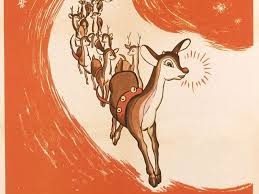
But then that 6th grade year a new Christmas song became widely popular--"Rudolph the Red-Nosed Reindeer"--and Mrs. Peterson promptly put it on her class's playlist. She even suggested to me that I might be able to sing it without disrupting the others.
I quickly memorized the lyrics and from her nods and smiles knew when singing along I was doing at least acceptably.
This was more than 70 years ago and still, when the holiday season approaches the one song that runs in a loop in my consciousness is "Rudolph." One doesn't overcome childhood trauma all that easily. Or at all--
Rudolph the red-nosed reindeer
Had a very shiny nose
And if you ever saw it,
You would even say it glowed . . .
And yet, though I am analytically-minded, it wasn't until just last week that I paid attention to the inner meaning of the lyrics.
For example--
All of the other reindeer
Used to laugh and call him names
They never let poor Rudolph
Join in any reindeer games . . .
Perhaps it is because we are in the Age of Trump where bullying is an acceptable, even preferred way to behave, I hadn't noticed that bullying is one of the important themes of "Rudolph."
Nor had I fully noticed that ultimately the song is about inclusiveness, including of those with special needs (like having a shiny nose!), and the positive power of diversity.
How one foggy Christmas eve, Santa turned to the stigmatized Rudolph and asked him, with his bright nose to guide his sleigh.
We know how it ends--
Then how the reindeer loved him
As they shouted out with glee
"Rudolph the Red-Nosed Reindeer
You'll go down in history"
I wonder what 6th graders are singing these days. I am sure some Hanukah songs and a few Kwanza songs. Hopefully, also "Rudolph." The message endures.
And so I did. They would sing "Home For the Holidays," and I would pretend to be a part of things in my silent way.
The Christmas season was the worst. "Silent Night" was way beyond my musical capacities and I felt isolated and frustrated while the other kids negotiated the song's subtleties. And making matters worse, as a Jewish kid I wasn't up to speed about the "Virgin Mother" and child.
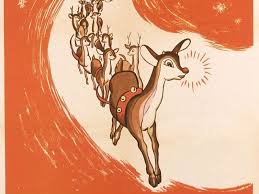
But then that 6th grade year a new Christmas song became widely popular--"Rudolph the Red-Nosed Reindeer"--and Mrs. Peterson promptly put it on her class's playlist. She even suggested to me that I might be able to sing it without disrupting the others.
I quickly memorized the lyrics and from her nods and smiles knew when singing along I was doing at least acceptably.
This was more than 70 years ago and still, when the holiday season approaches the one song that runs in a loop in my consciousness is "Rudolph." One doesn't overcome childhood trauma all that easily. Or at all--
Rudolph the red-nosed reindeer
Had a very shiny nose
And if you ever saw it,
You would even say it glowed . . .
And yet, though I am analytically-minded, it wasn't until just last week that I paid attention to the inner meaning of the lyrics.
For example--
All of the other reindeer
Used to laugh and call him names
They never let poor Rudolph
Join in any reindeer games . . .
Perhaps it is because we are in the Age of Trump where bullying is an acceptable, even preferred way to behave, I hadn't noticed that bullying is one of the important themes of "Rudolph."
Nor had I fully noticed that ultimately the song is about inclusiveness, including of those with special needs (like having a shiny nose!), and the positive power of diversity.
How one foggy Christmas eve, Santa turned to the stigmatized Rudolph and asked him, with his bright nose to guide his sleigh.
We know how it ends--
Then how the reindeer loved him
As they shouted out with glee
"Rudolph the Red-Nosed Reindeer
You'll go down in history"
I wonder what 6th graders are singing these days. I am sure some Hanukah songs and a few Kwanza songs. Hopefully, also "Rudolph." The message endures.
Labels: Christmas, Hanukah, Holiday Songs, Rudolph the Red-Nosed Reindeer. Elementary School. Kwanza
posted by Steven Zwerling at
4:25 AM
0 Comments