Tuesday, March 26, 2019

March 26, 2019--The Three Twilights

In search of distractions I stumbled on this--the three twilights. Did you know there are three? Three each day? If not, see below. (No metaphoric meaning necessarily intended.)

Civil Twilight

Each twilight phase is defined by the solar elevation angle, which is the position of the Sun in relation to the horizon. During civil twilight, the geometric center of the Sun's disk is at most 6 degrees below the horizon. In the morning, this twilight phase ends at sunrise; in the evening it begins at sunset. Sunrise and sunset are the moments when the Sun's upper edge touches the horizon.
As the Earth's atmosphere scatters and reflects much of the Sun's rays, coloring the sky bright yellow and orange, artificial lighting is generally not required in clear weather conditions to carry out most outdoor activities. Only the brightest stars and planets, like Venus and Jupiter, can be seen with the naked eye.

Nautical Twilight

Each twilight phase is defined by the solar elevation angle, which is the position of the Sun in relation to the horizon. During nautical twilight, the geometric center of the Sun's disk is between 6 and 12 degrees below the horizon.
In clear weather conditions, the horizon is faintly visible during this twilight phase. Many of the brighter stars can also be seen, making it possible to use the position of the stars in relation to the horizon to navigate at sea. This is why it is called nautical twilight.

Astronomical Twilight

Each twilight phase is defined by the solar elevation angle, which is the position of the Sun in relation to the horizon. During astronomical twilight, the geometric center of the Sun's disk is between 12 and 18 degrees below the horizon.
To the naked eye, and especially in areas with light pollution, it may be difficult to distinguish astronomical twilight from night time. Most stars and other celestial objects can be seen during this phase.
However, astronomers may be unable to observe some of the fainter stars and galaxies as long as the Sun is less than 18 degrees below the horizon – hence the name of this twilight phase.


Labels: , ,

Friday, July 21, 2017

July 21, 2017--The Universe

I've been reading Marcia Bartusiak's excellent The Day We Found the Universe, which is largely about how astronomers came to measure the size of our solar system, the galaxy of which our sun and the earth are a part, and ultimately the expanse of the entire universe.

Many astronomers contributed to what we now know about these cosmic distances. But Edwin Hubble is featured in the book as he is the astronomer who subjected all the partial theories to scrutiny and incorporated those that contributed to his own research about the size and components of the expanding universe.

He, thus, is thought to be the most important of cosmologists, the discoverer of the universe.

The book is primarily about sizes and distances. Less about motion and stellar velocities. But I have also been thinking about the speed of galactic bodies. For example, to complete one daily, 24-hour cycle how fast is the earth rotating? It turns out to be nearly 1,000 miles per hour.

Then there are other related, mind-boggling things to think about. For example, how fast is the earth moving as it completes its 365-day orbit around the sun? It turns out to be an astonishing 66,000 mph.

Earth along with the other planets and the sun that make up our solar system are also in motion.

That system is part of a vast galaxy, the Milky Way, and it circumnavigates that galaxy at 44,000 mph.

Also, the entire galaxy itself is in motion--it rotates-- and the earth, as part of the galaxy, rotates along with it as it, over 225 million years, completes one full rotation (a galactic year). The speed of rotation is an incomprehensible 483,000 miles per hour.

And finally, the galaxy itself is moving through space at 1.3 million mph.

To summarize these five interconnected movements--
  • 1,000 miles per hour is the speed of the earth's rotation;
  • 66,000 mph is how fast the earth goes about its 365-days-a-year orbit of the sun;
  • 44,000 miles per hour is how fast our sun and planets (our solar system) whips along as it circles the Milky Way galaxy;
  • 483,000 mph is how fast the Milky Way is racing to complete its 225-million-year circuit;
  • And 1.3 million miles per hour is the speed at which our galaxy moves through the universe.
It is a wonder that we aren't tossed off into space as the result of the sum of these five velocities.

The why of that is a whole other conversation.

Words, especially superlatives, fail me.


Labels: , , , , , , , ,

Monday, September 28, 2015

September 28, 2015--Blood Moon

Sunday night saw the last in a series of four total lunar eclipses that occurred within the past two years--a so-called tetrad.

This doesn't happen very often, especially when one of the eclipses, best when it is the last of the four, is a Blood Moon. The previous one was in 1982, the next in 2033.

This occurs when the moon is in its perigee, when it is closest to the Earth, and thus the reflected light of the moon, before it is eclipsed, has to pass through a maximum thickness of the Earth's atmosphere which causes the light to red-shift.

If this sparks our contemporary imagination, as Sunday's did, one can only imagine how it struck native people, who even at their most knowledgable (the Incas and Mayans come to mind), had limited astronomical and scientific sophistication.

For all ancient peoples, this occasional lunar phenomenon (and concomitant solar eclipses) was imbued with spiritual portent, often with concern expressed about the cycles of nature that people depended upon for their survival.

So any tribal leader, priest, or shaman who could understand these occurrences, their spiritual meaning, and predict when they would occur and, perhaps more important, offer assurances that they would soon end, wielded uncommon power among his people.

This was true as well for more modern and scientifically advanced people.

For example, in 1504, Christopher Columbus was on another of his voyages to the New World, this time along the north coast of Jamaica. Short of food, to dupe the natives into supplying his men with what they desperately needed, he knew it would help if he was able to appear god-like. To do so, knowing from his astronomical tables that a lunar eclipse was about to occur, he "predicted" it; and when it occurred on schedule, he was regarded as having supernatural powers.

This was especially true when after the Jamaican Indians begged him to make the moon reappear he "did" so as asked. The next day the natives gave Columbus and his men all the food and fresh water they has asked for.

Closer to our own time, there have been a number of apocalyptical prophesies associated with Blood Moons.

Perhaps most recent is the one propagated by the Reverend John Hagee. In 2007, like Columbus, anticipating an upcoming tetrad of special significance, he claimed that this one, which coincides with the Jewish Holidays, with no less than six full moons in between, including four consecutive lunar eclipses with no intervening partial eclipses, is a sure sign of the End Times and the beginning of the Millennium, which he asserts are described in the Bible in Acts 2:20 and Revelations 6:12.

I assume you are reading this on Monday, a day after the End Times were to commence. I don't know about you, but I have not as yet seen any evidence of this. Oh well.

If Hagee is still around in 2033, I assume we will be hearing more from him.


Labels: , , , , , , , ,

Wednesday, September 10, 2014

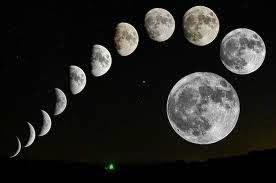
September 10, 2014--Gibbous Moon

Yesterday the moon was full. Through our bedroom window, about 4:00 AM, I watched it set over South Bristol. A path of moonlight across Johns Bay led to where I was trying to resume my interrupted sleep. Of course, I thought, one can't expect to have a restful night when the moon is full.

Tonight, happily, it begins to wane. Maybe I'll get some sleep.

Out of curiosity, I looked on line to learn a bit more about phases of the moon. I knew enough to know it goes through phases from New to Full but not much more about the less dramatic ones. Though the Crescent moon is dramatic, made more so because it is an important element in the flags of many Islamic countries from the former Ottoman Empire to today's Libya, Turkey, Tunisia, and Pakistan among others.

But what is the Gibbous moon, a phase I stumbled upon that was unfamiliar to me? First a little etymology, I thought.

From the Latin gibbus it is derived, meaning "hunchbacked."

But when does the moon seem hunchbacked? Well, soon, in a day or two, I read, when slices are daily taken from the illuminated face as the phases slip back toward the time when the moon will have lost all its reflected light--when it reaches its New phase and then, as has been true forever, begins to grow once more toward Full.

It is gibbous when the perfect Full-phase sphere begins to wane and looks ellipsoid or when it waxes, swelling from Crescent. "Swollen," another of gibbous' etymological meanings.
How wonderful, it occurred to me, that we have added to our language rarely-uttered words such as gibbous, originally meaning hunched and applied it first to those thus afflicted, and then, through an act of metaphoric alchemy, in turn used it to help us see beyond the moon mythology or the science, the astrology or the astronomy, as a way to make the otherwise unfathomable, the immense, and impersonal understood in more tactile human terms.

Labels: , , , , , , , , ,

Friday, November 08, 2013

November 8, 2013--Billions & Billions & Billions

Periodically, something from the world of science jars things into sharp perspective. For example, recent findings about Earth-like planets that could support life--very much including intelligent life--and apocalyptic implications about the just-discovered Higgs boson.

The Kepler spacecraft, launched into orbit in 2009 has as its primary mission calculating how many sun-like stars there are in our galaxy that have Earth-like planets: Eta-Earths.

Extrapolating from what Kepler finds to the entire universe, using the so-called Drake Equation (which is employed to estimate how many Eta-Earths in the Milky Way might contain intelligent civilizations), astronomers have been calculating just how likely it is to find various forms of life there and throughout the rest of the Universe.

Cornell University astronomer Carl Sagan back in 1980, through books such as Cosmos and a popular TV show, "Cosmos: A Personal Voyage," brought to non-scientists an enthusiasm for the possibility of life on other planets--SETI (Search for Extra-Terestrial Intelligence).

He famously began each show by talking about "the billions and billions and billions of stars" in our galaxy and claimed that "the total number of stars in the Universe is larger than the grains of sand on all  the beaches of planet Earth."

Though fascinated by Sagan's claims, many were equally amused by the breathless way in which he presented his ideas, including many times on the "Tonight Show" and on "Saturday Night Life" where he appeared as a guest and at other times as a target of parody.

As it turns out Sagan's speculations were on the mark.

According to recently announced findings based on images captured by the Kepler telescope, it appears that there are indeed billions and billions and billions of Eta-Earths in our galaxy and countless billions more in the 100 billion or so other galaxies in the Universe.

In our galaxy alone--the Milky Way--the current estimate is that there are 40 billion habitable Earth-size planets. Again, using the Drake Equation, many millions of them likely include intelligent life.

If this is not enough to make your head spin and fire your imagination, there is also significant news on the sub-atomic front. Specifically about the Higgs boson.

Physicist Peter Higgs a month ago was awarded a Nobel Prize for his theoretical work about a major source of energy that permeates space, confers mass on elementary sub-atomic particles, and gives forces such as gravity their distinctive features--the eponymous Higgs boson.

Until observed and identified earlier this year at the CERN particle accelerator in Europe the Higgs was an important but theoretical construct. But now actual Higgs bosons have been observed just where they were theorized to be.

There is general excitement all around. Higgs' work and that of the physicists at CERN is as important as any set of findings in at least 50 years.

But as with so much that is exciting and promising there is also a potential downside--in the case of the Higgs, a downside of literally cosmic proportions.

According to a report in the New York Times, the new boson could have "a fatal disease."

Some theorists, reviewing the history and future of the Higgs boson (with an emphasis on "future"), say that--
Taken at face value, the result [of these reviews] implies that eventually, (in 10-to-the-hundredth-power years) an unlucky quantum fluctuation will produce a bubble of a different vacuum, which will then expand at the speed of light, destroying everything. 
The idea is that the Higgs field could someday twitch and drop to a lower energy state, like water freezing into ice, thereby obliterating the workings of reality as we know it. Naturally, we would have no warning. Just blink and it's over.
Though 10-to-the-hundredth-power years is a very long time--very, very, very--this blink-and-it's-over business is a little depressing.

Labels: , , , , , , , , , , ,