Wednesday, September 12, 2018

September 12, 2018--9/11 at 17

That morning, 17 years ago, before heading to the office, Rona went out to our terrace to check the weather. Would we need something warm to wear?

It was a clear day, not a cloud in the sky. Shirtsleeves would do.


At that moment, flying at very high speed, the first plane roared right overhead. Much too low.


"I think it's in trouble," Rona said. 


Two minutes later we heard a explosion less than a mile south of us. 


And when, within five minutes, there was a second, even louder explosion, we knew that the world had changed.


Here is something I wrote about that day and posted in October, 2013--


We had a few hours to kill after we drove at dawn to Frosty's in Brunswick for a donut orgy.

We were waiting for the Bowdoin College Museum to open. It was the next to last day of the Maurice Prendergast show. I especially like his work on paper--watercolors, pastels, gouaches, mono prints--and didn't want to miss it.

Thinking about what to do, Rona remembered that our friend Al Trescot was planning to berth his boat in a nearby marina at the end of Mere Point. He plans a book of photographs of the waters of Casco Bay. "Let's drive down to Paul's Marina," she suggested, "From our GPS it looks as if it's only five miles."

We took our time as the historic town of Brunswick gave way to clusters of suburban-looking ranch houses before quickly turning into the more familiar look of rural Maine. The turnoff to Paul's came up quickly and I had to brake hard not to glide past the dirt road that lead down to the marina.

It turned out to be more basic than the yard where Al had been mooring his boat the past two years as he worked on a soon-to-be-published book about the Sheepscot and Kennebec Rivers. But I agreed with Rona who felt it had much more charm huddled among cabins and cottages that lined the shore facing the bay and Merepoint Neck.

We parked next to one of the cottages, maybe a bit too close; but we thought that would be all right since we intended to take a brief look around to get a visual fix on where Al would be moored early next spring.

"Let's get a quick cup of coffee," I proposed, "Just as Al said, there's a general store, over there, Judy's," I pointed toward the dock, "And maybe something to . . ."

"After what you ate at Frosty's an hour ago you want more . . ."

"Maybe some lobster?" Rona said.

I was confused. "See what that sign says."

"The Lobster You Buy Here Today,'" Rona read, "'Slept Last Night in Casco Bay.'"

"This is a perfect place for Al," we both laughed, "Let's just get a cup of coffee. More to see the shop than for the coffee or . . ."

"Good idea."

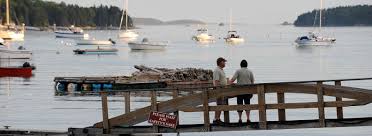
The coffee was hot and full flavored. We took it outside to a small deck and sat on a bench, passing it back and forth, looking into the half-risen sun and staring languidly out to the first of the more than 300 islands of Casco. More than enough for Al to find subject matter.

"Time to head out," I said, "By now the museum's open and I don't feel comfortable leaving the car so close to that house."

And with that, the door to it eased open and an elderly but seemingly physically vital man with a severe Amish-style beard began slowly to lumber down the few steps, heading toward our car.

I whispered to Rona as we trotted toward where we had parked, "I don't like the way he's looking at it or us. In fact, I don't like the way he looks. Let's just get into the car and not say too much. I'm in too good a mood to get yelled out for where we parked. Maybe I'll just signal a brief apology and move on."

"I see you're . . ."  I couldn't make out what he was saying but from the tone he seemed friendly. I also noticed that our car was not really encroaching on access to his garage.

I relaxed. He sensed I didn't hear him and repeated, "I see you're from New York." I nodded, by then half seated in the car. "What parts?"

"Manhattan," Rona said. "Downtown."

"Not my kind of place," he said. "All these islands right here are enough action for me." With his hand he swept the horizon.

"Where you there on 9/11?" He didn't turn to look at us.

"Yes, we were," Rona said. "The first plane flew right over our terrace. I went out there to check the weather. To determine what to wear when it flew by just above the roof, going full speed. I thought it was in some sort of trouble. Not of course what was really happening."

"Terrible day. Terrible. Terrible time. Then and since."

"I agree with that," I said, "Things haven't been the same."

"We've lost our way," he said. "That's why I hardly ever leave this place. What more do I need? I got all my wants taken care of. I don't need any of that other nonsense."

"I understand," Rona said. "When we're here we feel the same way."

"From then on things have been different," he said, still looking into the sun. "They'll never be the same."

"I agree with that," I said. "It's awful, just awful."

"Do you know what happened the day before?"

"You don't mean yesterday?"

"No, September 10th. That day before."

"Your asking about that reminds me that two of the hijackers started that day near here in Portland."

"That's right, they came to Portland on the 10th, stayed overnight, and then flew from Portland to Boston the morning of the 11th when they got onto the plane that they hijacked and crashed into the first building."

"The one I saw," Rona sighed.

"No one seems to know why they came to Portland on the 10th," I said. "Do you have any idea why?"

"I have my theories," he said. "Before I retired I used to be in law enforcement."

"Your theories?"

"That's for another day." He waved the thought away. "But I'll tell you something I bet you don't know about."

"What's that? I've tried to read a lot about the hijackers."

"In your reading did you see that they came to this here marina?"

"Really?" I exclaimed. "Here? Why would that be?"

"Don't know about why, but I do know they came right here the day before. Was a beautiful day just like today."

"To do . . .?"

"As I said, I don't know. But I do know it was them. Atta, the leader, and that Abdul fella."

"I think it was Mohammed Atta and Abdulaziz al-Omari. For some reason I seem to know the names of all 19 of them."

"They sat down right there on that dock." He pointed to a small float directly behind me. "For more than an hour."

"My God," Rona said.

"As I told you I was in law enforcement and they didn't look right to me. They didn't look like they were from here."

"What did you do?" I asked hesitantly, not wanting to probe too deeply into what might be a terrible memory.

"Well, I had my suspicions. Of course not about what they did. Who could have imagined that. Though I should have . . ." His voice trailed off.

"No one could have imagined what they were plotting," I said. "No one." And that was the truth, not something I said to make him feel better.

"But I did write down the license plate number of their car."

"And, if I may, what . . ."

"They sat down right there on that dock." He pointed to a small float directly behind me. "For more than an hour."

"My God," Rona said.

"As I told you, I was in law enforcement and they didn't look right to me. They didn't look like they were from here."

"What did you do?" I asked hesitantly, not wanting to probe too deeply into what might be a painful memory.

"Well, I had my suspicions. Of course not about what they did. Who could have imagined that. Though I should have . . ." His voice trailed off.

"No one could have imagined what they were plotting," I said. "No one." And that was the truth, not something I said to make him feel better.

"But I did write down the license plate number of their car."

"And, if I may, what . . ."

"I was at a meeting the morning of the 11th and just as we were about to get started someone rushed in to say something terrible just happened in New York, that we should come out and watch on the TV. So just like millions of others we were glued to the screen. When the second plane hit we knew it was an attack. We were all from law enforcement but no one could guess the extent of the damage or if there were other attacks all over the country. Or if we were bein' invaded."

"You're bringing that time back to me," Rona said.

As if not hearing her, he continued, "Two of the men who were at the meetin' had family working in those building and they raced to the telephone. Of course all the lines were tied up and they couldn't get through. So they came back to join us and we moved in close to them to help them get through what might turn out to be a tragedy for them too.

"At that time, horror-struck, I wasn't puttin' any pieces together. The two men who sat on the dock out there and what was happening in New York and Washington, D.C. too. Over the next few days we all went through pretty much the same thing. Fear, anger, wantin' to get even. No matter our politics we were one nation, indivisible. Just like the Pledge says we are, but for the most part we've forgotten."

"True. True," Rona said.

"A few days later--from your reading," he turned toward me but still looked out over the glinting water, "you probably know how many days--they released the names of the hijackers. The murderers."

"It was about three days," I said.

"Then a couple weeks after that they began to show pictures of them. Passport photo types. I forgot how many. 'Bout 20 of 'em.  And that's when it struck me--two of 'em (the Atta one and that Abdul fella) who took over the first plane were the same men who were here that day before. Spent an hour looking up at the sky and all them planes flyin' high overhead on the great circle route from Europe toward Boston and New York. 'Oh my God,' I thought, 'I had 'em here and let 'em get away.'"

I could hear his raspy breathing.

"There's no way you could of . . ."

He waved me off. "I let 'em get away. I'm from law enforcement. I even took their license number."

"What could you have done?" I asked, wanting to reach out to him, touch him. "Even if you had notified the police it's unlikely they would have done anything at all right them. Though they knew you and you had justifiable suspicions as it tragically turned out, it would not have been a priority for them. No one would have connected any dots and assumed they were up to such evil."

"I know what you're sayin' makes sense, and though I did talk to the FBI as soon as I saw who it was, thinking there might be more to learn about them and who was behind this, still I have trouble sleeping at night."

"I do too," Rona said. There are many nights when we're in the city and I hear a plane overhead heading for LaGuardia, my heart stops. As you said, things will never be the same."

"One more thing."

"Anything."

"You remember," for the first time he looked directly at me, "You remember where the president was? Bush?"

"I do. Somewhere in Florida at a school."

"In Sarasota. At an elementary school. And you remember what he did? Or what the Secret Service had him do?"

"I do. Until they knew the nature of the attack they flew him around from Florida to an air force base in Louisiana and eventually to the Strategic Command Center in Nebraska where he would be safe."

"Well, my son at the time was in the Marines. With everything goin' on I was worried about him. I couldn't reach him. I was real worried. Like I said, no one knew the full story of what was happening. There were all sorts of rumors."

I was confused about why he was talking at the same time about President Bush and his son.

"Then when Bush returned to the White House later that evening--he was eager to get to there--they showed him landing in his helicopter on the south lawn. Like they often do. But this time it felt more important to know he was all right."

"I remember feeling relieved about that," I said. "Even though I wasn't his biggest fan."

"And then I knew my son was also all right. You see, he was one of the pilots for the president's helicopter. Marine One it's called. And I saw him there when the president got off and turned to salute him."

With that, he turned toward Judy's General Store. "Gotta get me some of her muffins," he said sounding cheery, "before they run out."

In silence we drove back toward Brunswick.


At the museum, Rona said, "He never told us about his theories."


Labels: , , , , , ,

Monday, September 12, 2016

September 12, 2016--9/11 @ 15

That morning, 15 years ago, before heading to the office, Rona went out to our terrace to check the weather. Would we need something warm to wear?

It was a clear day, not a cloud in the sky. Shirtsleeves would do.

At that moment, flying at very high speed, the first plane roared right overhead. Much too low.

"I think it's in trouble," Rona said. 

Two minutes later we heard a explosion less than a mile south of us. 

And when, within five minutes, there was a second, even louder explosion, we knew that the world had changed.

Here is something I wrote about and posted in October, 2013--

We had a few hours to kill after we drove at dawn to Frosty's in Brunswick for a donut orgy.

We were waiting for the Bowdoin College Museum to open. It was the next to last day of the Maurice Prendergast show. I especially like his work on paper--watercolors, pastels, gouaches, mono prints--and didn't want to miss it.

Thinking about what to do, Rona remembered that our friend Al Trescot was planning to berth his boat in a nearby marina at the end of Mere Point. He plans a book of photographs of the waters of Casco Bay. "Let's drive down to Paul's Marina," she suggested, "From our GPS it looks as if it's only five miles."

We took our time as the historic town of Brunswick gave way to clusters of suburban-looking ranch houses before quickly turning into the more familiar look of rural Maine. The turnoff to Paul's came up quickly and I had to brake hard not to glide past the dirt road that lead down to the marina.

It turned out to be more basic than the yard where Al had been mooring his boat the past two years as he worked on a soon-to-be-published book about the Sheepscot and Kennebec Rivers. But I agreed with Rona who felt it had much more charm huddled among cabins and cottages that lined the shore facing the bay and Merepoint Neck.

We parked next to one of the cottages, maybe a bit too close; but we thought that would be all right since we intended to take a brief look around to get a visual fix on where Al would be moored early next spring.

"Let's get a quick cup of coffee," I proposed, "Just as Al said, there's a general store, over there, Judy's," I pointed toward the dock, "And maybe something to . . ."

"After what you ate at Frosty's an hour ago you want more . . ."

"Maybe some lobster?" Rona said.

I was confused. "See what that sign says."

"The Lobster You Buy Here Today,'" Rona read, "'Slept Last Night in Casco Bay.'"

"This is a perfect place for Al," we both laughed, "Let's just get a cup of coffee. More to see the shop than for the coffee or . . ."

"Good idea."

The coffee was hot and full flavored. We took it outside to a small deck and sat on a bench, passing it back and forth, looking into the half-risen sun and staring languidly out to the first of the more than 300 islands of Casco. More than enough for Al to find subject matter.

"Time to head out," I said, "By now the museum's open and I don't feel comfortable leaving the car so close to that house."

And with that, the door to it eased open and an elderly but seemingly physically vital man with a severe Amish-style beard began slowly to lumber down the few steps, heading toward our car.

I whispered to Rona as we trotted toward where we had parked, "I don't like the way he's looking at it or us. In fact, I don't like the way he looks. Let's just get into the car and not say too much. I'm in too good a mood to get yelled out for where we parked. Maybe I'll just signal a brief apology and move on."

"I see you're . . ."  I couldn't make out what he was saying but from the tone he seemed friendly. I also noticed that our car was not really encroaching on access to his garage.

I relaxed. He sensed I didn't hear him and repeated, "I see you're from New York." I nodded, by then half seated in the car. "What parts?"

"Manhattan," Rona said. "Downtown."

"Not my kind of place," he said. "All these islands right here are enough action for me." With his hand he swept the horizon.

"Where you there on 9/11?" He didn't turn to look at us.

"Yes, we were," Rona said. "The first plane flew right over our terrace. I went out there to check the weather. To determine what to wear when it flew by just above the roof, going full speed. I thought it was in some sort of trouble. Not of course what was really happening."

"Terrible day. Terrible. Terrible time. Then and since."

"I agree with that," I said, "Things haven't been the same."

"We've lost our way," he said. "That's why I hardly ever leave this place. What more do I need? I got all my wants taken care of. I don't need any of that other nonsense."

"I understand," Rona said. "When we're here we feel the same way."

"From then on things have been different," he said, still looking into the sun. "They'll never be the same."

"I agree with that," I said. "It's awful, just awful."

"Do you know what happened the day before?"

"You don't mean yesterday?"

"No, September 10th. That day before."

"Your asking about that reminds me that two of the hijackers started that day near here in Portland."

"That's right, they came to Portland on the 10th, stayed overnight, and then flew from Portland to Boston the morning of the 11th when they got onto the plane that they hijacked and crashed into the first building."

"The one I saw," Rona sighed.

"No one seems to know why they came to Portland on the 10th," I said. "Do you have any idea why?"

"I have my theories," he said. "Before I retired I used to be in law enforcement."

"Your theories?"

"That's for another day." He waved the thought away. "But I'll tell you something I bet you don't know about."

"What's that? I've tried to read a lot about the hijackers."

"In your reading did you see that they came to this here marina?"

"Really?" I exclaimed. "Here? Why would that be?"

"Don't know about why, but I do know they came right here the day before. Was a beautiful day just like today."

"To do . . .?"

"As I said, I don't know. But I do know it was them. Atta, the leader, and that Abdul fella."

"I think it was Mohammed Atta and Abdulaziz al-Omari. For some reason I seem to know the names of all 19 of them."

"They sat down right there on that dock." He pointed to a small float directly behind me. "For more than an hour."

"My God," Rona said.

"As I told you I was in law enforcement and they didn't look right to me. They didn't look like they were from here."

"What did you do?" I asked hesitantly, not wanting to probe too deeply into what might be a terrible memory.

"Well, I had my suspicions. Of course not about what they did. Who could have imagined that. Though I should have . . ." His voice trailed off.

"No one could have imagined what they were plotting," I said. "No one." And that was the truth, not something I said to make him feel better.

"But I did write down the license plate number of their car."

"And, if I may, what . . ."

"They sat down right there on that dock." He pointed to a small float directly behind me. "For more than an hour."

"My God," Rona said.

"As I told you, I was in law enforcement and they didn't look right to me. They didn't look like they were from here."

"What did you do?" I asked hesitantly, not wanting to probe too deeply into what might be a painful memory.

"Well, I had my suspicions. Of course not about what they did. Who could have imagined that. Though I should have . . ." His voice trailed off.

"No one could have imagined what they were plotting," I said. "No one." And that was the truth, not something I said to make him feel better.

"But I did write down the license plate number of their car."

"And, if I may, what . . ."

"I was at a meeting the morning of the 11th and just as we were about to get started someone rushed in to say something terrible just happened in New York, that we should come out and watch on the TV. So just like millions of others we were glued to the screen. When the second plane hit we knew it was an attack. We were all from law enforcement but no one could guess the extent of the damage or if there were other attacks all over the country. Or if we were bein' invaded."

"You're bringing that time back to me," Rona said.

As if not hearing her, he continued, "Two of the men who were at the meetin' had family working in those building and they raced to the telephone. Of course all the lines were tied up and they couldn't get through. So they came back to join us and we moved in close to them to help them get through what might turn out to be a tragedy for them too.

"At that time, horror-struck, I wasn't puttin' any pieces together. The two men who sat on the dock out there and what was happening in New York and Washington, D.C. too. Over the next few days we all went through pretty much the same thing. Fear, anger, wantin' to get even. No matter our politics we were one nation, indivisible. Just like the Pledge says we are, but for the most part we've forgotten."

"True. True," Rona said.

"A few days later--from your reading," he turned toward me but still looked out over the glinting water, "you probably know how many days--they released the names of the hijackers. The murderers."

"It was about three days," I said.

"Then a couple weeks after that they began to show pictures of them. Passport photo types. I forgot how many. 'Bout 20 of 'em.  And that's when it struck me--two of 'em (the Atta one and that Abdul fella) who took over the first plane were the same men who were here that day before. Spent an hour looking up at the sky and all them planes flyin' high overhead on the great circle route from Europe toward Boston and New York. 'Oh my God,' I thought, 'I had 'em here and let 'em get away.'"

I could hear his raspy breathing.

"There's no way you could of . . ."

He waved me off. "I let 'em get away. I'm from law enforcement. I even took their license number."

"What could you have done?" I asked, wanting to reach out to him, touch him. "Even if you had notified the police it's unlikely they would have done anything at all right them. Though they knew you and you had justifiable suspicions as it tragically turned out, it would not have been a priority for them. No one would have connected any dots and assumed they were up to such evil."

"I know what you're sayin' makes sense, and though I did talk to the FBI as soon as I saw who it was, thinking there might be more to learn about them and who was behind this, still I have trouble sleeping at night."

"I do too," Rona said. There are many nights when we're in the city and I hear a plane overhead heading for LaGuardia, my heart stops. As you said, things will never be the same."

"One more thing."

"Anything."

"You remember," for the first time he looked directly at me, "You remember where the president was? Bush?"

"I do. Somewhere in Florida at a school."

"In Sarasota. At an elementary school. And you remember what he did? Or what the Secret Service had him do?"

"I do. Until they knew the nature of the attack they flew him around from Florida to an air force base in Louisiana and eventually to the Strategic Command Center in Nebraska where he would be safe."

"Well, my son at the time was in the Marines. With everything goin' on I was worried about him. I couldn't reach him. I was real worried. Like I said, no one knew the full story of what was happening. There were all sorts of rumors."

I was confused about why he was talking at the same time about President Bush and his son.

"Then when Bush returned to the White House later that evening--he was eager to get to there--they showed him landing in his helicopter on the south lawn. Like they often do. But this time it felt more important to know he was all right."

"I remember feeling relieved about that," I said. "Even though I wasn't his biggest fan."

"And then I knew my son was also all right. You see, he was one of the pilots for the president's helicopter. Marine One it's called. And I saw him there when the president got off and turned to salute him."

With that, he turned toward Judy's General Store. "Gotta get me some of her muffins," he said sounding cheery, "before they run out."

In silence we drove back toward Brunswick.

At the museum, Rona said, "He never told us about his theories."


Labels: , , , , ,

Monday, October 19, 2015

October 19, 2015--Donuts

It was still dark at 6:15 but Rona was stirring.

So in a whisper I said, "Are you awake?"

"Sort of," she mumbled.

"Interested in Frosty's?"

"For donuts?" Without waiting for an answer, she threw back the covers and stumbled quickly toward the bathroom.

We hadn't been there for about a month and for the past were feeling a donut rush. And we knew, to get the widest selection--especially Boston Creams--we would be pushing our luck if we showed up after 8:00. It's about a 50 minute drive and knew if we didn't hit the road by 7:00, traffic being unpredictable, we might make all that effort and wind up disappointed.

And Frosty's is the last place in the world where you want to be disappointed. If you can't rouse yourself, better not even to go.

"Look at that pink sky," Rona said, almost impossible to understand with the electric toothbrush whirring away.

"That's sunrise. You're rarely up early enough to see it." I was attempting to represent my insomnia as evidence of my moral superiority. "Right now, actually in about 15 minutes, it should be rising above the horizon just north of Monhegan Island."

"If I hurry, do you think there's enough time to drive to the Pemaquid Loop so we can see it?"

I checked my watch and said, "It depends on what you mean by hurry."

"I know, I know, this is about donuts."

Well, Rona did hurray sufficiently and we did get to the Loop just in time to see the fireball of the sun leap above the horizon at the edge of the Gulf of Maine."

"I have to try this more often" Rona sighed. "I'm missing too many things of this kind. But let's get a move on I need one of those Boston Creams."

"I think we'll be OK, but to be sure why don't you call them to reserve one?"

"Reserve one? You can reserve a dozen. But just one?"

"It never hurts to ask."

Which Rona did and when we got there--almost too late at five to eight--there it was in a small white paper bag propped up on the counter with "Rona" written on it.

You get a better price if you order a half dozen so we asked for a Glazed Raised, a Butternut Crunch, one Maple Glazed, and two Chocolate Coconuts to accompany the Boston Cream. That made a half dozen.

"If we need more," I told the woman serving us, we can always come back for them."

"If there are any left," she alerted us knowingly. "If you want, I can put a few more aside for you."

Not wanting to appear as out of control as we were, I shrugged and said, "I think six will be fine for us."

Rona kicked me.

"OK," I corrected myself, "How about a Glazed Twist and another Butternut Crunch. We really love those."

The server smiled, having heard it all.

After filling up on Frosty's--we did manage to eat all eight--heading home I spotted a sign for Orr's and Bailey Islands.

"We've never been there so why don't we see what there is to see."

After only four miles we entered another universe of glacier-gouged coves, fishing villages from another era, and a landscape dotted with lobstermen's cottages and cabins.

Rona said, "This feels like a perfect place to get away from things and readjust one's inner balances. That Log Cabin Inn looks to be where one could book a room to take all of this in and get reoriented."

"It looks just right for that. Maybe next season we should check in for a few days."

"How about next week?" Rona said only half kidding. "They are clearly still open."

"Maybe we should," I said, "Thursday's our anniversary."

"And Frosty's only a short drive from here. And . . . "

On the way home we talked about the popularity of donuts. "At least as popular as pizza," Rona said.

"Or bagels," I said.

"I wonder about the origins of donuts," Rona mused.

"I don't know why I'm saying this but my guess is that they're of German origin. I mean, pretzels are and I think bagels."

"Donuts are not really like either pretzels or bagels. Except maybe they have similar shapes. But neither are fried. In fact, quite the opposite."

"If we had a smart phone we could look it up."

"I'd rather look at Casco Bay," Rona said, staring out her window at the foliage, now close to their magnificent peak.

So I stopped rattling on about donuts and paid attention to the narrow, twisting road.

Back home, after checking emails, In Wikipedia I looked up donuts. For certain they are not of German origin. In fact, who first made them is not definitively known. Probably the Dutch who in the early 19th century made what they called donut-like oliekoeks, or "oil cakes." The term donut itself is an American invention. First appearing in Washington Irving's History of New York. He called them doughnuts, and they were really more what Dunkin Donuts calls Munchkins, or donut holes.

Later that afternoon, agreeing it had been one of our best times ever, I said, "I know you won't believe this after what we ate for our so-called breakfast, But I'm feeling a little hungry."

"Me too," Rona sheepishly admitted. "Since we're not having a healthy eating day, why don't we heat up that can of Chef Boyardee ravioli we impulsively bought a couple of months ago. You said, it was 'for old times sake.'"

"Another guilty pleasure. But what a wonderful idea," I said, reaching for a small sauce pan. Rona already had the mini ravioli can opened.

With enough parmesan cheese, they were in fact delicious, tasting to each of us just as they had the last time we had any. Decades ago. "I don't think they had the mini version back then," I said.

"Maybe for next time we should get the classic version."

"The next time? You mean you want these again? Soon?"

"Why not? I read the label and the ingredients are all pretty much OK. With an arugula salad and some crusty bread they could make a pretty good dinner."

"We'd probably need more than one can. For lunch, one is plenty; but for dinner, I think a can each."

"We could make a mix of both kinds--the classic and the mini."

"Listen to us," Is said. "It's come to this. The next thing we know we'll be checking out recipes for Spam."

"While you're looking things up," Rona said. "Check out Chef Boyardee. To see if he is or was a real person."

In less than a minute I knew.

"Yes, he was an actual person, an Italian immigrant named Ettore "Hector" Boiardi, who made and served ravioli in his restaurant in Cleveland. They were so popular that his customers urged him to produce and sell them, which he did beginning in 1928. They appear to be made in the same factory."

"What a country," Rona said. Frosty's in the early morning, Chef Boyardee in the afternoon. What shall we have for dinner?"


Labels: , , , , , , , ,

Tuesday, June 23, 2015

June 23, 2015--Midcoast: Boston Creams

It was not yet 8:30 but already Frosty's was out of Boston Creams.

"They're my favorites," Rona whined. "We drove 40 miles to get here and they're gone?"

"I'm afraid so," one of the young women behind the counter said, clearly having heard disappointment of this kind expressed before. So cheerily she added, "We have all sorts of other donuts left that are equally delicious. Chocolate Coconut, Glazed Twists as well as Maple Glazed, Chocolate Butter Crunch, and Honey Dipped, my personal favorite. Surely . . ."

"I love them too," Rona said, calming down. "But it's just . . . I know I'm being a baby but . . ."

"I know, I know," the young woman said empathetically, "People come from hours away and if we're sold out of their favorites they get very upset."

"I'm not really upset," Rona assured her. "Just a bit disappointed." But perking up asked, "Did you say you still have Twists? I love them too. And Chocolate Butter Crunch?" The woman nodded, smiling broadly. "To tell you the truth, they're my second favorite. By the time we got to Wiscasset this morning I couldn't make up my mind if Boston Creams or Chocolate Butter Crunches are my favorite."

"So why not get a couple of the chocolate ones and a few others that the two of you can share?" She looked over at me contemplating the Twists and raised Glazed, my favorites.

"We probably should get a half dozen,"I said. "We're really in Brunswick to get our car serviced. We scheduled it so we could get to Frosty's early so as to be able to . . ."

"Not that early," Rona said under her breath still not reconciled to the fact that there were no more Boston Creams.

But we ordered a tray of six assorted donuts, coffee, and water and slid into a booth to savor our treats.

And they were wonderful. It took all our will power to keep us from finishing them in less than ten minutes.

"These really are amazing," Rona mumbled, her mouth full of Chocolate Butter Crunch.

"I say amen to that," I mumbled, my mouth stuffed with Raised Glazed.

I looked up from what was left on the tray--not much--and saw standing by our booth the young woman who had served us. She appeared to be hiding something in her Frosty's smock. "Here," she said. "Don't tell anyone." And with that she slipped another paper-wrapped donut onto our tray. "On me," she said.

"It's a Boston . . ." Rona almost shrieked.

"Keep it down," I said. "people are looking at us."

"How did it get here? I mean, did she . . . ?" Realizing what had happened Rona lowered her voice to a conspiratorially whisper. "How nice is that? Where did she get it? She said they had all sold out today by eight o'clock."

I looked over to the woman and gave her a surreptitious nod of thanks and saw her opening one of the boxes full of pre-ordered donuts, sliding a Glazed into it and quickly securing the lid. I was certain to replace a Boston Cream, the one she gave us.

"I think she . . ."

It was Rona's turn to stifle me. "Let's just eat it and not talk," she said. "Here, here's your piece." Decidedly less than half. But it is Rona's favorite and so I understood.

"It's some gud. I left em," Rona tried to say while washing down the Boston Cream with some of Frosty's fine French Roast coffee. "The cuffie's some gud wit da Bustin Cleam."

"And wasn't that the nicest thing ever? What the girl did?"

Rona, trying to smile with a full mouth, nodded.


Later that day, back in New Harbor, we wandered the aisles in Reilly's Grocery, seeking inspiration for what to make for dinner. We hadn't eaten anything since Frosty's and the car servicing turned out to be a car repair since they found two of our cylinders were misfiring. We were at the dealer's for hours. So we were tired, getting hungry, and grumpy.

"What do you think about grilling some of their beef medallions?" I suggested, "We had them last week and they came out really good. Especially with that Montreal Steak spice." Rona shook her head at that.

"I could go for meat but something a little more savory. Here, what about these skewers of thinly-sliced beef that say they were marinated in a Bourbon sauce? They look good to me. We've had some of their other marinated meat and they've always been good."

"I could go for that," I said, "But are there enough in the meat chest? By the time we can get everything cooked we'll both be starving."

"Am I in your way?" Rona asked another customer who was also looking at the meat on display.

"No, I'm fine," he said, "I'm actually here to get some of the skewered beef you're looking at. I eat it all the time. It's flavorful and simple to make. You see, I'm on my own. Live by myself."

"We were just wondering if there would be enough," Rona began to say. I nudged her since we might be in competition with the man who was clearly committed to buying a few skewers. There looked to be about five of them. I estimated to satisfy our appetite we would need at least three. That would leave him with only . . .

He turned away and drifted further down the aisle toward the pork chops.

"Let's try them," Rona said. "Reilly's never disappoints us. And they're only $5.99 a pound. Can't beat the price."

"But what about . . .?" I whispered, cocking my head in his direction, "I mean, he really lives here and is clearly a working man, a contractor or something, so . . ."

By then he had returned to where we were holding and looking more closely at three skewers. There were just two remaining in the chest. He bent to pick them up. Clearly he was as eager to have them as we. I sensed he was disappointed that there were only two left but thought, first-come-first-served.

"If three aren't enough for you," he said, "You can also have these."

"We don't want to . . ." I began to say.

"Really, you'll like them and I'm not sure if you're very hungry that three'll be enough." Feeling our hesitation, he said, "Truly. I'm fine. I'll be fine." He held the last two skewers toward us, as in an offering.

When we hesitated, he gently returned them to the shelf where they had been and picked up a package of boneless pork chops.

"I've been thinking about these all week," he said, heading toward the checkout counter.


Labels: , , , , , ,

Wednesday, August 13, 2014

August 13, 2014--Midcoast: Auto Repair Purgatory

This will be brief because I spent most of yesterday in car repair purgatory and ran out of time and energy for blogging.

Our car was making a put-put sound that concerned me. At breakfast I described it to my boating friend Stan who knows a lot about cars and engines. When he looked at me quizzically, I said, "Like the sound of a boat. A Put-Put."

I thought that might amuse him, but he was having one of his grumpy mornings and it annoyed him because he felt I was casting aspersions on boats in general, even though I meant a small, outboard motor boat. A Put-Put. Not his boat which emits a macho roar when underway.

Stan said this wasn't Car Talk where callers tell the Tappet Brothers how their cars sound and that helps them diagnose the problem over the radio. And with that, he left the diner in a bit of a huff-huff before I could draw on his mechanical expertise.

Driving over to the VW dealer in Brunswick I was thinking there was something seriously wrong and that to repair it they'd have to drop the engine. In my over-heated imagination I was looking at a four-figure bill. Anything requiring dropping the engine, I fretted, runs into the thousands.

The good news: after checking out the car they told me that the part would cost just $10 and for the labor it would take "only" two to three hours.

The bad news: this would not fix the put-put but the transmission which was leaking.

"The transmission? When did that happen?" I was close to screaming.

"Can't tell. All I know is that the transmission housing is wet all over. And, sorry," the service manager informed me, avoiding the sound effects, "but that won't take care of what's concerning you."

I interrupted to say, it wasn't the transmission that had been worrying me but now it was, even more than the "you-know-what."

"Well for that--the you-know-what--I'm afraid you need two new tires."

"What? For the put-put? I bought new tires, four of them, just two years ago."

Understanding, he nodded, "It's all the pot holes up here. They chew up tires. The bottom line still is that you need at least two. The ones on the rear are pretty chopped and that's what's making the," he lowered his voice, "put-put."

"What can I say," I said. "The car gods will do with me, with it, with them whatever they want. At least they won't have to drop the engine to mount the new tires. And considering the new transmission expense, I'll go to my tire dealer and have them replace the two."

"Okey dokey."

They must train them to be chipper, I thought. Like dentists.

"The good news," he said, "is the $10 part. The bad news," he clearly liked the good-news-bad-news business, "The bad news is that we have to order it and it won't be here until next Tuesday. In the meantime, you'll be fine. We'll top off the transmission fluid--like I said--it's leaking and . . ."

"I know. I know. The good news is all it needs is a $10 part. To tell you the truth, I'd feel better if it needed a $100 part. Then at least it would make sense to have to drop the engine. To drop it to install a cheap part seems like an extravagance."

"We'll try to avoid having to do that."

"That?"

"Drop the engine."

Later that day I went over to my tire place and had them order two new Michelins to match the other two they sold me two years ago.

"It was actually three years ago, sir," the tire manager corrected me. When I looked at him skeptically he pointed to the screen and said, "I have it right here in the computer. You put almost 45,000 miles on those babies. So to need only two, considering the roads 'round here, is not that bad."

The bad news again, I thought, or was it the good news? "Though I'd recommend your getting four."

Of course. Why not five? I probably could use a new spare even though I never used it. Just being driven around in the trunk for 45,000 miles would wear out a spare.

"Whatever," I said, fully beaten down.

Two days later when I returned to the tire dealer, worrying all the way about the transmission fluid hemorrhaging through the housing, the tires were there and in an hour were balanced, installed, and the wheels were aligned.

"Good you could do the alignment without having to drop . . ." I stopped myself from concluding the thought. Rona's jabbing me in the ribs helped.

And then back at the VW service yesterday, with the $10 part in hand, they gave us a loaner--"Why don't the two of you drive over to Frosty's. It's early and they should still have a selection of their donuts left. I love their glazed twists."

"They're his favorites," Rona said, "Though I like the chocolate cream myself."

"How long did you say it will take?" I asked, all business, though the thought of a couple of twists was appealing.

"I'll call in a couple of hours to let you know how things are going. In the meantime, have fun in Brunswick."

Forsty's actually had a fullish assortment of their donuts left and by the third one, with sugar and caffeine rushing through my system, I was thinking more about having fun then what might be going on back at VW. Coffee was more on my mind than transmission fluid.

"I wonder why it costs so much?" I said under my breath, contradicting what I just said about being focused on fun.

"Anything made from oil," Rona said, "costs a fortune. Look at what's happening with Russia and the Middle East."

"You had to remind me of that? Here I was trying to have fun and . . ."

"You're the one who muttered about why it costs so much. And you weren't talking about donuts."

"Touché," I said, trying to sound as bouncy as the VW service manager, "Let's go antiquing."

Two hours later, antiqued-out, we still hadn't heard from VW.

"Maybe call them?" I suggested to Rona.

She dialed them up. "What? What are you saying?" Now she was the one sounding all agitated. "The axel bolt? What does the axel have to do with the transmission? And why am I asking you that? I don't even know what a transmission does. For all I know it's connected to the axel and . . ."

"And when you dropped the engine," I shouted as a non sequitur into Rona's cell phone, which she promptly yanked away from me.

"OK. We'll be there in 15, 20 minutes. Then you'll explain everything." She snapped the phone shut.

Driving over, I said we needed to be ready for sticker shock. Rona had reported that when the mechanic did whatever needed to be done to the axel bolt the "thread came off with the bolt."

"Which means they'll probably have to replace the entire transmission housing."

"What's that?"

"I have no idea," I confessed. "It's the thing they told us was wet from whatever was leaking. I'm just assuming that . . ."

"You assumed they'd have to drop the engine to fix the tires. So what do you know?"

"Just that at least they gave us a brand new car for a loaner. Last time they gave us a clunker. Since it will take a week to get the new transmission parts and three days labor to install them, at least we'll have a good car to drive around in."

"Only three days of labor? I would have thought no less than five." Rona was making fun of me.

"Could be," I said, more than half serious.

When we got back to VW Rona noticed a car just like ours being washed. "They wouldn't be washing it," I said, "They told you they still have a lot of work to do to fix it. It must be one just like ours. Like you said, they'll be keeping ours a week or more and wouldn't be washing it until they replace the transmission."

"But that's a gray Passat wagon with New York plates--E*U*F* . . ."

"That must be us!" I almost jumped for joy. "Somehow while we were driving over they must have finished it."

"Or jiggered it together temporally so they can get their loaner back. I'm not driving around for a week with a patched-together car."

"I'm with you," I said. "Let's go inside and see what's-what."

What-was-what is that somehow the mechanic, in the last 15 minutes, figured out how to repair it permanently, assuming anything having to do with cars is permanent.

Not trusting, Rona said, "You're not sending us off with a car that's not fixed properly, are you?"

The manager leaned forward across the counter and whispered, "We'd never do that. It would be illegal. And you could sue VW for a fortune. And win," he winked, as if he was offering to represent us in a slam-dunk liability lawsuit.

"And the best thing," he said to me, now pulled back up to his full height, "the best thing is we didn't even need to drop the engine."

He and Rona rocked with laughter. They thought that was about the funniest thing they had heard all week.

The bill came to $248, ten dollars of it for the part. The rest labor. Not bad news.

Labels: , , , , , , , ,

Thursday, October 17, 2013

October 17, 2013--Midcoast: That Abdul Fella (Concluded)

"They sat down right there on that dock." He pointed to a small float directly behind me. "For more than an hour."

"My God," Rona said.

"As I told you, I was in law enforcement and they didn't look right to me. They didn't look like they were from here."

"What did you do?" I asked hesitantly, not wanting to probe too deeply into what might be a painful memory.

"Well, I had my suspicions. Of course not about what happened. Who could have imagined that. Though I should have . . ." His voice trailed off.

"No one could have imagined what they were plotting," I said. "No one." And that was the truth, not something I said to make him feel better.

"But I did write down the license plate number of their car."

"And, if I may, what . . ."

"I was at a meeting the morning of the 11th and just as we were about to get started someone rushed in to say something terrible just happened in New York, that we should come out and watch on the TV. So just like millions of others we were glued to the screen. When the second plane hit we knew it was an attack. We were all from law enforcement but no one could guess the extent of the damage or if there were other attacks all over the country. Or if we were bein' invaded."

"You're bringing that time back to me," Rona said.

As if not hearing her, he continued, "Two of the men who were at the meetin' had family working in those building and they raced to the telephone. Of course all the lines were tied up and they couldn't get through. So they came back to join us and we moved in close to them to help them get through what might turn out to be a tragedy for them too.

"At that time, horror struck, I wasn't puttin' any pieces together. The two men who sat on the dock out there and what was happening in New York and Washington, D.C. too. Over the next few days we all went through pretty much the same thing. Fear, anger, wantin' to get even. No matter our politics we were one nation, indivisible. Just like the Pledge says we are, but for the most part we've forgotten."

"True. True," Rona said.

"A few days later--from your readin'," for the first time he turned toward me but still looked out over the glinting water, "you probably know how many days--they released the names of the hijackers. The murderers."

"It was about three days," I said.

"Then a couple weeks after that they began to show pictures of them. Passport photo types. I forgot how many. 'Bout 20 of 'em.  And that's when it struck me--two of 'em (the Atta one and that Abdul fella) who took over the first plane were the same men who were here that day before. Spent an hour looking up at the sky and all them planes flyin' high overhead on the great circle route from Europe toward Boston and New York. 'Oh my God,' I thought, 'I had 'em here and let 'em get away.'"

I could hear his raspy breathing.

"There's no way you could of . . ."

He waved me off. "I let 'em get away. I'm from law enforcement. I even took their license number."

"What could you have done?" I asked, wanting to reach out to him, touch him. "Even if you had notified the police it's unlikely they would have done anything at all right them. Though they knew you and you had justifiable suspicions as it tragically turned out, it would not have been a priority for them. No one would have connected any dots and assumed they were up to such evil. Sadly, today it would be different."

"I know what you're sayin' makes sense, and though I did talk to the FBI as soon as I saw who it was, thinking there might be more to learn about them and who was behind this, still I have trouble sleeping at night."

"I do too," Rona said. There are many nights when we're in the city and I hear a plane overhead heading for LaGuardia, my heart stops. Things as you said will never be the same."

"One more thing."

"Anything."

"You remember," for the first time he looked directly at me, "You remember where the president was? Bush?"

"I do. Somewhere in Florida at a school."

"In Sarasota. At an elementary school. And you remember what he did? Or what the Secret Service had him do?"

"I do. Until they knew the nature of the attack they flew him around from an air force base in Louisiana and eventually to the Strategic Command Center in Nebraska where he would be safe."

"Well, my son at the time was in the Marines. With everything goin' on I was worried about him. I couldn't reach him. I was real worried. Like I said, no one knew the full story of what was happening. There were all sorts of rumors."

I was confused about why he was talking at the same time about President Bush and his son.

"Then when Bush returned to the White House later that evening--he was eager to get to there--they showed him landing in his helicopter on the south lawn. Like they often do. But this time it felt more important to know he was all right."

"I remember feeling relieved about that," I said. "Even though I wasn't his biggest fan."

"And then I knew my son was also all right. You see, he was one of the pilots for the president's helicopter. Marine One it's called. And I saw him there when the president got off and turned to salute him."

With that, he turned toward Judy's General Store. "Gotta get me some of her muffins," he said sounding cheery, "before they run out."

In silence we drove back toward Brunswick.

At the museum, Rona said, "He never told us about his theories."

Labels: , , , , , , , , , ,

Friday, October 11, 2013

October 11, 2013--Midcoast: Basic Food Groups

Donuts for us are one of the three basic food groups.

They are, we have convinced ourselves, an excellent source of carbohydrates and so, to get off to a nutritious start Wednesday, we drove nearly 40 miles to Brunswick to have a tray full at Frosty's.

Forsty's is a local institution and so popular that it's essential to get there early in order to find more than a few crumbs remaining. Did I mention that they open at four? Four in the morning. This is not the time they mix the batter and preheat the ovens but when they open for business.

Since they close when they run out of donuts--which can be by as early as 9:30--to have a semblance of a selection, we determined the night before to be on the road no later than 6:30.

It was a magical drive. It had cooled down over night and there was hoar frost crusting the fields and the ponds were steaming with ground fog. Thinking about the land being crusted was yet another inducement to think about donuts and seeing the ponds steaming reminded us that Frosty's also has excellent coffee. All just 50 minutes away.

"This is crazy," Rona said, "You know how I hate to get up so early. I'm still half asleep."

"Close your eyes," I said, "As long as Sirius continues to play Beethoven quartets I'm good to drive."

"But it's so beautiful out. I should train myself to get up and out earlier."

"It makes it special, though, to have to make an effort to get to Frosty's. In many ways it's better to have them so far away. Think about what it would be like if they were in Damariscotta."

"I'd weigh 25 pound more." And with that, Rona nodded off, dreaming, I was sure, about her favorite Boston creams.

When we arrived, though we were sixth in line and I was worried they would sell all our favorites by the time we got to the counter--almost everyone ahead of us was buying at least a dozen (one person bought eight dozen--I assume for a business meeting, though up here where people can really eat, I may have been mistaken), they still had a few left of all those we had been thinking about since earlier in the week--Rona's Boston creams and my favorite glazed twists. And since we had made such an effort to get there and rationalized that we wanted to secure our full quotient of carbs, we also got a chocolate glazed, a toasted coconut, a chocolate maple glazed (with real Maine maple syrup), and, to honor the season, a pumpkin spice donut.

With tea for Rona and French roast coffee for me, the bill totaled $7.00 and we happily slipped into one of Frosty's old-fashioned wooden booths, breathed deeply, and plunged in. Literally.

We didn't speak a word to each other for at least 10 minutes, which is unusual for us. Though being at Frosty's with a tray of melt-in-yor-mouth donuts was also unusual for us--we only do this two or three times a year.

In the adjacent booth there was a couple with a box of "ten mixed," who looked, how else to put this, beatific. When I had sampled all six of ours, I couldn't resist asking which were their favorites. I needed to ask three times as they were so engrossed in their donuts.

Without taking her eyes off her donut, our neighbor, as if in a trance, said, "The glazed twists."

"Mine too," I exclaimed. "What a coincidence."

"What about others?" Rona asked, coming up for air.

"I love them all," she said. "We're from Ohio, Columbus. We've been in the area for five days and we've been to Frosty's every day. We always have a box of ten." She smiled as if in a daze.

"Pants don't fit."

"What?" Her husband had finally roused.

"Pants don't fit," he mumbled.

"Who cares," she chirped.

"I sure don't," he said.

Later that day, after doing a little antiquing at Cabot Mills and visiting the Maurice Prendergast show at the Bowdoin Art gallery, Rona said, "I can't believe I'm saying this, but I'm feeling a little hungry."

"Frotsy's is just like proverbial Chinese food--you eat it and are hungry an hour later."

"It's four hours later and I admit I have an appetite."

"I'm game for anything. Do you have something in mind?"

"What about that drive-in along the Bath Road? We've noticed it before and thought to try it. I think it's appropriately called Fat Boys. They supposedly have the best BLT in Maine. I think they make it with Canadian bacon."

Indeed they do. And indeed it is noteworthy.

"Isn't bacon also one of the basic food groups?" Rona smiled, looking up blissfully from her BLT, as if to make us feel better about ourselves.

"With pizza," I noted, "being the last of them."

Later that evening, after devouring two delicious single-serving-sized Rosario's pizzas (made locally), Rona said, "Tomorrow, and for the rest of the week, we eat fish. Right? We have to G-tox."

"As I said, I'm game for anything."

Labels: , , , , , , , , ,