September 12, 2018--9/11 at 17
That morning, 17 years ago, before heading to the office, Rona went out to our terrace to check the weather. Would we need something warm to wear?
It was a clear day, not a cloud in the sky. Shirtsleeves would do.
At that moment, flying at very high speed, the first plane roared right overhead. Much too low.
"I think it's in trouble," Rona said.
Two minutes later we heard a explosion less than a mile south of us.
And when, within five minutes, there was a second, even louder explosion, we knew that the world had changed.
Here is something I wrote about that day and posted in October, 2013--
We had a few hours to kill after we drove at dawn to Frosty's in Brunswick for a donut orgy.
We were waiting for the Bowdoin College Museum to open. It was the next to last day of the Maurice Prendergast show. I especially like his work on paper--watercolors, pastels, gouaches, mono prints--and didn't want to miss it.
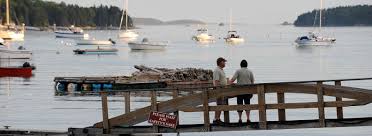
Thinking about what to do, Rona remembered that our friend Al Trescot was planning to berth his boat in a nearby marina at the end of Mere Point. He plans a book of photographs of the waters of Casco Bay. "Let's drive down to Paul's Marina," she suggested, "From our GPS it looks as if it's only five miles."
We took our time as the historic town of Brunswick gave way to clusters of suburban-looking ranch houses before quickly turning into the more familiar look of rural Maine. The turnoff to Paul's came up quickly and I had to brake hard not to glide past the dirt road that lead down to the marina.
It turned out to be more basic than the yard where Al had been mooring his boat the past two years as he worked on a soon-to-be-published book about the Sheepscot and Kennebec Rivers. But I agreed with Rona who felt it had much more charm huddled among cabins and cottages that lined the shore facing the bay and Merepoint Neck.
We parked next to one of the cottages, maybe a bit too close; but we thought that would be all right since we intended to take a brief look around to get a visual fix on where Al would be moored early next spring.
"Let's get a quick cup of coffee," I proposed, "Just as Al said, there's a general store, over there, Judy's," I pointed toward the dock, "And maybe something to . . ."
"After what you ate at Frosty's an hour ago you want more . . ."
"Maybe some lobster?" Rona said.
I was confused. "See what that sign says."
"The Lobster You Buy Here Today,'" Rona read, "'Slept Last Night in Casco Bay.'"
"This is a perfect place for Al," we both laughed, "Let's just get a cup of coffee. More to see the shop than for the coffee or . . ."
"Good idea."
The coffee was hot and full flavored. We took it outside to a small deck and sat on a bench, passing it back and forth, looking into the half-risen sun and staring languidly out to the first of the more than 300 islands of Casco. More than enough for Al to find subject matter.
"Time to head out," I said, "By now the museum's open and I don't feel comfortable leaving the car so close to that house."
And with that, the door to it eased open and an elderly but seemingly physically vital man with a severe Amish-style beard began slowly to lumber down the few steps, heading toward our car.
I whispered to Rona as we trotted toward where we had parked, "I don't like the way he's looking at it or us. In fact, I don't like the way he looks. Let's just get into the car and not say too much. I'm in too good a mood to get yelled out for where we parked. Maybe I'll just signal a brief apology and move on."
"I see you're . . ." I couldn't make out what he was saying but from the tone he seemed friendly. I also noticed that our car was not really encroaching on access to his garage.
I relaxed. He sensed I didn't hear him and repeated, "I see you're from New York." I nodded, by then half seated in the car. "What parts?"
"Manhattan," Rona said. "Downtown."
"Not my kind of place," he said. "All these islands right here are enough action for me." With his hand he swept the horizon.
"Where you there on 9/11?" He didn't turn to look at us.
"Yes, we were," Rona said. "The first plane flew right over our terrace. I went out there to check the weather. To determine what to wear when it flew by just above the roof, going full speed. I thought it was in some sort of trouble. Not of course what was really happening."
"Terrible day. Terrible. Terrible time. Then and since."
"I agree with that," I said, "Things haven't been the same."
"We've lost our way," he said. "That's why I hardly ever leave this place. What more do I need? I got all my wants taken care of. I don't need any of that other nonsense."
"I understand," Rona said. "When we're here we feel the same way."
"From then on things have been different," he said, still looking into the sun. "They'll never be the same."
"I agree with that," I said. "It's awful, just awful."
"Do you know what happened the day before?"
"You don't mean yesterday?"
"No, September 10th. That day before."
"Your asking about that reminds me that two of the hijackers started that day near here in Portland."
"That's right, they came to Portland on the 10th, stayed overnight, and then flew from Portland to Boston the morning of the 11th when they got onto the plane that they hijacked and crashed into the first building."
"The one I saw," Rona sighed.
"No one seems to know why they came to Portland on the 10th," I said. "Do you have any idea why?"
"I have my theories," he said. "Before I retired I used to be in law enforcement."
"Your theories?"
"That's for another day." He waved the thought away. "But I'll tell you something I bet you don't know about."
"What's that? I've tried to read a lot about the hijackers."
"In your reading did you see that they came to this here marina?"
"Really?" I exclaimed. "Here? Why would that be?"
"Don't know about why, but I do know they came right here the day before. Was a beautiful day just like today."
"To do . . .?"
"As I said, I don't know. But I do know it was them. Atta, the leader, and that Abdul fella."
"I think it was Mohammed Atta and Abdulaziz al-Omari. For some reason I seem to know the names of all 19 of them."
"They sat down right there on that dock." He pointed to a small float directly behind me. "For more than an hour."
"My God," Rona said.
"As I told you I was in law enforcement and they didn't look right to me. They didn't look like they were from here."
"What did you do?" I asked hesitantly, not wanting to probe too deeply into what might be a terrible memory.
"Well, I had my suspicions. Of course not about what they did. Who could have imagined that. Though I should have . . ." His voice trailed off.
"No one could have imagined what they were plotting," I said. "No one." And that was the truth, not something I said to make him feel better.
"But I did write down the license plate number of their car."
"And, if I may, what . . ."
"They sat down right there on that dock." He pointed to a small float directly behind me. "For more than an hour."
"My God," Rona said.
"As I told you, I was in law enforcement and they didn't look right to me. They didn't look like they were from here."
"What did you do?" I asked hesitantly, not wanting to probe too deeply into what might be a painful memory.
"Well, I had my suspicions. Of course not about what they did. Who could have imagined that. Though I should have . . ." His voice trailed off.
"No one could have imagined what they were plotting," I said. "No one." And that was the truth, not something I said to make him feel better.
"But I did write down the license plate number of their car."
"And, if I may, what . . ."
"I was at a meeting the morning of the 11th and just as we were about to get started someone rushed in to say something terrible just happened in New York, that we should come out and watch on the TV. So just like millions of others we were glued to the screen. When the second plane hit we knew it was an attack. We were all from law enforcement but no one could guess the extent of the damage or if there were other attacks all over the country. Or if we were bein' invaded."
"You're bringing that time back to me," Rona said.
As if not hearing her, he continued, "Two of the men who were at the meetin' had family working in those building and they raced to the telephone. Of course all the lines were tied up and they couldn't get through. So they came back to join us and we moved in close to them to help them get through what might turn out to be a tragedy for them too.
"At that time, horror-struck, I wasn't puttin' any pieces together. The two men who sat on the dock out there and what was happening in New York and Washington, D.C. too. Over the next few days we all went through pretty much the same thing. Fear, anger, wantin' to get even. No matter our politics we were one nation, indivisible. Just like the Pledge says we are, but for the most part we've forgotten."
"True. True," Rona said.
"A few days later--from your reading," he turned toward me but still looked out over the glinting water, "you probably know how many days--they released the names of the hijackers. The murderers."
"It was about three days," I said.
"Then a couple weeks after that they began to show pictures of them. Passport photo types. I forgot how many. 'Bout 20 of 'em. And that's when it struck me--two of 'em (the Atta one and that Abdul fella) who took over the first plane were the same men who were here that day before. Spent an hour looking up at the sky and all them planes flyin' high overhead on the great circle route from Europe toward Boston and New York. 'Oh my God,' I thought, 'I had 'em here and let 'em get away.'"
I could hear his raspy breathing.
"There's no way you could of . . ."
He waved me off. "I let 'em get away. I'm from law enforcement. I even took their license number."
"What could you have done?" I asked, wanting to reach out to him, touch him. "Even if you had notified the police it's unlikely they would have done anything at all right them. Though they knew you and you had justifiable suspicions as it tragically turned out, it would not have been a priority for them. No one would have connected any dots and assumed they were up to such evil."
"I know what you're sayin' makes sense, and though I did talk to the FBI as soon as I saw who it was, thinking there might be more to learn about them and who was behind this, still I have trouble sleeping at night."
"I do too," Rona said. There are many nights when we're in the city and I hear a plane overhead heading for LaGuardia, my heart stops. As you said, things will never be the same."
"One more thing."
"Anything."
"You remember," for the first time he looked directly at me, "You remember where the president was? Bush?"
"I do. Somewhere in Florida at a school."
"In Sarasota. At an elementary school. And you remember what he did? Or what the Secret Service had him do?"
"I do. Until they knew the nature of the attack they flew him around from Florida to an air force base in Louisiana and eventually to the Strategic Command Center in Nebraska where he would be safe."
"Well, my son at the time was in the Marines. With everything goin' on I was worried about him. I couldn't reach him. I was real worried. Like I said, no one knew the full story of what was happening. There were all sorts of rumors."
I was confused about why he was talking at the same time about President Bush and his son.
"Then when Bush returned to the White House later that evening--he was eager to get to there--they showed him landing in his helicopter on the south lawn. Like they often do. But this time it felt more important to know he was all right."
"I remember feeling relieved about that," I said. "Even though I wasn't his biggest fan."
"And then I knew my son was also all right. You see, he was one of the pilots for the president's helicopter. Marine One it's called. And I saw him there when the president got off and turned to salute him."
With that, he turned toward Judy's General Store. "Gotta get me some of her muffins," he said sounding cheery, "before they run out."
In silence we drove back toward Brunswick.
It was a clear day, not a cloud in the sky. Shirtsleeves would do.
At that moment, flying at very high speed, the first plane roared right overhead. Much too low.
"I think it's in trouble," Rona said.
Two minutes later we heard a explosion less than a mile south of us.
And when, within five minutes, there was a second, even louder explosion, we knew that the world had changed.
Here is something I wrote about that day and posted in October, 2013--
We had a few hours to kill after we drove at dawn to Frosty's in Brunswick for a donut orgy.
We were waiting for the Bowdoin College Museum to open. It was the next to last day of the Maurice Prendergast show. I especially like his work on paper--watercolors, pastels, gouaches, mono prints--and didn't want to miss it.
Thinking about what to do, Rona remembered that our friend Al Trescot was planning to berth his boat in a nearby marina at the end of Mere Point. He plans a book of photographs of the waters of Casco Bay. "Let's drive down to Paul's Marina," she suggested, "From our GPS it looks as if it's only five miles."
We took our time as the historic town of Brunswick gave way to clusters of suburban-looking ranch houses before quickly turning into the more familiar look of rural Maine. The turnoff to Paul's came up quickly and I had to brake hard not to glide past the dirt road that lead down to the marina.
It turned out to be more basic than the yard where Al had been mooring his boat the past two years as he worked on a soon-to-be-published book about the Sheepscot and Kennebec Rivers. But I agreed with Rona who felt it had much more charm huddled among cabins and cottages that lined the shore facing the bay and Merepoint Neck.
We parked next to one of the cottages, maybe a bit too close; but we thought that would be all right since we intended to take a brief look around to get a visual fix on where Al would be moored early next spring.
"Let's get a quick cup of coffee," I proposed, "Just as Al said, there's a general store, over there, Judy's," I pointed toward the dock, "And maybe something to . . ."
"After what you ate at Frosty's an hour ago you want more . . ."
"Maybe some lobster?" Rona said.
I was confused. "See what that sign says."
"The Lobster You Buy Here Today,'" Rona read, "'Slept Last Night in Casco Bay.'"
"This is a perfect place for Al," we both laughed, "Let's just get a cup of coffee. More to see the shop than for the coffee or . . ."
"Good idea."
The coffee was hot and full flavored. We took it outside to a small deck and sat on a bench, passing it back and forth, looking into the half-risen sun and staring languidly out to the first of the more than 300 islands of Casco. More than enough for Al to find subject matter.
"Time to head out," I said, "By now the museum's open and I don't feel comfortable leaving the car so close to that house."
And with that, the door to it eased open and an elderly but seemingly physically vital man with a severe Amish-style beard began slowly to lumber down the few steps, heading toward our car.
I whispered to Rona as we trotted toward where we had parked, "I don't like the way he's looking at it or us. In fact, I don't like the way he looks. Let's just get into the car and not say too much. I'm in too good a mood to get yelled out for where we parked. Maybe I'll just signal a brief apology and move on."
"I see you're . . ." I couldn't make out what he was saying but from the tone he seemed friendly. I also noticed that our car was not really encroaching on access to his garage.
I relaxed. He sensed I didn't hear him and repeated, "I see you're from New York." I nodded, by then half seated in the car. "What parts?"
"Manhattan," Rona said. "Downtown."
"Not my kind of place," he said. "All these islands right here are enough action for me." With his hand he swept the horizon.
"Where you there on 9/11?" He didn't turn to look at us.
"Yes, we were," Rona said. "The first plane flew right over our terrace. I went out there to check the weather. To determine what to wear when it flew by just above the roof, going full speed. I thought it was in some sort of trouble. Not of course what was really happening."
"Terrible day. Terrible. Terrible time. Then and since."
"I agree with that," I said, "Things haven't been the same."
"We've lost our way," he said. "That's why I hardly ever leave this place. What more do I need? I got all my wants taken care of. I don't need any of that other nonsense."
"I understand," Rona said. "When we're here we feel the same way."
"From then on things have been different," he said, still looking into the sun. "They'll never be the same."
"I agree with that," I said. "It's awful, just awful."
"Do you know what happened the day before?"
"You don't mean yesterday?"
"No, September 10th. That day before."
"Your asking about that reminds me that two of the hijackers started that day near here in Portland."
"That's right, they came to Portland on the 10th, stayed overnight, and then flew from Portland to Boston the morning of the 11th when they got onto the plane that they hijacked and crashed into the first building."
"The one I saw," Rona sighed.
"No one seems to know why they came to Portland on the 10th," I said. "Do you have any idea why?"
"I have my theories," he said. "Before I retired I used to be in law enforcement."
"Your theories?"
"That's for another day." He waved the thought away. "But I'll tell you something I bet you don't know about."
"What's that? I've tried to read a lot about the hijackers."
"In your reading did you see that they came to this here marina?"
"Really?" I exclaimed. "Here? Why would that be?"
"Don't know about why, but I do know they came right here the day before. Was a beautiful day just like today."
"To do . . .?"
"As I said, I don't know. But I do know it was them. Atta, the leader, and that Abdul fella."
"I think it was Mohammed Atta and Abdulaziz al-Omari. For some reason I seem to know the names of all 19 of them."
"They sat down right there on that dock." He pointed to a small float directly behind me. "For more than an hour."
"My God," Rona said.
"As I told you I was in law enforcement and they didn't look right to me. They didn't look like they were from here."
"What did you do?" I asked hesitantly, not wanting to probe too deeply into what might be a terrible memory.
"Well, I had my suspicions. Of course not about what they did. Who could have imagined that. Though I should have . . ." His voice trailed off.
"No one could have imagined what they were plotting," I said. "No one." And that was the truth, not something I said to make him feel better.
"But I did write down the license plate number of their car."
"And, if I may, what . . ."
"They sat down right there on that dock." He pointed to a small float directly behind me. "For more than an hour."
"My God," Rona said.
"As I told you, I was in law enforcement and they didn't look right to me. They didn't look like they were from here."
"What did you do?" I asked hesitantly, not wanting to probe too deeply into what might be a painful memory.
"Well, I had my suspicions. Of course not about what they did. Who could have imagined that. Though I should have . . ." His voice trailed off.
"No one could have imagined what they were plotting," I said. "No one." And that was the truth, not something I said to make him feel better.
"But I did write down the license plate number of their car."
"And, if I may, what . . ."
"I was at a meeting the morning of the 11th and just as we were about to get started someone rushed in to say something terrible just happened in New York, that we should come out and watch on the TV. So just like millions of others we were glued to the screen. When the second plane hit we knew it was an attack. We were all from law enforcement but no one could guess the extent of the damage or if there were other attacks all over the country. Or if we were bein' invaded."
"You're bringing that time back to me," Rona said.
As if not hearing her, he continued, "Two of the men who were at the meetin' had family working in those building and they raced to the telephone. Of course all the lines were tied up and they couldn't get through. So they came back to join us and we moved in close to them to help them get through what might turn out to be a tragedy for them too.
"At that time, horror-struck, I wasn't puttin' any pieces together. The two men who sat on the dock out there and what was happening in New York and Washington, D.C. too. Over the next few days we all went through pretty much the same thing. Fear, anger, wantin' to get even. No matter our politics we were one nation, indivisible. Just like the Pledge says we are, but for the most part we've forgotten."
"True. True," Rona said.
"A few days later--from your reading," he turned toward me but still looked out over the glinting water, "you probably know how many days--they released the names of the hijackers. The murderers."
"It was about three days," I said.
"Then a couple weeks after that they began to show pictures of them. Passport photo types. I forgot how many. 'Bout 20 of 'em. And that's when it struck me--two of 'em (the Atta one and that Abdul fella) who took over the first plane were the same men who were here that day before. Spent an hour looking up at the sky and all them planes flyin' high overhead on the great circle route from Europe toward Boston and New York. 'Oh my God,' I thought, 'I had 'em here and let 'em get away.'"
I could hear his raspy breathing.
"There's no way you could of . . ."
He waved me off. "I let 'em get away. I'm from law enforcement. I even took their license number."
"What could you have done?" I asked, wanting to reach out to him, touch him. "Even if you had notified the police it's unlikely they would have done anything at all right them. Though they knew you and you had justifiable suspicions as it tragically turned out, it would not have been a priority for them. No one would have connected any dots and assumed they were up to such evil."
"I know what you're sayin' makes sense, and though I did talk to the FBI as soon as I saw who it was, thinking there might be more to learn about them and who was behind this, still I have trouble sleeping at night."
"I do too," Rona said. There are many nights when we're in the city and I hear a plane overhead heading for LaGuardia, my heart stops. As you said, things will never be the same."
"One more thing."
"Anything."
"You remember," for the first time he looked directly at me, "You remember where the president was? Bush?"
"I do. Somewhere in Florida at a school."
"In Sarasota. At an elementary school. And you remember what he did? Or what the Secret Service had him do?"
"I do. Until they knew the nature of the attack they flew him around from Florida to an air force base in Louisiana and eventually to the Strategic Command Center in Nebraska where he would be safe."
"Well, my son at the time was in the Marines. With everything goin' on I was worried about him. I couldn't reach him. I was real worried. Like I said, no one knew the full story of what was happening. There were all sorts of rumors."
I was confused about why he was talking at the same time about President Bush and his son.
"Then when Bush returned to the White House later that evening--he was eager to get to there--they showed him landing in his helicopter on the south lawn. Like they often do. But this time it felt more important to know he was all right."
"I remember feeling relieved about that," I said. "Even though I wasn't his biggest fan."
"And then I knew my son was also all right. You see, he was one of the pilots for the president's helicopter. Marine One it's called. And I saw him there when the president got off and turned to salute him."
With that, he turned toward Judy's General Store. "Gotta get me some of her muffins," he said sounding cheery, "before they run out."
In silence we drove back toward Brunswick.
At the museum, Rona said, "He never told us about his theories."


Labels: 9/11, Bowdoin College Museum, Brunswick Maine, Casco Bay, Frosty's Donuts, Mere Point Maine, Paul's Marina
posted by Steven Zwerling at
5:42 AM
0 Comments