Wednesday, September 12, 2018

September 12, 2018--9/11 at 17

That morning, 17 years ago, before heading to the office, Rona went out to our terrace to check the weather. Would we need something warm to wear?

It was a clear day, not a cloud in the sky. Shirtsleeves would do.


At that moment, flying at very high speed, the first plane roared right overhead. Much too low.


"I think it's in trouble," Rona said. 


Two minutes later we heard a explosion less than a mile south of us. 


And when, within five minutes, there was a second, even louder explosion, we knew that the world had changed.


Here is something I wrote about that day and posted in October, 2013--


We had a few hours to kill after we drove at dawn to Frosty's in Brunswick for a donut orgy.

We were waiting for the Bowdoin College Museum to open. It was the next to last day of the Maurice Prendergast show. I especially like his work on paper--watercolors, pastels, gouaches, mono prints--and didn't want to miss it.

Thinking about what to do, Rona remembered that our friend Al Trescot was planning to berth his boat in a nearby marina at the end of Mere Point. He plans a book of photographs of the waters of Casco Bay. "Let's drive down to Paul's Marina," she suggested, "From our GPS it looks as if it's only five miles."

We took our time as the historic town of Brunswick gave way to clusters of suburban-looking ranch houses before quickly turning into the more familiar look of rural Maine. The turnoff to Paul's came up quickly and I had to brake hard not to glide past the dirt road that lead down to the marina.

It turned out to be more basic than the yard where Al had been mooring his boat the past two years as he worked on a soon-to-be-published book about the Sheepscot and Kennebec Rivers. But I agreed with Rona who felt it had much more charm huddled among cabins and cottages that lined the shore facing the bay and Merepoint Neck.

We parked next to one of the cottages, maybe a bit too close; but we thought that would be all right since we intended to take a brief look around to get a visual fix on where Al would be moored early next spring.

"Let's get a quick cup of coffee," I proposed, "Just as Al said, there's a general store, over there, Judy's," I pointed toward the dock, "And maybe something to . . ."

"After what you ate at Frosty's an hour ago you want more . . ."

"Maybe some lobster?" Rona said.

I was confused. "See what that sign says."

"The Lobster You Buy Here Today,'" Rona read, "'Slept Last Night in Casco Bay.'"

"This is a perfect place for Al," we both laughed, "Let's just get a cup of coffee. More to see the shop than for the coffee or . . ."

"Good idea."

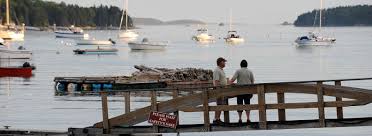
The coffee was hot and full flavored. We took it outside to a small deck and sat on a bench, passing it back and forth, looking into the half-risen sun and staring languidly out to the first of the more than 300 islands of Casco. More than enough for Al to find subject matter.

"Time to head out," I said, "By now the museum's open and I don't feel comfortable leaving the car so close to that house."

And with that, the door to it eased open and an elderly but seemingly physically vital man with a severe Amish-style beard began slowly to lumber down the few steps, heading toward our car.

I whispered to Rona as we trotted toward where we had parked, "I don't like the way he's looking at it or us. In fact, I don't like the way he looks. Let's just get into the car and not say too much. I'm in too good a mood to get yelled out for where we parked. Maybe I'll just signal a brief apology and move on."

"I see you're . . ."  I couldn't make out what he was saying but from the tone he seemed friendly. I also noticed that our car was not really encroaching on access to his garage.

I relaxed. He sensed I didn't hear him and repeated, "I see you're from New York." I nodded, by then half seated in the car. "What parts?"

"Manhattan," Rona said. "Downtown."

"Not my kind of place," he said. "All these islands right here are enough action for me." With his hand he swept the horizon.

"Where you there on 9/11?" He didn't turn to look at us.

"Yes, we were," Rona said. "The first plane flew right over our terrace. I went out there to check the weather. To determine what to wear when it flew by just above the roof, going full speed. I thought it was in some sort of trouble. Not of course what was really happening."

"Terrible day. Terrible. Terrible time. Then and since."

"I agree with that," I said, "Things haven't been the same."

"We've lost our way," he said. "That's why I hardly ever leave this place. What more do I need? I got all my wants taken care of. I don't need any of that other nonsense."

"I understand," Rona said. "When we're here we feel the same way."

"From then on things have been different," he said, still looking into the sun. "They'll never be the same."

"I agree with that," I said. "It's awful, just awful."

"Do you know what happened the day before?"

"You don't mean yesterday?"

"No, September 10th. That day before."

"Your asking about that reminds me that two of the hijackers started that day near here in Portland."

"That's right, they came to Portland on the 10th, stayed overnight, and then flew from Portland to Boston the morning of the 11th when they got onto the plane that they hijacked and crashed into the first building."

"The one I saw," Rona sighed.

"No one seems to know why they came to Portland on the 10th," I said. "Do you have any idea why?"

"I have my theories," he said. "Before I retired I used to be in law enforcement."

"Your theories?"

"That's for another day." He waved the thought away. "But I'll tell you something I bet you don't know about."

"What's that? I've tried to read a lot about the hijackers."

"In your reading did you see that they came to this here marina?"

"Really?" I exclaimed. "Here? Why would that be?"

"Don't know about why, but I do know they came right here the day before. Was a beautiful day just like today."

"To do . . .?"

"As I said, I don't know. But I do know it was them. Atta, the leader, and that Abdul fella."

"I think it was Mohammed Atta and Abdulaziz al-Omari. For some reason I seem to know the names of all 19 of them."

"They sat down right there on that dock." He pointed to a small float directly behind me. "For more than an hour."

"My God," Rona said.

"As I told you I was in law enforcement and they didn't look right to me. They didn't look like they were from here."

"What did you do?" I asked hesitantly, not wanting to probe too deeply into what might be a terrible memory.

"Well, I had my suspicions. Of course not about what they did. Who could have imagined that. Though I should have . . ." His voice trailed off.

"No one could have imagined what they were plotting," I said. "No one." And that was the truth, not something I said to make him feel better.

"But I did write down the license plate number of their car."

"And, if I may, what . . ."

"They sat down right there on that dock." He pointed to a small float directly behind me. "For more than an hour."

"My God," Rona said.

"As I told you, I was in law enforcement and they didn't look right to me. They didn't look like they were from here."

"What did you do?" I asked hesitantly, not wanting to probe too deeply into what might be a painful memory.

"Well, I had my suspicions. Of course not about what they did. Who could have imagined that. Though I should have . . ." His voice trailed off.

"No one could have imagined what they were plotting," I said. "No one." And that was the truth, not something I said to make him feel better.

"But I did write down the license plate number of their car."

"And, if I may, what . . ."

"I was at a meeting the morning of the 11th and just as we were about to get started someone rushed in to say something terrible just happened in New York, that we should come out and watch on the TV. So just like millions of others we were glued to the screen. When the second plane hit we knew it was an attack. We were all from law enforcement but no one could guess the extent of the damage or if there were other attacks all over the country. Or if we were bein' invaded."

"You're bringing that time back to me," Rona said.

As if not hearing her, he continued, "Two of the men who were at the meetin' had family working in those building and they raced to the telephone. Of course all the lines were tied up and they couldn't get through. So they came back to join us and we moved in close to them to help them get through what might turn out to be a tragedy for them too.

"At that time, horror-struck, I wasn't puttin' any pieces together. The two men who sat on the dock out there and what was happening in New York and Washington, D.C. too. Over the next few days we all went through pretty much the same thing. Fear, anger, wantin' to get even. No matter our politics we were one nation, indivisible. Just like the Pledge says we are, but for the most part we've forgotten."

"True. True," Rona said.

"A few days later--from your reading," he turned toward me but still looked out over the glinting water, "you probably know how many days--they released the names of the hijackers. The murderers."

"It was about three days," I said.

"Then a couple weeks after that they began to show pictures of them. Passport photo types. I forgot how many. 'Bout 20 of 'em.  And that's when it struck me--two of 'em (the Atta one and that Abdul fella) who took over the first plane were the same men who were here that day before. Spent an hour looking up at the sky and all them planes flyin' high overhead on the great circle route from Europe toward Boston and New York. 'Oh my God,' I thought, 'I had 'em here and let 'em get away.'"

I could hear his raspy breathing.

"There's no way you could of . . ."

He waved me off. "I let 'em get away. I'm from law enforcement. I even took their license number."

"What could you have done?" I asked, wanting to reach out to him, touch him. "Even if you had notified the police it's unlikely they would have done anything at all right them. Though they knew you and you had justifiable suspicions as it tragically turned out, it would not have been a priority for them. No one would have connected any dots and assumed they were up to such evil."

"I know what you're sayin' makes sense, and though I did talk to the FBI as soon as I saw who it was, thinking there might be more to learn about them and who was behind this, still I have trouble sleeping at night."

"I do too," Rona said. There are many nights when we're in the city and I hear a plane overhead heading for LaGuardia, my heart stops. As you said, things will never be the same."

"One more thing."

"Anything."

"You remember," for the first time he looked directly at me, "You remember where the president was? Bush?"

"I do. Somewhere in Florida at a school."

"In Sarasota. At an elementary school. And you remember what he did? Or what the Secret Service had him do?"

"I do. Until they knew the nature of the attack they flew him around from Florida to an air force base in Louisiana and eventually to the Strategic Command Center in Nebraska where he would be safe."

"Well, my son at the time was in the Marines. With everything goin' on I was worried about him. I couldn't reach him. I was real worried. Like I said, no one knew the full story of what was happening. There were all sorts of rumors."

I was confused about why he was talking at the same time about President Bush and his son.

"Then when Bush returned to the White House later that evening--he was eager to get to there--they showed him landing in his helicopter on the south lawn. Like they often do. But this time it felt more important to know he was all right."

"I remember feeling relieved about that," I said. "Even though I wasn't his biggest fan."

"And then I knew my son was also all right. You see, he was one of the pilots for the president's helicopter. Marine One it's called. And I saw him there when the president got off and turned to salute him."

With that, he turned toward Judy's General Store. "Gotta get me some of her muffins," he said sounding cheery, "before they run out."

In silence we drove back toward Brunswick.


At the museum, Rona said, "He never told us about his theories."


Labels: , , , , , ,

Tuesday, September 12, 2017

September 12, 2017--9/11

After breakfast at the diner, driving toward town yesterday morning, approaching the information center, I noticed that the flag was flying at half mast.

"For Florida?" I wondered out loud. "That would be a bit strange. I'm not sure that's appropriate to do."

Living up here one pays attention to things such as the display of flags and other symbols of patriotism. Not everyone is gung ho, far from it--there's a full range of feelings about the meaning of America and how to think about what it means to be an American.

"It's not about Florida," Rona said, sounding a little exasperated  with me.

"If not that what does it mean? Did someone like the police chief die? I didn't read or hear anything about that."

"You can be so oblivious," Rona said.

"So what is it then?"

"Don't you know what today is?"

"Monday? What are you getting at?"

"Listen to yourself--Monday, September 11th." She let that hang in the air between us.

After a moment it hit me, "I can't believe it. It's 9/11 and I was unaware of that. Considering how we personally experienced that morning I thought it would be etched in my mind forever, that I would never forget the anniversary."

"The day the world changed."

"Sixteen years," I said, "A lifetime. But it feels like it happened just a short time ago. That was some horrific morning."

"Yes," Rona said, "We were in the city. It was a beautiful day and I went out on the terrace to check the weather. Whether I needed a sweater before heading to Balthazar for coffee."

"And I was inside mindlessly watching the local news on TV, probably to get the Yankees' score."

"Right above our building," Rona said, "flying much too low and too fast, what turned out to be the first plane passed right over us, heading south about half a mile to the World Trade Center."

"And then in about a minute, both from outdoors where you were and on the TV that I was watching, which was showing a shot of lower Manhattan to illustrate the glorious weather, there were what seemed like two explosions. Of course, there was just one--the live one you witnessed and the one on TV, which I assume in retrospect was being broadcast with a seven-second delay."

"Then all that followed," Rona said recalling the fear and sadness.

"I'm so out of it," I said, upset with myself, "That I forgot today's the anniversary. I can get too relaxed here. Sometimes too disconnected from the world and time. But that's a lame excuse. There is and should be no excuse for not remembering the anniversary."

"I forgot as well," Rona said, "Until I saw that flag." I had pulled off the road to be close to the flagpole, in that way to perhaps feel more directly connected to the memory and emotions.

"And then we raced down to the street," I said, "found our nephew who was living in an NYU dorm even further south, closer to the attack. How we found him with the thousands of people running through the streets I'll never know. And then the three of us went to Washington Square Park and saw the second plane hit and in a few minutes watched as the two buildings imploded." 

We sat I the car looking up at the flag.

"Sixteen years," Rona said with a sigh. Almost a third of my lifetime ago. Where did those years go? Will it be that in another 16 years we'll be on this same road and stop to see the flag which I am sure will again be at half mast? People here won't forget. They don't forget things of this kind. But we . . ."

"It will be a stretch for me to be still alive in another 16 years. I don't mean to make this about me. I'm just being realistic. And since the last 16 years went by so fast, does this mean, as I think about the next 16, that . . ."

I didn't complete the thought. I didn't want to complete the thought.

Feeling me struggling with this, Rona slide closer, held onto me and said, "Your mother lived to 107 and so . . ."

She trailed off as well.

"We'll be OK," I finally said. "We'll be OK."


Labels: , , , , ,

Saturday, August 12, 2017

August 12, 2017--Messianic Calling

On 9/11, President George W. Bush spoke in apocalyptic terms about how he felt God calling upon him to respond to the terrorist attack on America. And how in this way he found his purpose in life. To combat evil, he said.

He was comfortable with messianic references because they derived, as a born again Christian, from his evangelical faith.

We know how that worked out. We are still, 16 years later, fighting the wars he initiated.

Now we have our current president also talking in apocalyptical terms as he threatens North Korea with old-testimental "fire and fury."

We know that this choice of words did not come from religious belief. As best as we can determine, he lacks any. But, as with Bush, they come from deep within him.

His is a secular narcissistic messianism.

Colloquially, he speaks about North Korea and his calling--

"Bill Clinton didn't get it done. Bush didn't get it done. Obama didn't get it done. Someone has to do it. It might as well be me." As with everything else, between rounds of golf, he shrugs his shoulders and matter-of-factly indicates it will be easy. He tells us and them he is "locked and loaded" with nuclear weapons.

I suspect, if he pushes the button, we know how that will work out.

Among other things we won't any longer be talking about Obamacare or collusion with Russia and, at least initially, his approval ratings will soar.


Labels: , , , , , ,

Thursday, March 23, 2017

March 23, 2015--The Wall We Need

The wall we need is not the one we've been talking about for well over a year--Donald Trump's "beautiful" wall along the border with Mexico. The wall for which he in a delusion assured us Mexico would pay.

We now discover that Mexico understandably continues to see this to be offensive and is so furious about the way they are being treated by President Trump that they have virtually severed relations with us.

We also discovered that the budget Trump submitted to Congress last week--the one received by both parties as "dead on arrival"--includes about $4.0 billion in U.S. taxpayer money to pay for the first phase of wall building. There is not a word about Mexico anteing up.

If we want to assess if a wall of this kind will be effective in shutting down illegal border-crossing, we need look no further than how well the various walls Israel has erected to contain the movement of Palestinians have worked.

Two years ago as Palestinian rockets rained down on Israel, fired from Gaza, the Israeli army discovered dozens of elaborate smugglers' tunnels under the fence, tunnels in many cases that were electrified and included lights and even air conditioning.

But there is one thing we can be certain about--the security fence that circles the White House is equally ineffective.

Evidence for that is the revelation last week that someone jumped that fence as if it weren't there and managed to elude Secret Service agents for a full 17 minutes before he was spotted and captured. He apparently had made his way right up to a White House entrance and was fiddling with the doorknob in an attempt to enter the premises.

President Trump was in residence at the time and we can only suspect that when the SS finally learned about the intrusion they roused him from his bed and bundled him down to the bunker six floors below the East Wing.

The same "undisclosed location" where they hid Vice President Cheney on 9/11.

From an electronic sensor the Secret Service was alerted to the fact that there was an intruder, but they could not locate him on the White House grounds.

The White House sits on only18 acres and one would assume that there are motion detectors every few yards and other surveillance devices that are so sensitive and secretive that we can only imagine their capabilities.

Assume away.

Not only should we be concerned about the possible danger President Trump faced but we should also be concerned in general about our capacity to monitor our borders and collect useful and time-sensitive data and intelligence from various hot spots around the world where we depend upon electronic as well as human intelligence to keep us safe.

Very much including what is going on in North Korea.

But who knows--the 26-year-old who snuck onto the White House grounds, when captured, said, "I am a friend of the president. I have an appointment."

Maybe he knew Trump was lonely with his wife and son in New York and would be happy to see him. They could watch Hannity together.

The next morning, the president said the "Secret Service did a fantastic job last night."

I also worry about his sense of what he considers to be fantastic.

Jonathan Tuan-Anh Tran

Labels: , , , , , , ,

Monday, September 12, 2016

September 12, 2016--9/11 @ 15

That morning, 15 years ago, before heading to the office, Rona went out to our terrace to check the weather. Would we need something warm to wear?

It was a clear day, not a cloud in the sky. Shirtsleeves would do.

At that moment, flying at very high speed, the first plane roared right overhead. Much too low.

"I think it's in trouble," Rona said. 

Two minutes later we heard a explosion less than a mile south of us. 

And when, within five minutes, there was a second, even louder explosion, we knew that the world had changed.

Here is something I wrote about and posted in October, 2013--

We had a few hours to kill after we drove at dawn to Frosty's in Brunswick for a donut orgy.

We were waiting for the Bowdoin College Museum to open. It was the next to last day of the Maurice Prendergast show. I especially like his work on paper--watercolors, pastels, gouaches, mono prints--and didn't want to miss it.

Thinking about what to do, Rona remembered that our friend Al Trescot was planning to berth his boat in a nearby marina at the end of Mere Point. He plans a book of photographs of the waters of Casco Bay. "Let's drive down to Paul's Marina," she suggested, "From our GPS it looks as if it's only five miles."

We took our time as the historic town of Brunswick gave way to clusters of suburban-looking ranch houses before quickly turning into the more familiar look of rural Maine. The turnoff to Paul's came up quickly and I had to brake hard not to glide past the dirt road that lead down to the marina.

It turned out to be more basic than the yard where Al had been mooring his boat the past two years as he worked on a soon-to-be-published book about the Sheepscot and Kennebec Rivers. But I agreed with Rona who felt it had much more charm huddled among cabins and cottages that lined the shore facing the bay and Merepoint Neck.

We parked next to one of the cottages, maybe a bit too close; but we thought that would be all right since we intended to take a brief look around to get a visual fix on where Al would be moored early next spring.

"Let's get a quick cup of coffee," I proposed, "Just as Al said, there's a general store, over there, Judy's," I pointed toward the dock, "And maybe something to . . ."

"After what you ate at Frosty's an hour ago you want more . . ."

"Maybe some lobster?" Rona said.

I was confused. "See what that sign says."

"The Lobster You Buy Here Today,'" Rona read, "'Slept Last Night in Casco Bay.'"

"This is a perfect place for Al," we both laughed, "Let's just get a cup of coffee. More to see the shop than for the coffee or . . ."

"Good idea."

The coffee was hot and full flavored. We took it outside to a small deck and sat on a bench, passing it back and forth, looking into the half-risen sun and staring languidly out to the first of the more than 300 islands of Casco. More than enough for Al to find subject matter.

"Time to head out," I said, "By now the museum's open and I don't feel comfortable leaving the car so close to that house."

And with that, the door to it eased open and an elderly but seemingly physically vital man with a severe Amish-style beard began slowly to lumber down the few steps, heading toward our car.

I whispered to Rona as we trotted toward where we had parked, "I don't like the way he's looking at it or us. In fact, I don't like the way he looks. Let's just get into the car and not say too much. I'm in too good a mood to get yelled out for where we parked. Maybe I'll just signal a brief apology and move on."

"I see you're . . ."  I couldn't make out what he was saying but from the tone he seemed friendly. I also noticed that our car was not really encroaching on access to his garage.

I relaxed. He sensed I didn't hear him and repeated, "I see you're from New York." I nodded, by then half seated in the car. "What parts?"

"Manhattan," Rona said. "Downtown."

"Not my kind of place," he said. "All these islands right here are enough action for me." With his hand he swept the horizon.

"Where you there on 9/11?" He didn't turn to look at us.

"Yes, we were," Rona said. "The first plane flew right over our terrace. I went out there to check the weather. To determine what to wear when it flew by just above the roof, going full speed. I thought it was in some sort of trouble. Not of course what was really happening."

"Terrible day. Terrible. Terrible time. Then and since."

"I agree with that," I said, "Things haven't been the same."

"We've lost our way," he said. "That's why I hardly ever leave this place. What more do I need? I got all my wants taken care of. I don't need any of that other nonsense."

"I understand," Rona said. "When we're here we feel the same way."

"From then on things have been different," he said, still looking into the sun. "They'll never be the same."

"I agree with that," I said. "It's awful, just awful."

"Do you know what happened the day before?"

"You don't mean yesterday?"

"No, September 10th. That day before."

"Your asking about that reminds me that two of the hijackers started that day near here in Portland."

"That's right, they came to Portland on the 10th, stayed overnight, and then flew from Portland to Boston the morning of the 11th when they got onto the plane that they hijacked and crashed into the first building."

"The one I saw," Rona sighed.

"No one seems to know why they came to Portland on the 10th," I said. "Do you have any idea why?"

"I have my theories," he said. "Before I retired I used to be in law enforcement."

"Your theories?"

"That's for another day." He waved the thought away. "But I'll tell you something I bet you don't know about."

"What's that? I've tried to read a lot about the hijackers."

"In your reading did you see that they came to this here marina?"

"Really?" I exclaimed. "Here? Why would that be?"

"Don't know about why, but I do know they came right here the day before. Was a beautiful day just like today."

"To do . . .?"

"As I said, I don't know. But I do know it was them. Atta, the leader, and that Abdul fella."

"I think it was Mohammed Atta and Abdulaziz al-Omari. For some reason I seem to know the names of all 19 of them."

"They sat down right there on that dock." He pointed to a small float directly behind me. "For more than an hour."

"My God," Rona said.

"As I told you I was in law enforcement and they didn't look right to me. They didn't look like they were from here."

"What did you do?" I asked hesitantly, not wanting to probe too deeply into what might be a terrible memory.

"Well, I had my suspicions. Of course not about what they did. Who could have imagined that. Though I should have . . ." His voice trailed off.

"No one could have imagined what they were plotting," I said. "No one." And that was the truth, not something I said to make him feel better.

"But I did write down the license plate number of their car."

"And, if I may, what . . ."

"They sat down right there on that dock." He pointed to a small float directly behind me. "For more than an hour."

"My God," Rona said.

"As I told you, I was in law enforcement and they didn't look right to me. They didn't look like they were from here."

"What did you do?" I asked hesitantly, not wanting to probe too deeply into what might be a painful memory.

"Well, I had my suspicions. Of course not about what they did. Who could have imagined that. Though I should have . . ." His voice trailed off.

"No one could have imagined what they were plotting," I said. "No one." And that was the truth, not something I said to make him feel better.

"But I did write down the license plate number of their car."

"And, if I may, what . . ."

"I was at a meeting the morning of the 11th and just as we were about to get started someone rushed in to say something terrible just happened in New York, that we should come out and watch on the TV. So just like millions of others we were glued to the screen. When the second plane hit we knew it was an attack. We were all from law enforcement but no one could guess the extent of the damage or if there were other attacks all over the country. Or if we were bein' invaded."

"You're bringing that time back to me," Rona said.

As if not hearing her, he continued, "Two of the men who were at the meetin' had family working in those building and they raced to the telephone. Of course all the lines were tied up and they couldn't get through. So they came back to join us and we moved in close to them to help them get through what might turn out to be a tragedy for them too.

"At that time, horror-struck, I wasn't puttin' any pieces together. The two men who sat on the dock out there and what was happening in New York and Washington, D.C. too. Over the next few days we all went through pretty much the same thing. Fear, anger, wantin' to get even. No matter our politics we were one nation, indivisible. Just like the Pledge says we are, but for the most part we've forgotten."

"True. True," Rona said.

"A few days later--from your reading," he turned toward me but still looked out over the glinting water, "you probably know how many days--they released the names of the hijackers. The murderers."

"It was about three days," I said.

"Then a couple weeks after that they began to show pictures of them. Passport photo types. I forgot how many. 'Bout 20 of 'em.  And that's when it struck me--two of 'em (the Atta one and that Abdul fella) who took over the first plane were the same men who were here that day before. Spent an hour looking up at the sky and all them planes flyin' high overhead on the great circle route from Europe toward Boston and New York. 'Oh my God,' I thought, 'I had 'em here and let 'em get away.'"

I could hear his raspy breathing.

"There's no way you could of . . ."

He waved me off. "I let 'em get away. I'm from law enforcement. I even took their license number."

"What could you have done?" I asked, wanting to reach out to him, touch him. "Even if you had notified the police it's unlikely they would have done anything at all right them. Though they knew you and you had justifiable suspicions as it tragically turned out, it would not have been a priority for them. No one would have connected any dots and assumed they were up to such evil."

"I know what you're sayin' makes sense, and though I did talk to the FBI as soon as I saw who it was, thinking there might be more to learn about them and who was behind this, still I have trouble sleeping at night."

"I do too," Rona said. There are many nights when we're in the city and I hear a plane overhead heading for LaGuardia, my heart stops. As you said, things will never be the same."

"One more thing."

"Anything."

"You remember," for the first time he looked directly at me, "You remember where the president was? Bush?"

"I do. Somewhere in Florida at a school."

"In Sarasota. At an elementary school. And you remember what he did? Or what the Secret Service had him do?"

"I do. Until they knew the nature of the attack they flew him around from Florida to an air force base in Louisiana and eventually to the Strategic Command Center in Nebraska where he would be safe."

"Well, my son at the time was in the Marines. With everything goin' on I was worried about him. I couldn't reach him. I was real worried. Like I said, no one knew the full story of what was happening. There were all sorts of rumors."

I was confused about why he was talking at the same time about President Bush and his son.

"Then when Bush returned to the White House later that evening--he was eager to get to there--they showed him landing in his helicopter on the south lawn. Like they often do. But this time it felt more important to know he was all right."

"I remember feeling relieved about that," I said. "Even though I wasn't his biggest fan."

"And then I knew my son was also all right. You see, he was one of the pilots for the president's helicopter. Marine One it's called. And I saw him there when the president got off and turned to salute him."

With that, he turned toward Judy's General Store. "Gotta get me some of her muffins," he said sounding cheery, "before they run out."

In silence we drove back toward Brunswick.

At the museum, Rona said, "He never told us about his theories."


Labels: , , , , ,

Wednesday, February 17, 2016

January 17, 2016--My Republican Friends

She sounded so angry.

"I hate them!" It was a lifelong friend calling from New York.

"Is everything all right?"

"No! Everything's all wrong!"

"With?"

"I just told you. With everything"

"Everything?"

"Well, not everything." She was beginning to calm down. "But pretty much everything. We're finished."

"We're? Who's the we? And again what's the everything? Or the pretty much everything? That sounds serious." I was looking for some way to lighten the mood.

"The country. Everything's getting worse. Look at the election. I mean, at the Republicans."

"We can argue about all of this because I don't think everything or pretty much everything is getting worse. I agree that some things are worse; but I'm old enough, and to tell the truth, so are you, to remember when down here in Florida there was legal segregation, women couldn't easily get into medical or law school, pretty much all gay people were closeted, there was a lot of overt antisemitism, there was World War II and the Cold War, and . . ."

"You're right about much of this but still. Maybe it's an aging thing, I hate what's going on and I hate them."

"Again the them. You have to help me out here. Clearly I'm not following you. If, as you say . . ."

"Republicans."

"That's who you hate?"

"I despise them. Is that better than hate?" I could sense her quivering.

"To me, not that much better. And . . ."

"And I know what you're going to say. I've told you this before, you spend too much time with them. With Republicans. I read your stuff and a lot of it sounds as if you're apologizing for them. How many positive things have you written about that horror show Donald Trump? Whose last name you keep insisting on capitalizing."

"About this we can really disagree. Both in Florida and in Maine I do have quite a few Republican friends and, though I differ with them about most of their political views, I really like them and beyond that learn a lot from them. Partly by having some of my insufficiently examined beliefs and views challenged but also because I find myself agreeing with some of what they have to say."

"There. You said it--you agree with them."

"Not about everything. Far from that. But . . ."

"But about what?"

"Like we need to revisit the cost structure and effectiveness of our social programs. Especially Social Security, Medicare, and the Veteran's Administration."

"You'd cut them back? Obamacare too?"

"No. But make them work better and make sure that people who need them get more assistance than at present. Making the system more pay-as-you-go. Remember that concept? Shouldn't we liberals or, if you prefer progressives, who believe in a significant role for government, be the first ones clamoring to clean up the inefficiencies and abuses and stop making excuses for them?"

"Sounds dangerous to me. If we join the conservatives in critiquing these safety-net programs that people pay for, we'll only contribute to pulling the rug out from under them."

"But doesn't our reflexive, unquestioning support for these programs do more harm than good? Doesn't that call our credibility and the justification for these programs into question? I'm trying to say that though I come to very different bottom lines than most of my Republican friends I share their criticism that all these programs should have to face scrutiny and be forced to clean up their act. So they can run more efficiently, be less vulnerable, become more cost-effective, and do more good. I don't hear too many progressives saying this."

"And what about your Donald Trump? You seem unduly attracted to him."

"He's not mine but I'll admit to that."

"You'd consider voting for him?"

"Maybe but when it comes time to pull the lever I doubt I would. In any case, I'm not ready just yet to do any declaring."

"What's the attraction?" I was happy to hear that my friend had stopped sounding so agitated.

"For me he's a wonderfully disruptive force. Even a radical one. More than Bernie Sanders. Which is why both establishments are so afraid of him. He could turn out to be a traitor to his class. I'm not saying he's potentially dangerous because the GOP feel he'd lose to Hillary. Or because the Democrats are afraid he'd win in November. But because they both fear that if he wins he will expose and then change the nature of the game both parties have been playing for years and getting away with."

"I still hate them all."

I chose to ignore that.

"Take just two recent examples--how he responded to getting booed during the debates in New Hampshire and South Carolina. How TRUMP turned on the audience, saying that the auditoriums were packed with party hacks, donors, and lobbyists who were invited to attend by the Republican National Committee. He was right about that. Ditto, by the way, for the Democrats. And, here's the radical part--he didn't care that they were booing him. He responded with a dismissive wave, indicating he doesn't need them. That in fact they are at the heart of our political and governmental problems. Not part of the solution."

"I admit I did like that," my best friend said.

"And my other example, an even more potent one, was how he insisted on picking at the 9/11 scab, saying, correctly I'm sure you would agree, that George W. Bush didn't 'keep us safe.' Quite the opposite. He reminded Republicans that George W was president on 9/11, not Bill Clinton, and had been for eight months. Then after that he had us invade Iraq, lying--that was his word--about their having weapons of mass destruction. And how as a result that region is now in almost total chaos. What did you think about that?"

My friend muttered something into the phone which I didn't understand.

"Remarkable, right, that the GOP front runner would say this, and double down on it, while in South Carolina on the very same day ex-president Bush emerged from his political cocoon to campaign for little brother Jeb. And when someone from the press suggested that he'd pay a political price for saying this, especially in so-called 'Bush Country,' TRUMP said, he literally said, 'I don't care.'"

"I didn't hear that."

"Maybe that's because you don't have enough Republican friends."

At that at last we both laughed.


Labels: , , , , ,

Tuesday, December 08, 2015

December 8, 2015--Muslim Rapture

I have been wondering why so many people are reporting that the massacre in San Bernardino is making them feel more fearful than the events of 9/11.

The nearly 3,000 deaths by terrorists dwarfs the 14 murdered last week. And yet many are saying they are now more frightened than at that time.

I have been informally questioning people I know about this. Mainly well educated, independent-minded, intrepid people who have made their way successfully through life. Some have lived adventurously and, for the most part, the ones I have been surveying are among the politically most progressive people I know.

They tell me that it is not about the numbers. Obviously "only" 14 deaths pale by comparison to the carnage in 2001. What is emotionally occurring this time for them is the difference between the externally-driven attack on September 11th and the fact that in San Bernardino the assault was conceived and carried out by seemingly assimilated Americans.

The husband at least. And his wife, though born in Pakistan, is described as a typical suburban spouse and mother, not apparently alienated by life in the United States. Though she may turn out to be a version of the Manchurian Candidate, she and he felt to neighbors, family, and friends just like the rest of us.

So to be attacked by them brings the terrorist threat home. Makes it, if you will, homemade. Perversely almost mater of fact. Not too, too much planning or preparation was required.

And it occurred right in the neighborhood. Just down the block. Around the corner. As so to those I surveyed, this feels very different than the attack perpetrated by Al Qaeda operatives who trained for and planned an enormously complicated plot against America that culminated on that horrific day in 2001.

So the nature of this most recent assault means everyone is a threat.

Well, I have been hearing, not everyone. Not everyone is a threat.

I have been hearing that the fear and threats are not from all of our neighbors but from Muslims.

And, again, I am not being told this by supporters of Donald TRUMP who is calling for racial profiling and now forbidding all Muslims from entering the country until "we find out what the hell is going on."

 These, once more, are liberals. Otherwise tolerant people. People who pride themselves on enjoying the diversity that is America. This is from those who have spent a lifetime defending and embracing our various forms of difference.

These formerly tolerant people are even going further than TRUMP, saying that if all Muslims could suddenly and painlessly disappear, they would welcome that.

One who shared this opinion called it a Muslim Rapture--that all Muslims in the world, the billion-plus of them--would be taken right up to heaven and those of us Left Behind could go on with our lives.

After hearing this, I asked others about this and quite a few said it sounded to them like a good idea. Everyone would get what they want--Muslims an early departure to heaven while the rest of us could live on in peace.

Everyone who shared this views, of course, realized and acknowledged it is an unrealistic fantasy. But it is an expression of their fears and perceptions that they are not seeing a clear path to a solution to the problem radical Islam represents.

Most were quick to add, as if to mitigate these views, that though it embarrassed them to feel this way, they also deplore the excesses of all religions, the fanatical fringes. Especially messianic ones like millennialist Jews who are waiting for the Messiah to appear and radical Christians such as the Adventists who are eagerly looking forward to the Apocalypse. All anticipating End Times.

One even had a joke--

"What's the difference," he asked me, unsmiling, "between radical and moderate Muslims?"

Also not smiling, knowing where this might be heading, I said I didn't know.

"The radical Muslims want to kill us. The moderates want the radical Muslims to do the killing."

I groaned.

But then turning the tables on me, I was asked what I thought about the Muslim Rapture. Stammering, I said, "Please don't quote me as I won't quote you, but I am ashamed to admit--of course it's a fantasy and not a reality--but . . ."


Labels: , , , , ,

Thursday, November 19, 2015

November 19, 2015--By the Numbers

I noted here previously that the true horror of Paris is not equal to the number killed and wounded.

Yes, 129 were killed outright and another 350 wounded, some critically. And another 224 were killed last month when ISIS brought down a Russian charter jet over the Sinai Desert.

But in other, earlier terrorist actions about as many and sometimes more were slaughtered and maimed.

Thus, in an attempt to keep emotions from overwhelming us, including policy makers, government officials, and the public, it is important to keep things in perspective. I suspect, though he wasn't overt about it, this attempt to contain heated calls to rush to declare World War III, one explanation for President Obama's tepid response is that he was trying to keep his head while others about him were losing theirs and beating the drums of war.

Me included.

Here then is the bloody scorecard--

The terrorist bombing of the U.S. Marine barracks in Beirut in 1983 killed 161 Americans. Ronald Reagan promptly withdrew all forces from the region. And, tellingly, was not widely criticized for doing so.

In 1998, simultaneously in Tanzania and Kenya two American embassies were bombed. 224 were killed. It was the first time al Qaeda and Osama bin Laden were brought to the public's attention.

During the peak of the Madrid morning rush hour, in March 2004, four commuter trains were hit with ten bombs by al Qaeda-inspired terrorists. 191 were killed and another 1,800 wounded.

And then of course, on September 11, 2001, four passenger jets were taken over by al Qaeda jihadists and deliberately crashed into the World Trade Center, the Pentagon, and, when passengers fought back, a field in Shanksville Pennsylvania. 2,996 in the planes and workers in the buildings were killed. Another 415 first responders lost their lives.

And then there are deaths of a different sort--

22,000 die annually of drug overdoses. 32,000 die on the highways in car crashes. Another 41,000 commit suicide. 12,500 are killed with legal handgun and assault weapons.

In the latter cases there is no panic, no calls for dramatic action, and certainly no rush to either judgement or retribution. We accept these fatalities as we accept the inevitability of the sun rise and tides. As if they were natural, unremediable phenomena.


Labels: , , , , , , , , , ,

Monday, November 16, 2015

November 16, 2105--ISIS in Paris

I may have a different perspective after I, perhaps, cool down.

God knows there have been much worse cases of barbarism, evil during my lifetime. Even quite recently. By the numbers, ISIS's blowing the Russian plane out of the sky over the Sinai killed more innocent people than the seven or eight coordinated attacks in Paris.

Numerically, the terrorist bombings in Mumbai, Spain, Beirut, and of course on 9/11 killed and maimed more people, but there is something different about ISIS than al Qaeda. Something different for me about Paris than even New York.

That tells you how in a rage I am about what happened Friday night.

OK, I used the e-word. Evil.

All of these terrorist atrocities, including the pubic beheadings, are more than "cowardly acts." If there is such a thing as evil, this is it. Have there been worse examples? Of course. Including in France.

The French, among other "civilized" people, during the Second World War rounded up and shipped many thousands of their Jews to certain death in Nazi Germany.

A special definition of evil is necessary to categorize the various holocausts of the 20th century.

But what was perpetrated Friday still qualifies as dastardly. Unspeakable. All too human in its inhumanness.

Words fail.

French president Hollande says this was an act of "war." The Pope said we are in "World War III." Both may be right.

If we are, what then does that mean?

France is a linchpin of the NATO alliance. NATO's charter in effect says that "an attack on one is an attack on all." That includes us. The United States.

That charter was written well before al Qaeda and ISIS existed. It was for a time when there were credible threats of a Soviet invasion of Western Europe. What does it mean now when the definition of war had shifted? Does it mean that the U.S. is also at war? That because France was "attacked," that it experienced more than an evil act of terrorism, we too have been attacked and thus are obligated to act accordingly? To join them in waging war?

I do not know how to think about this. What I do know is that this has struck me deeply. I have even been gathering information about going to France, Paris, this week. As an act of solidarity and defiance.

Rona thinks I'm crazy. She's right. I am.

Minimally I am trying to think about what France should do, more appropriately, as an American citizen what we should do because I do think we are at war.

Yes, I know how we got there. Not solely as the result of President Obama's weak leadership--though he has been weak and that hasn't helped, feeling that the "Arab Spring" would help bring about versions of democracy to the region. This just as naive in its own way as George W. Bush's delusion that toppling Saddam Hussein would do that for Iraq and surrounding dictatorships.

What matters now is what to do going forward.

Drone-guided bombings will not get the job done. Depending on lightly-armed Kurd forces on the ground will not defeat ISIS in Syria and Iraq. Russia's involvement, even if it shifts to confront ISIS rather than Syrian rebels, will not get the job done.

Nothing this simple, this limited will work.

I can hardly believe I am thinking this, but only a massive, boots-on-the-ground force of American troops has any chance of succeeding. Perhaps 100,000 are required. Maybe more.

This would mean many casualties, even the beheading of captured U.S. soldiers. But does anyone have a better, more realistic idea?

I hate this. Hate all of it. But I am feeling radicalized.

ISIS has to be shown to be a failure in order to stem the flow of young lunatics to its "cause." Disaffiliated youth from the Islamic world as well as from Europe and the United States are partly drawn to ISIS because it is perceived to be winning. This encourages those with distorted minds to believe that the apocalypse they seek is near at hand. Defeat ISIS, devastate it, and that belief system will crumble.

I am sorry. I wish I could believe in the effectiveness of diplomacy and financial warfare, including bombing the oil fields and petroleum distribution system in ISIS-controlled territory.

I don't.

As long as they feel they are winning, ISIS fighters can live on fumes. They are that motivated and tenacious.

So they have to be killed. All of them would be ideal. As many as possible is imperative.

Again, I can't believe these worlds are coming from me. I have up to now considered myself to be moderate, essentially pacifistic. Not any more.

Paris on Friday changed that.

When will we too again feel the pain and fear?


Labels: , , , , , , , , , , , , ,

Wednesday, May 27, 2015

May 27, 2015--Safe Rooms

The latest thing in New York City real estate chic are safe rooms where owners can hide from intruders; those seeking to do them harm; and, for the seriously anxious, protect them from chemical or nuclear attack.

This is post 9/11 behavior for those in fact feeling that kind of serious threat or just another form of conspicuous consumption.

According to a report in yesterday's New York Times some with safe rooms that set apartment dwellers back six figures to construct are pretty comfortably set up and stocked with enough provisions and entertainments to accommodate them for some time--until burglars leave or when after a terrorist attack it is considered safe to venture out.

Some, who do not have an extra bedroom that can be converted into a safe room, are fortifying closets and bathrooms. Though in Manhattan closet space is at a premium. When Gwyneth Paltrow had a town house in the city, her safe room doubled as a closet. A typical New York solution to never feeling you have enough square footage.

But according to safe-room contractor Tom Gaffney, president of Gaffco Ballistics . . .

The world is a very scary place right now, especially for people of means; they feel cornered and threatened. When you have so much to lose, and you can afford it, you put a premium on your safety.

My first thought--why then have a place at Ground Zero, New York City? Why not hole up in the country where you can build an electronic moat around your place and have the perimeter patrolled by security forces armed with attack dogs and the latest weapons?

But the Big Apple is irresistible even for the hyper-nervous. And for the Middle Eastern and Russian billionaire condo owners, looking for safe havens for their ill-gotten wealth, in spite of the perceived threats, NYC is still a good and safe-enough deal. Worrying about intruders or even chemical attacks is something they are used to back in their home countries.

It all, as they say, comes literally with the territory.


Labels: , , , , ,

Thursday, December 11, 2014

December 11, 2014--Torture

Regarding the Senate Intelligence Committee's report about the C.I.A. and its use of "enhanced interrogation techniques," this from Peter Baker of the New York Times--
The C.I.A. maintains that the brutal interrogation techniques it used on terrorism subjects a decade ago worked. The Senate Intelligence Committee concluded that they did not. And on that, at least, President Obama is not taking sides. 
Even as Mr. Obama repeated his belief that the techniques constituted torture and betrayed American values, he declined to address the fundamental question raised by the report: . . . Did they produce meaningful intelligence to stop terrorist attacks, or did the C.I.A. mislead the [Bush] White House and the public about their effectiveness.
My view, controversial among liberals, is that this is in fact the fundamental question--does torture work?  

Not who said what to whom or informed or misinformed the White House and the public because if torture does lead to actionable intelligence that could save American lives--like knowing in advance about the 9/11 attacks--we should be having a very different discussion.

That discussion should be about, must be about, what techniques work and how to use them going forward in a way that, though ugly and brutal, is both justified and applied as humanely as possible. 

But even if there is no "humanely as possible" that should not thwart the use of these techniques. Confronting the brutal and ugly methods of the other side, the enemy, an enemy not playing by any recognizable set of rules, may mean that to defend ourselves against terrorist acts we too may need to employ the ugly. As indeed we are and have been doing from our origins as a country until this very day, often, frequently unacknowledged or publicly monitored. Like authorizing bombing raids and drone attacks that we know will kill children--"collateral damage."

And that discussion needs to be lead by an engaged President, not one, like Obama, who, as Baker reports, continues not to want to become deeply involved in daunting issues of contradictory complexity. In his White House the buck doesn't appear to stop with him. At times I even wonder if there is a buck.

If torture works, and though I doubt it does, we still need to boldly ask and answer that question because what would one prefer--not to torture someone who could tell us in advance of an about-to-occur attack on American or on our bases, troops, or citizens overseas; or should we authorize the use of effective techniques, no matter how loathsome, to forestall that.

To answer this authoritatively is way above my pay grade, likely yours as well; but how should we respond to this impossible question?

Labels: , , , , , , ,

Tuesday, September 02, 2014

September 2, 2014--ISIS

Most objective historians contend that George W. Bush and, before him, Bill Clinton ignored the many early signs that Al-Queda represented a deadly threat to the U.S. homeland.

Famously or infamously, President Bush was cutting brush at his ranch in Crawford, Texas and didn't want to be disturbed by a National Security memo that warned of an imminent attack by Al-Qaeda on America.

It was a failure to "connect the dots," both critics and apologists said retrospectively. It was at least that. Worse--why did citizens and our government have to learn about the reach and power of Al Qaeda for the first time on 9/11?

Which brings me to today to ISIS, the even more radical successor to Al-Qaeda.

ISIS, the jihadist faction that has recently swept out of Syria, where it was incubated, and is rampaging through central Iraq, slaughtering Shiites, Kurds, and Christians as it expands the borders of its self-procliamed Caliphate is now commanding the attention of Western leaders. President Obama as well as British Prime Minister Cameron cut short their vacations to pay more attention to this dangerous movement.

Where did they come from seemingly so quickly? How did they develop the capacity, apparently overnight, to take on first Syria's army and then roll back Kurdish and Iraqi armed forces? Armies that we equipped and trained for years to be self-sufficient retreated across Iraq with hardly a fight in the face of ISIS's self-trained militias.

Why does it appears that the president and other world leaders are just now learning about ISIS and finally taking action to halt its advance? Including, President Obama implied late last week, seeking them out at their sanctuaries in Syria.


Did we again forget to connect the dots when we began to notice that scores of Americans and hundreds of Europeans were making their way to Syria to join the rebels fighting the Assad regime and then to enlist in ISIS's brigades?

It is understandable that we did not want to get directly involved in arming the rebels in Syria much less supplying air cover or, worse, boots on the ground. The situation is a quagmire, best to remain uninvolved; but if we had evidence that the situation there was an incubator of jihadist terrorists who might ultimately threaten us directly, maybe we should have reconsidered keeping our hands off.

Perhaps we should have learned some lessons from our own history of involvement in the region. First, how we intervened in a surrogate Cold War confrontation with Russia in Afghanistan. How we armed the Mujahideen who in turn defeated the Russians and then, without pausing to thank us, using our weapons, transformed themselves into the Taliban who shortly thereafter supported and provided sanctuary to Osama bin Laden and his Al-Qaeda fighters. As a result there was 9/11.

A version of the same thing is now happening in Syria-Iraq.

After we brought down Saddam Hussein, with the full participation of the American occupying forces, we agreed with the Shiite majority to rid the government and, more importantly, the military of any Sunni Muslims who were members of Hussein's Baathist Party. We took the lead in the de-Baathification of the country and placed our support behind the Shiites who, in the process, disenfranchising this talented group of government officials and military leaders, also doing all they could to publicly humiliate them.

So it should come as no surprise to find them now in leadership roles within ISIS. A major reason ISIS is so effective, so able to fight with discipline and precision, is because of their Baathist allies, who, as in Afghanistan, have taken possession of massive amounts of American arms and weapon systems that they seized from the retreating Shiite forces.

As a consequence, again because of inept American and European leadership, expect to see us engaged soon in various forms of combat in the lands now controlled by ISIS--in Iraq, Kurdistan, and even Syria, where, as a result, ironically, we may wind up helping Bashar al-Assad to keep his grip on power.

Labels: , , , , , , , , , , , , , , ,

Monday, August 18, 2014

August 18, 2014--This Guy Is Getting Interesting

Senator Ted Cruz--the physical and ideological image of demagogic Senator Joseph McCarthy--is a candidate for the 2016 Republican nomination for president, but he's going nowhere. Actually, he is setting himself up for a lucrative future on the lecture, book, and Fox News circuit. So we do not have to take any shifting in his positions seriously. He is merely building his brand.

Senator Rand Paul, on the other hand, the current frontrunner for that nomination, is doing some interesting things to adjust or, to be kind, flesh out his views and image. He clearly doesn't want to be this generation's Barry Goldwater and get trounced two years from now by Hillary Clinton.

Indeed, I am beginning to get the feeling that not only is his likely to be nominated but he may have a good chance to become president. Hillary has probably already peaked and is feeling like yesterday's news, a part of the problem in Washington who, playing it safe, thus far has nothing new to say or credibly promise. She's got the gender thing going and has a talented and widely beloved husband, but there may be enough Clinton fatigue to override even that. Barbara Bush may be right--enough already with the Bushes and Clinton. We're not talking Adamses or Roosevelts.

Rand Paul is the only national Republican figure with the guts and inclination to speak at the recent NAACP convention; is comfortable with young people, gays, and people of color; is calling for sentencing reform; and last week had some fascinating things to say about the racial confrontation in Ferguson, MO.

Since 9/11 the Department of Homeland Security has been paying for the arming of the nation's local police forces, making armored vehicles, helicopters, high-capacity weapons, sniper rifles, grenade launchers, and body armor readily available. And so, when there is a confrontation between police and alleged perpetrators (the Boston bombing suspects, for example) or between police and demonstrating and rioting citizens (Ferguson, for example), the cops show up armed to the teeth in full military regalia.


Observing this, Rand Paul late last week in an op-ed piece on Time.com first made a connection between himself and the demonstrators--
If I had been told to get out of the street as a teenager, there would have been a distinct possibility that I might have smarted off. But I wouldn't have expected to be shot.
Then, in regard to the military-style arming of the police and the expansion of their powers he said--
When you couple this militarization of law enforcement with the erosion of civil liberties and due process that allows the police to become judge and jury--national security letters, no-knock searches, broad general warrants, preconviction forfeiture--we begin to have a serious problem on our hands.
Interesting, no?

Labels: , , , , , , , , , , ,

Thursday, May 15, 2014

May 15, 2014--9/11 Museum

As frequently reported, in lower Manhattan, the morning of September 11, 2001 was glorious but soon to be shattered.

It was 8:40 and we were ready to head for coffee and then the office, our daily routine. Rona went out to our top-floor terrace to check to see if she needed a sweater.

"I don't think so," she called back to me. "It's quite mild."

I was dressed but lolling in bed reading through the paper. waiting for her to decide--sweater or no sweater.

That was the most serious thing we had on our minds that morning.

But then, Rona said, with concern in her voice, "I think there's a problem."

"A problem? How could that be on such a day?"

"Did you hear that?"

I am often asked that since I am hard of hearing.

"Nothing that unusual. But you know . . ."

"A huge plane just flew over the top of the house seemingly descending and at top speed. That shouldn't be."

We are in the LaGuardia Airport flight path and planes flying overhead are not that unusual.

As if reading my thought, Rona said, "That plane is heading south. Not toward the airport."

And with that we heard the sound of a huge explosion.

"I think it may have crashed in New York Harbor. Oh my god! Turn on the TV."

I did and in a moment saw that there was a fire raging in one of the World Trade Towers.

I raced out to the terrace to join Rona just when the second plane struck.

"This is no accident," I said.

                                                  *     *     *

More than twelve years later, early next week, the museum at the site will begin to admit the public. Today, President Obama will attend the ceremonial opening.

I am not happy about this. Not of course what happened that day--about that I will be forever distraught--but the very idea of a museum.

New York City, America, is not the place for museums about death and destruction and fear.

We are about being optimistic, looking forward, overcoming adversity and even tragedy, not memorializing victimhood, commodifying it, turning it into a voyeuristic tourist venue that charges $24 to enter and sells cheesy 9/11 T-shirts at the gift shop.

Gift shop?

Do I really need to see a crushed firetruck? Do I want to look at a pair of shoes that a survivor tossed aside as she fled to safety? Behind glass, no less, theatrically lit? Or the stopped watch of one of the victims on UA Flight 93, headed for the White House, that heroic passengers caused to crash in a field near Shanksville, Pennsylvania?

I will continue to resist a life coiled in mourning and fear.

Labels: , , , , , , ,

Thursday, October 17, 2013

October 17, 2013--Midcoast: That Abdul Fella (Concluded)

"They sat down right there on that dock." He pointed to a small float directly behind me. "For more than an hour."

"My God," Rona said.

"As I told you, I was in law enforcement and they didn't look right to me. They didn't look like they were from here."

"What did you do?" I asked hesitantly, not wanting to probe too deeply into what might be a painful memory.

"Well, I had my suspicions. Of course not about what happened. Who could have imagined that. Though I should have . . ." His voice trailed off.

"No one could have imagined what they were plotting," I said. "No one." And that was the truth, not something I said to make him feel better.

"But I did write down the license plate number of their car."

"And, if I may, what . . ."

"I was at a meeting the morning of the 11th and just as we were about to get started someone rushed in to say something terrible just happened in New York, that we should come out and watch on the TV. So just like millions of others we were glued to the screen. When the second plane hit we knew it was an attack. We were all from law enforcement but no one could guess the extent of the damage or if there were other attacks all over the country. Or if we were bein' invaded."

"You're bringing that time back to me," Rona said.

As if not hearing her, he continued, "Two of the men who were at the meetin' had family working in those building and they raced to the telephone. Of course all the lines were tied up and they couldn't get through. So they came back to join us and we moved in close to them to help them get through what might turn out to be a tragedy for them too.

"At that time, horror struck, I wasn't puttin' any pieces together. The two men who sat on the dock out there and what was happening in New York and Washington, D.C. too. Over the next few days we all went through pretty much the same thing. Fear, anger, wantin' to get even. No matter our politics we were one nation, indivisible. Just like the Pledge says we are, but for the most part we've forgotten."

"True. True," Rona said.

"A few days later--from your readin'," for the first time he turned toward me but still looked out over the glinting water, "you probably know how many days--they released the names of the hijackers. The murderers."

"It was about three days," I said.

"Then a couple weeks after that they began to show pictures of them. Passport photo types. I forgot how many. 'Bout 20 of 'em.  And that's when it struck me--two of 'em (the Atta one and that Abdul fella) who took over the first plane were the same men who were here that day before. Spent an hour looking up at the sky and all them planes flyin' high overhead on the great circle route from Europe toward Boston and New York. 'Oh my God,' I thought, 'I had 'em here and let 'em get away.'"

I could hear his raspy breathing.

"There's no way you could of . . ."

He waved me off. "I let 'em get away. I'm from law enforcement. I even took their license number."

"What could you have done?" I asked, wanting to reach out to him, touch him. "Even if you had notified the police it's unlikely they would have done anything at all right them. Though they knew you and you had justifiable suspicions as it tragically turned out, it would not have been a priority for them. No one would have connected any dots and assumed they were up to such evil. Sadly, today it would be different."

"I know what you're sayin' makes sense, and though I did talk to the FBI as soon as I saw who it was, thinking there might be more to learn about them and who was behind this, still I have trouble sleeping at night."

"I do too," Rona said. There are many nights when we're in the city and I hear a plane overhead heading for LaGuardia, my heart stops. Things as you said will never be the same."

"One more thing."

"Anything."

"You remember," for the first time he looked directly at me, "You remember where the president was? Bush?"

"I do. Somewhere in Florida at a school."

"In Sarasota. At an elementary school. And you remember what he did? Or what the Secret Service had him do?"

"I do. Until they knew the nature of the attack they flew him around from an air force base in Louisiana and eventually to the Strategic Command Center in Nebraska where he would be safe."

"Well, my son at the time was in the Marines. With everything goin' on I was worried about him. I couldn't reach him. I was real worried. Like I said, no one knew the full story of what was happening. There were all sorts of rumors."

I was confused about why he was talking at the same time about President Bush and his son.

"Then when Bush returned to the White House later that evening--he was eager to get to there--they showed him landing in his helicopter on the south lawn. Like they often do. But this time it felt more important to know he was all right."

"I remember feeling relieved about that," I said. "Even though I wasn't his biggest fan."

"And then I knew my son was also all right. You see, he was one of the pilots for the president's helicopter. Marine One it's called. And I saw him there when the president got off and turned to salute him."

With that, he turned toward Judy's General Store. "Gotta get me some of her muffins," he said sounding cheery, "before they run out."

In silence we drove back toward Brunswick.

At the museum, Rona said, "He never told us about his theories."

Labels: , , , , , , , , , ,

Wednesday, October 16, 2013

October 16, 2103--Midcoast: That Abdul Fella

We had a few hours to kill. It was later in the morning of the day we drove at dawn to Frosty's in Brunswick for our donut orgy.

We were waiting for the Bowdoin College Museum to open. It was the next to last day of the Maurice Prendergast show. I especially like his work on paper--watercolors, pastels, gouaches, mono prints--and didn't want to miss it.

Thinking about what to do, Rona remembered that our friend Al Trescot was planning to berth his boat in a nearby marina at the end of Mere Point. He plans a book of photographs of the waters of Casco Bay. "Let's drive down to Paul's Marina," she suggested, "From our GPS it looks as if it's only five miles."

We took our time as the historic town of Bowdoin gave way to clusters of suburban-looking ranch houses before quickly turning into the more familiar look of rural Maine. The turn off to Paul's came up quickly and I had to brake hard not to glide past the dirt road that lead down to the marina.

It turned out to be more basic than the yard where Al had been mooring his boat the past two years as he worked on a soon-to-be-published book about the Sheepscot and Kennebec Rivers. But I agreed with Rona who felt it had much more charm huddled among cabins and cottages that lined the shore facing the bay and Merepoint Neck.

We parked next to one of the cottages, maybe a bit too close; but we thought that would be all right since we intended to take a quick look around to get a visual fix on where Al would be early next spring before we could join him for a trip or two.

"Let's get a quick cup of coffee," I proposed, "Just as Al said, there's a general store, over there, Judy's," I pointed toward the dock, "And maybe something to . . ."

"After what you ate at Frosty's an hour ago you want more . . ."

"Maybe some lobster?" Rona glared at me. "See what that other sign says."

"The Lobster You Buy Here Today,'" Rona read, "'Slept Last Night in Casco Bay.'"

"This is a perfect place for Al," I said. "It even rhymes." We both laughed. "Let's just get a cup of coffee. More to see Judy's than for the coffee or . . ."

"Good idea."

The coffee was hot and full flavored. We took it outside to a small deck and sat on a bench, passing it back and forth, looking into the half-risen sun and staring languidly out to the first of the more than 300 islands of Casco. More than enough for Al to find subject matter.

"Time to head out," I said, "By now the museum's open and I don't feel comfortable leaving the car so close to that house."

And with that, the door to it eased open and an elderly but seemingly physically vital man with a severe Amish-style beard began slowly to lumber down the four or five steps, heading toward our car.

I whispered to Rona as we trotted toward where we had parked, "I don't like the way he's looking at it or us. In fact, I don't like the way he looks. Let's just get into the car and not say to much. I'm in too good a mood to get yelled out for where we parked. Maybe just signal a brief apology and move on."

"I see you're . . ."  I couldn't make out what he was saying but from the tone he seemed friendly. I also noticed that our car was not really encroaching on access to his garage.

I relaxed. He sensed I didn't hear him and repeated, "I see you're from New York." I nodded, by then half seated in the car. "What parts?"

"Manhattan," Rona said. "Downtown."

"Not my kind of place," he said. "All these islands right here are enough action for me." With his hand he swept the horizon.

"Where you there on 9/11?" He didn't turn to look at us.

"Yes, we were," Rona said. "The first plane flew right over our terrace. I went out there to check the weather. To determine what to wear when it flew by just above the roof, going full speed. I thought it was in some sort of trouble. Not of course what was really happening."

"Terrible day. Terrible. Terrible time. Then and since."

"I agree with that," I said, "Things haven't been the same."

"We've lost our way," he said. "That's why I hardly ever leave this place. What more do I need? I got all my wants taken care of. I don't need any of that other nonsense."

"I understand," Rona said. "When we're here we feel the same way."

"From then on things have been different," he said, still looking into the sun. "They'll never be the same."

"I agree with that," I said. "It's awful, just awful."

"Do you know what happened the day before?"

"You don't mean yesterday?"

"No, September 10th. That day before."

"Your asking about that reminds me that two of the hijackers started that day near here in Portland."

"That's right, they came to Portland on the 10th, stayed overnight, and then flew from Portland to Boston the morning of the 11th when they got onto the plane that they hijacked and crashed into the first building."

"The one I saw," Rona sighed.

"No one seems to know why they came to Portland on the 10th," I said. "Do you have any idea why?"

"I have my theories," he said. "Before I retired I used to be in law enforcement."

"Your theories?"

"That's for another day." He waved the thought away. "But I'll tell you something I bet you don't know about."

"What's that? I've tried to read a lot about the hijackers."

"In your reading did you see that they came to this here marina?"

"Really?" I exclaimed. "Here? Why would that be?"

"Don't know about why, but I do know they came right here the day before. Was a beautiful day just like today."

"To do . . .?"

"As I said, I don't know. But I do know it was them. Atta, the leader, and that Abdul fella."

"I think it was Mohammed Atta and Abdulaziz al-Omari. For some reason I seem to know the names of all 19 of them."

"They sat down right there on that dock." He pointed to a small float directly behind me. "For more than an hour."

"My God," Rona said.

"As I told you I was in law enforcement and they didn't look right to me. They didn't look like they were from here."

"What did you do?" I asked hesitantly, not wanting to probe too deeply into what might be a terrible memory.

"Well, I had my suspicions. Of course not about what happened. Who could have imagined that. Though I should have . . ." His voice trailed off.

"No one could have imagined what they were plotting," I said. "No one." And that was the truth, not something I said to make him feel better.

"But I did write down the license plate number of their car."

"And, if I may, what . . ."

To be concluded tomorrow . . .

Labels: , , , , , , , , , , , ,