Thursday, June 01, 2017

June 1, 2017--Talaq, Talaq, Talaq

Say Talaq three times and you're divorced. That is, among certain Muslim sects in India.

As reported in the New York Times--
When Neeha Khan's husband entered her parent's house in eastern Mumbai last February, he carried a letter that contained a word, repeated three times, that can instantly change the course of a Muslim woman's life in India. 
Talaq, talaq, talaq
He flung the letter to the floor and just like that, Ms. Kahn's seven-year marriage was over. 
Talaq is the Arabic word for divorce. It is used by Indian Muslims even if they do not know its meaning. But they do know it works!

These "quicky" divorces not surprisingly are only available to men. Their wives are ousted from their homes, almost always without alimony or other forms of financial support, which leaves them with few resources or prospects.

My father frequently said, "Most of the world's problems are the result of religious orthodoxy. And that includes our Jewish religion." In his own way he was a macho feminist, if that oxymoron works. If he had read about Talaq in his cherished New York Times, he would have said, "This is as outrageous as it gets."

There are worse examples of course--like being stoned to death for certain "offenses"--but in India, which prides itself on being a democracy that protects all its people from discrimination, this practice defines what it means to treat women as less than fully human.

Neeha Khan

Labels: , , , , ,

Monday, February 09, 2015

February 9, 2015--Equal Opportunity Offender

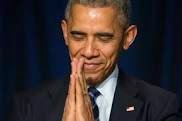
Somehow President Obama managed to offend nearly everyone Friday during his speech at the National Prayer Breakfast--the Chinese, Indians, Muslims, Jews, and especially Christians.

To agnostic me this suggested it was a good speech.

To offend or minimally agitate those who hold and are guided by powerful belief systems is a good thing to do every once in awhile to shake them up, especially at a time in world history when radical religious forces are roiling nations and regions.

It was a speech Obama impressively didn't paddle back from, even after the predictable chorus of outrage and criticism. These days even a few raised eyebrows will get pandering politicians to
"clarify" in the afternoon what they in the morning said about, say, the safety and efficacy of vaccinations.

But first, what is this Breakfast anyway?

It has been sponsored since 1953 by the Fellowship Foundation, otherwise known as "The Family," which is a secretive organization devoted to spreading Christian values and, through its many powerful congressional members, lobbies for legislation compatible with its mission. Many key members of Congress, mainly male conservative Republicans, are and have been active in The Family. Among many others, Jim DeMint, Sam Brownback, Strom Thurmond, Bill Nelson, and Mark (Appalachian Trail) Sanford.

In The Family: The Secret Fundamentalism at the Heart of American Power, Jeff Sharlet described his experiences working for them as an intern. He provides evidence that The Family "fetishizes" power by comparing Jesus to "Lenin, Ho Chi Minh, and Bin Laden." Not that The Family or Jesus holds beliefs similar to these dictators but rather The Family takes note of and admires the ways in which they exercised power. Guided by these lessons in wielding authority, The Family also engages in below-the-radar international diplomacy, especially in the Middle East, that skirts what is permitted by law for religious-based, tax-exempt organizations.

And the Fellowship attempts to have its own version of influence on American society. They have been remarkable effective and powerful. As an example of their ability to mobilize support, since 1953 every President from Eisenhower to Obama has addressed the group at its annual Breakfast.

It was before this group last week that Obama intentionally stepped into the weeds.

His basic theme was to draw attention to how dangerous it is to use faith to justify violence. From his detractors' perspective, so far so good if he is talking exclusively about Islam. But his caution was more wide reaching than that. There's the rub. He not only indicted Muslim extremists but noted that people also "committed terrible deeds in the name of Christ." Particularly during the Crusades.

As might be imagined, that brought down a firestorm of criticism. The firebrand fringe was the first to react. Michelle Malkin, an ultra-conservative columnist said it is historically outrageous to compare ISIS with Christian Crusaders. On Twitter she wrote, "ISIS chops off heads, incinerates hostages, kills gays, enslaves girls. Obama: Blame the Crusades." Not a word about what Christian crusaders perpetrated with the sword in the name of Christ.

According to the New York Times, semi-credible responses came from commentators who actually know a little about history--they defended the Crusades, noting that they were launched as a response to earlier Muslim advances across Europe. On the other hand, the best informed historians who study this era reject that view and offer evidence that the Crusades were motivated by attempts to reclaim sacred territory (Jerusalem) not Muslim dominated lands that resulted from incursions more than 400 year earlier.

As another example the President spoke about religious strife in India. In his words, though he called India "an incredibly beautiful country," irrelevant to his larger point, he also noted that it is "a place where, in past years, religious faiths of all types have, on occasion, been targeted by other people of faith, simply due to their heritage and their beliefs--acts of intolerance that would have shocked Gandhi."

In spite of Obama noting this occurred in past years and only on occasion (some might say he was being kind considering the enmity and violence, some of it religiously-based, between millions of Indian Hindus and Muslims) Indian leaders reacted in unison and outrage. For example, the Finance Minster said that India "has a huge cultural history of tolerance. Any aberration doesn't alter history."

Obama committed another alleged faux pas at the Breakfast when he shook hands with the Dalai Lama and in his remarks noted how he is a "powerful example of what it means to practice compassion," one "who inspires us to speak up for the freedom and dignity of all human beings.

A high-ranking Chinese spokesman reacted with public fury, saying, "We oppose any country using the issue of Tibet to interfere in Chins'a internal affairs."

It might have been politically wiser for Obama to have taken a pass on so publicly acknowledging the Dalai Lama, but he did choose not to point out that Tibet is not a Chinese internal affair but rather an example of Chinese imperialism, their having conquered and occupied Tibet since 1950, including forcing the Dalai Lama into exile.

Again, instead of walking his comments back later in the day, Obama doubled-down, having a senior aide reiterate that he intended "to be provocative," wanting to connect how the brutality of ISIS is part of a sweep of global history that frequently calls forth "a sinful tendency that can pervert and distort our faith."

Our faith? Which one might that be?

That aside, one final question--

Ours is a free country, a secular country that protects our freedom to believe or not to believe, and, if religious, to worship as we choose. Since we are not a Christian nation, why then do our Presidents choose to attend this so-called National [Christian] Prayer Breakfast?

My recommendation--stay home and let former senator, Family member Jim De Mint, president of the Heritage Foundation run things.


Labels: , , , , , , , , , , , ,

Thursday, April 03, 2014

April 3, 2014--Very Foreign Policy

Barack Obama came into office offering the hope that he would work effectively to reset America's tattered international relations

After nearly a decade of failed preemptive wars and empty preened for having "won" the Cold War, it was time, he intoned, for a fundamental change of direction.

It seemed as if Obama understood the issues both from study and having spent formative years in the less-developed world. His very being offered the promise of new approaches--less Western, less chauvinistic, more nuanced.

During the 2008 campaign he made a powerful speech in Berlin that outlined his global vision and called for dramatic new approaches in our relations with allies, adversaries, and the uncommitted. Then, early in his presidency, in Cairo he outlined a new agenda for America as he saw us interfacing with Islamic nations and aspiring peoples. His very words, it was thought, would spark change.

There was so much hope unleashed that the Nobel Prize Committee awarded the Peace Prize to Obama preemptively. In anticipation of all that he would for certain accomplish.

But by now almost all of this early promise has been unfulfilled.

Where in the world, after nearly six years, have we seen any of this promise realized?

In the Middle East? Just yesterday Mahmoud Abbas effectively scuttled any possibility for improvement in relations between Israel and the Palestinians. In a funk, John Kerry cancelled a meeting with him and flew home. Mission not accomplished.

Russia moved into Crimea and threatens the rest of Ukraine. The famous reset button is long forgotten. Mentioned now only for the purpose of mockery. Relations are so frayed between Barack Obama and Vladimir Putin that they can barely be in the same room together.

What to make of Syria? A country, an ancient civilization destroyed while we couldn't can't figure out how to be influential much less directly helpful. Obama drew red lines and than ignored them.

And what about Egypt? We were complicit in the overthrow of Hosni Mubarak and now, after a reasonably democratic election that saw the Muslim Brotherhood brought to power, after they were deposed by the generals, we see in place an even more oppressive regime than Mubarak's. It is also impervious to U.S. influence.

Then there is Saudi Arabia. Whatever one thinks about their leadership (very little), for 70 years we have had a mutually beneficial relationship. We buy their oil and sell them arms to defend themselves from and buy-off Islamists living and plotting in their midst. Because of our feckless policy with Syria and the Saudis' perception that by showing uncertainty and weakness Iran will soon have nuclear weapons, they have not just distanced themselves from us but are actively thinking about developing nuclear weapons of their own. It may be a hold-one's-nose relationship, but it has been useful to us and our European and Asian allies and, out of self-interest, needs to be retained and strengthened. Does anyone anymore think Obama is capable of this?

Where else?

Thanks to Obama's anti-terrorist polices, including the overuse of drones and grossly intrusive N.S.A. surveillance, even formerly friendly foreign leaders such as Angela Merkel are estranged. Also, Delima Rouseff, the president of Brazil, will not longer talk civilly with Obama thanks to our listening in on her private communications. Was any of this spying necessary? Are we safer for it? It is difficult to imagine anyone believes we are.

The Japanese have less and less use for us; and the Chinese, resenting Obama's "tilt" to Asia, if they didn't hold so much of our debt, would distance themselves further from us than at present. They have not been helpful in containing the North Korean nuclear threat and equally uninterested in weighing in about nuclear proliferation in Iran. The want the oil. And, frankly, our T-Bills.

Turkey, once held up as the ideal moderate Islamic nation, is unraveling and we have totally lost influence there. And forget Sudan, Pakistan, Yemen, Afghanistan, or the Central African Republic.

I could go on.

Making this list late last night got me good and depressed. What, happened, I wondered, to all that initial promise now so dissipated?

One could say that sometimes out of nationalistic chaos a new, preferable order will emerge. What we are seeing are the final gasps of a failed colonial paradigm. The remnants of 18th century empires; the redrawing of the redrawn borders at the end the First World War; and yes, America's economic empire. All are in their death throes. And death throes are always painful and difficult.

On the other hand, I thought, might there be some important cases where the Obama foreign policy is actually working?

What about India, I asked myself. I haven't heard much from there recently except occasional nuclear saber rattling over border disputes with Pakistan. Weren't we substantially estranged from them during the Cold War? Wasn't India tilted toward the Soviets? Yes, but haven't we in recent years been able to establish a "special relationship" with them? Facilitated by that fact that both of us are leery of China? Actually, hasn't Barack Obama been adept at maintaining and filling in the details of what that special relationship could mean? Didn't he call our relationship with India the "defining partnership of the 21st century"?

Indeed he did, when he visited in 2010. So what have I been reading recently in the New York Times?

Sadly, more of the same.

As reported there, "Almost four years later, the United States and India have found themselves on opposite sides of the world's most important diplomatic issues," from Ukraine where India is siding with the Russians to disagreeing about U.S. military policy in Afghanistan.

A senior Indian diplomat summed matters up this way--"There is a feeling that no one in this administration is a champion of the India-U.S. relationship." That should not be. India is the second most populace nation and has a burgeoning economy. Having a sound relationship with them should be a national priority.

When looking for an explanation about how, in this instance, high hopes have been dashed, Jonah Blank, an analyst of the now nonpartisan RAND cooperation said--
In this administration there is a small group of people in the White House making all the decisions, so issues that are important but not urgent rarely get the attention they deserve.
This sounds sadly familiar. Many who have written about the inner workings of the Obama White House say the same thing--Obama has chosen to cut himself off from almost all outside influence and depends upon a very few ultra-trusted advisors who go back to his Chicago days.

He famously said after being elected, "Make no new friends in Washington." At that he has been remarkably successful

This may be a good approach to negotiating one's way though the political thicket in the Windy City but no way to run the world.

Labels: , , , , , , , , , , , , , ,

Monday, February 03, 2014

February 3, 2014--Ladies of Forest Trace: India

"Come over as soon as . . . you can. There's something . . . I need to talk to you about."

My mother, short of breath, sounded ominous. I thought, considering her age, was this the . . .

"Are you OK?" I asked, not really wanting to know the truth.

"Come."

"We'll be there in 35 minutes." I was already looking for the car keys and signally to Rona to get ready.

"Just you."

"Me? Alone?" That was unprecedented. Rona and I have always visited together.

"You. There's something . . ." She didn't or couldn't finish and hung up.

"I need to go to Forest Trace," I said to Rona who was hovering close, picking up my sense of concern.

"Give me a second to get my sweater."

"My Mom wants to see me."

"Just you?"

I shrugged.

"Of course, whatever she wants. But call me as soon as you get there. I can always have car service drive me and . . ."

"Just me," I said as I headed for the car, full of trepidation.

It's not as if this was unexpected. She is after all nearly 106 and though in remarkably good condition for someone her age--or even someone ten years younger--the time comes for everyone.

The drive south was harrowing. More so than usual. Everyone who lives here says I-95 is a death trap with cars darting across lanes as if in a Nascar race. So with death on my mind anyway, I shifted into the extreme right lane and got in line with the usual stream of cautious and traumatized senior citizen drivers. I thought, considering the circumstances, I'd better not get killed.

My mother wasn't at the front door when I arrived. As she always is. Arms out. Smiling. Like she wants to envelop you and all the world.

I rushed to the den, relieved when passing her bedroom not to see her curled in her bed in her last throes of  . . .

"Here I am," I said, breathless myself.

"That I can . . . see," she gasped.

"You have me worried. You never asked only me to come to see you. I was afraid that . . ." I trailed off not able to complete my thought.

"I need to talk . . . to you. You. I have something to say . . . to . . . you. My son." She squeezed out her words one at a time.

"I'm here for that or anything you need."

She sat silent for a moment, panting, then said, "India."

"India?"

"There."

"What about India, Mom? I'm all confused." I genuinely was.

"I want to talk with you about . . . India."

"I'm glad to hear you're all right enough to want to talk . . . But India? I thought . . . Honestly, I thought that . . ."

"I was . . . dying." She smiled up at me.

"You scared me half to death. I thought . . . But?"

"Half to death sounds . . . good to me. At my age . . ." She trailed off.

"You're 106, Mom, so when you called and said . . ."

"Not yet."

"Not yet what?"

"106."

"OK. You're 105-and-a-half. What difference does sixth months make?"

"At my age I'm allowed . . . to be . . . any age I want."

"At your age?" I couldn't restrain myself from feeling put upon. Relieved, yes; but in truth annoyed as well that she had gotten me here this way to talk about . . .

"What did you tell me . . . about India?"

"Here we go again with India."

"Indulge me a minute."

"Go on."

"Like I tried to say . . . before being interrupted," she was sounding better, "What did you tell me about India?"

"I can't remember. Please remind me."

"That you want to go . . . there."

"True. I casually mentioned it to you a few months ago. That, all things considered . . ."

"I'm trying now to consider all things."

"And?"

"And I have something I want . . . I need to say . . . to you."

"I'm listening." I moved closer and took her hand in mine. Though still not understanding why India or what I had said about it was on her mind.

"You should go."

"I just got here." I was totally puzzled.

"Not here. There."

"Which there are we talking about?"

"Where . . . you said you wanted to go. To India."

"I was just talking. We were just talking. Looking for things to talk about. I think I said that it's one place I haven't been that one day I might like to visit. I said might. Which is different than want."

"I know the difference. I'm not saying you need . . . to go; but if you want to, you should. Go."

"Since you brought me over this way, as if you had something very important to say or, because . . ."

"Again with the dying business. I told you that I'm not . . ."

"I'm relieved to know that. But, again, let's not worry about India. We don't need to. You for sure don't.  I mean, need to worry about India or anything. I'm OK, we're OK with the way we are living and how . . ."

"I am keeping you from . . . your dreams."

I was beginning to understand where this was going. What was concerning her.

"No you're not. We're living how we want to live."

"I don't believe you."

"How can you say that, Mom?"

"Because . . . I know you. I know Rona. You're . . . sacrificing for me." She squeezed my hand.

"How can I convince you we're not?"

"You can't."

"Can't what?"

"Convince me."

"I don't know what else to say." I really didn't.

She said, "Time zones," and peered at me as if that would explain everything. Now fully confused I looked back at her and shrugged.

"You say you want to always be in the same time zone."

"Oh, now I think I understand. That we want to live in the same time zone as you--from Maine to New York City to Delray Beach. I mean, in the same time zone as you. So if . . ."

"It's the if I want to talk with you about."

"The if? Just as I thought I was understanding you, you have me mixed up again."

"It's usually me . . . who's all mixed up. Now you. That's what I'm trying to say. About . . . being mixed up."

I thought it better to just listen.

"Old people get all mixed up." I nodded. "I'm all mixed up . . . and now you're mixed up." I continued to look at her, trying not to show concern about her being so seemingly mixed up.

"You're getting to be . . . an old man." All too true, I thought. "Which is my point." Now she was squeezing my hand with more strength that one had any right to expect from someone as old as she.

She saw tears beginning to well in my eyes. "I don't want you . . . to get any older waiting for me." I knew all too well what she meant by waiting.

"Go there . . . if you want. Forget about time zones. Live. Live . . .  your life. Don't worry about me. I am all right. And will be all right until . . ."

"It's hard, Mom. I understand what you're saying and I love you for it. And for many other things. But, yes. It does feel as if we're all waiting."

Now she too was teared up. Too old sentimentalists, I thought, tethered to each other for more than seven decades. Waiting. Maybe even wondering who would be first to . . .

"Live your life," she repeated.

"We are," I tried to assure her as well as myself. "We . . ."

"Just do."

Labels: , , , , , , , ,