Monday, December 21, 2020

December 21 2020--Ladies of Forest Trace: Kapos

A number of Behind readers have been asking if I've heard from the Ladies of Forest Trace--my very ancient mother (who was 107 the last time I wrote about her) and the "girls," a group of her friends, who lived together in Lauderhill, Florida, in Forest Trace, a residence for seniors.

When George Lindberg asked about them the other day, George who has followed them here for years and who knows their histories and should have known their fate, I realized something strange was happening--George, other friends, and readers have been asking if I've heard from people who are no longer here. No other way to put it--people who are deceased, who have died.

I asked George,"What's with this? You of course know that . . ."

He cut me off. "I know what you'e asking and what more can I say. I know the truth and what's realistically possible, but with all that's happening one could think that maybe, just . . ."

This time I tried to cut him off, but George pressed on, "That your mother and her friends would have figured out a way to, you know, communicate with you and that you would then be able to pass along what they've been thinking and where they see us headed. On the other hand," he continued, "they may have decided to ignore the mess we've made of the world they left us. Who could blame them if they're looking for distractions. Like the rest of us. But if there is any way to reach out to us, mother Zwerling is the one I'd bet on to figure out a way to do so."

"What a wonderful fantasy," I said, "I would love to hear from her."

And then, shortly thereafter, wouldn't you know it, I began having a series of vivid dreams in which my mother and the Ladies were featured. 

When I told George, he didn't seem surprised.

"Don't let them tell you how wonderful it is where I am now," my dream mother said, sounding very much herself, "You would think they could at least serve a good piece of fish. But it always comes out dry and tasteless."

I leaned in, wanting to remember every word.

"Can you believe it," my mother said, "The world is coming apart at the seams and I'm talking about fish!"

"It's all right," I said, "Just hearing your voice is wonderful enough. And so . . ."

No, no, darling. I know you want to know about them. Him. What we think."

"Well, yes, but I don't want to aggravate you."

"What else do I have to do? Aggravation here is an activity. Like shuffleboard, Mah Jong, and bypasses."

She whispered, "We'll talk later. I don't want to upset the younger girls. They get cranky if they miss their beauty sleep. So I'll wait until they go to bed and come back. At 7:30. Then we'll have time to talk. As you would say, heart-to-heart. Or do I mean, head-to-head? As I told you last time I'm beginning to forget things."

I could sense her frustration. She had always been a perfectionist. Holding herself to the highest, most impossible standards. The rest of us as well.

At the stroke of 7:30 I sensed her presence.

"Did I wake you?" she asked softly.

"No," I said in jest, "It's still a half hour to my 8 o'clock bedtime."

Ignoring that, she said, as if out of the blue, "So, do you know about Kapos?"

"I do, but what about them? What do Kapos have to do with him? You promised you would tell me what you and the Ladies think."

"Tell me first what you know about them."

"Him and his people? His enablers?"

"That's a good way to talk about them. But I mean his Kapos. Tell me what you  know about them."

To talk about them was not something I relished. We lost so many relatives in the camps. This would take us well beyond aggravation.

"You can tell me. I'm still your mother and your can share anything."

I knew that to be true and so I said--

"During the Holocaust, there were Jews who were called Kapos. They were chosen by the gestapo guards to help them run the camps. Including murdering their landsmen, other Jews, in the gas chambers and ovens. They were the lowest of the low. Animals."

"And for this," my mother said, "the Nazis gave them more food to eat. They should only perish."

"Most of them did. Most of the Kapos also were exterminated. But, mom, I am still reluctant to think about him as a Nazi or a Kapo. As a despicable authoritarian, yes; unfeeling, yes; corrupt, yes; dangerous, yes. But not like an SS Nazi or a Kapo. It hasn't, and I believe it will not, come to that. I think he will begin to fade from the scene after Biden is sworn in. But," I said, "here I am telling you what I think while I'm really interested in hearing about what's on your mind. The Ladies too."

"What we see to be the worst are those you call enablers and what we call collaborators. They are the most dangerous. Without them collaborating he never would have gotten this far. We do think he has harmed our democracy but it still survives and will outlast him. About his Kapos, though, we're not so sure. That's what has us worried."

"I agree."

"How many billions voted for him?"

"Seventy-four million is bad enough. Thank God it was only millions. But too many. Especially if you're concerned about his supporters and what they might be up to."

"Now you see why the girls are always sleeping. Or trying to."

"And you?"

"Like a rock, knock wood. I'm happy to be at eternal rest. Which reminds me, it's past my bedtime. I listen to music, operas, when I'm sleeping. In spite of what is happening music that beautiful reminds me things will get better.


Labels: , , , ,

Monday, June 11, 2018

June 11, 2018--Ladies of Forest Trace: President Grump

The phone rang as we were in the midst of preparing dinner. 

"Who would call us at this time?" I asked. "Anyone who knows us knows we have dinner about this time."

"Maybe it's a robocall," Rona said. "Check the caller ID."

I did and said, "It's from an unfamiliar area code--123."

"Pick it up. Maybe an actual person is placing the call. Not a computer. We've had an increase in the number we've been receiving. Maybe you can get them to take us off their caller list."

"Forget that," I mumbled. I was just about ready to add the spice mix to the vegetarian chili that was simmering on the stove. 

Rona said, "I thought no area codes are allowed to start with a 1."

"With telemarketing and hacking," I said, "I assume anything goes. So maybe I shouldn't answer it. We don't want to get drawn into anything that will take over our computer or phone."

"Now you have me curious," Rona said, "I wouldn't worry too much about that. I'll add the spices. You answer the phone. Let's see what this is."

"You would think I have all day." On the phone it was a woman's voice that sounded vaguely familiar."

"Who is this?" I asked tentatively.

"Have I changed that much in three years?"

"Who is it?" Rona mouthed.

Shrugging, I shook my head.

"Well, in fact I do have all day," the caller chuckled.

"Tell me what this is about. We're in the middle of preparing dinner. Chili." I was poised to hit the phone's Off button.

"How can I be at rest while that Grump is making himself a king?"

"Is this . . . ?" I began to tremble.

"Who else calls you when you're hiding in Maine?"

"We're not hiding . . . " I couldn't catch my breath but finally said, "Mom?"

"This is not the time to be hiding away. It wasn't easy, but if I could get permission to call you between now and November the least you can do is put down your potholder."

"Is it really . . .?"

"The girls and the people who run this place are very concerned with what is happening."

"In Maine?" I didn't know what to say. My heart was thumping and I thought I was about to pass out or have a stroke. 

I collapsed in a chair and Rona rushed over to see if I needed help. I signaled that I was OK. Just overwhelmed with emotion.

I mouthed, "I think it's my mother."

"How can that be?" Rona said so loud that my mother or whoever was on the phone could hear her.

"Tell my darling I love her and not to worry about me. They take very good care of us here. Even better than Forest Trace. Especially the food. Last night we had flanken with horseradish. It was delicious, I could chew it, and best of all it didn't give me gas."

Rona reached for the phone but I pulled it away. So she ran into the living room and snatched the other one from its cradle.

"Mom?"

"It's so good to hear your voice. I miss you every day."

"I think about you all the time. What an inspiration you have been and continue to be. So now you're here to . . . ?"

"Help with the election. We don't have newspapers or cable so I can't listen to Wolf or read Maureen Shroud. It's been difficult to keep up with the news. But we do know who was elected and can't believe what his people are doing to our  country. The same country that rescued so many of my family who fled the pogroms before the Nazis took over. Today, Grump would want to arrest us and send us back to Auschwitz."

"It isn't that bad," I said, and then after a pause added, "Yet."

"That's what they said in Germany. Things are bad but we will be safe. All we have to do is not make trouble. We're Germans, yes Jews, but we have always lived side-by-side with gentiles and they won't allow the worst to happen." She took a deep breath and said, "And then the worst happened. More than the worst."

"And so?"

"So, we have to make trouble. That's why I got permission to call. To make sure you and your friends--not just your Jewish friends--make trouble."

"Which means?"

"Working every day to make sure good people get elected. If he wins in November I fear for the future. It will say the American people agree with what he has been doing. What a message that will be to the world. And how it would encourage him to continue doing all the things he is doing. What will this mean to young people? I was a teacher and a mother all my life. My heart breaks when I think about what the future will be like for young people. They will lose hope. For the young, that would be the worst thing. Not to look forward to the future."

"That would be a tragedy," I agreed, "But young people are activated and it seems are eager to vote in November."

"They didn't vote two years ago. Not enough of them. They wanted Burning Sanders and when they couldn't have him they didn't vote. And what about women? I remember when we couldn't vote. I was 12 years old when they passed the Amendment. My sisters were suffragettes. They marched and marched and marched. In the heat and the rain and the snow. But now too many women didn't vote for the first woman running for president. Hillary. Not my favorite but better than him, no?"

"Much better," Rona said, "Especially as we see what he is doing. At least with her things wouldn't be this bad. But more than 50 percent of white women voted for Trump. So it was white women and young people more than anyone else who helped elect him. But we are organizing and demonstrating. Just last week we did well in primary voting in California."

"I hadn't heard about that," my mother said, "That is good news but unless Democrats won by big numbers it may not be good enough. And when I think about the demonstrations I am not impressed. How long has he been in office?"

"About a year and a half."

"And what did you have? Two marches? One right after he was sworn in, the Pussy Cat march (I'm old fashioned and hated the name), but it still was good and then there was the one organized by the Florida children after 17 of their friends were killed. Also very good. But I didn't make all this effort to be able to talk with you to pretend to feel good about two marches."

"What would have made you feel good?" I asked.

"A march every week or at least every month. That would be at least 18 marches already. I know the news people would stop talking about it but if it went on and on they would have to pay attention and it could make a difference. It would keep the drum drumming  It would also show that people, including young people, care about the future of America and the world. Their country, their world. Not mine and too soon not yours.

"What do you mean 'too soon'"? I asked, fearing she knew something I didn't.

"Time. Time is marching even if Americans aren't. Time doesn't need to do much or really anything to keep moving along. Time and tide. Look out your window up there and pay attention to the tide."

I glanced at Johns Bay and was about to ask about the tide since it ebbs and flows, first north and then it swings around to the south. I wasn't sure why this was significant to her. But before I could enquire, she told us she needed to pass the phone to one of the Forest Trace ladies who was waiting in line. She promised, until November, to try to call every few weeks. Maybe, she said, on her birthday, June 28th, when if she were still here she would be 110. Not, she said, that they make a big fuss there about birthdays. Or that 110, considering where she is now, is a big deal.

But before yielding the phone, she asked "Doesn't chili give you gas?"

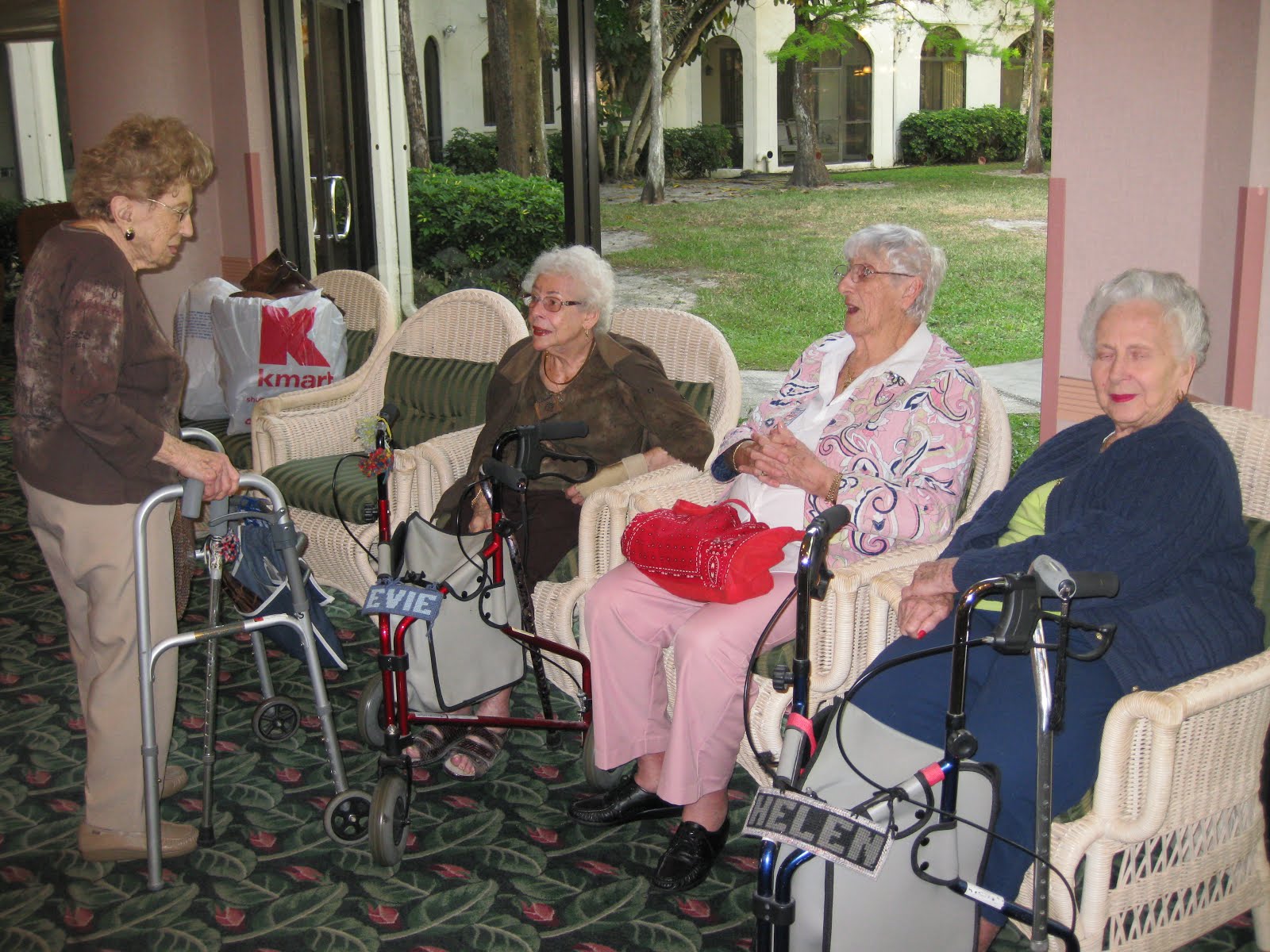
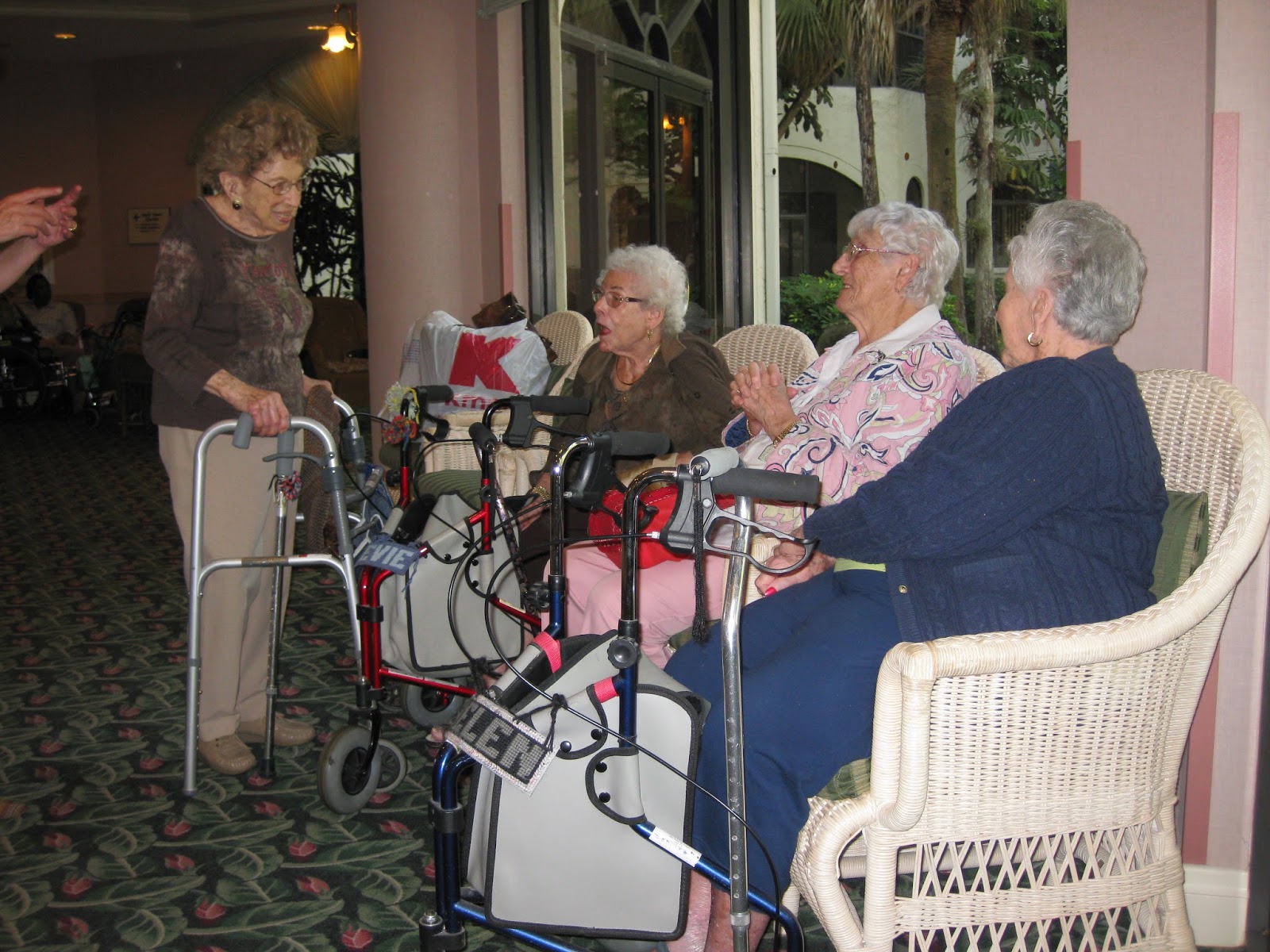
The Ladies of Forest Trace (Mom Standing)

Labels: , , , , , , , , , , , ,

Friday, June 30, 2017

June 30, 3017--Lady of Forest Trace

Two days ago would have been my mother's 109th birthday. Tomorrow is the second anniversary of her death.

My emotions this week have been saturated with thoughts of her. And memories. Memories including  her days as an elementary school teacher. She was from that generation of great teachers, talented women for whom teaching was one of the few available professional paths. Those of us who were among their students were more than fortunate.

I know I am not objective, but she stood out even among her remarkable colleagues. Even today I am frequently asked by someone about my age who learns my unusual last name if I am, perhaps, related to Ray Zwerling. Ray Zwerling, who was their first grade teacher, they tell me, and who through her gifts and caring changed their lives.

Mine was affected as well. Daily. Even today.

And now, with her no longer here, in reflection and advancing age, I am reminded about one of her stories. How in her day, if a women became pregnant, she was required to reveal that to her principal (all men) and immediately go on maternity leave.

I have been rereading this week Howard Zinn's People's History of the United States, a progressive alternative to the rosy history we all were taught in public school. In the 13th chapter, "The Socialist Challenge," he turns attention to the limited role of women as late as the early 20th century. To illustrate, he quotes from a year 1900 list of "Rules for Female Teachers" posted by a school district in Massachusetts. A list my mother likely still largely found to be enforced when she began to teach in Brooklyn in the early 1930s--
1. Do not get married. [She married shortly after she began to teach.]
2. Do not leave town without permission of the school board.
3. Do not keep company with men. [I know she ignored this one!]
4. Be home between the hours of 8 P.M. and 6 A.M. [Ditto.]
5. Do not loiter downtown in ice cream stores. [Another rule I am certain she ignored--ice cream was one of her passions.]
6. Do not smoke. [She smoked Chesterfields.]
7. Do not get into a carriage with any man except your father or brother.
8. Do not dress in bright clothes. [She loved bright clothes.]
9. Do not dye your hair. [She did so in the late 1940s when my brother asked, as her hair began to turn gray, if she was "going to die soon."]
10. Do not wear any dress more than two inches above the ankle.
The constitutional amendment that gave women the right to vote was ratified in 1920 when she was 12 years old.

When I left the Ford Foundation, in my farewell comments, I said the reason I became an educator was so I could help all children have my mother for a teacher. If only that could be.

Mom at 102

Labels: , , , , , , , , , , ,

Monday, March 13, 2017

March 13, 2017--Ladies of Forest Trace: Not Resting

The Ladies are in a place of tranquility but they are not in repose.

I know this from my mother, who deserves to be at rest after more than 107 years of life. I discovered her state of agitation during a recent visit to Mt Lebanon Cemetery in Queens.

When I was a child we visited Mt. Lebanon regularly so that she could be with her parents and bring them news of the family and the world. We would sit together on the bench beside where her mother and father were and I would listen while she told them about Bertha's recovery from a stroke, Nina's trip to Israel, Eli's struggles with his creditors, Fanny's plans to move to Florida, news about Stalin, and how things were with my father.

About that, the state of her own marriage, she would whisper so I needed to lean close and strain to hear what she was reporting. Though I could not catch most of the words, I could tell from their tone and her trembling that things were not going well.

"He never . . . He always . . . ," she said and then tearfully would switch to Yiddish to protect me from being swept into her unhappiness. But from this and how she placed her arm around me and drew me close into the protective nest of her body, I knew her pain was real. And that to her I represented a sense of purpose. She was happy I was there with her, with the family.

More than sixty years later I again needed to be close to her and so, though I sat alone on that now crumbling bench, listening to the wind, I tried to pick up her emanations, the comfort she provided, and, on that chilly pre-spring afternoon, her still flickering warmth.


"The girls are so upset," she began. I could hear the pain in her voice.

"Tell me Mom."

"About him."

"Who?"

"Thump, Donald Thump."

I didn't correct her wonderful malaprops, which frequently revealed more than literal truth.

"You've been hearing about him?" I wasn't sure how information was acquired and shared by the Ladies now that they were no longer . . .

"All the terrible things he's doing. With immigrants--wasn't his own father an immigrant?--with minorities, with women, with health. And we are so afraid about Korea and Russia. Especially Russia. We know Russia. Two of the Ladies are from there and I was born in Poland, near the border. Russian Cossacks raided our village, Tulowice, when I was a little girl. My mother hid me and my sisters and brother in the root cellar below the floor of our log cabin. The evil things they did which I cannot tell you about."

"You can tell me, Mom. You can tell me anything."

"You're still young and I don't want to upset you. You should be enjoying life."

Only someone who lived to 107 would consider me to be young. It was this kind of affirmation that I loved and which I greedily still needed.

"You should have your rest," I said, reversing her lifelong admonition to me.

"As your father said, 'There's plenty of time for rest. Later, there's time for rest.'"

"Yes he always did say that. As I grow older I understand it more and more."

"Ruth, who marched so we could vote, the women, is so upset that a majority voted for him--I can't say his name--so many women that I am sure Wolf on TV is saying that if it wasn't for the women voting for him we would have Hillary. Not that she's such a bargain. But almost anything would be better. Even Mike Expense, the Vice President, who we all are hoping will become president. This person, Expense, who doesn't believe in women's health and is too religious for any of our tastes we are wishing for."

"I am hoping for the same thing. Maybe if there's an impeachment or . . ."

"We're both dreaming. The Republicans in Congress, who we know did not support him will keep him in office because he will sign anything they approve--health care, taxes, regulations, pollution and who knows what else."

"It's a long list."

"But, one of the girls, Rose reminds us things have been worse."

"How? He's been in office only two months, though it feels like years, so how can things already be worse?"

"She means in the past. When we and Negroes couldn't vote. They couldn't drink water here in Florida. They had their own colored fountains. We didn't have the Pill but we had world wars. We had Depression but didn't have Xanax for that." She paused to let me know she meant that to be funny. So I wouldn't worry more than I do about her mental capacities.

"And you are old enough to remember the gas chambers. We had family who survived Auschwitz. Cousin Malkie and her family who lived with Aunt Tanna and Uncle Eli when they escaped and came to Brooklyn. You heard those stories when you were seven years old. I tried to protect you from them but you insisted you wanted to know about the world. Even at its most evil. So I let you sit with us at the kitchen table while Malkie and her son, whose name I forgot but whose haunted look I will always remember, told us about the nightmare."

"I remember that. I also wanted to see the tattoos on their arms. I didn't want to be shielded from the worst that life could bring. But I know you felt otherwise and wanted me to have nothing but a happy childhood. One time you told me that was in part because of all the children who were forced to suffer. You wanted me to live for myself but also when I was old enough to try to do things that would make less fortunate children's lives better."

Recalling that I began softly to cry.

"I bring this up," she said, "because I want to remind you that Rose is right. Too many things were worse in the past. Not quite as much so for those who were blessed to be born here or came to America as hopeful immigrants and refugees. We survived and over time many things did get to be better."

"You always say this," I said, knowing I had come to Mt. Lebanon in large part to have her remind and reassure me about that.

"Of course, things here could get worse but worse than Pearl Harbor? Worse than the Cold War? The Depression? The lynchings? I could say more but I know you have to rush away."

"I have a little more time," I said, feeling a bit better, though not yet assured or optimistic, "So tell me whatever else is on your mind and making you and the Ladies so restless."

"This isn't enough?"

"But I thought you brought up the War and women to remind me not to get too overwrought with what is happening?"

"That's my attention. But, yes, there is something else that is very disturbing to us."

"Please tell me."

"You know your history better than we do so I'm sure you have examples."

"Of what?"

"About what I am going to tell you."

"Sorry."

"And it's not all his fault. Though he is the beneficiary of it."

"You're starting to lose me."

"The hate." I waited but she didn't continue.

"The hate?"

"I'll give you a for-instance. When they talk about health there is so much resentment, so much hate for poor and elderly people who will have it taken away from them. They talk as if it's about how much it costs the government but what we really hear is how much the Republicans--and it is them--feel it is people's fault that they are poor and need help. They say they are making the wrong choices about how they spend their money--as if they had so much. Did we hear this correctly--sometimes communications to where we are are not so good--that someone in Congress, Jascha Heifetz, said that if people had enough money to have a telephone . . ."

"Jason Chaffetz, from Utah."

"I don't have my hearing aids with me. But that's him. He said if they have money for those phones they could give them up and use the money to buy health insurance."

"I did hear that. He really did say that."

"In the meantime if so many millions lose insurance how many will die from that? Who was it who talked about death panels? This is like that. Worse."

"Congresswoman Michele Bachmann."

"Who was also running for president. But all this meanness and resentment about struggling people--about children and old people--is very sad and tells us what these Washington people really think. They are so full of anger and resentment and this makes it acceptable for him to say the ugly things he has for years been saying. About Obama, about women, about Negroes, about Mexicans. And what's really worse when he talks this way is that many of the people who support him, who are filled with fear and hate, want to hear this. They give him encouragement and permission to say the ugliest things. They cheer loudest when he does."

"There has been hate and fear at other times in our history, that's true. About the Irish and Italian and Jewish immigrants. And obviously black people. You experienced that when you were a young girl and woman. People are this way when there are hard economic times. And when . . ."

"I'm sorry to interrupt but whatever was or has been is no excuse."

"I agree."

"About that, by now, we should know better."

To that I had nothing to say.

"We're all gone now," my mother whispered, "There is no room left here for anyone else. All the places are filled. Everyone from the family is here. And the Ladies are scattered like leaves. Ruth to her daughter in New Jersey. It's so cold there. Ruth was always shivering. And Rose next to her beloved father also in Queens. In Mt. Hebron. Adele, poor thing, is by herself. She lost all her family in Russia and never married. Never had children or grandchildren. I love her so much. How she made such a good life for herself. The first woman to become a school principal in Brooklyn."

"She was remarkable," I said.

"I could talk all day, but I know it must be getting dark and they close the gates soon. And you don't like to drive after the sun is down. You were such a good driver," I noted the past tense, "When you would take me to the doctor or out for Chinese, I felt so secure. And now . . ." Her words trailed off. Her breathing slowed. I didn't want her to strain herself.

It was time for me to go. I was feeling better. If not about the state of the world about her and how loved and safe she still made me feel.

"And remember, as I always say, be sure to wear your sweater."

It was as if I could see her smiling.


Labels: , , , , , , , , , , , ,

Tuesday, November 08, 2016

November 8, 2016--Ladies of Forest Trace: Election Day

They are no longer with us.

All the Ladies of Forest Trace, my mother and her friends, have moved on. But if there is a way for them to watch from their undisclosed location, through the day today, and especially this evening, they will be tuned in to Anderson Cooper (who they all thought is "adorable") to watch the vote tallies, especially in Florida, because the outcome of the election may again come down to "Florida, Florida, Florida," and some of the Ladies feel they still have some expiating to perform considering it was they as well as many other ladies of South Florida who, in 2000, either mistakenly voted for the anti-Semite Pat Buchanan or hang enough chads on their paper ballots to give the election to George W. Bush.

The rest is history. Sad history.

I know that today, with the opportunity to vote for the first woman to have an excellent chance of becoming our president, that would have been a highlight of all of their very-long lifetimes. My mother would be the oldest of the Ladies--she would be half-a-year more than 108 today--but all of her friends would be old enough to remember vividly when the 19th Amendment to the Constitution was ratified, August 18, 1920, when my mother was 12 years old. In her day, she and other girls were very much women at 12, in my mother's case having been born in a log cabin in the Polish woodlands.

All of the Ladies were disappointed in 2008 not to have had Hillary Clinton as the nominee, having lost in a bitter primary struggle with Barack Obama, but to a person they all came around to feeling good about voting for him because of his progressive views, his ability to promulgate hope, and not incidentally because he was African American. And most lived long enough to enthusiastically vote for him again four years later.

But today is different, very different.

I know that my mother and most of her friends had some "issues" with Hillary. They may have liked many of Bill Clinton's governing priorities but they thought little about his suitability as a husband. Some of the Ladies had issues with their own long-departed husbands and from that they knew a cad when they saw one.

But sharing this with Hillary they understood the impulse they felt to endure, to put up with what most younger women today would not tolerate. But they all lived long enough to understand the behavior and compromises expected of their generation, Hillary's, and of much younger women, who they over time successfully struggled to feel good about.

They also saw Hillary's flaws in her various official roles as First Lady, senator, and secretary of state.  Most were alive for all of that and had the experience and enough accrued wisdom not to deceive themselves because of her gender or feminism. But they saw the same falabilities, or worse, among Hillary's contemporaries and colleagues. These Ladies were not about gilding lilies or for that matter anything. They may not have had the exact words to express this but they were individually and personally viable in the world of very realpolitik.

And so through the day today, one by one they would have stood in line bent over their walkers, declining the offered wheelchairs or help to shuffle to the head of the line.

They had waited more than 80 years for this.

They had stood on many lines over the many decades--at dockside in Bremen, Germany to board the ship that would transport them to America, on lines at Ellis Island, on lines to file citizenship papers, on other lines when food was scarce during the Depression or rationed during the War, on lines while waiting at their children's schools, on lines at heath clinics, on lines in some cases to secure applications for scarce jobs or to apply for subsidized housing, on lines too many to count that led them to pay respects at the caskets of too-many-to-count friends and family members.

So, I know they would have thought today--"This is one final line I want to stand on because I've been waiting all my life to stand on a line to a polling booth where I can vote to make a woman president of the United States."

Then, after lingering with the ballot on which Hilary Clinton's name appears, with tears and pride, they would cast that magical vote and head home to Forest Trace for a nap so they could stay awake late enough tonight to see Florida, Florida, Florida seal the victory for Hillary.


Labels: , , , , , , ,

Tuesday, June 28, 2016

June 28, 2016--Lady of Forest Trace: Mom at 108

Yes, I'm greedy.

Today would have been my mother's 108th birthday. She came up 362 days short, having died on July 1st last year. A great run, especially considering she was still pretty much her essential self well into her 107th year.

How amazing. What good fortune for her and these many of us who loved her and found inspiration in how she lived her extra-long life.

You would think that getting to my own advanced age and still having a mother to talk to and visit and be inspired by would have satisfied me. Or anyone.

But I hasn't.

I wish I could call her today and talk about Brexit and Hillary and Trump and Orlando. I wish I could be there to celebrate even if being there toward the end was more to sit with her and hold her hand as she lived out with dignity her final months and days.

A smile is all I really need. Not just today, but since I am certain I will have the same greedy feeling on every one of her future birthdays, for as long as I go through my own late-life dramas.


Labels: , ,

Friday, March 25, 2016

March 25, 2016--Ladies of Forest Trace: Posthumous Lunch With the Ladies

"We're only here for a few more days and though I know it will be difficult," Rona said, "maybe it would be good, even therapeutic to visit Forest Trace one last time and . . ."

"But with my mother . . . why would . . .  ?"

"Closure, I suppose. We've been in Florida now for almost three months--for the first time with your mother not here . . ."

"Dead. Not 'not here,' but dead because that is what she is. Avoiding saying it that way has not been helpful to me. It's gotten in the way of my mourning because I expect to get a phone call from her and even be able to pop over to see her. Her being 'not here' means she's only away. For the time being. Not gone. Not final. Not dead."

"I get your point, but I think the anti-euphemism business is not helpful. I know what she is but it doesn't feel necessary to say it over and over again. For me . . ."

"For you, fine. For me, I think I need to think in these terms. But I'll try not to obsess about it. I do need to do some more grieving. I've been stuffing my feelings of loss. When we head for New York this time no one will care when we leave or what route we take or be waiting for a call when we arrive safely."

"We're more on our own, that's true," Rona said, reaching out to hug me. When she did I burst into tears. "But we're fine, as fine as we can expect to be right now. And we will be better. These last three months in Florida have been helpful to thinking about what was and what will be."

"It would help if we didn't know so many people in such dire circumstances and . . ."

"That's always been true. We're fortunate to know so many people and that means we'll always have someone struggling with mortality."

"Put me on that list," I said, still tearful, "I'm struggling big time."

"Is there something you're not telling me? I mean do you have symptoms I should know about?"

"None other than a heavy heart."

"I have an idea," Rona said, sounding upbeat.

"I'm open for anything that would help lift me out of this."

"Why don't we call a few of your mother's friends. Some of the Ladies, and see if we can take them out to lunch."

"I like that idea. Maybe to that wonderful dim sum place, Toa Toa, where Mom, six months before she died had her last meal in a restaurant."

"She loved that lunch. We ordered all her favorites from wanton soup to soy sauce noodles."

"She ate everything. So slowly that they had to reheat the food four times and it took her two hours to finish."

"I'll remember that lunch forever."

"Six months later she was gone."

"No longer here," Rona smiled, holding on to me.

So a few days later we were able to arrange for three of the "girls," as my mother referred to them, to meet us at Toa Toa where we ordered up a storm, including a sampling of my mother's favorites.

We wanted to talk about her, and though they were happy to do that, it was clear they wanted to do so for only a limited time.

Bertha said to us, "We remember her with love. She was a remarkable person, but one special thing about her was her not wanting to dwell on unpleasant things. 'There are enough of them at our ages,' she used to so. 'In our lives, in the world. So let's try to look for positive things to talk about. To think about the future, not just the past. Things we can feel optimistic about.' That was her in a nutshell."

"This is not always easy for us," Fannie said, "We all come from Europe from a  time when things there were not good for people like us and then here with the Depression, World War II, and of course what Hitler did."

They all nodded. But perked up almost immediately when the first in a stream of steamed dumplings arrived.

"She wouldn't be happy about the election," Gussie said.

"I thought we were supposed to talk about more optimistic things," Fannie said, at 97 managing her chopsticks quite well.

"We'll get to that," Gussie said, asking for a knife and fork, "We'll get to that. But, like I said, she would not be happy about that Trump."

"Who is," Bertha said. "such a bully. Such a bigot. Who says such terrible things about women. He claims he has Jewish friends and loves Israel, but I have my doubts."

"Though some of the men where we live, the few men who are still with us, some of them like him and voted for him in the primary."

"Did they tell you their reasons?" Rona asked.

"He can get things done, they say."

"Just that?"

"Just that. And most of the men think he knows what to do with the Muslims and Mexicans. I mean, the terrorists and immigrants. They talk as if they're one and the same."

"Did they say what they think Trump will do?"

"No. Just that he's strong and will keep them safe and build that wall."

"To tell you the truth," Fannie said, "These men are lucky to wake up in the morning or even know who they are. They're that oyver-botled. You expect them to know any specifics about Trump or any of the other ones? They get lost going to the bathroom." The ladies smiled and nodded in agreement.

"I love these chive dumplings," Bertha said, "These were your mother's favorites. In the past, when she was better, when she had lunch here, when she got back to Forest Trace she would go down the list of what everyone ordered and gave an analysis of each of the dishes."

Remembering that, when she was fully herself, really until not so long ago, when she was already 105, I began to tear up.

"I'm sure I know what she would be thinking about Trump," I managed to say, "Among everything  else she would have been repelled by his crassness, his crudeness. She never uttered a four-letter word even when that would have been forgivable. She was very proper and held everyone including herself to very high behavior standards. She could be quite judgmental about those kind of things."

"Do you remember the 2008 election?" Fannie asked.

"I think I know what you are going to say," I said.

"How your mother worked so hard to help Obama win the nomination?" I nodded. "How she worked on the three of us and dozens and dozens of others at Forest Trace. Almost all women, many who were born before women could vote, how she worked on us one by one to convince us that Obama would make a better president than Hillary."

"And how at first we all resisted," Gussie added. "It took her awhile but slowly but surely she persuaded almost all of us to vote for Obama. Which we did. She helped 125 of the girls fill out absentee ballots and then in huge shopping bags took them to the board of elections."

"I do remember that," Rona said. "I was so proud of her. She was a feminist in her own way. Very much so. But she put that aside because she saw more potential in Obama."

"And she was thrilled,"I said, "when he not only won the nomination but was elected. Not that she overlooked his flaws as president. She could be very critical. Tough-minded but fair. She never let anyone off easy. I can tell you from personal experience that she had very high standards and it wasn't easy to meet them."

"We held ourselves responsible for Bush," Fannie said.

"How so?" Rona asked.

"Those chads. Remember how in 2000 George Bush won Florida because of those hanging chads in Broward and Palm Beach Counties? That's where we live and I am sure with our shaky hands we by mistake pushed the wrong chads and wound up voting for that Nazi, Pat Buchanan."

"He's just an anti-Semite, which is bad enough," Gussie said.

"Well, your mother wanted to make sure that never happened again. So she had us fill out those absentee ballots. With her checking everything, I'm sure none of us voted for John McCain and that awful Sarah."

"And Obama did win Florida, by a comfortable margin, and of course the election. Your mother was very proud of that."

"So, here's the big political question," I said. They put down their forks and chopsticks to make sure they heard me. "How would she be feeling this time about Hillary?"

For a moment no one said anything. "That would be complicated," Fannie said.

"I'm sure she'd vote for Hillary," Gussie was quick to add.

"But with mixed feelings," Fannie said. "Though there's no one else she would even consider voting for." The other girls looked quizzically at Fannie, who added, "She might have been well over 100, but she had all her marbles and she'd be like all those young women not yet voting for Hillary. The ones interested in Bernie. I think she would have felt that Hillary takes for granted the votes of women just because they and she are women. Solidarity. A word we used to use in the labor movement. You know I was a member of the ILGWU. The ladies' union. Garment workers."

"Say a little more," Rona said, "We can ask them to reheat the food."

"This is more important than shrimp dumplings. For your Mom that would not have been enough. Just being a woman. To her as you said that was important but not enough to vote for a president. As with Obama eight years ago, she was only interested in who she felt would make the best president. If that person happened to be a woman, so much the better."

"Or a black man,"Bertha added with a wide smile. "And I agree, only if it's so much the better."

"She would have understood all these young women," Fannie continued, "How they don't want to feel pressure or obligated  to thank their mothers' generation for what is now possible for young women. Though that's to a large extent true--all the opportunities--these girls, and they are girls to me, are entitled to stand on their own two feet and accomplish all they are capable of accomplishing. And not feel they have to be beholden to anyone."

"But I am also absolutely sure," Bertha said, "that she would have said that it's important not to forget the past and all the sacrifices women made to blaze a path for their daughters and granddaughters. That's only fair. And in the primary we just had and in November, if she had only still been with us, she would've voted for Hillary. And proudly."

Bertha nodding said, "Can you imagine what your mother might have accomplished if she had all the rights and opportunities these young women have?"

"She would have been a school superintendent," Gussie said. "Running all the schools. Not just a first grade teacher. And a good one."

"She wouldn't have had it any other way," Rona said, "Only if she earned it. No special treatment or sense of entitlement."

"I'll drink to that," all three of my Mom's friends said, clicking tea cups.

"Do you think they could bring us some more hot tea?" Bertha asked. "We Polish girls like our tea very hot."

Labels: , , , , , , , , , , , ,

Tuesday, December 15, 2015

December 15, 2015--Ladies of Forest Trace: Mt. Lebanon

We visited my mother on Sunday at Mt. Lebanon Cemetery. It was a little more than five months since her death. It was a beautiful, unseasonably warm day and she was at rest amid the graves of her parents, among her bother, sisters, and their spouses, and next to my father.

Being there reminded me of earlier times at Mt. Lebanon. In truth, often happy, secure times for me when I was a young child. I wanted nothing more than, in one way or another, to be with my family.

I thought to share again something I wrote a few years ago about her final resting place, the family plot in Mt. Lebanon Cemetery--

Shuttling between cemeteries is the way I spent much of my childhood.  One was Mount Hebron, my father’s family’s place of final rest; the other, my mother’s family plot at Mount Lebanon.  Just three miles apart, in the borough of Queens.  It felt like being pressed between the pincers of two grim parentheses.
My mother’s family, the Munyas, arrived in the America in about 1912 from a shtetl town in central Poland, Tulowice.  Her father, Laibusya Munya, was a paymaster in a forest.  This was a job for Jews—they were trusted with the money but not the physical labor of cutting down trees.  That was for the goyim.  Grandpa Laibusya went into Warsaw each week to pick up zloties and brought them back to the forest to pay the men who cut down the trees and schlepped the logs to the river.  With his wife, Frimet, my eventual grandmother, he lived in a log house with his six children, including my infant mother.  When the pogroms became more frequent and bloody, he began to make plans to leave.  As with so many before him, he went first on his own to the New World, established himself as a baker on the Lower Eastside, saved money by existing on rye bread, and then sent for the rest of the family.  They settled within a community of other Polish Jews, most of whom came from the same part of the Pale of Settlement.
They moved from apartment to apartment whenever the landlord raised the rent, but once they were all huddled safely in America, they found a more permanent place to live (a rent controlled third-floor walkup in Bensonhurst, Brooklyn), a store for groceries (Beckman’s, down the block), a butcher (Fleishman’s, next to Beckman’s), a fruit store (Willy’s, across the street), and of at least equal importance, they formed a burial society—a Landsmanshaftn, or a home town association.  There was no time to waste—as my grandfather would say in Yiddish, one never knew when having a plot would come in handy.  And through the years it turned out to be as he predicted--before I was of legal age more family members resided in Mt. Lebanon than Bensonhurst.
Even before finding suitable burial sites, the members of the Landsmanshaftn elected officers—a president, vice president, secretary, and especially a treasurer.  Especially, since the treasurer was responsible for what little money there was—money to pay the cemetery the annual maintenance fee and to write checks for the “perpetual care” for the ground around and on the graves.  Also, the treasurer, because of these fiduciary responsibilities, was the only one who was compensated.  At first five dollars a year.  And thus it was a coveted honor and contested fiercely, particularly as time went by and the annual stipend was raised to $25. Real money when a dollar was still a dollar.
The Tulowice Landsmanshaftn somehow managed to strike a good deal with Mt. Lebanon in spite of great demand-side pressure: Jews were arriving in New York in such numbers during the first two decades of the twentieth century, and dying at such a rate thanks in part to the unchecked influenza, that more and more dairy farms in Queens were being converted into cemeteries and plots were gobbled up as fast as pastures could be converted into graves. 
Mt. Lebanon was established in 1919.  Perfect timing for the Tulowicians who were able to get in on the ground floor during the year of the most virulent and deadly flu epidemic.  They were able to buy a reasonably contiguous cluster of thirty or so plots in a desirable, hilly, shady corner.  It came with a pine tree and a view of the new Interboro Parkway.  As evidence of how desirable a location, Richard Tucker, the famous cantor turned Metropolitan Opera star came to occupy a nearby plot of his own as did Nathan Handworker, founder of Nathan’s Famous in Coney Island.  So the family was in good company and assured of eternal upward mobility.
Exactly what they had come to America for. The streets may not have been paved with gold, but to forever be across from the “biggest” tenor and the hot dog king showed that they had “arrived.”
On the other hand, the Zwerlings, my father’s family, claimed they came to America from Austria, not from the downscale Pale in Poland (although there are in fact no extant papers to prove this assertion).  Full of pride they boasted they were from Vienna, spoke German, and arrived well before those Eastern European shtetal Jews showed up at Ellis Island with their cardboard suitcases.  In fact, unlike the Munyas, who had the good fortune to have had an Irish immigration officer convert Munya to Mooney, the Zwerling needed no such transmutation—the German-sounding “Zwerling” was fine just as it was.  Though hardly of the Our Crowd crowd, the Zwerlings prided themselves on the fact that they were born in America, owned their own house, and didn’t understand Yiddish, much less speak it.  So when it came preparation for dying, they had a different approach than the Malones. 
The cemetery they selected and in which they bought real estate (that is how they viewed it—as a real estate transaction), Mt. Hebron, was founded by assimilated German Jews in the late 1880s.  In contrast to the other Mount, there were no burial societies, none of the carving on the tombstones were in Hebrew--everything in Mt. Hebron was ostentatiously in English--the roads weaving among the graves were wider (Mt. Hebron families had cars), there was abundant parking, the above-ground mausoleums were more elaborate and spacious, and there were even well-tended restrooms.
However, though in all other ways the Zwerlings and Mooneys lived cultural worlds apart, they did share one thing in common—an absolute obsession with illness, dying, death, and above all their final arrangements.  And no one was more obsessed with final matters than my father. 
But first I need to say more about how my mother’s family devoted themselves to their sixteenth of an acre of American soil.  First, with a name like Mooney they had to convince the Mt. Lebanon authorities and that they were in fact Jews and thus eligible to be laid to rest in ground consecrated exclusively for people of the Old Testament.   With their Irish-sounding name they were suspected of being goyim and had to show not only their Ellis Island papers but also those they brought along with them from Poland that identified them as Munyas, and thus Jews.
After successfully making that case to the Mt. Lebanon council of rabbis and being allowed to erect a tombstone with the gentile name “Mooney” chiseled on it, they then needed to consider how to care for the plot itself.  There was the “Perpetual Care” option, but neither the family nor the Landsmanschaftn as yet had the hundred dollars necessary to arrange for it.  That would come later when Uncle Jac did well enough and could afford to underwrite the tending of all thirty plots.  Even then, because of their experiences with pogroms and subsequently the Holocaust, the Mooneys were suspicious of institutions, including cemeteries (after all they too were businesses) and thus were congenitally incapable of trusting them to provide care perpetually (enough of them by then knew English sufficiently to understand how long perpetual in truth was) much less trust the cemetery owners not to run off with the hundred dollars before the clock on perpetual ran out.
Thus, during the spring and summer growing season, we went to Mt. Lebanon every Sunday.  Not to visit Grandpa and Grandma Mooney, who at the time were the only ones in permanent residence, but to care for the gravesite itself.  As the youngest and most agile that meant I was designated to crawl around among the tombstones to pull weeds and cut grass with the pinking shears my Aunt Tanna always had in her pocketbook.
Sitting on the bench to supervise, her sister, my Aunt Fay, would watch with pride as I scampered from head- to foot-stone, kvelling, “Look at him, look at how little Steveala is clipping Papa’s grass and plucking Mama’s weeds.  He has such hands.  With those hands one day he could be a surgeon, be rich,  and make everyone proud.” 
At her older sister’s words praising my skills and predicting my promising future, my mother would swell with maternal satisfaction and say to me, “When I am buried here, Steven, with the family, I know you will come to take good care of me.  And you will tell me about your own wife and your own children and grandchildren.  And about your patients and their appendectomies. Just like I talk to Mamma and Poppa.” 
Though this was more than I wanted to contemplate, any aspect of it—I was already burdened at school with spelling and the six-times table--I nodded and continued to clip away. I moved among the grass and weeds as if born to the task, wielding the pinking shears, which I was told were the only scissors in the family with enough heft to cut through thistles.  So when I had completed my pulling, chopping and cutting with those slotted shears it looked as if the grass had been Marcelled.  As a result, the Malone wavy gravesite was reputed to be the envy of the two burial societies that owned adjacent plots.
In truth I loved this first adult responsibility.  And since none of us had the wherewithal to ever get to real mountains during the hot weather, going to Mt. Lebanon was our version of a trip to the country. 
While I scooted among the tombstones, my aunts would sit on the bench and talk to their Momma and Papa, telling them about what had happened during the week.  There was a lot to report since the family apartment was the site of a constant shuffle of relatives and friends from the Camps in Europe, distant New Jersey, and even the occasional refugee on the way to Palestine.  For the latter, Aunt Tanna would collect money for their passage or to help them buy a car or icebox.  All that news was duly recounted to my grandparents at rest nearby.  But since it was in Yiddish, I could gather little of what they reported.  My ears perked up, however, and my nearly non-existent Yiddish improved, when they whispered about “That Rifka. Not quite a relative but a distant cousin of a friend of my grandparents, Rifka was someone they referred to as a nafke, which even with my limited Yiddish I knew meant tramp.  I made a mental note that when I was old enough I would make an effort to meet that Rifka.
My father’s obsession with his family’s cemetery, however, was of quite a different sort. 
Among the Zwerling, he was the only one preoccupied with the family plot.  To the others it was just that place in Queens where they might eventually have to be taken after marrying off the children and retiring to Florida.  But to him it represented a different order of reality.  Again, in the tradition of the Zwerling, it was more about real estate than visiting the departed and reporting to them life’s quotidian events. To him it was a matter of being sure there was a physical place for everyone entitled to be there.  And that the arrangement of those places, the individual gravesites, were appropriately hierarchical. 
Proximity to the family patriarch, Louis, his father, my grandfather, and mother-grandmother, Anne, was, as it should be, where the hierarchy began, with the sons and their wives and the sisters and their husbands arranged in descending tiers by birth-order and gender.  As the oldest, the first-born male of a first-born father, this meant my father would reside right below his father and mother, and so on down the Zwerling family genealogy.
An awareness of the shape of the Zwerling Family Plot would immediately see that the task my father set for himself was not so easily accomplished.  If they had been able to purchase a plot with hierarchy and primogeniture in mind, they would have bought something more in the shape of a pyramid.  But in the gridded-out reality of Mt Hebron, obtaining a family plot in this anthropological configuration was impossible.  So my father, the arranger, had to work with the rectangle that was bequeathed to him by his father, Grandfather Louis.
He spent endless hours with an outline of the full plot inscribed on a large sheet of oak tag, and within it, using an architect’s triangle and ruler, drew a series of perfectly scaled grave-shaped rectangles, in various combinations and permutations until he had it laid out as appropriately as he could, considering the restraints imposed on his grand design by the unyielding boundaries of the plot.  And when he had his plan worked out as much as possible in primogeniture order, he made a final rendering, using draftsman’s indelible ink; and at a series of family meetings with his brothers and sisters and their spouses, he got each to initial the rectangle assigned to them until all were duly filled in and signed off on.
And thus the responsibility his father bequeathed to him was done. . . . 
That is until his sister, my Aunt Madeline began to upset the scheme by marrying a series of husbands who in turn died shortly after each wedding, and, most critically, were buried, one by one by one, side-by-side in the Zwerling plot.  
By the time Husband Number Three was interred, my father began to worry.  As you by now would expect, he worried not so much about his carefully crafted plan, but, in frankness, more about his own eventual fate.  If Madeline mainatined her current pace, by the actuarial time my father would need the full services of Mt. Hebron, there would no longer be room remaining for him.
Thus, he convened an urgent Zwerling family gathering and laid out the issue squarely and frankly.  Madeline was understandably distraught, having lost her third husband, Morty, just the previous month. He had jumped off the roof of their apartment building—it was well known that she was not easy to live with. 
But in spite of Madeline’s grief, with at least the appearance of sympathy, my father was able to forge ahead and succeeded in mobilizing a majority of sibling and spouse votes to let Madeline know there were no more places at Mt. Hebron for subsequent husbands.  That is unless she was willing to relinquish her own plot.  Or, perhaps she would prefer to have my father arrange to move one or two of her husbands to a different part of the cemetery. 
Considering her options, Madeline agreed that though there would likely be more husbands (that was not open to family discussion) there would be no more places for additional deceased husbands.
That should have been the end of the story.  But again there is more.
As it turned out, there would be room for two more husbands because my father, when his time arrived, did not after all require his place in Mt. Hebron. Nor would my mother.
When a Jewish person dies, it is considered desirable that the person be buried as quickly as possible.  The dust-to-dust imperative is very strong indeed and thus the sooner the better.  As might be expected, to expedite the process, my father had arranged for a prepaid funeral. For him it was also an opportunity to shop for his own casket and arrange for the limousines and memorial service, including that there be nothing that involved a rabbi or any prayers in any language—he was an outspoken lifelong atheist.
His place next to his father’s side at Mt. Hebron awaited, but my mother had a different plan in mind—something more indelible than the ink he had used to make the oak tag diagram.
During their 60-year marriage, she had participated in dozens of discussions about Mt. Hebron.  Or, to put it more appropriately, my father’s plans for them at the Zwerling plot.  She had only hinted to my father how much she did not look forward to spending eternity with The Zwerlings.  It was an era when wives hinted at things that concerned them. She, in truth, dreaded the thought that she would not be with her parents and her real family.  She also hated the idea that she would have to spend her afterlife listening to the Zwerlings arguing, talking simultaneously at the top of their voices, literally forever. 
And so she directed the funeral director--“Let’s put him in Mt. Lebanon.” 
Fortunately there was still room.  Again, in the informal shtetl ways of the Tulowice Landsmanscahftn, without the existence of a notarized plan, she was able to get her remaining siblings to agree to find a space for him and one beside him for her. 
She did feel some guilty that this new arrangement placed him right next to his family rival, brother-in-law Harry.  They had been in a series of failed businesses together and had not only fought about money but about such things as how many spare light bulbs to have on hand—my father thought six were enough; Harry always believed in buying by the gross. She knew, as a result, that there would be family tension right there at Mt. Lebanon. About light bulbs and also who was at fault for driving customers away from their last deli. (She personally blamed my father.)
But she also knew she would be in the warm vicinity of Mamma and Papa. And, when her time came, being separated by my father from Harry, would bring her more peace than she was accustomed to in life. In any case, she assertedly thought--Who cares. Let them fight.


Labels: , , , , , ,