Tuesday, June 25, 2019

June 25, 2019--Biden's Sister Souljah Moment

As is his propensity, last week Joe Biden stepped in it.

But then again, perhaps he didn't. 

This flap, significantly taken out of context, was from something he said when Vice President, in a commencement address at Yale in 2015. Among many things he spoke about how when he was in the Senate he attempted to work directly with even other senators who were avowed segregationists and racists to advance important legislation.

Some of his current rivals, though acknowledging he is not himself a racist, claimed he minimally showed insensitivity to people of color who do not look back to that Jim Crow era with any sense of nostalgia or bipartisan clubbiness. Among others, sensing a political opportunity, Cory Booker called on Biden to apologize.

That really got under Biden's skin.

He fired back, "Apologize for what? He knows better. I don't have a racist bone in my body."

I suspect the old Joe would have tied himself up in knots of contrition and squeezed out a version of a self-righteous apology. But not this Joe. He doubled down. Tripled down. And in at least two regards this may have been the politically smart thing to do.

Voters this time around are looking for feistiness not wimpiness, confrontation not nuance. Even many liberals who pride themselves on being measured and understanding--never hot under the collar, no drama--more than anything want their candidate to be able to go toe-to-toe with Trump and take him down. After that, we can get back to seeking dialogue and reasonableness in the hope that maybe we can get a few legislative things done. Like fixing Obamacare and Social Security. Like doing something about our collapsing infrastructure. Like rebuilding our standing in the world.

For any of this to happen, assuming the Dems capture the White House and retain their majority in the House, it will be essential to figure out ways to work across the aisle with at least a half dozen Republicans. Biden by insisting on his ability to do this is boldly putting the spectrum of his political history out for review. Admittedly, some of it is on the compromised side.

Related, but more complicated, if he is to recapture some of the white, blue-collar vote that last time went overwhelmingly to Trump and more than anything else put him in the White House, he needs to demonstrate that though he is responsive to voters of color and progressive in other ways, he will not allow himself to become their agent. 

So this current flap could turn out to be Biden's Sister Souljah Moment. The original was in 1992 when Bill Clinton was the Democratic nominee. He was at risk of being perceived as pandering excessively to black voters as part of his strategy to win at least a few southern states, but in the process he risked alienating enough moderate white voters to lose to incumbent George H.W. Bush.

For those of you who do not recall what Clinton audaciously did, here is the best definition of a Sister Souljah Moment I have as yet come upon--

It is a critical moment in a campaign when a candidate takes what appears to be a bold stand against certain extremes in his or her own party and offers a calculated denunciation of that extreme position or special interest group. 

Such an act of repudiation is designed to signal to centrist voters that the politician is not beholden to traditional, and sometimes unpopular, interest groups associated with the party, although such a repudiation runs the risk of alienating some of the politician's allies and the party's base voters.

In 1992 popular African-American hip hop artist and social activist, Sister Souljah, provided Clinton with the opportunity to criticize her extreme views about race relations and thereby demonstrate he was not beholden to any special interest groups.

In a Washington Post interview Sister Souljah was quoted as saying (in response to a question regarding black-on-white violence during the 1992 Los Angeles riots):
Question: Even the people themselves who were perpetrating that violence, did they think that was wise? Was that a wise reasoned action?

Souljah: Yeah, it was wise. I mean, if black people kill black people every day, why not have a week and kill white people?... White people, this government and that mayor were well aware of the fact that black people were dying every day in Los Angeles under gang violence. So if you're a gang member and you would normally be killing somebody, why not kill a white person? Do you think that somebody thinks that white people are better, are above and beyond dying, when they would kill their own kind?

Speaking to Jesse Jackson's Rainbow Coalition in June 1992, Clinton responded both to that quotation and to something Souljah had said in the music video of her song "The Final Solution: Slavery's Back in Effect" ("If there are any good white people, I haven't met them").

Clinton said: "If you took the words 'white' and 'black,' and you reversed them, you might think the KKK's David Duke was giving that speech." 

This elicited a storm of hot debate but most dispassionate observers concluded that Clinton won the political battle and that helped him do better than expected, like it or not, among disaffiliated white voters.

I said "like it or not" because I do not like any of this. But politics is an ugly business and if Biden roughing up Booker will help him defeat Trump I will find a way until the day after Election Day 2020 to live with it.


Labels: , , , , , ,

Thursday, April 05, 2018

April 5, 2018--My Martin Luther King Story

Fifty yeas ago last night I was a junior faculty member at Queens College in New York City and one of my classes scheduled for that evening was an interdisciplinary seminar in literature and the arts for a carefully selected group of community leaders, mainly adults from the black ghetto of Jamaica, Queens. This meant that all 25 of the students in the class were African American.

We were well into a discussion about Jonathan Swift when a late-arriving student, Alan Jenkins, burst into the classroom.

Struggling to catch his breath, he finally gasped, "He's been shot," as if we knew who the "he" was. Sensing this, he added, "Martin. Martin Luther King. In Memphis."

"Is he . . . ?"

"I don't know. I was driving here and on the radio heard the report about the shooting. But not about his condition."

By then many of the students were quietly sobbing.  From their experience they knew the news would turn out to be devastating. It would not be that he was "just" shot. They had lived too long with violence in their lives to not immediately sense the truth.

A number of the students held hands and, kneeling, prayed. Others, clinging to each other, softly began to sing, including psalms and the civil rights anthem, "We Shall Overcome."

Grieving, supporting myself on the lectern, feeling estranged, denying what was occurring, I tried to convince myself that if I behaved "normally," got us back to Swift, reality itself would revert to where it had been only minutes before when we had talked together, dispassionately, about Gulliver.  

Then slowly it occurred to me I was the only white person in the room. I am not sure from where that feeling originated. It was not quite from feeling danger, but something close to that. Some primal recidivism close to tribalism, some self-protective reflex wired in my DNA. 

"Do you think you might drive me home?" Whispering was the most academically promising of my students, Nellie McKay.

By then Alan had come back from listening to the radio in his car. He trembled as he told us that it was over. King was dead. Shot down on the balcony of the Lorraine Motel in Memphis. The news, he said, was now turning to reports from inner cities across the country. Dozens were already in flames, stores and houses were set on fire by rampaging street gangs crazed with rage and fear.

"I'm afraid," Nellie said, "And about you . . . I don't think it's safe for you . . . to be driving home alone . . . the only . . . person in the area."

She meant white person. She asked me to drive her home not so much because of her fear but because she was concerned about me. White people out and about, well after dark, on the evening Martin Luther King was assassinated, would, she felt, not be safe. Being in the car with me would give me a margin of safety. She knew from inner-city uprisings during the previous few years that some white car and truck drivers had been ripped from their vehicles, beaten and even killed, as the riots spiraled out of control.

Opting to think less about myself I tried to concentrate on how I might provide safety for her--she commuted to the college by local buses. 

By then all the other students in ones and twos had departed. Nellie and I were the only ones remaining and we walked to the parking lot, clinging to each other.

In my car, a conspicuously yellow Opal, we headed south, needing to drive through segregated Jamaica, out toward where she lived in an integrated neighborhood near the bay.

Buildings were on fire all along the way. As I slowed to stop for a red light Nellie told me to ignore it, to keep moving, as it would be unsafe if we stopped.

To distract me from the news crackling on the radio she told me about her dreams--for her teenage son, it meat helping him get though his adolescence intact. By that she meant alive, out of the clutches and demands of violent street gangs. He was very bright, she said, but was already showing signs of succumbing to the allure of street life.

"I'm thinking of sending him to live with my mother, in Mississippi. Believe it or not, it's safer there. Even with Jim Crow."

"And what about you? You're a terrific student. Especially of literature. Are you thinking . . . ? We heard gunshots and saw a car a block ahead of us burst into flames and explode when the fire reached the gas tank.

"Turn that way," Nellie instructed me. "Quickly. Down there," she pointed to a one-way street where we would have to drive into oncoming traffic. "I know it's a one-way against us but it takes us to what I'm sure will be a safer route."

I followed her directions and at the end of one block we came to a cross street of abandoned houses and undeveloped lots where there were no signs of life or disorder. I began to breath more normally. 

"I am thinking about graduate school," Nellie said, resuming her story as if nothing unusual was happening, "Perhaps even working on a PhD. I know I'm a little old for that, but it's my dream. To be like you. A college professor." She smiled.

"We're getting close," she continued. "You are welcome to stay with me. But I know you live in Brooklyn and are married. Your wife will be worried about you."

I almost told her our marriage was on the rocks and that I would prefer to stay with her. But those emotions, if we survived, were perhaps for another day. 

At her house I got out to open her car door and, on the sidewalk, sobbing, we embraced for what felt like not enough time. As if we would not see each other again. That we were saying goodbye forever.

"We'll be all right," she said. "America will recover and be all right. You will be all right. And so will I."

With that she ran to the steps that led to her house and disappeared behind her aluminum front door.

I got home safely and the following week classes resumed. We all knew we were living in a changed America. Two months later Bobby Kennedy was assassinated. Swift and Jane Austen lost some of their importance.

Nellie's son did well, eventually becoming a social worker, and after Queens College, Nellie pursued her dream. She was admitted to graduate school at Harvard where she eventually earned her doctorate. After Harvard, Nellie began a distinguished career as a professor of English and Women's Studies at the University of Wisconsin.

I reencountered her when she approached the Ford Foundation, seeking a grant to support her work. I was happy to be able to assist. 

Nellie McKay, at only 76, died in 2006.

Labels: , , , , , , , , , , , ,

Friday, June 09, 2017

June 9, 2017--Freedom Summer

It's graduation season but though it's 2017 some of the official celebrations feel a bit like back to the future.

For example, at Harvard, Harvard, African American graduate students had their first separate ceremony with their own speaker.

Reading about this took me back to the past--my early years as an English instructor at Queens College, a selective unit of the City University University of New York. Thus, because of rampant inequalities and lingering segregation in New York's K-12 system, when I arrived in the early 60s, the student body was overwhelmingly white.

Two years later, I became deputy director of the SEEK Program, which was a pre-open admissions effort to foster the enrollment of minority students. It worked quite well. After a few years we had 500 or so mainly Black and Hispanic students and almost all of them excelled academically when, if needed, after some remedial work, we mainstreamed them into the "regular" course work and programs of the college.

Was everyone happy about this? Far from it. Some on the faculty were upset about what they perceived to be pressure to lower standards. In fact, in too many cases, mean-spirited faculty raised their expectations to help assure that SEEK students would fail. To contribute to a racially-motivated self-fulfilling prophesy. But, for the most part, rising to the occasion, many SEEK students did not feel at home on campus, sensing that they were not fully welcomed there or in the surrounding all-white neighborhood.

So, in the student cafeteria minority students arranged to sit at self-segregated tables. There were Black tables and Hispanic tables. I hated it, but understood.

In addition to understanding, there was an irony--Queens College was where civil rights worker Andrew Goodman was enrolled. With companions James Chaney and Michael Schwerner, a few years earlier, during the 1964 Freedom Summer, near Philadelphia, Mississippi, he and they were brutally murdered and buried in a shallow ditch.

During one English Department faculty meeting a memorial service for Andrew Goodman was underway right outside the building where we were gathered. They were remembering him while we argued about the way in which a new Medieval Literature course was to be described in the college catalog.

So, again, I understood the reasons for those separate tables.

But a separate graduation at Harvard? In 2017? Though I understand this as well it is not quite for the same reasons.

SEEK students at Queens College were not made to feel comfortable. Often quite the opposite. There was widespread resistance to their admission and attendance. Any number of faculty confronted me about how thanks to us the academic currency of the college was being debased. There were all-college faculty meetings at which some professors did not feel reluctant to speak out against the change in complexion of the Queens student body.

That was one reason there was a SEEK Program.

But at Harvard and other elite colleges where various forms of self-separation are being reintroduced, in a campus climate that includes an infusion of Black Lives Matter's agenda, minority students are saying, as one did recently to a New York Times reporter, "We have endured the constant questioning of our legitimacy and our capacity, and yet we are here."

Here and yet not fully here. And not during their separate graduation ceremony.

Also not at Emory and Henry College where this spring they held their first "Inclusion and Diversity Year-End Ceremony." The University of Delaware held a "lavender" separate graduation for lesbian, gay, bisexual, and transgender students; and at my old college, Columbia, where they held a "First-Generation Graduation" for students who were the first in their families to graduate from college.

I wonder if I would have been happy to attend. I suspect not. I was trying to "pass."

Passing no longer needs to be on too many agenda--and that's a good thing. But isn't that the point?

That with colleges and universities for at least four decades getting comfortable, seeing it advantageous to have a diverse student body, what we used to call campus "climate" has changed and there should thus be less not more need for separate tables much less graduations.

Harvard Black-Student Graduation Ceremony

Labels: , , , , , , , ,

Wednesday, June 24, 2015

June 24, 2105--Republican Demons

Republican politicians are struggling now with demons of their own arousing--the demons of white supremacy and racism.

Here's the problem--

Until 1963-64 when the Civil Rights and Voting Rights Acts were passed by Congress and signed into law by Lyndon Johnson, politically, the South was the "Solid South" with all offices from dog catcher to sheriff to governor and senator totally in the hands of Democrats. Republicans were seen as the party of Lincoln, the president who pressed the Civil War.

That all began to change as Richard Nixon, seeing an opportunity for the GOP, implemented his Southern Strategy, a blatant appeal to white southerners to switch their allegiance to Republicans who, in spite of the law, would not put pressure on them to integrate, act affirmatively in regard to college admissions and employment, or encourage black people to register or turn out to vote.

In fact, with GOP leadership, the opposite happened, including supporting elaborate schemes to suppress minority-voter turnout and pressing for cutbacks in federal programs that served many people of color--food stamps, Medicaid, public housing, welfare.

And so by the 1980s, schools in the South remained largely segregated, laws remained on the books that did not allow whites and blacks to marry, and with the exception of gerrymandered congressional districts that were carved out to create a few with black voter majorities, virtually all elected officials were white and Republican.

Now, the Republican electoral base, especially party activists who through their engagement during primary campaigns, that base which disproportionately determines who will be nominated for gubernatorial, congressional, and national office, is largely made up of aging white men.

And sad to say, since a large part of that base harbors anti-minority, even racist views, to attract their support it is necessary for candidates to pander to their prejudices.

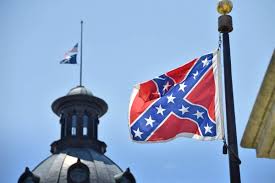
Even now, after the massacre in the Emanuel A.M.E. Church in Charleston, GOP aspirants to the presidency are speaking equivocally about what happened (Rick Perry called it an "accident") and dodging the controversy surrounding the Confederate flag that flies on the grounds of the state legislature.

With the notable exceptions of thus-far non-candidate Mitt Romney, who immediately called for it to be removed, and just yesterday South Carolina governor Nikki Haley's call for it to be taken down, all other Republican candidates have spoken out of both sides of their mouths.

For example, both Jeb Bush and his estranged mentee, Marco Rubio punted questions about the flag by saying they felt "confident that the state will do the right thing."

More troubling, more toxic, as a way to cozy up to racists and cater at the party's bigoted base, many of the current Republican candidates have accepted campaign contributions from white-supremasist organizations that the church shooter followed and to whose websites he contributed comments and manifestos.

One stands out--

The Council of Conservative Citizens, which, according to the New York Times, in the council's words, opposes "all efforts to mix the races" and calls for the dismantling of the "imperial judiciary" that  in 1954 required the desegregation of the nation's public schools.

The council as well has been a generous funder of many of the current GOP nomination seekers. Though as the result of the murders in Charleston, some of the candidates last weekend returned the money or contributed what they received to charity, one wonders what Rand Paul, Ted Cruz, Rick Santorum, Mike Huckabee, Scott Walker, and even Nikki Haley were thinking when they accepted council support.

It is actually clear what they were thinking and attempting to say by their tacit involvement with this hate group--
Wink, wink--you know we're with you. In spite of what we may have to say to appear tolerant, we stand with you, share your views, and won't cause you any pain. We'll make sure you can keep your guns, even of the same type that kid used in Charleston. And again, in spite of what we may have to say, we won't take away the flag you so passionately choose to salute.

Labels: , , , , , , , , , , ,