Monday, October 22, 2018

October 22, 2018--1.5 Degrees Centigrade

Though barely noticed, the climate last week was prominently in the news.


First, there was a landmark report from the United Nations’ scientific panel on climate change, "Global Warming of 1.5 Degrees Centigrade," paints a far more disturbing picture of the immediate consequences of climate change than previously thought and says that avoiding the damage requires transforming the world economy at a speed and scale that has “no documented historic precedent.”
The report describes a world of worsening food shortages and wildfires, and a mass die-off of coral reefs as soon as 2040--a period well within the lifetime of much of the world's population.
One good thing about getting to be my age--by then I should be long gone.
This report landed with a thud on Donald Trump's otherwise empty desk where it lay, undoubtedly unread. When he was asked about it, in effect, to his base, he said, "Who knows. We'll see."

Also pandering to his political base was the frontrunner in Brazil's upcoming presidential election, Jan Bolsonaro, a far right congressman who says that Brazil's environmental policy is "suffocating" the country's economy. Thus he plans to unfetter the country's agribusiness sector and allow it to accelerate the massive deforestation of the Amazon Rain Forest, often referred to as the "lungs of the Earth."

Stretching across two million square miles, most of it in Brazil, the forest acts as a giant filter for the carbon dioxide emissions that humankind as a whole generates.

Bolsonaro's proposed deregulatory policy is designed to create more farm and ranch land to capitalize on the increasing global demand for soy beans and beef. Some of this demand the result of Trump's regressive trade policies.

Thus, this presidential contest is by far the most consequential one underway anywhere in the world, including our midterms, as every inhabitant of Earth will be negatively affected.

Bolsonaro's opponent, Fernando Haddad of the Workers Party, is far behind in the polls. In the first round of voting last month, he received just 29 percent of the vote while Bolsonaro received 46 percent.

The Amazon is home to more native people than any other place on Earth and for decades millions of acres of land have been set aside for them. But Bolsonaro has a different plan. He has said that if elected "there won't be a square centimeter demarcated as an indigenous preserve . . . Where there is indigenous land there is wealth underneath."

None of this is good news for the planet.


Labels: , , , , , ,

Monday, October 31, 2016

October 31, 2016-- Midcoast: Cultural Profiling

It was the morning after the third debate and the diner was buzzing with political talk.

Buzzing so much that my new hearing aids were overwhelmed so I resumed an old habit--pretending to hear and understand and thus doing a lot of nodding and smiling. Most of it inappropriate and of a non sequitur sort.

Before I tuned out I picked up that, as usual at the diner, opinion was split pretty much down the middle with half the folks liking how Hillary turned to her own advantage Trump's jibe, "She's a nasty woman," while the other half agreed that she is in fact nasty.

Concentrating on my French toast, I enjoyed the sounds of passionate talk I could not fully make out. I thought I need to ask my audiologist to make an adjustment he had indicated was just for this kind of situation--being able to hear someone across the table in an otherwise noisy restaurant.

I was sitting by the window and to distract myself turned to enjoy the rush of falling leaves when a mud-splashed SUV pulled up and out of it tumbled two very large couples. It was the first truly chilly morning and I was surprised to see that one of the men was not only wearing shorts--not uncommon among Mainers who when the seasons change dress for the previous one as if the best way to get through the summer heat or, more commonly, the icy winter is to assert mind over matter--not only was he wearing shorts but a t-shirt and sandals without socks. Everything, including a full-brimmed hat, totally emblazoned with camouflage. I realized that the hunting season was to begin in just a few days and it looked as if he couldn't wait.

From their outfits and deportment it appeared that all three of his companions would be happily joining him while stalking moose in the North Woods.

Oh god, I noticed as they stepped in, the only empty table was pressed close to ours which meant they would be sitting right next to us.

They were Second Amendment people for sure as well as, I was certain, Trump supporters. Even if I couldn't hear every word that I was sure was about to be broadcast by them, after the debate, where I suspected Trump did himself some good, I wasn't into listening to snarky political boasting.

So I took up the pace, indicating to Rona that I was wanting to leave as soon as we finished our breakfast.

"Humans are the only species . . ." I heard from the hunter with the bare feet, ". . . who do so." I couldn't hear much more and thus had no context in which to fit this. I thought he was also sounding like a Fundamentalist and was talking about the uniqueness of human religion. I could take a pass on that too.

"I never thought of that," one of the women said. I assumed not his wife who I suspected from him had heard it all and then some.

"It's true," he said.

Then the other man puffed up in a red flannel shirt with Larry-King size black suspenders said something I thought about the "natural world." Creationists to boot, I thought.

By then things in the diner had settled down to a murmur and my new hearing aids took over and I was able to hear pretty much everything they said.

"It is fascinating to think about," the first hunter said, "How humans are the only animals--and we are animals," he said with a wink, "how in the animal kingdom we are the only species to produce more young than we need for survival."

"If true," his companion said, "Why is that significant?"

"It means that we pose a danger to the global ecosystem. We are the only animals who overpopulate. And I don't have to tell you of all people what the implications are."

Rona, who was listening in to another conversation, one about how Trump will surely lose after the Billy Bush hot-mike tape gets more widely aired, was stirring in her seat, having finished her food and signaling to me she was about to ask for the check.

"No hurry," I said, confusing her.

"I thought you were eager to leave," she whispered, glancing quickly at the hunters.

"No rush," I said, wanting to hear more about what else was unique to humans.

"What do you think," one of the neighboring women asked, noticing I was eavesdropping.

Caught in the act, I stammered, "Oh, well . . . not that much." I slipped back into my familiar non-sequitur mode.

"About what John said about the human species?"

"Oh, I suppose that's interesting. But, you know, I never thought about that. I mean, it could be that . . ."

She smiled. "John's a naturalist. A journalist. Writes a column that's picked up in lots of papers around the country. Show him your card, John."

I thought he must write for Hunters World or even Guns & Ammo.

He fished one out of his bulging wallet and handed it over. Below his name was "Environmental Storyteller."

"That's a new one to me," I said, beginning to feel upset with myself for what I had imagined him to be.

I looked again at his card and read so Rona could hear. By then she had tuned into our conversation--"Continual wanderer of the planet, observing in perpetual wonder."

As I read this the other man, "T.W," slid his card to me. It identified him as president of Silver Creek Media, through which he told me with a twinkle he published--pointing to how his work was described on the card--"words and stuff."

And with that, as quickly as they had arrived, the four of them stood up simultaneously and headed to their car.

So there Rona and I remained, thinking about how I had mischaracterized them. I said, confessing, "You know of course about racial profiling. How police and others periodically are accused of stopping African Americans because of their race or young Middle Eastern men who without evidence are thought to be potential terrorists."

"You didn't do that," Rona said, "They look more American--whatever that means--than you. So it wasn't racial."

"True," I said, "But I think I did something similarly upsetting--I culturally profiled them, as with racial profiling, on the basis of their appearance."

"You did in fact do that," Rona said.

"Which means I have more work to do on my consciousness."

"That's one of the things I love about being here," Rona said, "How often we get surprised like this. It's really a challenging place to live."

"Wouldn't want it any other way."


Labels: , , , , , , , , ,

Monday, October 27, 2014

October 27, 2014--Busy Bees

I caught a lot of grief about Friday's blog, "Just Talk."

Those I heard from felt I was being unfair to liberals and too "understanding" and "casual" about those beliefs of conservatives that are not only "outrageous" but "harmful." That I let off the hook too casually those who do not believe in evolution or climate change. In a world threatened by ebola, as an example, how could I sit so comfortably over coffee with someone resistant to the findings and "truth" of science? Perhaps, some speculated, I have become so besotted about life here in Midcoast Maine that I have lost perspective and my ability to think clearly.

There may be some truth to this but some of this criticism missed my bigger point. Or at least the point I thought I made clearly enough that was to me the bigger point--

That credibility accrues to those who are activated by their views (even views one rejects or disagrees with) and less to those who just talk about them. And my perception--perhaps over-generalized--is that it is we liberals who tend to talk while letting others act for us while conservatives are mobilized, looking to change things. And among the things they want to change, if we would listen and pay attention, are at times things in which we are in agreement. Even if the underlying reasoning is something about which we differ. I cited Willy's and Ben's active support for local recycling, not so much for environmental reasons but for literal cost-benefit ones. In this instance, we can stand on common ground about the behavior if not the motivation and ideology.

And so, as I ended the Friday piece--it's complicated.

Here is another example from Saturday night.

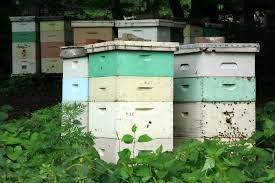
We were invited to a wonderful dinner and evening with good friends. Among the many things in which they are engaged is beekeeping.

This is a relatively new interest but they are doing it quite successfully in that this year, for the first time, they are gathering and using honey from their hive. It is producing enough (amazingly, I learned, it takes 50,000 individual pollen gatherings to produce just one teaspoon of honey) that for us and the other couple who was there, there was a ribbon-adorned jar to take home. Of course we couldn't wait and tasted some at the table--it is amazing!

I asked them how and why they got interested. "Well," he said, "you know about how there's a dangerous dying off of pollenating bees."

"I've been reading about that," I said. "Sounds serious. But how does that relate to your interest?"

"When I became aware of this I decided, in my own way, I wanted to do something about it. Not just to read and talk about it."

(See where this is going?)

"I guess all I do about the problem is read about it," I mumbled, as if to myself.

"We weren't satisfied just being aware of the problem. Mind you, we thus far have two hives and maybe 70,000 bees and we know that won't solve even a small part of the problem. But the way we look at it, every little bit helps."

"Indeed it does," I agreed, again, more from theory and concern than practice.

I don't know all that much about these friends' politics or ideologies. We haven't spent that much time talking about it. We have so many other things to discuss and enjoy together. But I sense he, at least, is a true political Independent. I know, for example, that he has voted for perhaps as many Republicans as Democrats for the presidency and Senate. Perhaps more. I guess that qualifies as Independent.

But when it comes to bees, though he blames big agribusiness for much of the problem (over spraying of the wrong insecticides), and this might be construed to be the progressive take, about other matters he feels quite friendly to many aspects of big business and would like to see more backing off from some of government's regulations.

So, again, it's complicated.

Labels: , , , , , , , , , , ,

Friday, August 01, 2014

August 1, 2014--Best of Behind: Midcoast--Cutting Back

This is from September 17, 2010. I thought about it because we are entering eggplant season here on the midcoast of Maine. 

“See what’s going on over there?” We were at Rose’s Farm Stand up near Thomaston and she was pointing at something across the road.

“I’m not following where you’re pointing,” I said, squinting into the sun. It was a perfect end-of-summer day. The air recently washed by a quick shower which produced such clarity that I wished I could paint or draw. It was not surprising why so many artists have been attracted to the coast of Maine.

“That tree,” Rose said still pointing, “The big maple. Look how wide around it is. I wouldn’t be surprised if it’s 200 years old.”

“Really?” Rona said. “I had no idea they got that old.”

“And then some,” Rose said.

“But I still don’t see what you’re getting at,” I said. And with that a massive limb came thundering to the ground.

“That’s what,” Rose said with a snarl.

“What’s going on over there?” Rona asked.

“That’s what I’m getting at,” Rose said. “That old bitch—forgive my French--who bought that house right next to it is having it cut down.”

“For what reason? It looks healthy enough to me.”

“See that field over there?” She pointed then at a plot of land adjacent to the house. “Well, there were three other big trees there. Must have been 150 years old, the two of them.”

“I don’t see any trees over there,” I said.

“My point exactly. There were two there and she had 'em cut down. Now she’s got a big old lawn but no trees. Must be doin' the same thing with the maple. ’For you know it, there won’t be any trees left ‘round here. Or anywhere for that matter.”

“I hope you’re wrong,” Rona said. “That would be very sad. It’s so beautiful here and the trees are a big part of that.”

“Well, if the storms don’t git ‘em people like her will. I don’t know what’s wrong with ‘em. And I know what you’re thinkin’, that the owner over there is new to the area and she wants to ‘improve’ things. Which is not the case. Her family’s been here for as long as that tree. And when I talk about people new to the area present company is excluded. I know you two well enough by this time to suspect that’d you’d never do a thing like that. Quite the opposite. I’ll bet by now you’ve joined every conservation group in the state.” She broke into a broad grin.

“Not exactly all,” Rona said, "but by this time next year you may be right.”

“Nothin’ wrong with that,” Rose said. “In fact, my Lewis and me, if we had the means, would do the very same thing.” 

I nodded. We had come to buy some eggplant and onions right out of her field for a vegetable lasagna we were planning for dinner. Rose’s eggplants are the best I’ve ever had.

“Speaking about ‘means,’” Rose said, “Guess how much she is payin’ to have that done. Removing the maple, I mean.” She paused for a beat then quickly continued, “You’ll never guess but I hear at least twenty-two hundred.”

“Wow,” Rona said, “But it is a big tree.”

“Which is my point—a tree like that deserves to live. If anything, she’s the one who should be removed!” She doubled over with laughter, coughing up cigarette smoke. “Gotta stop these before they kill me.” That made her laugh and cough even harder and I was concerned that she might pass out from choking and lack of oxygen.

“On the other hand,” Rose resumed after catching her breath, “I s’pose work is work and twenty-two hundred isn’t to be sneezed at.” With that, again from the smoke, she sneezed three quick times. “Not that that justifies what she’s doin’, but those tree guys can sure use the work and the money.” She paused, “And frankly so can we.” 

Rona was nodding compassionately. “My Lewis, he works construction. He’s an electrician and there’s not much these day for him to do. He’s lucky enough to be finishing a job now on a new house but his boss says there’s nothing waitin’ in the pipeline. So we’re strugglin’. Lot’s of folks can’t pay their taxes. Tomorrow’s tax day here. Real estate taxes are due then.”

I began to interrupt and Rona poked me as she knew I was going to say that we had paid ours early at Town Hall last week. To avoid the lines. I appreciated the poke as it for sure was what I awkwardly was about to say could rightly have been seen as insensitive. We are very fortunate indeed to feel as financially secure as we do.

“Like I was sayin’, lot’s of people, Lewis and me included, are having trouble keeping up with our payments. I know it’s going on all over but it doesn’t make it feel any better here. We’re thankful to have folks like you around who can afford to pay a premium for our corn and tomatoes. And of course our eggplants.” She winked at me.

“Well we . . .” I stammered.

“No need to be getting all guilty on my behalf,” Rose said reassuringly, “I meant that as a genuine thanks. I don’t know what we’d do if we didn’t have this.” Her gesture took in the entire little shop where she sold her remarkable veggies. “Probably have to live in our van.”

“I hope . . .” Rona this time stammered.

“I’m bein’ lit’ral with you. Things are that bad.” We both lowered our heads slightly and broke off eye contact. In spite of Rose’s dispensation we were feeling guilty about our relative secure situation.

“We’ve had to do a lot of cuttin’ back. As we sensed things getting’ bad, more than a year ago, we began to pull back. At first we had enough extra cash to do a few fun things. Like come home from work Fridays and get all spiffed up and go out for a nice dinner. But we cut that out more than a year ago.”

“That sounds . . .” I said without looking up.

“. . . about right,” Rose put a finish on my interrupted sentence. “That’s what we did and I’m sure glad we did. ‘Cause now we’d have no choice but to cut back on even more things. You know we both work hard—two, three jobs if we can fine ‘em.” We both raised our heads at the same time and took to nodding at Rose with as much respect and understanding as we could generate.

“Why not more than six months ago when money became even more scarce, we stopped eatin’ breakfast out on Sundays. We really enjoyed that but had no choice. It was either that or maybe lose the house. We’re playin' things that close to the margins.”

“That sounds . . . well, I mean, what you and Lewis are doing . . . if there is no choice, I mean . . .” Again I could not complete a coherent sentence.

“I ‘preciate what you’re sayin’. I know you folks are doing as well as can be expected in these times. I don’t have any bad feelings about that. I really don’t. You’d be the first to know if I did! I know you worked hard and all that. And you deserve what you got.”

“Thanks but we . . .” Rona was no better at finishing her thoughts than I.

“Look, we have to keep on goin'. In life I mean. With whatever it is that we have or don’t have. It’s not about that, I’m sure you’ll agree. The most important thing we have is life itself and we have to make the most of it, whatever else we’re lucky enough to have or what gets dealt us.”

“We try to think that way and live accordingly,” Rona said. I was still struggling with the image of Rose and Lewis having to live in their van.

“So maybe after all that bitch is doin' her part to make things work. Don’t get me wrong, what’s she’s doin' to her trees is a crime. Or at least it should be. But maybe if she is spendin' as much as I think on the job, and what with those other trees I told you about, well she is doing some good in the process.”

“Do you really . . ?”

“I’m trying to put the best spin on what’s happenin’ over there.” The chain saws had resumed their high-pitched whine and more huge limbs were plummeting to the ground. The massive tree was by then a forlorn shadow of its former majestic self, more like a tree for hanging people than shading them. 

“As a result maybe at least one less family will have to live in their car.” She sighed and we were left to contemplate our own fortunate reality and to figure out what to make of the larger picture she had sketched.

“So what can I do for you today?” Rose was again her old chipper self. “Did I hear vegetable lasagna? I love that. You want a couple of my eggplants? I could have misheard you what with them damn chainsaws and all.”


Labels: , , , , , , ,