Thursday, November 08, 2018

November 8, 2018--A Note To Some of My Liberal Friends

I have been hearing from a number of friends that they are disappointed with the results of the midterm election.

That though Democrats regained control of the House and all that that will allow, Stacey Abrams lost the governor's race in Georgia and in Florida not only did Andrew Gillum not win the governorship but also incumbent Democrat senator Bill Nelson failed to be reelected  But to many of my friends, equally disappointing, Beto O'Rourke in Texas failed to unseat Ted Cruz.

Certainly it would have been wonderful if they had come through and thus I share their disappointment. But it concerns me that as a result some friends are disappointed with the overall results.

"I'm spoiled," one friend said, "I'm greedy and want to win everything."

I get it but is the best way to think about the results? 

It would have been exhilarating if they had won, but electoral politics is not about generating exhilaration. It is about electing people who share our values, have the ability to set needed agendas, win, and then (the hard part) are skillful enough to carry them out.

When I heard about this unhappiness I attempted to push back, saying we have to keep our eyes on the prize. In this case the prize is not only diminishing Trump (this week's election has already begun to do that) but to thwart the worst of his plans and (even more important) reduce his 2020 reelection chances.

And now with Jeff Sessions fired and who knows what else Trump will do in a panic to save himself, Democrats controlling the House is even more of an imperative and very good news.

I argue to my friends that politics is the art of the possible, not the perfect, and to be effective one needs to be able to compromise, set longterm goals, be strategic-minded, persist, and accept the reality that almost everything we contribute to accomplishing not only takes too much time to achieve but, even when we do, will never be fully satisfying. It is often frustrating. It's the grinding nature of the process.

My late friend Flash put it this way. He used to say when we saw this tendency among the people with whom we were working (most were progressives), "Though understandable and based on good intentions, when seeking to bring about change it is imperative to avoid the tendency to be satisfied only with the perfect solution. Unfortunately, since we never can achieve that we run the risk of winding up frustrated and ultimately powerless. Feeling pure may make us feel good about ourselves," he would add, "but if we are seeking to make as much a positive difference as possible, being satisfied only with the ideal we run the danger of rendering ourselves ineffectual."

In some circumstances this could feel as if he was calling for compromising in advance (it can have elements of that) but I continue to think at its heart it is true.

Thus, with all the disappointments, Tuesday's election may turn out to be historic. 

Trump had us on the road to an American version of autocracy. If he (yes he) had maintained control of the House, one more essential check built into our constitutional system would have been blunted and an even more emboldened Trump would have felt empowered to chip away at an accelerated pace at the protections thankfully hardwired into our constitutional system.

That we voted successfully to resist this is the headline from Tuesday, not that Beto and the others lost. In fact, looked at it another way he and they might be thought of as actually having won. 

Frequently, in a process that takes years to culminate, blazing trails and coming close is not only essential--it is often the most difficult part--but also can include elements of exhilaration.

The implications and complexity of this are worth more thought. 

Labels: , , , , , , , , ,

Tuesday, March 13, 2018

March 13, 2018--Spatting With Friends

I'm spatting again with some of my liberal friends. 

This time about the potential meeting between Donald Trump and Kim Jong-un.

They are sharply critical of Trump for so impetuously agreeing to meet while I, though I too have my reservations, have been asking them what are the better alternatives--Not talking? Exchanging insults? ("Little Rocket Man," "Dotard") Saber rattling? All-out war where everyone agrees hundreds of thousands would die within minutes?

Most frequently, my friends, though they generally feel direct talks are ultimately a good idea, contend it is premature for Trump to agree to meet before traditional forms of negotiation and diplomacy prepare the way for a presidential meeting.

As one put it, "Countries such as North Korea, rogue countries seeking the imprimatur of legitimacy, see being invited to a face-to-face encounter in itself to be a major goal. Trump meeting with Kim would be a sign of welcoming him and North Korea into the company of credible nations. Kim craves a seat at that table. And so for Trump to trade it away, getting nothing substantial in return, is not the way to make a deal with the likes of Kim."

All good points, I concede but continue to ask what are the alternatives. My friends say, "None of the above."

So again I ask, "What should we do?"

My friends continue to say have Secretary of State Tillerson and what little staff he has work on what they would discuss when meeting, preparing the way for it, very much including what the two leaders will say and do when they finally get together. What agreements they can endorse and literally sign off on. Come up with agreements about step-by-step plans for the North that include ratcheting back their nuclear program while we agree to drawdown our military forces that are stationed in South Korea. 

And, of course, my friends say, to make sure before Kim and Trump meet that there will be verifiable stipulations regarding how the various drawdowns will be verified. To quote Ronald Regan when dealing with the Soviet Union, "Trust, but verify." In Russian, Doveryay, no proveryay.

"Sounds good," I say, "But the sad reality is that Trump does not have a diplomatic team in place or anyone for that matter in his administration who knows anything about East Asia much less Korea. We don't even have an ambassador to South Korea. And so, considering all of this and the reality of North Korea's nuclear weapons and ICBMs, what's the best way to proceed?"

At this point conversation begins to lose velocity with my friends and I at least agreeing that there are no precedents to draw upon and, considering the type of leaders they and we are afflicted with, maybe we have no choice but to try it Kim's and Trump's way--roll the dice and hope for the best. 

With that hope based precariously on the very fact of who are our leaders. One, in Kim, whose favorite American seems to be the preposterous Dennis Rodman while those most on our president's mind also come from the media and popular culture--"Alex" Baldwin and Chuck Todd. 

Before we move on, to underscore why I am attempting to cling to hope, I ask my friends why they believe with a Kim and a Trump traditional approaches, traditional forms of diplomacy have any chance of succeeding. Even if there were the usual Republican foreign policy folks serving in the Trump administration or, for that matter, if Hillary Clinton had been elected and with her there was the usual army of Democratic foreign policy experts, with Trump and Kim why would we expect any of the traditional approaches to foreign policy to work.

"Didn't we try that?" I ask, "Republicans as well as Democrats, when they or we were in power? What evidence of success can we point to from the approaches of the previous four presidents, who, over more than 25 years, tried various strategies, from cajoling and threatening to buying-off (bribing) the North Korean leadership?" 

Pressing further, I also ask, "What did George H.W. Bush, Bill Clinton, George W. Bush, or Barack Obama for that matter accomplish with regard to North Korea?" 

And concluding, I say, "During those two-plus decades the North Koreans became a major nuclear power. That's what got accomplished."

One more troubling thing--a friend, who I suspect represents a somewhat widespread feeling in progressive circles, acknowledged that a big part of him doesn't want this approach to work because he doesn't want anything positive to happen during Trump's presidency. Not to the economy and not in world affairs.

"So," I said, "If Kim and Trump roll the dice and that fails won't we then wind up going to nuclear war? If this is where we're already headed, maybe, just maybe . . ."


Labels: , , , , , , , , , , ,

Monday, January 30, 2017

January 30, 2017--Jack Again

"I know you think something terrible's going on with me because, you're right, I hate talking on the phone."

It was Jack calling again.

"I read what you wrote about our last conversation," he said, "which you summarized pretty well. You, of course, made yourself come off better than you I fact did when we spoke." I ignored that.

"So, what's it about this time?"

"Things with Trump are happening so fast that I can't wait to May to talk with you. Who knows, by then, we might be at war with Mexico."

"I know you mean this as a joke but it could really happen. He's on such a rampage."

"Well, you know, I can't stand Democrats--present company excepted--but I find myself interested in trying to think what you guys might do to become more competitive. I prefer winning when challenged and at the moment you and your kind are pathetic. Sunday morning, for example, on TV, while criticizing Trump's new immigration policy, like John Boehner, Chuck Schumer, your minority leader, cried his way though his comments. What a wuss."

"I really appreciate your concern about us," I said, attempting not to sound as sarcastic as I was feeling.

"So I watched some of the left-wing Sunday talk shows. Meet the Press, among others, to see what they were saying. Michael Steele was on. He used to be the head of the Republican National Committee and is a smart and decent guy."

"I saw a bit of that too. I think that . . ."

"I didn't call to find out what you think but to tell you what I think." That's my old friend Jack, I thought and was tempted to hang up on him.

"He and Doris Kearns Goodwin, who was also a guest, were saying that the Democrats are in trouble because they don't have an appealing one-paragraph message of what they stand for and would do for the country if elected."

"That's what they said and I sort of agree with them. With emphasis on the sort of."

"I thought," Jack said, "that that's your problem. You not only don't have a clear message about what you're about but you still don't get the main reason why Trump won the election. Part of the reason was that he had a four-word message--Make America Great Again--and then let the voters fill in the blanks about what he meant by that. Including the nasty dog-whistle stuff."

"I agree with that. It was pretty basic and it's own peverse way brilliant."

"What you're all leaving out is the fact that Trump was not elected by Republicans. Sure, a lot voted for him but so did about the same percentage of Independents and, here's the main point, Democrats. If you exclude African-American Democrats, he got more white Democrats than Hillary. Many of them women. In effect, he was elected by Democrats. So to make any progress, Democrats have to recognize that and deal with it. Ask me why."

"OK, why?"

"Because though he's a billionaire who lives in a gold-leaf triplex on Fifth Avenue and has been married three times, he made people in the middle of the country and in small-towns everywhere, even in all the Blue States--New York and California included--he made average Americans feel like he cared about what they cared about and liked mingling with them. In contrast, these people felt that Liberals flew over their counties on their way from one coast to the other and had disdain for them and their concerns. You know, Hillary's deplorables."

"Oh, that again," I said.

"Ignore this at your peril. But I have something to help you and your fellow travelers."

"What's that?"

"You could play it as a parlor game when you get together with your friends for Chardonnay and Brie."

"You mean like Scrabble?"

"Whatever turns you on. But here's how my game works. It requires people to be honest about themselves. Which might be a problem for Liberals." He liked that jibe and I could hear him chuckling.

"The game is called Who Do You Know? and it requires someone to read a list of types of people and for each participant to keep a list of who knows, say, a lawyer or professor. I mean really knows. Not just hires a lawyer to draw up a will or a contract when buying a house. Or their psychology professor from college."

"You're being snarky because you know most coastal liberals will have lawyer friends."

"I confess I was being snarky. Sorry about that. In the meantime you want to play?"

"I'm game. Shoot."

Here's part of the Who Do You Know? list. Do you know, again really know, a plumber or electrician? An assembly line worker? Someone currently serving in the military? A wounded veteran? A nurse? A cashier? A police or fireman? A farmer? A waitress in a diner, not a fancy restaurant like your Balthazar? A body-and-fender man? A short-order cook? A maid? An X-Ray technician? A bookkeeper? A healthcare aide? A gardener? A Walmart employee? A coal miner? A stay-at-home Mom? A doorman? A fisherman? A painter, and I don't mean an artist? A . . ."

"You can stop," I interrupted, "I get your point and where you're going with this."

"How did you do?"

"Do?"

"I assume you were making your own list."

"Well, I sort of was." Without being specific, I said, "I confess to not doing as well as I'd like."

"Give it a try," Jack said, "The next time you get together with your lawyer and professor friends.  Maybe there is hope for you and them. Even though I'm a confirmed right-winger we need all of you socialists to be part of what we think of as Americans and we need to find ways to talk with each other. Not just across party lines but across occupational and cultural ones as well."

"I like that," I said. "You could be right so between now and May feel free to call again."


Labels: , , , , , , , , ,

Thursday, December 22, 2016

December 22, 2016--Liberals Need to Fess Up

If we progressives are to rescue our political souls we need to begin by doing some fessing up.

I'll begin and then maybe you will consider doing the same.

Since 1981, Ronald Reagan's first year as president, most liberals have been big beneficiaries of conservative fiscal policy. Especially tax policy.

Though publicly rueing the dramatic cuts he and Congress pushed through, privately and unconfessedly we have done very well.

The Reagan tax cuts followed years later by the Bush tax cuts (re-upped by Barack Obama) were of benefit primality to upper-middle-income people. Not just the top 1-percent but most who were just upper-middle-class. Millions and millions of Americans with advanced education comfortably slotted into the professional, knowledge-working sectors of the economy.

People like me.

These are approximate numbers that reveal how I have fared thanks to Reagan, Bush, and even Obama--

Since 2001 when the Bush cuts took effect, Rona and I have paid at least $5,000 less a year in taxes. Over the course of these 15 years this totals $75,000.

Not bad, not bad at all.

This savings funds a lot of our lifestyle since it is discretionary income.

And the good times for us in this regard, with Donald Trump about to become president, look as if they will continue to roll. Maybe even accelerate. The stock market is so happy that the Dow is about to top 20,000 and our portfolio of stocks in only six weeks, thanks to the Trump Rally, has gone up more than 6-percent.

No bad, not bad at all.

All the time this has been happening, I have moaned and ranted here and among equally-privledged friends about the unfairness of the economic system, focusing my outrage primarily on how, as the result of right-wing fiscal policy, inequality has grown worse.

While all the time I and we have been thriving, millions are being left behind.

This looks and feels like hypocrisy to me.

And among the hypocrites you will find me.

Then, what else has been going on?

Again, since Reagan's time, white working-class and lower-middle-class Democrats have been drifting rightward. When the media noticed this phenomenon, they called these voters "Reagan Democrats," and a few weeks ago these same Democrats became "Trump Democrats," and their votes are propelling him to the White House.

All the while, what have many of us liberals been up to? Trying to enjoy ourselves, leaving the social policy agenda to Republican conservatives who have delivered more to us than the people whom they claim they represent.

I don't know about you, but I haven't noticed myself sending an additional $5,000 "equity" check to the IRS every April 15th with my tax returns.

Instead, at that time, I'm typically planning my next vacation in Maine and trip to Italy.

If we don't begin by taking an honest look at our own lives we will have no chance of overtaking the political forces at work. We used to be the party of "the working man." Now we are the party of self-indulgence and condescension.

More about that tomorrow.

Labels: , , , , , , ,

Monday, November 28, 2016

November 28, 2016--Listen Liberals

Thomas Frank's Listen, Liberal is a must read for progressives who are confused, frustrated, or just plain furious about why our preferred candidate is not the president-elect, ensconced up in Chappaqua, assembling her cabinet.

He is the author, recall, of What's the Matter With Kansas? which exposed the truth about how the conservative establishment backed by big-buck contributors such as the Koch Brothers figured out how to hoodwink Kansans among others by promising to make their lives great again--they would deliver on all the social issues that at the time were tormenting traditional-minded voters, from abortion and gay rights to prayer in school but not evolution in school.

If elected, the Republican Party promised it would end affirmative action and the voters would in return agree to tax cuts to benefit only the top five percent.

What of course happened was that the wealthy got their loopholes but average Americans did not have their social issues addressed.

Gays now can marry in all 50 states, evolution is still being taught in most schools, women still have the right to seek an abortion (often sadly having to run the gauntlet to secure one), and prayer in schools continues to be unconstitutional.

So now Frank turns his attention to the collapsed liberal majority. His subtitle says it well--What Ever Happened to the Party of the People?

If you haven't done so, read it and weep.

With a wealth of data and other forms of evidence, sardonically, he lays out how the old Democratic coalition of constituents has slipped further and further behind while progressive leaders offer lip service explanations and support policies that do not even chip away at inequality. In fact, they have voted for policies like the Bush tax cuts that have made things worse while at the same time for the liberal professional elites things have actually gone quite well.

Among liberals, Frank demonstrates, a kind of political ju jitsu is taking place that is spookingly similar to that practiced by Republican conservatives in the heartland of Kansas and the rest of red-county America.

In his words, "A form of corporate and cultural elitism has largely eclipsed the party's old middle-class commitment. For certain favored groups in a handful of cities, this has meant prosperity. But for the nation as a whole, it is a one-way ticket into the abyss of inequality."

And Frank does a good job of vividly describing that abyss--
There was a time when average Americans knew whether we were going up or going down--because when the country prospered, the people prospered, too. But these days things are different. From the middle of the Great Depression [of the 1930s] up to 1980, the lower 90 percent of the population, a group we might call the "American people," took home some 70 percent of the growth in the country's income. 
Look at the same numbers beginning in 1997--from the beginning of the New Economy boom to the present--and you find that this same group, the American people, pocketed none of America's income growth. Their share of the good times was zero. The gains they harvested after all their hard work were nil. The upper 10 percent of the population--the country's financiers, managers, and professionals--ate the whole thing. The privileged are doing better than at any time since economic records began.
The last chapter of Listen, Liberal, rather than the current, "Liberal Gilt," could easily have been, "Why Donald Trump Won the Election." And the chapter after that should be, "It's Time, Liberals, to Fess Up, Organize, and Fight Back."


Labels: , , , , , ,

Monday, July 25, 2016

July 25, 2106--A True Independent

I pretend to be, but in reality am not a political Independent.

Yes, back years ago, I voted for Jacob Javits who was a "liberal" Republican senator from New York. And at the presidential level, after a failed four years of Jimmy Carter's presidency, in 1980, conveniently not remembering, I may have held my nose and voted for Ronald Reagan.

About that one, I have regrets.

But in every other election cycle, I voted as a pretty much party-line Democrat.

When I think about myself as an independent, I am not referring to how I vote but rather that I like to think about myself as independent-minded.

So this cycle, at the risk of alienating my liberal friends, in the spirit of independent thought, I have been struggling to understand the Trump phenomenon and contending here and elsewhere that he ran one of the most remarkable primary campaigns in history and that he is smart and politically skilled enough to have tapped into the zeitgeist that derives from and motivates many millions of disaffected Americans.

Though never intending to vote for Trump, I have been attempting to remain independent-minded enough to make the distinction between my voting plans while taking note of his ability to understand what is motivating alienated voters. I have also tried to alert those of us who are not among his supporters to the forces churning within our culture, forces not well enough understood by the liberal elites.

For example, just the other day, as an example of out-of-touchness, David Brooks in his column in the New York Times rather hysterically claimed that only Ted Cruz among Republicans has the chutzpah and cojones to tell the faithful the truth--that Trump has taken the Republican party hostage and will turn it into a "cult of personality." Brooks pined for the GOP party of "Lincoln, TR, and Reagan."

He forgot to mention that it is also the party of Nixon and George W. Bush. In fact, it is more their party than either Lincoln's or Brooks.'

Clearly, though describing himself frequently as an Independent, Brooks among most others has his mind fully made up, not to be confused by historical inconveniences.

In fact, surveys show that most who claim to be Independents are anything but, and conclude that only between and 5 and 10 percent truly are. They are the only ones struggling to figure out which candidate to vote for--Trump or Clinton. The rest of us are committed to one or the other and there is almost nothing that could happen between now and November that would convince us to switch affiliations.

As Trump horrifyingly but insightfully boasted, he could shoot someone on Fifth Avenue and still win the nomination. And Hillary could have said, "I could break the law about passing along top secret documents via my private e-mail server and also be nominated."

So how intrigued Rona was the other morning when we stopped at a local market to pick up a copy of the New York Times.

Passing the paper to her, Kate said, "I am in a quandary about the election and for the first time may not vote."

"Really?" Rona said.

"Really. I like some things about Hillary and some things about Trump. But then there are enough things about each of them that I don't like that I may stay home on Election Day."

"Are you a registered Republican or . . ."

"Neither," she said, "I'm an Independent."

"We'll talk more later," Rona said. "We're rushing to meet someone. But to tell you the truth, you may be the first legitimate Independent I've ever met. Everyone else I know may say they are but aren't."

"That's me! Kate smiled.

Back in the car, after reporting this brief exchange, Rona said, "That was such an unusual way to talk about the election. How there are things she likes about both candidates."

"Very unusual," I said. "Do you think we know any liberals who consider themselves Independents saying anything like that about Trump?"

"Or for that matter any Trump people having anything positive to say about Clinton?"

"I can't wait to talk more with Kate as November approaches. Very interesting."

Labels: , , , , , , , ,

Monday, December 15, 2014

December 15, 2014--Backbone

For all the years of his presidency, Barack Obama has been criticized for his reluctance, almost visceral reluctance to confront Republican members of Congress who are devoted to undermining his presidency and thwarting his legislative agenda.

Critics claim that Obama has no appetite for confronting or even working with members of Congress. He is no Lyndon Johnson, they say, nor even a Ronald Reagan or Bill Clinton who seemed to have been adept at collaborating with the opposition in order to get at least some of their agenda accomplished. But things are so bad now, it is alleged, that Obama doesn't even like involving himself with Democrat members of Congress.

In fact, he is so reluctant to deal with Congress that he is prone to negotiate with himself, preemptively giving up on programs in which he believes without a struggle or fight to avoid a confrontation and compromise down the road where, if he were inclined to do so, he would get some or all of what he sought.

The best example of this came during the battle over health care reform, over what eventually came to be known as the Affordable Care Act or, more popularly, Obamacare. He was an advocate for a time of the single-payer approach. A version of Medicare for all, but traded away that progressive and more cost-effective option without much of a fight and got nothing in return, no quid pro quo from Republicans. Just grief, which continues.

So, last week, when there was controversy about what to include in the $1.1 trillion bill to appropriate money to run the government, to avoid yet another shut-down, President Obama finally showed some political backbone and worked the phones to urge wavering members of Congress to support the bill before the House of Representatives and Senate. A bill that was passionately opposed by an unlikely coalition of liberals and Tea Party stalwarts, led principally by Nancy Pelosi in the House and Elizabeth Warren and Ted Cruz in the Senate.

But ironically the arms Obama twisted were those of reluctant Democrats who were upset by a rider stuffed into the 1,600-page bill by financial institution lobbyists that was designed to gut a major provision of Dodd-Frank, legislation passed four years ago to rein in some of the same kinds of risky practices of banks, using taxpayer-insured money, that led to the crash that became the Great Recession and which cost taxpayers hundreds of billions in bailout money.

So, with his new-found gumption, Obama wound up challenging Nancy Pelosi, who carried the congressional water for him for Obamacare and the economic stimulus, and not Mitch McConnell, who said on day-one of the Obama administration that his goal as minority leader was to assure that Obama would be a one-term president.

If he was going to fight for something, why didn't the president stand with fellow Democrats and fight to have that pro-big-bank rider purged from the bill? Even if it meant seeing the government shut down. That would have made Obama look like a leader, shown him supporting Main Street over Wall Street (good politics), and again having the Republicans to blame for pulling the plug on most of the operations of the federal government (even better politics).

Or am I missing something?

Labels: , , , , , , , , , ,

Tuesday, November 11, 2014

November 11, 2014--Liberals

Shortly before leaving Maine we had breakfast with two very liberal friends. This was about a week before the recent midterm election and part of what we discussed was how they thought the results would turn out.

"Don't believe the polls," Arnie said, "He may be behind, but I feel certain LePage will be reelected governor. And easily. In fact, I predict we'll see a Republican sweep across the country."

"Why's that?" I asked. My read of things was that the GOP had a good change to take control of the Senate but thought Dems would do well in governors races.

"That's because we liberals don't get off our fat asses for midterm elections. We save our political energy for those years when presidents are elected. But we're good at complaining--in fact we make an art form of it--but when it comes to taking action we're not so good."

"Wouldn't you think," Jim said, "that women, young people, and minorities would be racing to vote this time around? Because if they don't, say goodbye to reproductive health care and, for that matter, health care more generally. And what do you think will happen to voting rights and education funding, especially money to help low-income youngsters pay for college?"

"When all the votes are in," Arnie said, "we'll hear all the whining and moaning and groaning on MSNBC."

"And excuse making," Jim added. "How the system is broken. Blah, blah, blah."

Sure enough, things turned out even worse than Arnie and Jim predicted and, yes, there is now all that liberal finger pointing.

Back in New York, after the election, I took up the conversation with other friends. They too complained that the system is broken. When I asked them what they had done beside sending out some checks to favored candidates and causes they avoided eye contact. I'm not even sure they voted. But they were full of jizzum about, again, the broken system.

When I said that I felt the system was broken only for us liberals, that conservatives are feeling pretty good these days about the system, that they are looking forward to that system getting government out of their lives (that should only be) and out of the business of spending their tax money on people who don't want to get off their duffs and work to feed their kids.

"Well," Sarah said, "that's because they have all these beliefs, unverified ones by the way, about the natural order of things. A version of survival of the fittest where competition and the market will take care of our problems. That is, if we leave things alone. As you know from history, this just doesn't work. But, if they believe," she said sarcastically, "to them it must be true."

"I agree with some of that," I said, "But let me ask you something--in fact, let me also ask myself something."

"What's that?" an equally frustrated Doug asked.

"Are there any beliefs that we have? Liberals I mean. Beliefs that are equally not verifiable from evidence?"

"You mean all the research and talk about the fundamental, even neurological differences between belief-oriented versus evidence-oriented people and how that affects political behavior?"

"Maybe. But not to get into that discussion, which in my view is based on still insufficient evidence, I'm simply asking if we who consider ourselves open-minded and minimally fact- or scientifically-oriented, if there are things we just believe."

Both Sarah and Doug stroked their chins, trying hard too come up with something they believe that was based on something like faith. I too sat sipping my coffee, asking myself the same thing, admitting it's not something I had thought too much about, satisfied as I am with how objective and rational I considered myself to be.

"Wait, I have something," I said all excited.

"I can't wait to hear this one," Doug muttered.

"Here's something I think that goes to our political and ideological core--don't we believe, without supporting objective evidence, that government should play a significant role to help our most vulnerable citizens?" Sarah and Doug stared at me blankly.

"You know, in health care, education, housing, things of that kind?"

"I'm not following you," Doug finally said.

"Look, I support all of these programs. At least the ones that work, which is a whole other conversation. But what hard evidence can we cite to support these beliefs?"

"The evidence that student loans help millions go to college who otherwise couldn't afford to."

"Again, I favor that. But that's about outcomes, not the truth from nature that tells us what must to be done. To support programs of this kind is not written on tablets but is based on following a set of beliefs about how we should behave toward each other. It's the right thing to do, I feel certain about that, but it's justified by how I feel about our various roles as citizens. I believe that's how we should behave as individuals and governments. With 'feel' and 'believe' underlined. Again, these core values are not evidence-driven. Maybe the outcomes are objectively measurable but not the underlying principles about the appropriateness or requirement that we act this way.

"Maybe," I continued, "we don't even having 'inalienable rights,' that these too are not from nature but socially constructed."

"In other words," Sarah offered, "you're saying we're no different than those who believe in a very limited role for government? Let the chips fall where they may in a survival-of-the-fittest mode?" I nodded. "I'm not interested in living in that kind of world."

"Neither am I," I said, "But I think it's a good idea to recognize, to acknowledge that we're not so different than conservatives in that much of our political core is as belief-driven as theirs. We obviously believe very different things and come to very different conclusions, but like them believe we do."

"If this is true," Doug sighed with a sense of resignation, "we are to some extent jerking ourselves around. Thinking about ourselves as superior--intellectually and, worse, morally superior to the Tea Party folks and their GOP enablers."

"Which is why," I said, "we too often sit around analyzing and complaining and excuse making. We're good at all of that and maybe even get it right--at least I believe that," I winked, "But I don't think it's helping us push back or do well at the polls--nationally, at the state level, and locally. We're losing on all those fronts. The other side is now even out-organizing us. They have the energy and momentum. OK, because they are more fervent in their beliefs; but since we share strong beliefs too we had better get up off our couches and turn off our iPhones and get to work.  Especially locally because that 's where the future leaders are coming from."

"I did notice a bit of a generational shift in last week's election results," Sarah said, "The Democrats felt old to me and the Republicans more youthful and energetic."

"Hillary beware," Rona said.

"One more thing," I said. "I know you have to run, but here's another problem that's under-discussed--Evidence is that minorities aside, Democrats, true liberals like us, are better educated and much more affluent than your average middle-class and rural conservatives--excluding billionaires like the Koch brothers of course--and we thus have been big beneficiaries of the Bush-era economic and tax polices, all of which were made permanent during the early Obama years."

Sarah was looking at me skeptically. "You, too have benefitted, " I said to her. "And me as well. Without getting into specifics, I have paid much, much less in taxes the past 14, 15 years than previously. And, I confess, I like that and thus do not feel that motivated to agitate to pay more. Even if it went to programs I believe in and at least theoretically support. I say 'theoretically' because I'm not that much good when it comes to political action and mobilization. I'll confess--I like my lifestyle and don't want to see too much of it change."

Doug said softly, "I think you're right," he glanced at me, "We have been too full of ourselves, believing that if we get the policies right the politics will follow."

"Obama said the same thing Sunday on one of the talk shows," Rona said.

"That view feels a little arrogant to me," Sarah admitted.

"I agree," I said, "I think so-called 'average people' perceive us and our policies this way. To them we come across as knowing better than they do what's best for them."

"I need to think about this some more," Doug said, staring into his empty coffee cup.

Labels: , , , , , , , , , , ,

Monday, October 27, 2014

October 27, 2014--Busy Bees

I caught a lot of grief about Friday's blog, "Just Talk."

Those I heard from felt I was being unfair to liberals and too "understanding" and "casual" about those beliefs of conservatives that are not only "outrageous" but "harmful." That I let off the hook too casually those who do not believe in evolution or climate change. In a world threatened by ebola, as an example, how could I sit so comfortably over coffee with someone resistant to the findings and "truth" of science? Perhaps, some speculated, I have become so besotted about life here in Midcoast Maine that I have lost perspective and my ability to think clearly.

There may be some truth to this but some of this criticism missed my bigger point. Or at least the point I thought I made clearly enough that was to me the bigger point--

That credibility accrues to those who are activated by their views (even views one rejects or disagrees with) and less to those who just talk about them. And my perception--perhaps over-generalized--is that it is we liberals who tend to talk while letting others act for us while conservatives are mobilized, looking to change things. And among the things they want to change, if we would listen and pay attention, are at times things in which we are in agreement. Even if the underlying reasoning is something about which we differ. I cited Willy's and Ben's active support for local recycling, not so much for environmental reasons but for literal cost-benefit ones. In this instance, we can stand on common ground about the behavior if not the motivation and ideology.

And so, as I ended the Friday piece--it's complicated.

Here is another example from Saturday night.

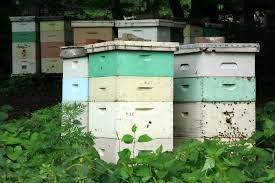
We were invited to a wonderful dinner and evening with good friends. Among the many things in which they are engaged is beekeeping.

This is a relatively new interest but they are doing it quite successfully in that this year, for the first time, they are gathering and using honey from their hive. It is producing enough (amazingly, I learned, it takes 50,000 individual pollen gatherings to produce just one teaspoon of honey) that for us and the other couple who was there, there was a ribbon-adorned jar to take home. Of course we couldn't wait and tasted some at the table--it is amazing!

I asked them how and why they got interested. "Well," he said, "you know about how there's a dangerous dying off of pollenating bees."

"I've been reading about that," I said. "Sounds serious. But how does that relate to your interest?"

"When I became aware of this I decided, in my own way, I wanted to do something about it. Not just to read and talk about it."

(See where this is going?)

"I guess all I do about the problem is read about it," I mumbled, as if to myself.

"We weren't satisfied just being aware of the problem. Mind you, we thus far have two hives and maybe 70,000 bees and we know that won't solve even a small part of the problem. But the way we look at it, every little bit helps."

"Indeed it does," I agreed, again, more from theory and concern than practice.

I don't know all that much about these friends' politics or ideologies. We haven't spent that much time talking about it. We have so many other things to discuss and enjoy together. But I sense he, at least, is a true political Independent. I know, for example, that he has voted for perhaps as many Republicans as Democrats for the presidency and Senate. Perhaps more. I guess that qualifies as Independent.

But when it comes to bees, though he blames big agribusiness for much of the problem (over spraying of the wrong insecticides), and this might be construed to be the progressive take, about other matters he feels quite friendly to many aspects of big business and would like to see more backing off from some of government's regulations.

So, again, it's complicated.

Labels: , , , , , , , , , , ,

Friday, October 24, 2014

October 24, 2014--Midcoast: Just Talk

After a complicated breakfast with Jim, during which a nuanced and balanced conversation about affirmative action and same-sex relationships descended into indiscriminate Obama bashing (Jim whispered conspiratorially as we were leaving, after I confessed disappointment in Barack Obama's presidency, "Don't you agree that he's working to bring down America?") over anniversary dinner later in the evening with other friends, we got to talking about how in small towns such as this one, where people depend upon, even need each other to get through life's perils, we generally find ways to disagree and often those with whom we have the sharpest disputes are the very ones we call on when things are most urgent; and, if we are honest about that and, more important about ourselves, we discover that our differences almost always amount to just words.

They amount to just words because, in truth, most of us are not actively or directly engaged in working to bring about social or political change (no matter its ideological direction or content) and are not that active in fraternal or civic organizations. Rather we talk. Talk passionately about things we believe in while remaining relatively unengaged.

Is this too cynical a view?

In some ways yes. In other cases maybe not. Like so much here this too can be complicated.

It is not cynical when it comes to holding accountable many of my fellow liberals (me as well) who are especially adept at the talking while this cynical view is unfair for many of those of more conservative persuasion who tend to be more actively and directly involved in the life of the community.

They are more likely to be volunteer firemen or, as a member of the EMS squad, are the ones likely to come in the middle of a stormy night to race us to the local ER. Or active on the Town Board. Or lead discussions about why source separation of trash is important--not necessary as liberals would have it to preserve the environment but because the Town can make money selling recyclables and thereby lower taxes.

About that, Rona wondered out loud if our environmentalist-minded friend, Peggy (to pick on her), back in New York City recycles as much or as assiduously as Jim in Bristol, Maine.

"No way," I said, agitated by my awareness of Peggy's hypocrisy as well as mine.

Jim, who is 81, is active on the local school board even though his youngest is in her thirties. "I have grandchildren, you know," he shrugs as if that explains it all.

And though he's not so sure about including a lot about climate change in Earth Science or referring too much to Evolution in Biology, he's out there in the middle of winter determined not to miss even one meeting while I talk, talk, talk about how we can't ignore the lessons of science, not only if we want to try to repair our planet but also to prepare our youngsters to be competitive in the global world of the 21st century. And though the signboard by the school I drive by at least twice a day says "All Are Welcome" to board meetings I haven't made it to one yet though every year I intend to make them all.

When I confess this to him, to help alleviate my guilt, he reminds me that I was an educator for more than 40 years and I do write and publish my views on schooling. That I've "paid my dues," and--

"But," I say before he can finish making excuses for me, "Yes, but still . . . I know. . . Maybe next . . .

He smiles to let me off the hook but . . .

Bottom line--a lot of things seem to work better here because at the most fundamental level we all know it is our relating and caring for each other that counts more than the talk, which in spite of various forms of inflation, is still cheap.


Labels: , , , , , , , , , , , , ,

Friday, October 17, 2014

October 17, 2104--Liberal Wusses

For about 10 minutes last night, on TV, I stumbled onto the Maine governor's debate. That's all the time it took--actually, five minutes would have sufficed--to figure out who will win: current Republican governor Paul LePage in a walk.

It will help that he has two opponents, both in effect Democrats, and they will split the progressive vote so that LePage, as last time, will win with less than 40 percent of the vote. Actually, his two opponents this time are such wusses that he could easily get close to that magic 50-percent-plus-one.

Even as a part-time resident I know enough about LePage's record to cause me to hate the idea that he is one of my governors. (The other two, Rick Scott in Florida and Andrew Cuomo in New York, are in their own ways as terrible as LePage.)

I know--so what else is new.

I see LePage winning easily in spite of the fact that he's currently in a statistical dead heat with Mike Michaud--he's at 40 percent, Michaud 39 percent, and Eliot Cutler trails with less than half that.

Here's how I know--

LePage has an awful record when it comes to government programs targeted to make life a little easier for low-income Mainers. Of course he's against Obamacare and refuses to support it here. He also turned down federal support for the expansion of Medicaid. And you should only hear what he has to say about Food Stamps and minorities, even though Maine is almost all white.

Michaud and Eliot favor all of these programs and then some. They even look like central casting governor material--tall, slender, full heads of hair--while LePage has a weight problem, is height challenged, and has a snarly-looking face.

So, what's the story and why am I so sure that LePage will trounce the two of them?

I needed to hear responses to just one question to convince me who will win--

One of the things LePage has not done is expand food programs for poor, school-age kids. The host of the debate asked all three candidates what they would do about the 20 percent of Maine youngsters who do not get adequate nourishment. This should have been an easy one for Michaud and Cutler. Who doesn't want to see kids get fed? Especially if the federal government picks up most of the tab.

The two governor-types, all earnestness, took weak shots at LePage (missed opportunities) and proceeded to rattle off a long list of forgettable statistics, none of which scored any points with the audience or this viewer.

Then it was LePage's turn to respond.

He leaned forward, depositing his full weight on the podium (I feared for it) and snarled, "I know what it's like to be hungry. I didn't grow up rich [a swipe at his two rivals]. There were days I went to school hungry. I know about hunger. So don't lecture me about feeding kids. I favor that and have done everything I could during my first term to work on the problem [a lie]. And if I'm reelected I'll do more [probably another lie]."

Case closed. Election over.

One reason Republicans are doing better than Democrats is because Republican politicians, as insincere and hypocritical as they are, are better at coming across as authentic.

Take George W. Bush as as example--people thought that Yale-Harvard graduate George W, a third generation Brahmin Prescott-Bush who never wanted or worked hard for anything, was actually one of them. Just plain folks who it would be fun to hang out with and have a (nonalcoholic) beer. This also explains the appeal of a Chris Christie. Another faux-authentic.

Most Democrats, in contrast, come off as effete know-it-alls, telling people that they know best what's good for "ordinary people." Think John Kerry and Hillary (not Bill) Clinton. People are tired of hearing this, being treated this way. Lectured to.

I hate the idea, but I am trying to get used to the idea that I'll have four more years of LePage and probably Rick Scott. Cuomo I can swallow. But if liberals want to make a comeback, they had better practice being real. Or at least how to pretend to be.


Labels: , , , , , , , , , , , ,

Thursday, September 04, 2014

September 4, 2014--Fear Itself

Reading Before the Storm: Barry Goldwater and the Unmaking of the American Consensus, the first of Rick Perlstein's monumental trilogy of books about the contemporary conservative movement, there is this about Fred Koch, the Koch Brothers' sire, and his comrades in 1960 when they were working largely out of view to promote the conservative movement. Specifically about the role of fear in American politics:
. . . Conservatism was a conservatism of fear. They harped endlessly on the "communist income tax," how the economy would be decimated by inflation every time a worker got a raise. (Taft Republicans, joked The Nation, feared "only God and inflation.") Their scapegoats were unnamed subversives who were invisibly destroying the system from within: "I am at a lose to understand the current public attitude deflating the inflation psychology," Fred Koch wrote in a self-published pamphlet. "Perhaps it is propaganda, of which we have been fed much of late--pink propaganda, in as much as, in my opinion, Russia's first objective is to destroy our economy through inflation."  
Politically the philosophy lost when it won [my italics]: if you removed the fear of subversion by catching subversives, you ended the fear that brought you to power in the first place--although, of course, you could never catch all the subversives, for the conspiracy was a bottomless murk, a hall of mirrors, a menace that grew greater the more it was flushed out. 'The Communists have infiltrated both the Democrat and Republican Parties for many years," Koch wrote. "If we could only see behind the political scenes, I am sure we would be shocked."
Thinking about this early the other morning, I speculated that there are basically two underlying sources  from which political power derives--

Fear is one force. Real, imagined, and often, by politicians, manipulated. Recall that during the 2008 primary campaign Joe Biden, famously calling Rudy Giuliani out as a fear merchant, said that everything he says is made up of a "noun, verb, and 9/11."

When looking at the social psychological reasons why people, without coercion, will give up their freedom to authoritarian leaders, Erich Fromm in Escape from Freedom, offers evidence that they do so because they either have real things to fear (economic collapse, external military threat, discrimination) or are fear-driven in their orientation. Like the Kochs they see threats all around even when they do not in fact exist.

Progressives, on the other hand, are willing to give up some of their autonomy--freedom, if you will--for the collective good. At least the collective good as they perceive it--that no one should go homeless or hungry or untreated if they are ill. Seeking the greatest good for the greatest number is what drives them politically.

As with conservatives, there is with them also the possibility, and often the reality, of self-delusion. And they have not always been reluctant to embrace their own manipulative methods. What one may claim to be the greatest good for others is not often put to the test--asking those for whom decisions are being made if they perceive them to be in their best interest.

So, in the first instance the instinct for a version of survival drives belief and behavior and in the latter case arrogance can take hold as those with power decide for the rest of us what is supposedly in our best interest.

Labels: , , , , , , , , , , ,

Tuesday, August 12, 2014

August 12, 2104--Midcoast: Peggy Pays a Visit

"Don't you find it frustrating to be living here among so many conservative people?" This from a visiting friend who is very progressive and politically-minded.

"Actually, I find it both challenging and interesting." Peggy looked at me skeptically. "Really, the challenging part is obvious. It's always difficult to converse with people with whom you have deep disagreements. But the interesting part is more important."

"Interesting?"

"Well, I learn new things if I can manage to keep my mouth shut and listen. And in spite of what you might think, not all conservatives are ill-informed or rigid. That is, no more rigid that you or I." I winked at her.

"But don't you find that when talking about, say, food stamps, you immediately run right smack into a brick wall--they're dead set against it while you'd like to expand it?"

"Maybe. Or at least that may be where we start--with them (usually a him) wanting to eliminate it while, you're right, I'd probably put more money into funding it."

"And so? That's it, right? Dead end?"

"Well, no."

"No what?"

"No, that doesn't always end the conversation." She continued to look at me out of the corner of her eye. "And that's half the point."

"What is?"

"That it's a conversation--at least we try to make it one. Not a shouting match or a series of pronouncements that go over each other's head."

"I'd believe that when I see it."

"You'll have to trust me." She folded her arms across her chest and took a deep breath. "But let me give you an example from last week. It just happened to be about food stamps. This friend, Willy, was going on and on about how he was at the checkout counter in Hanneford's and ahead of him was this guy who was paying with a SNAP card. Willy said, 'I know him. He lives in a $500,000 house and drives a BMW that must have cost at least $60,000. He shouldn't be getting food stamps.'

"I said, 'If that's true, I agree with you.'"

"'You do?'

"'Absolutely. I'm against anyone ripping off any government program, be it food stamps or Medicare.'

"Surprised at that, he said, 'But I thought all you liberals want to give everyone a free ride--food stamps, housing vouchers, disability, heating oil, the whole works.'

"I said, 'I don't know about others, but I'm pretty progressive and don't want to do any of that. I'd like to see more money in some of those programs, true, but I'd put in jail anyone who rips them off.'"

"You said that?" Peggy said, "You believe that?"

"Indeed I do. Shouldn't we liberals be the first ones to call for the end to waste and abuse in our favorite programs? If we believe in them and want to see them continued, we should be in the forefront of critiquing them and cleaning them up when they go off the rails and not let the conservatives have a field day, attacking them like Willy, based on a few bad examples. We should protect what we believe in by being extra vigilant and out front about problems."

"So that did the trick? You agreed with him about the guy with the BMW and now Willy's in favor of food stamps?" She was mocking me.

"Not exactly."

"What happened next?"

"I said, 'Let's try to narrow our differences.' Willy nodded, indicating he was OK with that. We had tried to do that before about other issues with occasional success. So I asked him how he feels about children not being properly fed. He said no child should go to bed hungry or to school without breakfast. I said that I agree with that but asked how we should make sure kids get food if their parents either can't afford it or are irresponsible.

"He at first didn't have an answer to that. Then he said, 'We have this Caring for Kids program here. Local people contribute money to it so students can have healthy snacks during the school year; and during the summer, when they can't get lunch in school, they provide it at no cost.'

"'That's a good example,' I conceded, 'of how people, not the government, can help those with needs. But,' I pressed, 'I know about the program, which is very good--I contribute to it--but it's reach is limited and they can't provide other meals to kids. Dinner, for example. Or during weekends. For that, I think, we have to have something like food stamps because the need is so great and only government can cover the costs. The whole program costs $75 billion a year.'

"He said, 'For that I'm all right with a government program. To make sure children are taken care of. It's not their fault if there isn't enough charitable money for that.'

"'I'll tell you what I'll do,' I offered, 'Neither one of us, of course, has a smart phone . . .' 'Another thing we agree about,' he said. 'Touché,' I said 'But let me check on the Internet later today to see how the food stamp money is distributed. How much of it goes to children. Than we'll see where things stand.' He reached across the table to shake my hand in agreement."

"So what did you discover?" Peggy asked.

"It took me just a few minutes to learn that there are about 22 million kids who receive food stamps and that this represents 48.7 percent of all food stamp recipients. Nearly half. More than I had thought."

"What happened next?"

"Well, Willy was waiting for me at the diner the next morning and without ado I told him what I learned."

"And what did he say when you told him this?"

"'I trust you and . . .' and then he got quiet.

"'And?' I probed.

"'And, so I suppose about this we're in 48.7 percent agreement.'

"'Let's work on the rest,' I said. 'Disabled elderly people, for example, get about 8 percent of the food stamp money. Are you OK with that?'

"He said he was. 'And about 19.8 percent are seriously disabled adults. He said he was OK with that too.

"'If I know my arithmetic,' I said, 'this means that maybe in regard to food stamps, we're in more than 75 percent agreement.'

"'76.5 percent,' he said with an exaggerated wink.

"So there you have it," I said to Peggy. "How up here we try to talk about even controversial things and at times manage to find some common ground."

I think Peggy was impressed. "I want to meet this Willy character," she said.

"Only if you promise to play nice."

"I'll think about it," she smiled.

Labels: , , , , , , , , , , ,

Tuesday, April 01, 2014

April 1, 2104--Progressives' Dirty-Little-Secret

Here's the dirty-little-secret--

Liberals and progressives like me are actually clandestinely happy with most of George W. Bush's policies.

That's why there are no large-scale protests. Occupy Wall Street came and went in a month. The rest is silence except for the occasional New York Times editorial and the shouting and smugness that passes for political discourse on MSNBC.

With the tax season culminating in two weeks, we liberals are especially happy with what the Bush-era tax cuts have meant for us.

Demographically, progressives are more highly educated, have better jobs, and earn more money than "ordinary" conservatives. Thus, all things being equal (which they are not thanks to the previous president) we affluent lefties have disproportionately benefitted from the 2001 tax reductions that Bush promulgated (to be fair and balanced, 12 Democratic senators voted for them) and Obama reupped in 2009, with Democrats in numbers again endorsed.

On Saturday from our accountant we received our filled-out tax forms for 2013. We had a good earnings years and needed to pay a little more than in 2012. But, but, as the result of the Bush-Obama tax cuts we owed about $5,000 less than we would have had to pay under Clinton's more progressive tax polices.

Furthermore, how many liberals are out in the streets protesting cuts in food stamps and aid to education; slashes in spending for medical and science research; less available for environmental protection; cutbacks in support for women's health programs; Supreme Court decisions to allow unlimited corporate spending on political campaigns and the effective rollback of the Voting Rights Act of 1965?

We're even OK with Bush's Patriot Act and Obama's use and expansion of it since we care more about protecting our comforts than our privacy.

And, since we have an all-volunteer military and our children and grandchildren are not in danger of being drafted, much less inclined to sign up and be shipped off to Iraq or Afghanistan (or Ukraine), beyond spouting rhetoric about how awful all this is, how perfidious and hypocritical Republicans are (they are), we secretly smile when we sign our tax forms, sit back on the deck at our vacation homes, and sip Chablis while streaming House of Cards.

Hey, if these policies don't affect me directly why get all out of joint much less use Twitter as they do or did in Egypt and Venezuela and Russia to mobilize? It's cold out there, it might rain, and I might even get my head busted by an overzealous policeman.

Even if half the states so restrict abortions as to make them unavailable, we live on one or the other of the coasts--so no problem.

Actually, for the fortunate us there are few problems with anything.

Labels: , , , , , , , , , , ,

Wednesday, March 26, 2014

March 26, 2014--Political Celebrities

I was thinking the other day that one of the very few benefits of being a progressive is that liberal entertainers are much better and cooler than conservative ones.

Who, for example, would prefer Tom Selleck to Matt Damon? Or (an easy one) Ted Nugent to The Boss?

But then I did a little more Googling and I'm not so sure.

Democratic supporters include--

Demi Moore
Jack Nicholson
Regis Philbin
Hugh Hefner
Jerry Springer
Paula Deen
Hulk Hogan

I like the Hulkster, but Paula Deen's a Democrat? That's just too much.

So, I took a closer look at the roster of GOP supporters, thinking maybe there are a few less-than-75-year-old white guys on the list. In fact, there are some--

Kid Rock
Susan Lucci
Britney Spears
Sylvester Stallone
Larry the Cable Guy
Meatloaf

But then there's Pat Boone, who's at least 100 and very white. And, equally ancient and Caucasian, Clint Eastwood of the empty stool.

Some say Taylor Swift's a Republican, and I suppose that counts for something. Though her singing sounds pitchy to me.

On the other hand, a still prominent liberal to be endured is Babra Streisand.

Life can be so complicated.

Labels: , , , , ,

Wednesday, January 08, 2014

January 8, 2014--Lynching

Circulating virally right now among progressives is a blog posting by Frank Schaeffer, a former member of the Religious Right, in which he comes to the defense of Barack Obama, claiming, with considerable truth, that much of the disproportionate and even savage criticism of Obama is because of racism.

Schaeffer emerged from his Evangelical life a number of years ago and has been telling his story in a three-volume memoir called by some the God Trilogy. In the first of the three, Crazy for God, he reveals that he left his Fundamentalist coreligionists when he "realized just how anti-American they are."

In the blog, "GOP Driven Crazy by Hatred for Obama," which is being widely circulated by some liberal friends of mine, Schaeffer reveals that--
[He] changed because, if this country will lynch a brilliant, civil, kind, humble, compassionate, moderate, articulate, black intellectual we're lucky enough to have in the White House, we'll lynch anyone. What chance does an anonymous black man pulled over in a traffic stop have of fair treatment when the former editor of the Harvard Law Review is being lynched? [Emphasis added.]
Shaeffer is the new darling of many progressives because it is so rare for someone, anyone to switch ideologies from right to left. Pretty much all political conversions are in the other direction, from liberal to conservative. It is much more common to find Dick Morrises who begin life as fervent supporters of Democrats and then, for various reasons, become disillusioned with liberal orthodoxy and migrate to the other side of the political spectrum. In cases such as Dick Morris' they become ultra-conservative, believing in paranoid conspiracies or come to realize there's more of a quick-buck available on the extreme right than left.

But the criticism and attacks Obama is experiencing is not a lynching.

A lynching is a lynching as the Holocaust is the Holocaust.

If liberals who pride themselves on knowing their history engage in this kind of hyper-inflated rhetoric how can one criticize right-wing conservatives when they call Obama an Islamic socialist or communist?

Labels: , , , , , , , , , , ,

Tuesday, October 08, 2013

October 8, 2013--Stagehands

"It's not that I'm antiunion," Stan said, which surprised me. He tends to take conservative positions on most issues of public policy.

"But from what I'm hearing about your stagehands, I'm not so sure."

"My stagehands?" I looked at him quizzically, "I'm a bit confused. I don't have any." We were sitting together in a booth at the Bristol Diner, with the sun streaming in, whiling away the morning.

"Well, you are New Yorkers, aren't you?"

"Still, I'm not following you." At times Stan tends to speak elliptically. Or playfully when tweaking us about being from the Big City. "Stagehands?"

"Don't you read your own paper? The one you're always writing about?"

"The Times? The New York Times?"

"There was something there, I think on the front page, about how they were on strike."

"I've been busy and somehow must have missed that."

"Not for more money but because they were insisting that Carnegie Hall hire more stagehands to work for the new education program they're planning to launch."

"What does the work entail? Traditional stagehand work? Moving props and scenery?"

"I don't think so. The Carnegie Hall people say it's mainly moving chairs and other lightweight chores. And so they want to hire people who will work for less money than the stagehand's union requires."

"What kind of money are we talking about?"

"I think that's why the dispute wound up on the front page."

"So, how much? As I said, this is the first I'm hearing about it."

"I'm glad you're sitting," Stan said with a broad grin. He leaned across the table to make sure I couldn't avoid making eye contact.

"On average, $400,000 a year in salary and benefits."

"What?" I was incredulous.

"You heard me--400 grand. More than most Carnegie executives make and a lot more that any of the musicians in the orchestra."

"I can't believe this is true. I know they have a strong union and at times have gone on strike and shut down Broadway theaters. And I know they make a lot and . . ."

"Here's how I think it works," Stan said, cutting me off and getting out his pen, using his napkin for scratch paper. "They get whatever their base is. For working 9 to 5 Mondays through Fridays. Like the rest of us. But since everything at Carnegie Hall is at night or on weekends they get paid for that at double or triple overtime."

"So you're thinking that even though there's not much to do weekdays during the day, still they come to work then and wait for after hours for the actual work to kick in and at those times they make a lot more than they do for the first 35 hours?"

"It's gotta be. Otherwise how does it add up to $400,000 a year?"

"And there's probably no way for Carnegie Hall to change the deal. Or on Broadway, for that matter, where it must be pretty much the same situation."

"I don't know about that," Stan said, "But about Carnegie Hall I only know what I read in the paper."

"You mean my Times?" I winked. "I didn't know you read that."

"My son-in-law, who knows my views, showed it to me on-line. Probably to make me crazy."

"So," I couldn't resist poking at him, "If it was up to you, you'd let them stay on strike while not just resisting hiring more $400,000-a-year men for the new program but also demand all sorts of givebacks from the current stagehands? To bring their compensation into line with management and, more important, the musicians?"

He smiled back at me in answer.

"They'd probably stay on strike forever," I said, "if the Carnegie board insisted on that. But I take your point about union overreach. I'm pretty liberal . . ."

"Don't I know it," Stan said. This time he did the winking.

". . . but this doesn't do the union movement any good."

"You're right about that," Stan said. But then, as he occasionally does, he surprised me, "Look, there are only four or five stagehands at Carnegie Hall and this is not a typical union situation. In fact aren't you surprised that your leftwing paper made such a big issue out of it? About four or five people making a ridiculous amount of money?"

"Good point," I said.

"This will be all over talk radio tonight. Another thing to make people feel they're being taken advantage of and that everything's unfair. There are many unfair things," Stan continued, "But not everything is unfair. It doesn't help to simplify things this way. If we want to dig out of the mess we're in we need to be smart. And blowing this all out of proportion makes us stupid."

I nodded. "What's more, it distracts us from looking at what's really unfair. I know we'll disagree about most of that but at least we'll be talking about the real problems. Not sideshows."

"That's why I love you Stan. So much so that I'm paying for your coffee."

"For today or the whole week?"

Labels: , , , , , , , , , ,