Wednesday, May 27, 2020

May 27, 2020--Mike Stevens: Empty Calendar Depression

Take a look at the email exchange I had recently with a good Maine friend, Mike Stevens. It's about, what else, aging. It begins with my note to him--


To Mike

Word filtered all the way to the Epicenter, New York City, that you have or had something with which I am all too familiar-- diverticulitis  I hope that for you it's in the past tense as I know it can be wicked unpleasant. And I hope you have been otherwise well and are enjoying the reemergence of spring.

Spring with the virus. 

I could take a pass on that combination. We all could. But in truth living here in New York City in a version of quarantine the past 3-4 months isn't so different from the way we normally live our lives. So for us, we are blessed, it has been more inconvenient than perilous. Though we have lost a few friends and family members. 

Illness and death thus feel pervasive even though we continue to feel well. It takes someone much smarter than me to figure it out, to make sense of it. Assuming that is in fact possible.

As I mentioned, I hope you are OK  and that you and Mary have been doing as well as possible.

We do not as yet have firm Maine plans. We had been hearing, though not universally, that as "people from away" we will not be welcomed. As we do not want to affront anyone, we have to think about the right way to make plans to live a version of our traditional Maine lives.

But we hope to figure it out. One thing that would certainly be nice would be the chance to see you both.

From Mike to Steven--

Hi Steven
    
Thanks for checking in.  It took a long time, but I am now recovered from the diverticulitis.  It was not fun!  I still find my energy level is a little low, but I am basically fine.
     
Like you two, Mary an I are finding we do not spend our days in ways that are terribly different from the usual.  We feel very fortunate to have such a pleasant place to stay at home in.  I do, though, complain a little about “empty calendar depression.”  

Usually I ask Mary each evening, “What’s on the calendar for tomorrow?”  She checks and often mentions a meeting or an appointment or a get-together with friends.  Now it’s always, “Nothing.” Hardly a reason to get up the next morning. 
    
Still, unlike you, we have lost no family members or friends to the virus, so we count ourselves lucky.  You have our sympathy.  I find myself yearning for someone who would unify us all in a time of mourning, but we seem sadly lacking in national leadership these days.
    
Out of staters are beginning to make their way back to Maine.  If you are willing to observe the governor’s request that you observe a two-week quarantine when you get here, I think you would be welcome. Year-round residents appreciate that effort.  

We would be happy to help by delivering groceries and any other necessary supplies to your house once you arrive.  We’re good at social distancing.
    
Again, thanks for being in touch.             

Peace!


Labels: , , , ,

Wednesday, April 22, 2020

April 22, 2020--Our Friend Ken Longe

We had been having coffee at the diner in Bristol, Maine with Ken Longe for the longest time before he began to show inordinate interest in our fireplace.

"You have a fireplace, don't you?" he said.

The first time he asked we didn't pay much attention. We were still sharing growing-up stories--his in Andover, Massachusetts ours in Brooklyn. Though we had been renting a place for the season in Pemaquid and had known Ken for three or four months and a friendship was emerging, there was a lot remaining to share.

"Is it a big one?" He spread his arms to indicate the fireplace's possible width. 

"That's about right," Rona said.

"And does it draw good?" Ken asked.

"Yes," I said, "We can make quite a fire."

We moved on to other subjects. Labor Day was approaching. 

"We're starting to get ready to leave," Rona said. "You know how much there is to do. Though we're just renters and since we've been here three or four months we really got settled in and now have to restore the house to the way we found it."

"It's been cold," Ken said. "Have you been comfortable?

"We have a couple of electric heaters and as I mentioned we get pretty good heat from the fireplace. It warms most of the living room. So we're OK."

"Why then don't you stay a little longer? Though you might not be able to make it all the way to Thanksgiving, it would get to be pretty cold, that would be nice. You could do fine the month of September and even October. It's my favorite time of year. The leaf-peppers show up but otherwise its real quiet. And it's interesting to watch the seasons change."

"Maybe if we come back next year," Rona said. "I wouldn't mind being here to observe that." The house was for sale and we were thinking seriously about trying to buy it.

We drifted on to other subjects. That morning might have been the one when we had our first tentative discussion about political things. It was well before there was Trump to talk about. It was more than ten years ago and Obama was president. From some earlier tentative probings we all knew we weren't on the same page about him and politics more generally. Without discussing it we knew to stay off the subject. At least for a time.

A few mornings later, at about 5:30, with the sun in pastels rising over Johns Bay, with Rona still sleeping and me reading about Abraham Lincoln and the history of slavery in the  U.S., I was startled to hear what sounded like serious thumping on the roadside porch. I thought it must be some large animal. We had seen deer on the water side of the cottage. Could it be that one was wandering around probing to see if there was anything in the vicinity good to eat. 

Or, was it an intruder? We rarely locked any of our doors even when sleeping and so the big-city boy in me tensely began to make plans to scare away or perhaps confront whoever or whatever it was. 

I debated if I should wake Rona and get her to a secure place before dealing with what was going on out there. I made enough noise putting on my pants and shoes to wake her. In an instant she too was alert and on guard. This was not what we wanted to be happening a few days before leaving and while simultaneously negotiating a potential sale price with the owner. 

If we were in some sort of danger there is no way we would be comfortable being in the house, even with the doors locked. We had enough anxiety living in New York's City. We were thinking about the possibility that Maine could be an alternative to that. With someone perhaps about to break into what would be our hideaway house, that sense of refuge was evaporating.

Rona whispered that I should back off and let the situation resolve itself. But recklessly oblivious to the danger, I ignored her, thinking I could scare away the deer or whatever by just making enough noise from inside the house.

So I stomped down the hall to where a window looks out over the front porch. Perhaps I could catch a glimpse of what was going on and raise a protective clamor. 

In the car park area there was an unfamiliar pickup truck. At least it wasn't a bear, I thought, and continued to made enough of a ruckus to be heard outside. I thought, hopefully, that would scare away the intruder. 

Rona in the meantime was moving to dial 911.

With that I saw someone, a tall, slender man in a blue windbreaker, trudging up the front steps. It was still half light and I couldn't make out who it was or what he was carrying. Though it was clearly something quite large.

It was Ken I then realized with a bundle of firewood cradled in his arms.

Relieved, I raced to the front door.

"Ken," I half-shouted, all excited and breathing again, "What are you doing? Let me help you." I saw firewood in the bed of his truck.

He waved me off. "I'm almost done," he said.

"Done with what?" I said.

He had already stacked what looked like half  a cord on the deck and neatly added those he was carrying to the pile.

"The other morning at the diner," he said, "I was asking you about why you were going back to New York so soon."

"I remember that," I said.

"Well you told me you had a big fireplace and I thought if you had enough firewood to keep things cozy you might stay longer." He said this, avoiding eye contact.

"That is incredibly generous," I finally said, "You've been so--" I didn't finish the thought.

"You can help me with the rest of the load," he said. With the two us working side-by-side we were done in five minutes.

"Can I at least get you a you cup of coffee?" I said.

By then Rona had joined us and she gestured toward the house. "I'll have some brewed in a moment."

"Better yet," he said, "Meet me later at the diner and buy me a cup," he winked, "I want to talk about that Obama fellow." 

Some months later, after completing the purchase of the house, when a few of our New York friends asked what motivated us to do so I told them this story. 

Some got it. Others, didn't. It nonetheless is the truth.


Ken Longe

Labels: , , , , ,

Monday, April 20, 2020

April 20, 2020--My Friend Frank Brecher

We met for the first time when we were both in our ninth decade. 

Not the best arrangement, many would claim, with so little time presumably remaining, to be thinking about making friends. 

For folks our age, likely settled in our ways and beliefs, there is usually not much psychic space left to make the adjustments required for a relationship that seeks to become a friendship. Much less provide the motivation to even consider it.

But Frank Brecher and I quickly discovered that though we in fact were set in many ways, enough of them were complementary and thus what was developing between us might turn out to be deep and substantial.

We grew up on the streets. He in the Bronx, me in Brooklyn. In many ways at the time there were few differences between someone who hung out on the Grand Concourse or on Eastern Parkway. A Jewish kid was a Jewish kid.

Our neighborhoods were middle-class ghettos, rife with street crime but with enough opportunity to make something of one's self. If we were lucky enough to survive. Survive physically, and do well enough in school to make being admitted to college a possibility, with a college education seen as a ticket out, which in both of our cases turned out to be what happened. 

As our friendship developed we discovered that a love of history was a common denominator. Though a Foreign Service officer for decades, Frank was also the author of a half dozen books, including most recently, the highly-regarded Securing American Independence, that focuses on John Jay, a senior diplomat during the Revolutionary War and America's first Chief Justice. And I am a voracious reader of history, wanting to learn all I can from the past about what it means to be American.

But more profoundly, for the few years we shared before he died two days ago from the coronavirus, thinking in friendship terms may not be the best way to consider our relationship.

We became more than friends. Rather, members of an intentional family. We spoke the same meta-language, our instincts were aligned, and over time we became brothers.


Labels: , , , , ,

Friday, June 03, 2016

June 3, 2016--Always Talk To Strangers: Holly & Chris

Beginning in July, 2007, I wrote a series of pieces about encounters with strangers. By now they total nearly 50. Many appeared here. 

Over the next number of months, on Fridays, I will publish some of my favorites in the hope that you will enjoy them.

Here from that July is the first of them--"Holly & Chris"--

I was brought up in a family that did not believe in friends. Or even in the concept of friendship.

Thus, by the time I graduated from college, I had established no lasting friendships. And since from everyone I knew who had these kinds of relationships—those formed during childhood, adolescence, and early adulthood—this meant that I would never have real friends because real friends, if not carried over from early in life, could not be made during middle age much less even later.

This was one of the axioms of that era, equivalent to the theory, actually assertion, that one’s personality, one’s very being was fully formed by no later than age eighteen. The rest of life was a matter of playing out that hand of intra-psychic cards.

So, like my parents, I focused almost all of my relating on my relatives, or what my Aunt Fay, a strong proponent of blood being thicker than water (as if water flowed in the veins of everyone with DNA different than ours), called “My wonderful family!” I can hear that exclamation point even now, lo these many decades after I first felt it.

At the time I didn’t question any of these assumptions, these forbidding a priori givens. I merely motored on, preparing myself in a variety of ways for responsible adulthood. Always keeping in mind my father’s admonition when I took the risk to ask, rather tell him, if it was permissible to want a life with connections beyond just my loving immediate and extended family, was it acceptable to want to seek happiness in various ways likely to be different from his and their definitions? When I found the passive, conditional-voice courage to ask this, he admonished me with something that has echoed through all of my life and against which I have attempted in recent years to struggle—“What does happiness have to do with anything?” Period. End of story. So get on with it. Which I attempted to do.

But later, feeling somewhat bereft and isolated from the kinds of warm relationships I saw among the people I knew, friendships that clearly meant so much to them, that obviously enriched their lives, and in many cases were stronger and more profound than what they took or got from their own families, I struggled, first, to try to understand why I was taught not to trust strangers and to seek all warmth, love, and security from just within my family; and, second, I tentatively began to reach out to others to see if there was any possibility of forming later-in-life versions of friendships—pushing against the more pessimistic developmental perspective and admonishments of my family and formative years.

In regard to the first struggle--My mother’s immediate family managed to get out of Eastern Europe a decade before the Nazi anschluss and the subsequent pogroms and ultimately the Holocaust. Those of her relatives who remained behind, thinking it would all pass them by, never made it beyond Auschwitz and Dachau. And so, when they arrived in America and later learned the full horror of what they had escaped, they huddled together even more, isolated in their foreignness, their Jewishness, and their perceived vulnerability. Even here. In America!

My father’s people were more secular, solidly middle-class bourgeois Austrian Jews who came to the United States in the 1880s, never agreed to be ghettoized on the Lower East Side, learned English quickly, made a good living, bought a house in a mixed neighborhood in Brooklyn, and considered themselves both superior to the Polish and Russian Ashkenazi Jews. Above all they felt assimilated and decidedly American. It seems that the first thing they did after buying the brick house on Bedford Avenue was figure out how to get to Ebbets Field so they could root for the Dodgers in person—it didn’t get any more American than that.

But then, just as they were settling in to be quite comfortable, they were battered by the Depression and discovered than not only were their savings worthless and their house dramatically diminished in value, but also in the eyes of others in even more desperate circumstances they were JEWS and were thus collectively responsible for what the country, their country, was suffering. They were seen to be a part of the universal “Zionist conspiracy” that had inflicted this nightmare on America and the rest of the world. And so when my father and his brothers and sisters went out looking desperately for work, willing to do anything, even things decidedly beneath them, they were met with signs that literally said--

“No Jews. No dogs.”

So indeed, what did happiness have to do with anything? And who could you trust? Basically no one. In truth, though from both of my families’ experiences it is no wonder they would turn inward, they also found that you could not, even when just fighting to pay the rent and feed your wife and children, you could not casually even trust everyone in your, to quote Fay, “wonderful family.” I could tell you some of these stories if that were the subject of the day. Suffice to say that I suspect my father and my Uncle Harry, who reside now in side-by-side graves in Mt. Lebanon Cemetery, are still not talking to each other.

So is it any wonder that these two families, with my blood an equal mix of both, would orient me not to trust strangers and thereby not to believe in friendship. In a world red in tooth and claw, where dangers and worse lurk, though they are not perfect—Mt. Lebanon being a case in point--when it comes to friends versus family, no contest.

But, second struggle, when I looked around for counter examples in my own family I noticed that my cousins Nina and Murray, to cite two, had not allowed the family promulgations to define their lives—in both cases they carried dear childhood friends along with them well into and beyond their middle years. They were still family stalwarts but they had reserved equal emotional energy for lifelong friendships. So with their example before me, with considerable trepidation, I pushed myself to begin to reach out to others, seeking at least the possibility of relationships. I thought, if I can succeed at that, which would be a big step, who knows where it might lead. I might actually make a few friends!

Which brings me to Holly & Chris.

For some years now Rona and I have been “regulars” at Jenny Lake Lodge in the Tetons of Wyoming. This means that we return there each year on exactly the same dates as in all the previous years. And we are by no means the only guests who do so—we understand that fully fifty percent do and so that means we see many familiar faces each year when we return. And in this new mode of seeking relationships, since dinner is provided and the place is small, it is easy and natural, even for me, minimally to nod hello and ask how other regulars fared during the fall and winter. Of course we hear many stories about illnesses and operations and children graduating from college and plans for the future when we all will be working less or, better, not at all.

Chris & Holly have been regulars for about ten years. Their time at Jenny overlaps all our days but for one—they leave the day before we do. More about that in a moment.

Last July, after just nodding at each other in the lodge for at least two years, Chris asked if we might like to meet one evening for a drink before dinner. Sensing that my interest in wanting to do so was tempered by some ambivalence he must have sensed seeping up from all of my deep early-life conditioning (which in itself was impressive since he didn’t even appear to be Jewish), he suggested that we meet for only a half hour before our dinner reservation time. Just enough time to do a bit more than nod and ask how long we each had been coming to Jenny, which cabins we had, and if we hiked or rode or did both. About as much discussion I had had with anyone at Jenny in eight years of regular ensconcement.

We might actually have time to begin to get to know each other, exploring the usual--Where are you from? Where were you from? Are you still working? At what? Or when did you retire and what did you do now with all the time you have? Do you travel to places other than the Tetons? Are there any places you like as much? What are you reading? Anything good? And what makes you laugh and feel happy? These later questions are of course not posed, but we discover each other’s sense of humor, or lack thereof, experientially.

So we met at 7:30 the next evening for a drink; and there was so much immediate frolicking and laughing, almost too much to engage in in public at the rather staid Jenny, that Michael the manager came over to us, not to admonish us but to ask if rather than two tables for two for dinner, perhaps, if he could arrange it, might we prefer a table for four?

To cover my nervousness about this prospect, I told Holly & Chris about a former colleague who after a rough divorce eventually began to date. He found the experience so depressing, he experienced so many unhappy evenings where after fifteen minutes both he and his date realized that it was not working that he developed the concept of the progressive date. They would agree to meet for a drink. If that went well they would move on to a light dinner. If that was pleasant, they would go to a movie. But if at any stage either one was not feeling positive about their prospects, they would have social permission to say, “It was very nice to meet you”; and that would end the evening.

Part in jest and part to protect myself from the tremors of an potential impending acquaintanceship, I suggested that we proceed with a progressive dinner—If Mike could hold the second table, let’s maybe begin by having appetizers together, I suggested; see how we do; and if it goes well, proceed to the soup course; and then to the salad; perhaps possibly all the way to the entrée; and who knows, maybe even to dessert!

And so we proceeded, and things began to work, to “click” between and among the four of us. We progressed from course to course and by the time the salad was served signaled to Mike that he could release the second table. We had such a good time that evening and over the next few days that when it came time for Holly & Chris to depart—a day before our time was up—I felt an overwhelming and unfamiliar feeling of sadness: I realized that unless we figured out how to meet between then and the following July it would be a full year before we could in person resume our acquaintanceship and progress perhaps beyond that to . . . ?

Now here we are again this year, back in Wyoming, back at Jenny; and all I can think about after resuming my love affair with the mountains and meadows and lakes and air is—Where are Holly & Chris? Are they OK? Chris had had some “medical issues” during the fall and winter and so . . .  But right there in the lodge the first evening we saw them, and they looked healthy and radiant and we happily picked up right where we left off.

Mike had already reserved a table for four, a little apart from the others correctly suspecting that we would again be laughing as much as catching up with each other’s lives and he didn’t want the other guests to be disturbed.

Our "dates" this year turned out so well that, after one of them, Holly, who is by nature not that kind of gal said, “If this were a real progressive date, we’d now go off to bed together.”

So, Dad, I hope things are fine with you and that maybe even you and Uncle Harry are talking. If not, give it a try because, take it from me, happiness and friendship are indeed worth pursuing.

Jenny Lake Lodge: Dinner for Two

Labels: , , , ,

Friday, December 19, 2014

December 19, 2014--Best of Behind: A Different Perspective

This is from November 24, 2009, after Barack Obama had been in office for just 10 months. My friend Dick, who contributed this different perspective, got it more right than I. I was already growing restive and he was counseling me to be patient and to look at the unfolding Obama agenda and leadership style in a different way, not as things are traditionally viewed in Washington and New York.

Considering the stunning announcement on Wednesday that Obama is moving to fully normalize relations with Cuba, I thought this was worth a second look--

If you’ve been paying even casual attention to these posts, you could not help but notice that I have been raising questions about President Obama.  

Is he being forceful enough in advancing the agenda he laid out so clearly and hopefully during the campaign? When it comes to health care legislation what does he really want? Is he committed to a single-payer option or is he willing to sign anything Congress sends him so he can claim he was the first president since Lyndon Johnson to reform the system?

What was he up to during his recent trip to Asia? It was good to see he was paying attention to the region after eight years of neglect by the Bush administration, but what did he actually achieve? After so much bowing to the Japanese, what happened in China? He seemed unwilling to make any demands on the leadership there in return for various U.S. concessions. Yes, they are our bankers and we will need them to lend us more money during the coming decade, but how about a word about human rights? How about receiving unfettered access to the Chinese media? He met with a handpicked group of university students who asked him pat questions—an event that was not televised throughout the country—and he wasn’t allowed to hold a press conference. Not impressive it felt to me.

And speaking of Asia, what is going on with regard to Afghanistan? Dick Cheney called it “dithering”; and I, help me, have been thinking that the former vice president may just have gotten this one thing sort of right.  

None of this has been seeming very presidential. Not the change I enthusiastically voted for.

Even my 101-year-old mother—an early and fervent supporter of Obama's—has been getting into the act, raising questions about the effectiveness of his leadership and how out of touch he appears to be with average Americans who are still very much hurting more than a year after his election.

But then there is the perspective of a friend who goes back about as far as I and has had through the years an excellent record of sensing shifts in the country's political culture. Before anyone I knew, for example, he not only recognized Obama’s talents but also foresaw the likelihood that he would be elected. He does not allow himself to be distracted by day-to-day instant analyses of who’s up and who’s down but rather sees things in broader, generational terms.  

So last night over dinner I was eager to get his views of Obama’s first ten months in office.

He felt that things were going rather well. He calmly reminded me about all the extraordinarily difficult problems that Obama inherited. “I know,” he said, “that most people by now are getting tired of hearing him talk about the legacy of ‘the previous eight years.’ But though that understandably might be the emotional and political case—that by now we would like to see more problems solved at home—they are so complex and deeply rooted that it will take much more time to chip away at things much less change them than even one term in office will allow.”

“I agree with that,” I said, “but shouldn’t he be more forceful about what he wants from Congress, our allies, and trading partners?”

“He is a different kind of person, a different kind of leader. He sees what that kind of blustery leadership has achieved—economic precariousness and a disenchantment with America among even our friends. He realizes how difficult and complicated it is to get Congress as it is currently constituted to pass transformative legislation. Or any legislation. Things are so partisan, special interests are so powerful, that to reach any sort of consensus, even among Democrats, is daunting.  

“So, for example, to leave health care legislation to the Congressional leaders, though it is messy and it looks as if he is indifferent, may very well be the one strategy that has a chance to succeed. And getting even a flawed bill passed may not only be as much as can be expected but may actually do some significant good. Just as though Medicare and Medicaid were and are flawed look how much benefit they have provided to the elderly and indigent.” 

“You may be right about this. But what about Afghanistan and the way he appears to be ineffective with, say, China and Japan?”

“I see the same things operating. His is a new and refreshing way. Perhaps just what is needed. We are no longer either the hegemonic military or economic power. At the end of the Cold War many felt that there would be a Pax Americana that would be the result of our unquestioned power and inclusive values, but that view turned out to be very short lived. Faced with terrorism and insurgencies, our vaunted might has turned out to be ineffective and of course our near economic collapse has shown that our form of capitalism is not a viable model for most of the rest of the world. In fact, even our cultural and ideological power has been shown to be compromised and inappropriate for most people and nations.”

“So you are agreeing with me.”

“Perhaps with your diagnosis but not your pessimistic views about Obama. If you hold on for a moment, let me complete my thought—about how the ways in which he has been acting domestically, in this new collaborative mode, is consistent with his view of diplomacy.”

“Go on.”

“I both cases he is displaying patience in the face of seemingly intractable problems. He knows none of these can be quickly or easily solved. Much repair work needs to be done before anything significant can occur. Trust needs to be reestablished. In regard to our role in the larger world, perhaps trust has to be established for the first time in nearly a century as we move into our own version of a post-colonial role.”

“Perhaps.”

“And in order to do so, to begin to achieve this, Obama appears to have decided to spend down some of his national and global political capital. Even at the risk of appearing to be weak and indecisive. Though many here are eager for certainty—for a leader who will tell them what to think and do (take note of Sarah Palin’s current popularity)—Obama is neither inclined to offer this nor does he believe it to be the best way to lead. His is an entirely different approach. He seems to be willing to build trust in others by actually trusting them. Not necessarily naively but with an understanding that they as well as he and we are always motivated largely out of self-interest.

“By doing this he is showing respect, rather than arrogance, because I feel he both respects others—or at least doesn’t underestimate them—and recognizes the roles that everyone needs to play to reach reconciliation and mutually-beneficial consensus.

“Remember, he is not only our first African-American president but is also our first Asian or Pacific president. He was born in Hawaii and spent formative years in Indonesia. So he combines within himself some of the cultural qualities he assimilated from those early years. It is of course dangerous to oversimplify what it means to be at least in part ‘Asian,’ but one thing that characterizes what that might mean is an understanding of the power or being yielding and indirect. And, make no mistake, these are powerful qualities. At least potentially so. And may turn out be in Obama’s case.”

As I suspected, he had given me some new things to think about, including what to order for dessert!

Labels: , , , , , , ,

Monday, October 27, 2014

October 27, 2014--Busy Bees

I caught a lot of grief about Friday's blog, "Just Talk."

Those I heard from felt I was being unfair to liberals and too "understanding" and "casual" about those beliefs of conservatives that are not only "outrageous" but "harmful." That I let off the hook too casually those who do not believe in evolution or climate change. In a world threatened by ebola, as an example, how could I sit so comfortably over coffee with someone resistant to the findings and "truth" of science? Perhaps, some speculated, I have become so besotted about life here in Midcoast Maine that I have lost perspective and my ability to think clearly.

There may be some truth to this but some of this criticism missed my bigger point. Or at least the point I thought I made clearly enough that was to me the bigger point--

That credibility accrues to those who are activated by their views (even views one rejects or disagrees with) and less to those who just talk about them. And my perception--perhaps over-generalized--is that it is we liberals who tend to talk while letting others act for us while conservatives are mobilized, looking to change things. And among the things they want to change, if we would listen and pay attention, are at times things in which we are in agreement. Even if the underlying reasoning is something about which we differ. I cited Willy's and Ben's active support for local recycling, not so much for environmental reasons but for literal cost-benefit ones. In this instance, we can stand on common ground about the behavior if not the motivation and ideology.

And so, as I ended the Friday piece--it's complicated.

Here is another example from Saturday night.

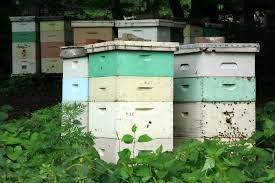
We were invited to a wonderful dinner and evening with good friends. Among the many things in which they are engaged is beekeeping.

This is a relatively new interest but they are doing it quite successfully in that this year, for the first time, they are gathering and using honey from their hive. It is producing enough (amazingly, I learned, it takes 50,000 individual pollen gatherings to produce just one teaspoon of honey) that for us and the other couple who was there, there was a ribbon-adorned jar to take home. Of course we couldn't wait and tasted some at the table--it is amazing!

I asked them how and why they got interested. "Well," he said, "you know about how there's a dangerous dying off of pollenating bees."

"I've been reading about that," I said. "Sounds serious. But how does that relate to your interest?"

"When I became aware of this I decided, in my own way, I wanted to do something about it. Not just to read and talk about it."

(See where this is going?)

"I guess all I do about the problem is read about it," I mumbled, as if to myself.

"We weren't satisfied just being aware of the problem. Mind you, we thus far have two hives and maybe 70,000 bees and we know that won't solve even a small part of the problem. But the way we look at it, every little bit helps."

"Indeed it does," I agreed, again, more from theory and concern than practice.

I don't know all that much about these friends' politics or ideologies. We haven't spent that much time talking about it. We have so many other things to discuss and enjoy together. But I sense he, at least, is a true political Independent. I know, for example, that he has voted for perhaps as many Republicans as Democrats for the presidency and Senate. Perhaps more. I guess that qualifies as Independent.

But when it comes to bees, though he blames big agribusiness for much of the problem (over spraying of the wrong insecticides), and this might be construed to be the progressive take, about other matters he feels quite friendly to many aspects of big business and would like to see more backing off from some of government's regulations.

So, again, it's complicated.

Labels: , , , , , , , , , , ,

Wednesday, September 24, 2014

September 24, 2014--New Friends

I've envied friends who are so much better than I at remaining close to people they know from college and even childhood.

I have felt there is something missing within me because I have maintained so few friendships from those times. How could I, I chastise myself, have seemingly intense, meaningful  relationships that span years and even decades and then distance myself to the point that they becoming attenuated and then ultimately end.

I rationalize--

At first we had so much in common but then life intervened: they moved, I moved--distance did not make our hearts fonder; they married people with whom I was not compatible, I did a version of the same thing; they had children, I never did; they developed extravagant tastes, I didn't; they drifted to the political right, I became more progressive; they found God, I was unable to.

So it was understandable, I justified to myself, that I would move on from generation to generation of friends. Different kinds of friends for different stages of life, I would say to myself. But it always sounded hollow.

And, I confess, I pulled back from some friends who I prefer to keep frozen in time.

Yeas ago I worked closely with a colleague, Flash was his street name, who at about 40 began to change in ways that upset and distanced me, including becoming attracted to orthodox Judaism and conservative Republican politics.

I wanted to remember him as the audacious and activist "Flash" and did not want to follow along his evolving journey to places I didn't understand or respect and, after that, into old age. Another issue.

So to me, though he is no longer an active friend, I will remember and cherish him as always youthful, unshaven, with shoulder-length hair, over-size lumberjack shirt, and battered construction boots, tirelessly working all day every day to help bring about social justice.

"Yes," a current friend says, "as you suspect about yourself, there is something missing within you; but since that may be true for me as well, I suppose this making and letting go of friends across a lifetime helps make us compatible. It's just who you are. Who I am as well."

But still I give myself grief about this since this also sounds like more rationalizing.

"Look," my friend presses on, "we met only, what, three, four years ago and don't you consider me a friend? A close friend? As close as I consider you?"

"Indeed," I say. "A friend, yes, and a very close one. What do you make of that? How could that possibly be? At this age?" I am genuinely perplexed.

"We enjoy each other. We need each other," he added almost in a whisper as if he didn't want me to hear. "And since we have experienced many similar things, including some sad and some tragic, and have gravitated to a range of common understandings, we have found many ways to enjoy each other's company and have come to care deeply about each other. Even this quickly. Limitations and imperfections aside, we are two reasonably fully-formed people. And that helps."

While taking this in, while I ruminated, he added, "Part of it is at this time of life many things are behind us which, if present, could, do get in the way of true and deep friendships."

"Like what?"

"Ambition, for one. And how we are now less about gathering and accumulating, engage in less pretending, have less fire in the belly, are less competitive, share aches and pains and worse, experience diminished hormone flow, less--"

"I get your point, and it's a good one" I said, cutting him off with a laugh. I was not wanting to get that intimate. But what he said made sense. And, if true, helped me understand why later in life it is possible to make new friends and gather them close. Perhaps as important--friendships that may last for the rest of our attenuated lifetimes.

I have been thinking about the nature of my experiences with friends, especially reflecting on some that are recent but powerful, since one of them, Steve Gerson (Dr. Stephen Gerson), died, to me, unexpectedly on Sunday. Yesterday was his funeral.

How could it be that since Sunday morning he has not been out of my thoughts?

He was anything but a lifelong friend--perhaps we saw each other during two, three years twenty times--and yet I despair that we will not have more time together. It is not just because, in spite of being chronically ill, he was so inspirationally full of life and interests and joy and work and memories and stories and insights and fun and optimism that I will miss him, but because there was an instantaneous intimacy that sparked between us and connected us deeper than understanding, seemingly for life. An anticipated much longer life, thwarted now, which also revealed that the magic potential of friendship does not end with age and it can come in stages.

Sad, I'll take what I got. It was a gift.


Labels: , , , , , ,

Friday, August 22, 2014

August 22, 2014--Best of Behind: A Jew in Vermont

This was originally posted on October 3, 2007. Since then, my friend has made a significant adjustment. He pines less for Manhattan and takes pride in growing tomatoes--

To come to Vermont for a visit in the autumn to witness the leaves changing or in summer to get away from the heat of the city is a non-sectarian event. But to leave your roots behind in that city in order to live there permanently is decidedly something else.

My Jewish friend (who to protect him from himself will here be referred to as “he”) who moved up here eight years ago, put his condition this way as we sat in a vast meadow, having arrived at it after following an abandoned logging trail; sprawling on the cut hay grass and looking out over the broad Connecticut River Valley toward the White Mountains of New Hampshire—I cannot recall a more transporting vista or feeling more at one with nature—he said: “Every day, and I mean every day, I think about what I need to do to get back to New York City.”

His wife, also Jewish, made a remarkable adjustment to their new life. Actually, a remarkable transformation. Really, a remarkable metamorphosis. She owns horses and cows and sheep and chickens and slaughters and butchers the latter to feed the family. She takes care of and rides the horses to the hounds (truely) and for hunting. Last year she had a moose license from the county and this year is allowed to “take” one doe. She seems to know everyone and all about every aspect of their lives—even of the usually stoical Vermonters. Jewishness does not appear to have been a problem for her.

He on the other hand knows nearly no one, can’t distinguish the front end of the horse from the rear (and doesn’t care to learn); has allergies to virtually all of Vermont’s wildflowers (which proves beyond DNA evidence that he is Jewish); and even the sight of anything that contains cheddar cheese makes him instantly nauseous.

There are, I suspect, other Jews in Vermont. For example, there is something that looks very much like a Jewish Center in Woodstock. But you would never know this from him. Though he holds a Hanukkah party every December and invites to it everyone who he knows or suspects might be Jewish (don’t ask how he makes that determination), even stretching his definition of what makes one Jewish, at its most attended there were no more than ten people who showed up—and, to drive home his predicament, I understand he invited potential members of the Tribe from every part of the state.

The few friends he has made (he calls them “acquaintances”) are worried about him. Even the non-Jews. Those are, truthfully, more concerned than worried—concerned being the gentile way to be worried. So, concerned or worried, they have through the years made many suggestions and offered encouragement about things he might do that they feel he would enjoy and that might make him become more of a Vermonter. Like get into serious recycling or heating his home with wood fires or organic gardening or throwing pots. Or even developing an interest in nature. Some, more radically, thought he might like skeet shooting or gourmet cooking. To them he said, “But I'm from New York. Guns are illegal and I always ate out."

And, he insisted, after getting into source separation where he divided his clear glass bottles from his green glass bottles and his coated paper from his newsprint, and so on, everything they suggested and urged made him think about illness, dying, and, what else, death.

“A Jew after all,” he would insist, “is a Jew.” Though no one within 50 miles of where he lives understood any of this, they did respect his right to think that way. Vermont, after all, prides itself on its openness to all manner of views and differences. It was the first state in the union, for example, to legalize same-sex unions. Do you need to know anything more?

“When I made a vegetable garden,” he moaned, “I was surprisingly good at it. In Brooklyn, where I grew up, there was hardly any dirt to stick a seed into much less a backyard that wasn’t made of cement. So what would I know about gardening? Organic no less. But when it came time to harvest my crop, every time I pulled a radish or carrot from the ground it felt like I was committing a violation against the Commandment ‘Thou shall not kill.’ I could almost hear them crying in pain.”

 I nodded in understanding. “And even worse was when I bought two of the latest high-tech wood stoves and tried to heat our house that way. To be environmentally responsible. I did well at that too, but when I had to clean the grate all I could think about was how all those mighty logs were reduced to a mere handful of ashes. ‘Dust to dust,’ as the sages said. It took me weeks to recover from the depression.” Again, I nodded.

“And then I threw pots, even though I never could figure out how what I was doing had anything to do with throwing.” This sounds promising, I thought. “But I had my problems with that too. Metaphysical problems.” I had no idea where this was headed. “Because whenever I placed one of my vases or bowls into the kiln they came out shattered. I turned them into shards. Just like the Zohar says. You know, that ancient book of Jewish mystical lore. How Cabbalists believe that the world was once a perfect vessel that became shattered, with the shards scattered everywhere. And that we Jews have a responsibility, Tikkun, to regather those shards as our contribution to healing the world. So there I was in the pottery shed making more shards all the while thinking I’m not carrying out my responsibilities. In fact I’m making an even bigger mess of the world!”

To this I had nothing to say and so he continued, “But what was worst was trying to become interested in nature. You’re up here now to see the autumn leaves. Fine. You think they’re a majestic and beautiful sight. And you are right. Before we moved here, when we would come for a visit that’s what I also felt. But now, when Nature puts on this display, all I can think about, again, is dying and death. This is the dying season. Call me crazy,” and I was beginning to, “but that’s the way I look at things in Nature. Yes, things bloom and are beautiful but very soon they start the withering and dying.”

I decided not to talk about dormancy and regeneration and the promise of spring. After all, I was headed back to New York in a day and a half to my restaurants and cable TV, so I tried a different tack--“But maybe this is a good thing. I mean maybe what you are observing in Nature is to put you in touch with elemental things and thereby inspire you to make every moment count.” I only half-believed this, but I was trying my best to be a good friend.

“And tell me what will I be doing with all those moments that I’ll be counting?” He swept the horizon dismissively with his hand.

For this I didn’t have a ready answer and said to him, in part to change the subject, “Look at those clouds over the mountains. Aren’t they magnificent?”

“Clouds. Smouds. To tell you the truth, right now I could go for a nice pastrami sandwich.”

Amen, to that, I thought.

Labels: , , , , , , , , , ,

Thursday, August 21, 2014

August 21, 2014--Obama's Past Tense

Over lunch with Loraine and Doug, after lots of catch up about family and work and what they've been doing while in Maine, she asked what we've been thinking about Barack Obama. She made a bit of a face which tipped off what she is feeling.

A lifelong progressive and feminist, Loraine in 2008 initially was a fervent supporter of Hillary Clinton's, but during the primaries found Obama's ability to inspire and his position on issues she cared deeply about to be so persuasive that she switched her support and offered her organizational skills to him and his campaign.

"I remember the excitement I felt when he won the nomination," she said now with a sense of sadness. "I found myself screaming with excitement, just like a teenager, and unashamedly and uncontrollably crying with joy."

I confessed that I found myself doing the same at that time and then later when he managed to get elected. If it were possible, when he gained a majority of Electoral College votes, I felt even more elated.

"The promise he represented," I said.

"For me," Loraine said, "it was more than that. It felt unbelievable that someone from his background, his mixed race background, who had spent his childhood in an Islamic country, that Americans could put all that aside and vote for him, to elect him. To me it seemed miraculous."

"It was a miracle," Rona said, "It felt as if America had healed its racial wounds, that we were voting as if to say--no, literally to say--we are one people. That the worst of our past is receding. For the current generation, hopefully, maybe it is fully healed. Wouldn't that be the end of the worst chapter in American history?"

"I felt it was all that," Doug, who is African-American, said.

"I notice," I said, "that we're speaking in the past tense. Or am I wrong? Am I projecting my frustrations with how things have turned out?"

"No, you're right," Loraine sighed.

"So what are you thinking now?" I asked.

"It's still the same miracle," she said, "But . . ." She trailed off.

"You know," Rona said, "we were at a dinner party last month with three other couples, all liberals, all of whom were enthusiastic supporters of Obama's."

"There's that past these again," Loraine said, smiling.

"Well, to the eight of us it was all past tense. No one was still feeling good about him. We as one said . . ." She didn't complete the thought.

"I still feel good about him," Loraine said. "In the present tense."

"I thought you were suggesting disappointment," I said.

"I am disappointed."

"Then I'm confused."

"In historical terms I feel good about him. Actually, still inspired."

"Because?"

"Because of what he represents and what he achieved. Maybe not in the governing arena--where I have become quite disillusioned--but in his very being. That he was able to inspire much of the nation and figure out a way to get elected. Twice. Amazing. Remarkable. Inspiring. But . . ."

"To be fair," Doug interrupted, "They--and you know who I mean--they did everything to thwart him, from day one to bring him down."

"From even before day one," I suggested.

"Right. So how could he have been more effective with all that fierce, bigoted opposition? His honeymoon lasted, what, maybe 15 minutes."

"Less."

"But, to be fair," Loraine offered, "He never figured out how to work with Congress even during the first two years when the Democrats controlled both houses. And, maybe more significant, where he has a lot of independent power, in foreign affairs, what can we say about him that's positive?"

No one said anything. Or had anything to offer.

"But, and it's a big but," Loraine concluded, "we've had other presidents who turned out to be disappointments."

"Many," I said, "Maybe most."

"And so he will probably be ranked by historians among those who have been disappointments. But I want to stay in touch with how I felt. Not to forget that. To continue to feel some measure of joy and inspiration. Our son, who looks like Obama, if you know what I mean," she glanced toward Doug, "for him anything is possible. That wasn't true the day he was born but today, because of Obama's example, it is. That means a lot to him, to me, to you as well," she winked at us, "And, if I may be so bold, to everyone else in this country. Even to those who don't recognize that or hate him. About this, they haven't a clue."

Labels: , , , , , , , , ,

Monday, July 15, 2013

July 15, 2013--Midcoast: Pumpkin Cove

"If you pass Pumpkin Cove Road you've gone to far." We were invited for drinks and a new friend was giving me directions to his house.

"If you do, make a U-turn and drive back in the direction you were traveling, being sure to go slowly because the road to our house, which is marked Private, is easy to miss."

"I think I know where it is. I mean, I know where Pumpkin Cove Road is; and before we get to it I'll be sure to drive slowly."

"Good," he continued. "So when you get to our road, turn left if you haven't gone too far or right if you had to make a U-turn. I hope the left and right directions aren't confusing."

"No," I said. "I'm good at directions and know if I don't pass your road I have to turn left, but if I do, I have to do the reverse--turn right."

"You sure sound like you know your directions," Martin said, "So I don't think you'll have any trouble once you're headed down our road. That is, if you don't miss it. It's a narrow gravel road, so my advice is that you should proceed slowly. You aren't in New York anymore where everything's paved and well lit."

"I'm used to these kinds of roads," I said. "Half the roads in Maine are narrow gravel roads."

"So, let's assume to don't pass our road and wind up at Pumpkin Cove, you'll be turing left."

"I got that already," I said, feeling a bit as if Martin was feeling doubt about my ability to know my left from my right.

"I'm just trying to make sure you don't get lost." He clearly had picked up on my building frustration.

"I appreciate that. I hate to get lost, especially when I don't know where I am."

He laughed at that, "Isn't that the definition of being lost?"

"What?"

"Not knowing where you are?"

"I suppose so."

"OK. So you managed to find our road and turned left or right onto it." I decided to just listen and take notes. "You go about half a mile, no, maybe two-thrids of a mile down our road."

I wrote down--Avoid Pumpkin CoveGravel road. Half mile. Maybe 2/3s.

"Then on your right, after you've passed a few roads that lead to other people's houses, you'll see a wheelbarrow lying on its side. On the right side. Of the road I mean. It's painted blue."

"Not William Carlos William's 'red wheelbarrow beside the white chickens'?"

"I like that poem too. About depending on it and how it's 'wet with rain water.' But, no, this one, I'm afraid, is blue."

"I'm a little colorblind and so it may not look blue to me."

Missing my sense of humor, he plowed on, saying, "I'm afraid it's the only one along the road, which is a good thing because it's there as a sort of road sign. We don't want any actual road signs. The people along our road like to keep things pristine and rural. But maybe like many colorblind people you are good with shapes."

"In fact I am."

"Good. So just look for something on your right side after half a mile--actually, more like two-thrids of a mile--that has the shape of a wheelbarrow. As I said, there's only one."

"And what do I do?"

"Turn right. That is unless you pass it and have to make another U-turn. Then you'll be turning left."

"It won't be another U-turn because I intend not to miss your road in the first place and wind up in Pumpkin Cove."

"That's good to hear, but you'd be surprised to learn how many of our first-time visitors get lost even though I give them very specific directions."

"Don't mishear me, you're doing an excellent job with the directions. I'm just being a little playful."

"All right then. So at the blue wheelbarrow you've turned right, hopefully, or, if necessary, you've come about and will be turning left."

I liked the nautical reference about coming about. Their house was, he said, right on the bay. In my notes I wrote--Blue wheelbarrow (look for one of any color). Turn right. Or, come about and turn left.

"Slow down then, not that you can go very fast because the road at that point has narrowed even further. But slow down anyway since you need to go just 50 feet more. Any more than that and you'll be on our neighbor's lawn." He chuckled. "Theirs is a red house. Oh, I forget," he paused, "you're colorblind. OK, it's the first house you come to. The only one. It's red, but you'll know it's a house by its shape." He laughed again. He was enjoying having a little goodnatured fun at my expense. I was totally enjoying all of it and sensed we were going to become good friends.

"Avoiding the lawn, make a sharp left. If you've made it this far." He assured me, "There'll be no need for any more U-turns. There's only one way to go. Actually," he corrected himself, "there are two: the first is up on their lawn, which you want to avoid; the second is to find the last 50 yards of the road that leads to our house. Got it?"

"Got it," I said. and wrote--50 feet. Red house. Avoid lawn. Go left. 50 yards. Arrive. Drinks!

"To me," I added, "if there isn't much light, red can look like black. The good news, though, is that Rona will be with me and she knows her blue and red is one of her favorite colors."

"Sounds perfect," he said. "See you at about 6:00. If you run into trouble or get lost, just give us a call and we'll get you here."

"No need for that," I said with self-confidence.

                                                            *    *    *

For the record--

On my first attempt, I did miss their road and made a U-turn at Pumpkin Cove Road. I remembered, then, to turn right onto their private lane.

And even though Rona has a good eye for color and I know my shapes, we missed the wheelbarrow. ("Should have been red," Rona said, "and wet with rainwater.") We did come about successfully and turned left.

I did not go up on their neighbor's lawn--I was going about two-miles-an-hour at the time--but because the left turn there is very tight and narrow, I did nip it a bit, which set his German shepherd to barking.

"Keep going," Rona said, "I don't like the sound of that dog."

And after another half minute we arrived at their front door. By then it was almost 6:30.

"I'll bet you can use a drink," Martin said, with a broad smile.

"Indeed I do," I said, "A double of whatever you have would be ideal."

He does make a mean martini.

An enduring friendship is certain.

Labels: , , , ,