Wednesday, May 16, 2018

May 16, 2018--Morel Mushroom Time

My friend Murray says that many of his liberal friends are feeling "dispirited." 

I asked why and he told me it's for at least two reasons--first that Trump seems to be doing well, that in spite of his outrageousness and the daily scandals his approval ratings are rising, perhaps into the mid-forties; and people he knows are fed up with all the breaking news. It's wearing them down, getting under their skin. As he put it, "They've had it up to here."

Another friend, Nancy, told me the other morning about a meeting she attended of Democrat activists who are attempting to nominate people who have a change of unseating incumbents in the November election. "The first meeting of this kind a couple of months ago attracted 60 participants," she said, "Those who attended were full of energy and optimism. Last week there was a followup meeting. Only 30 showed up."

When I asked why that might be she said because people are growing pessimistic as they contemplate the direction in which the country is moving. More following Trump than toward moderation.

And then I heard from another friend, Seth, who lives in Washington, DC, who is very bright, well informed, and activated. For months on Facebook he has been posting tough pieces that offer a sharp critique of Trump and his most fervent followers, both those in the government as well as politically-engaged Trumpians. 

In response to something I posted about reconnecting with what had happened during the week in which I did not watch any TV, Seth posted a response on Facebook. He has been a very inventive and successful chef and from that experience wrote--
Here's my two cents--turn the news back off. It isn't getting any better. Reason and logic will not overcome and we are all just waiting til midterms to find out if half the country really do support this administration, or if all the decent smart people just figured that the last election was a wash and didn't show up. 
Anyway, the more important current situation is that morel mushrooms should be popping up in the woods all around you right now. And for me there is nothing that soothes away the politics like a long walk in the woods. 
I have switched my political energy to mushroom hunting--not sure if living in DC makes it easier or tougher to drop out, but dropping out lets me sleep better.  
I am an avid recruiter for the sport of mushroom hunting. I think you will eventually find the coming chanterelle season to hold more anticipation than the Mueller investigation.
I love Seth, I really do, and I understand his feelings, frustration, and inclination to drop out. Especially if that includes morels. And I know he is writing this in part with tongue in cheek. But I also sense that he is feeling politically dispirited and that is not a good thing.

We need Seth and Nancy and Murray and everyone like them who see Trump and his administration to be a dangerous catastrophe to hang in there and fight, particularly when feeling dispirited. Because if we and people like us drop out and turn to our version of mushroom hunting, as a people, as a nation we are cooked. 

If in November Republicans retain their House majority, a walk in the woods will not be sufficient to distract us from what is surely to occur during the next two to six years.

Republicans, conservatives, Trump people will not be out searching for mushrooms. While we are, they'll be marching in majority numbers to local, state, and national voting booths. They are passionate and organized.

This is not the time to feel sorry for ourselves. There's a war going on and we have to engage in it. I'm for walks in the woods and gathering morels but we also have to find the right balance to do what we need to do to maintain our sanity--I get that--but also how to fight and win. 


Labels: , , , , , ,

Thursday, November 17, 2016

November 17, 2016--Don't Turn Off Your TV

Many of my liberal friends have been telling me that the results of the election and the current state of the transition are so upsetting that they've stopped reading newspapers and watching TV.

Having similar inclinations, I understand this.

In spite of this, I also feel we have to resist the impulse and make sure we're watching a lot of network and cable news, that we're reading all the newspapers and magazines we can tolerate, that we are spending time surfing the internet for political stories and insights, and are pushing ourselves to talk with each other about our frustrations and, much more important, what happened and what to do, to actually do, to make a difference, to recapture the agenda.

Republican conservatives have been adept at keeping in touch with who their people are and their issues and for decades have been organizing themselves to shape the discourse and gain power from the local to national levels.

Progressives? Not so much. Especially when it comes time to move beyond check-writing and self-referential smart-talk.

I'll be frank--what I've been hearing from liberal friends is that they are tuning off the news because dealing with it is making them unhappy. To quote many, "When I turn off the TV, I immediately feel better."

In response I have begun to say that, "With all due respect and affection, this sounds indulgent. Being an engaged citizen is not about feeling good. It's often about feeling bad and in spite of that, because of that seeking ways to become productively activated."

It's gotten to the point that some people I've known for many years don't want to talk with me anymore. Or, if we talk, want only to speak about happy, diverting things.

But unless more of us who opted out even before the election, pretty much having become disenchanted with politics, leaving the protection of our rights to governments, unless we reengage and get mobilized what we have seen recently is what we will likely experience for the rest of our lives.

One friend yesterday, finally exasperated by my unwillingness to stop hectoring him, said, "OK. I hear you. But what should we do? What should I do?"

Here's what I told him--
  • Write letters to the editor and op-ed pieces
  • Call in to radio talkshows, especially right-wing ones, and take on their demagoguery
  • Write to Democratic members of the House demanding they vote to replace Nancy Pelosi as minority leader
  • Write to whomever makes the decision about who you prefer to be the next head of the Democratic National Committee
  • Support, volunteer for, send checks to organizations such as the ACLU that are dedicated to promulgating and protecting liberal rights and values
  • Consider running for public office--school board membership is a good place to start
  • Spend vacation time driving the blue highways of America and talk with, listen to people at the lunch counters of local diners
  • Keep the TV on and watch not only PBS but Fox News, especially Fox News
  • Get started fighting back
  • Never give up!
Richard Nixon

Labels: , , , , , , ,

Thursday, March 10, 2016

March 10, 2016--Dangerous Election

The most recent issue of The New York Review of Books includes a cautionary article by Michael Tomasky about the presidential election, "The Dangerous Election."

He attempts to ferret out and explicate the concerns of voters from both parties.

Here is the heart of what he has to say--
The developments within both parties reflect the long-standing anxieties that liberals and conservatives feel about the country, anxieties that have only grown sharper as time has passed. For liberals, the chief concern for thirty-five years now has been about the unfairness of the economy—virtual wage stagnation for most workers, huge gains for the top 1 percent, and the lax regulatory and enforcement regimes that have permitted those outcomes, along with slow recovery from the most recent recession. 
For conservatives, for about the same period of time, the main worry has been what is broadly called “culture,” by which we really mean the anger and resentment felt by older white Americans about the fact that the country is no longer “theirs” and that their former status and authority no longer seem what they once were. This rubric takes in a number of issues—immigration, especially illegal immigration; same-sex marriage; a black president in the White House; all the things that conservatives bundle under the reviled label “political correctness.” In their minds it is some sort of taint that has infected every institution in this once-great nation and is destroying it daily before their eyes.
What's wrong with this is that it is full of stereotypical thinking. 

As common on the left as the right.

According to Tomasky, liberals are interested in economic issues while conservatives are concerned primarily with those that are cultural.

This is so oversimplified as to make his analysis useless. Actually, harmful.

Conservatives are as interested in economic issues as Democrats. Manay may have a different perspective--less focused on inequality and more on tax policy and deregulation--but since by no means are all conservatives affluent, those in the middle class have also experienced wage stagnation since the 1970s. And are as frustrated about this and feeling as betrayed as those on the left.

And to imply that liberals do not have passionate cultural concerns suggests one has been oblivious to the powerful agenda pursued by Democrats to assure equal rights to women--the right to choose is as cultural an issue as the fight to overturn it. Further, the ongoing campaign to expand and protect the rights of various minorities from people of color to those from the LGBT community are also cultural  Affirmative action and the right to marry who one loves for many progressives trumps economic concerns.

It is important not to mischaracterize those with whom we have differences. If we want to heal the social divide and find ways to work with those with whom we disagree, we need to avoid such superficial thinking. 

If we feel that there are social maladies that require addressing, that this, in Tomasky's words is "a dangerous election," it is essential to begin with a carful diagnosis. Promoting stereotypes is the opposite of being helpful.

Labels: , , ,

Tuesday, August 04, 2015

August 4, 2015--The Southernization of America

Anyone interested in understanding the conservative resurgence or revolution, if you will, should turn off Fox News and read Godfrey Hodgson's prescient, 1996 eyeopener, The World Turned Right Side Up: A History of the Conservative Ascendancy in America.

If you are interested in the intellectual roots, he does a good job of summarizing the contributions of serious economists such as Friedrich Hayek; pseudo-serious novelists such as Ayn Rand; polemicists like William F. Buckley, Kevin Phillips, and Irving Kristol; evangelical religious leaders such as Jerry Falwell; and political figures including Barry Goldwater and of course Ronald Reagan.

All of this is familiar ground for anyone paying attention to the cultural and political shift rightward, but nowhere all pulled together as well as by Hodgson.

For me, noteworthy is Hodgson's insight--or at least his clear statement--of how the ideology and politics that followed on in the South, transforming it from the Democrats' Solid South, after the Civil Rights Acts of 1964 and 1965 were signed into law, and quickly became solidly conservative and Republican. The South at that time became the South that we now know and live with, continuing today to shift inexorably to the right.

Nothing that new about that. But what is new is Hodgson's perception that much of the North shortly thereafter--certainly by 1980 when Ronald Reagan became president by picking off millions of so-called Reagan Democrats--became southernized.

This happened in two stages--first there was the dramatic population shift of northerners to the former Confederate States and thereby their accruing electoral power. Reallocation of members and redistricting meant more seats in the House of Representatives for conservatives at the expense of liberal states such as New York and Pennsylvania; and, as Texas and Florida passed New York to become the second and third largest states, there was a dramatic increase in the South's number of votes in the Electoral College. With the South also becoming solidly Republican that made it much more difficult for Democrats to control Congress much less the White House.

The second stage, the result of Reagan's appeal to traditional blue collar Democrats and his election and reelection, subsequently turned a number of blue states into purple states (Pennsylvania is a good example) and over time threatened to turn a few northern purple states to red states.

Perhaps the most dramatic example of that transformation, and perplexing to progressives because of its role in the history of the emergence of the Progressive Movement, is Wisconsin, where Scott Walker managed to get elected governor three times, largely by acting as if Wisconsin were South Carolina.

As in the South he appealed to hawkish hyper-patriotism, belief in American exceptionalism, evangelical impulses, anti-affirmative action forces, a desire to limit government of all kinds, dog-whistle racism, and above all attacks on unions. Thus, Wisconsin has tipped to the right and now culturally and politically could become a permanent part of the emerging conservative majority.


Labels: , , , , , , , , , , , ,

Tuesday, November 11, 2014

November 11, 2014--Liberals

Shortly before leaving Maine we had breakfast with two very liberal friends. This was about a week before the recent midterm election and part of what we discussed was how they thought the results would turn out.

"Don't believe the polls," Arnie said, "He may be behind, but I feel certain LePage will be reelected governor. And easily. In fact, I predict we'll see a Republican sweep across the country."

"Why's that?" I asked. My read of things was that the GOP had a good change to take control of the Senate but thought Dems would do well in governors races.

"That's because we liberals don't get off our fat asses for midterm elections. We save our political energy for those years when presidents are elected. But we're good at complaining--in fact we make an art form of it--but when it comes to taking action we're not so good."

"Wouldn't you think," Jim said, "that women, young people, and minorities would be racing to vote this time around? Because if they don't, say goodbye to reproductive health care and, for that matter, health care more generally. And what do you think will happen to voting rights and education funding, especially money to help low-income youngsters pay for college?"

"When all the votes are in," Arnie said, "we'll hear all the whining and moaning and groaning on MSNBC."

"And excuse making," Jim added. "How the system is broken. Blah, blah, blah."

Sure enough, things turned out even worse than Arnie and Jim predicted and, yes, there is now all that liberal finger pointing.

Back in New York, after the election, I took up the conversation with other friends. They too complained that the system is broken. When I asked them what they had done beside sending out some checks to favored candidates and causes they avoided eye contact. I'm not even sure they voted. But they were full of jizzum about, again, the broken system.

When I said that I felt the system was broken only for us liberals, that conservatives are feeling pretty good these days about the system, that they are looking forward to that system getting government out of their lives (that should only be) and out of the business of spending their tax money on people who don't want to get off their duffs and work to feed their kids.

"Well," Sarah said, "that's because they have all these beliefs, unverified ones by the way, about the natural order of things. A version of survival of the fittest where competition and the market will take care of our problems. That is, if we leave things alone. As you know from history, this just doesn't work. But, if they believe," she said sarcastically, "to them it must be true."

"I agree with some of that," I said, "But let me ask you something--in fact, let me also ask myself something."

"What's that?" an equally frustrated Doug asked.

"Are there any beliefs that we have? Liberals I mean. Beliefs that are equally not verifiable from evidence?"

"You mean all the research and talk about the fundamental, even neurological differences between belief-oriented versus evidence-oriented people and how that affects political behavior?"

"Maybe. But not to get into that discussion, which in my view is based on still insufficient evidence, I'm simply asking if we who consider ourselves open-minded and minimally fact- or scientifically-oriented, if there are things we just believe."

Both Sarah and Doug stroked their chins, trying hard too come up with something they believe that was based on something like faith. I too sat sipping my coffee, asking myself the same thing, admitting it's not something I had thought too much about, satisfied as I am with how objective and rational I considered myself to be.

"Wait, I have something," I said all excited.

"I can't wait to hear this one," Doug muttered.

"Here's something I think that goes to our political and ideological core--don't we believe, without supporting objective evidence, that government should play a significant role to help our most vulnerable citizens?" Sarah and Doug stared at me blankly.

"You know, in health care, education, housing, things of that kind?"

"I'm not following you," Doug finally said.

"Look, I support all of these programs. At least the ones that work, which is a whole other conversation. But what hard evidence can we cite to support these beliefs?"

"The evidence that student loans help millions go to college who otherwise couldn't afford to."

"Again, I favor that. But that's about outcomes, not the truth from nature that tells us what must to be done. To support programs of this kind is not written on tablets but is based on following a set of beliefs about how we should behave toward each other. It's the right thing to do, I feel certain about that, but it's justified by how I feel about our various roles as citizens. I believe that's how we should behave as individuals and governments. With 'feel' and 'believe' underlined. Again, these core values are not evidence-driven. Maybe the outcomes are objectively measurable but not the underlying principles about the appropriateness or requirement that we act this way.

"Maybe," I continued, "we don't even having 'inalienable rights,' that these too are not from nature but socially constructed."

"In other words," Sarah offered, "you're saying we're no different than those who believe in a very limited role for government? Let the chips fall where they may in a survival-of-the-fittest mode?" I nodded. "I'm not interested in living in that kind of world."

"Neither am I," I said, "But I think it's a good idea to recognize, to acknowledge that we're not so different than conservatives in that much of our political core is as belief-driven as theirs. We obviously believe very different things and come to very different conclusions, but like them believe we do."

"If this is true," Doug sighed with a sense of resignation, "we are to some extent jerking ourselves around. Thinking about ourselves as superior--intellectually and, worse, morally superior to the Tea Party folks and their GOP enablers."

"Which is why," I said, "we too often sit around analyzing and complaining and excuse making. We're good at all of that and maybe even get it right--at least I believe that," I winked, "But I don't think it's helping us push back or do well at the polls--nationally, at the state level, and locally. We're losing on all those fronts. The other side is now even out-organizing us. They have the energy and momentum. OK, because they are more fervent in their beliefs; but since we share strong beliefs too we had better get up off our couches and turn off our iPhones and get to work.  Especially locally because that 's where the future leaders are coming from."

"I did notice a bit of a generational shift in last week's election results," Sarah said, "The Democrats felt old to me and the Republicans more youthful and energetic."

"Hillary beware," Rona said.

"One more thing," I said. "I know you have to run, but here's another problem that's under-discussed--Evidence is that minorities aside, Democrats, true liberals like us, are better educated and much more affluent than your average middle-class and rural conservatives--excluding billionaires like the Koch brothers of course--and we thus have been big beneficiaries of the Bush-era economic and tax polices, all of which were made permanent during the early Obama years."

Sarah was looking at me skeptically. "You, too have benefitted, " I said to her. "And me as well. Without getting into specifics, I have paid much, much less in taxes the past 14, 15 years than previously. And, I confess, I like that and thus do not feel that motivated to agitate to pay more. Even if it went to programs I believe in and at least theoretically support. I say 'theoretically' because I'm not that much good when it comes to political action and mobilization. I'll confess--I like my lifestyle and don't want to see too much of it change."

Doug said softly, "I think you're right," he glanced at me, "We have been too full of ourselves, believing that if we get the policies right the politics will follow."

"Obama said the same thing Sunday on one of the talk shows," Rona said.

"That view feels a little arrogant to me," Sarah admitted.

"I agree," I said, "I think so-called 'average people' perceive us and our policies this way. To them we come across as knowing better than they do what's best for them."

"I need to think about this some more," Doug said, staring into his empty coffee cup.

Labels: , , , , , , , , , , ,

Monday, October 27, 2014

October 27, 2014--Busy Bees

I caught a lot of grief about Friday's blog, "Just Talk."

Those I heard from felt I was being unfair to liberals and too "understanding" and "casual" about those beliefs of conservatives that are not only "outrageous" but "harmful." That I let off the hook too casually those who do not believe in evolution or climate change. In a world threatened by ebola, as an example, how could I sit so comfortably over coffee with someone resistant to the findings and "truth" of science? Perhaps, some speculated, I have become so besotted about life here in Midcoast Maine that I have lost perspective and my ability to think clearly.

There may be some truth to this but some of this criticism missed my bigger point. Or at least the point I thought I made clearly enough that was to me the bigger point--

That credibility accrues to those who are activated by their views (even views one rejects or disagrees with) and less to those who just talk about them. And my perception--perhaps over-generalized--is that it is we liberals who tend to talk while letting others act for us while conservatives are mobilized, looking to change things. And among the things they want to change, if we would listen and pay attention, are at times things in which we are in agreement. Even if the underlying reasoning is something about which we differ. I cited Willy's and Ben's active support for local recycling, not so much for environmental reasons but for literal cost-benefit ones. In this instance, we can stand on common ground about the behavior if not the motivation and ideology.

And so, as I ended the Friday piece--it's complicated.

Here is another example from Saturday night.

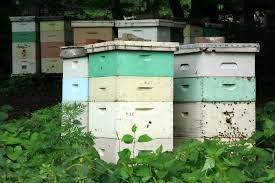
We were invited to a wonderful dinner and evening with good friends. Among the many things in which they are engaged is beekeeping.

This is a relatively new interest but they are doing it quite successfully in that this year, for the first time, they are gathering and using honey from their hive. It is producing enough (amazingly, I learned, it takes 50,000 individual pollen gatherings to produce just one teaspoon of honey) that for us and the other couple who was there, there was a ribbon-adorned jar to take home. Of course we couldn't wait and tasted some at the table--it is amazing!

I asked them how and why they got interested. "Well," he said, "you know about how there's a dangerous dying off of pollenating bees."

"I've been reading about that," I said. "Sounds serious. But how does that relate to your interest?"

"When I became aware of this I decided, in my own way, I wanted to do something about it. Not just to read and talk about it."

(See where this is going?)

"I guess all I do about the problem is read about it," I mumbled, as if to myself.

"We weren't satisfied just being aware of the problem. Mind you, we thus far have two hives and maybe 70,000 bees and we know that won't solve even a small part of the problem. But the way we look at it, every little bit helps."

"Indeed it does," I agreed, again, more from theory and concern than practice.

I don't know all that much about these friends' politics or ideologies. We haven't spent that much time talking about it. We have so many other things to discuss and enjoy together. But I sense he, at least, is a true political Independent. I know, for example, that he has voted for perhaps as many Republicans as Democrats for the presidency and Senate. Perhaps more. I guess that qualifies as Independent.

But when it comes to bees, though he blames big agribusiness for much of the problem (over spraying of the wrong insecticides), and this might be construed to be the progressive take, about other matters he feels quite friendly to many aspects of big business and would like to see more backing off from some of government's regulations.

So, again, it's complicated.

Labels: , , , , , , , , , , ,

Friday, October 24, 2014

October 24, 2014--Midcoast: Just Talk

After a complicated breakfast with Jim, during which a nuanced and balanced conversation about affirmative action and same-sex relationships descended into indiscriminate Obama bashing (Jim whispered conspiratorially as we were leaving, after I confessed disappointment in Barack Obama's presidency, "Don't you agree that he's working to bring down America?") over anniversary dinner later in the evening with other friends, we got to talking about how in small towns such as this one, where people depend upon, even need each other to get through life's perils, we generally find ways to disagree and often those with whom we have the sharpest disputes are the very ones we call on when things are most urgent; and, if we are honest about that and, more important about ourselves, we discover that our differences almost always amount to just words.

They amount to just words because, in truth, most of us are not actively or directly engaged in working to bring about social or political change (no matter its ideological direction or content) and are not that active in fraternal or civic organizations. Rather we talk. Talk passionately about things we believe in while remaining relatively unengaged.

Is this too cynical a view?

In some ways yes. In other cases maybe not. Like so much here this too can be complicated.

It is not cynical when it comes to holding accountable many of my fellow liberals (me as well) who are especially adept at the talking while this cynical view is unfair for many of those of more conservative persuasion who tend to be more actively and directly involved in the life of the community.

They are more likely to be volunteer firemen or, as a member of the EMS squad, are the ones likely to come in the middle of a stormy night to race us to the local ER. Or active on the Town Board. Or lead discussions about why source separation of trash is important--not necessary as liberals would have it to preserve the environment but because the Town can make money selling recyclables and thereby lower taxes.

About that, Rona wondered out loud if our environmentalist-minded friend, Peggy (to pick on her), back in New York City recycles as much or as assiduously as Jim in Bristol, Maine.

"No way," I said, agitated by my awareness of Peggy's hypocrisy as well as mine.

Jim, who is 81, is active on the local school board even though his youngest is in her thirties. "I have grandchildren, you know," he shrugs as if that explains it all.

And though he's not so sure about including a lot about climate change in Earth Science or referring too much to Evolution in Biology, he's out there in the middle of winter determined not to miss even one meeting while I talk, talk, talk about how we can't ignore the lessons of science, not only if we want to try to repair our planet but also to prepare our youngsters to be competitive in the global world of the 21st century. And though the signboard by the school I drive by at least twice a day says "All Are Welcome" to board meetings I haven't made it to one yet though every year I intend to make them all.

When I confess this to him, to help alleviate my guilt, he reminds me that I was an educator for more than 40 years and I do write and publish my views on schooling. That I've "paid my dues," and--

"But," I say before he can finish making excuses for me, "Yes, but still . . . I know. . . Maybe next . . .

He smiles to let me off the hook but . . .

Bottom line--a lot of things seem to work better here because at the most fundamental level we all know it is our relating and caring for each other that counts more than the talk, which in spite of various forms of inflation, is still cheap.


Labels: , , , , , , , , , , , , ,

Thursday, September 04, 2014

September 4, 2014--Fear Itself

Reading Before the Storm: Barry Goldwater and the Unmaking of the American Consensus, the first of Rick Perlstein's monumental trilogy of books about the contemporary conservative movement, there is this about Fred Koch, the Koch Brothers' sire, and his comrades in 1960 when they were working largely out of view to promote the conservative movement. Specifically about the role of fear in American politics:
. . . Conservatism was a conservatism of fear. They harped endlessly on the "communist income tax," how the economy would be decimated by inflation every time a worker got a raise. (Taft Republicans, joked The Nation, feared "only God and inflation.") Their scapegoats were unnamed subversives who were invisibly destroying the system from within: "I am at a lose to understand the current public attitude deflating the inflation psychology," Fred Koch wrote in a self-published pamphlet. "Perhaps it is propaganda, of which we have been fed much of late--pink propaganda, in as much as, in my opinion, Russia's first objective is to destroy our economy through inflation."  
Politically the philosophy lost when it won [my italics]: if you removed the fear of subversion by catching subversives, you ended the fear that brought you to power in the first place--although, of course, you could never catch all the subversives, for the conspiracy was a bottomless murk, a hall of mirrors, a menace that grew greater the more it was flushed out. 'The Communists have infiltrated both the Democrat and Republican Parties for many years," Koch wrote. "If we could only see behind the political scenes, I am sure we would be shocked."
Thinking about this early the other morning, I speculated that there are basically two underlying sources  from which political power derives--

Fear is one force. Real, imagined, and often, by politicians, manipulated. Recall that during the 2008 primary campaign Joe Biden, famously calling Rudy Giuliani out as a fear merchant, said that everything he says is made up of a "noun, verb, and 9/11."

When looking at the social psychological reasons why people, without coercion, will give up their freedom to authoritarian leaders, Erich Fromm in Escape from Freedom, offers evidence that they do so because they either have real things to fear (economic collapse, external military threat, discrimination) or are fear-driven in their orientation. Like the Kochs they see threats all around even when they do not in fact exist.

Progressives, on the other hand, are willing to give up some of their autonomy--freedom, if you will--for the collective good. At least the collective good as they perceive it--that no one should go homeless or hungry or untreated if they are ill. Seeking the greatest good for the greatest number is what drives them politically.

As with conservatives, there is with them also the possibility, and often the reality, of self-delusion. And they have not always been reluctant to embrace their own manipulative methods. What one may claim to be the greatest good for others is not often put to the test--asking those for whom decisions are being made if they perceive them to be in their best interest.

So, in the first instance the instinct for a version of survival drives belief and behavior and in the latter case arrogance can take hold as those with power decide for the rest of us what is supposedly in our best interest.

Labels: , , , , , , , , , , ,

Tuesday, August 12, 2014

August 12, 2104--Midcoast: Peggy Pays a Visit

"Don't you find it frustrating to be living here among so many conservative people?" This from a visiting friend who is very progressive and politically-minded.

"Actually, I find it both challenging and interesting." Peggy looked at me skeptically. "Really, the challenging part is obvious. It's always difficult to converse with people with whom you have deep disagreements. But the interesting part is more important."

"Interesting?"

"Well, I learn new things if I can manage to keep my mouth shut and listen. And in spite of what you might think, not all conservatives are ill-informed or rigid. That is, no more rigid that you or I." I winked at her.

"But don't you find that when talking about, say, food stamps, you immediately run right smack into a brick wall--they're dead set against it while you'd like to expand it?"

"Maybe. Or at least that may be where we start--with them (usually a him) wanting to eliminate it while, you're right, I'd probably put more money into funding it."

"And so? That's it, right? Dead end?"

"Well, no."

"No what?"

"No, that doesn't always end the conversation." She continued to look at me out of the corner of her eye. "And that's half the point."

"What is?"

"That it's a conversation--at least we try to make it one. Not a shouting match or a series of pronouncements that go over each other's head."

"I'd believe that when I see it."

"You'll have to trust me." She folded her arms across her chest and took a deep breath. "But let me give you an example from last week. It just happened to be about food stamps. This friend, Willy, was going on and on about how he was at the checkout counter in Hanneford's and ahead of him was this guy who was paying with a SNAP card. Willy said, 'I know him. He lives in a $500,000 house and drives a BMW that must have cost at least $60,000. He shouldn't be getting food stamps.'

"I said, 'If that's true, I agree with you.'"

"'You do?'

"'Absolutely. I'm against anyone ripping off any government program, be it food stamps or Medicare.'

"Surprised at that, he said, 'But I thought all you liberals want to give everyone a free ride--food stamps, housing vouchers, disability, heating oil, the whole works.'

"I said, 'I don't know about others, but I'm pretty progressive and don't want to do any of that. I'd like to see more money in some of those programs, true, but I'd put in jail anyone who rips them off.'"

"You said that?" Peggy said, "You believe that?"

"Indeed I do. Shouldn't we liberals be the first ones to call for the end to waste and abuse in our favorite programs? If we believe in them and want to see them continued, we should be in the forefront of critiquing them and cleaning them up when they go off the rails and not let the conservatives have a field day, attacking them like Willy, based on a few bad examples. We should protect what we believe in by being extra vigilant and out front about problems."

"So that did the trick? You agreed with him about the guy with the BMW and now Willy's in favor of food stamps?" She was mocking me.

"Not exactly."

"What happened next?"

"I said, 'Let's try to narrow our differences.' Willy nodded, indicating he was OK with that. We had tried to do that before about other issues with occasional success. So I asked him how he feels about children not being properly fed. He said no child should go to bed hungry or to school without breakfast. I said that I agree with that but asked how we should make sure kids get food if their parents either can't afford it or are irresponsible.

"He at first didn't have an answer to that. Then he said, 'We have this Caring for Kids program here. Local people contribute money to it so students can have healthy snacks during the school year; and during the summer, when they can't get lunch in school, they provide it at no cost.'

"'That's a good example,' I conceded, 'of how people, not the government, can help those with needs. But,' I pressed, 'I know about the program, which is very good--I contribute to it--but it's reach is limited and they can't provide other meals to kids. Dinner, for example. Or during weekends. For that, I think, we have to have something like food stamps because the need is so great and only government can cover the costs. The whole program costs $75 billion a year.'

"He said, 'For that I'm all right with a government program. To make sure children are taken care of. It's not their fault if there isn't enough charitable money for that.'

"'I'll tell you what I'll do,' I offered, 'Neither one of us, of course, has a smart phone . . .' 'Another thing we agree about,' he said. 'Touché,' I said 'But let me check on the Internet later today to see how the food stamp money is distributed. How much of it goes to children. Than we'll see where things stand.' He reached across the table to shake my hand in agreement."

"So what did you discover?" Peggy asked.

"It took me just a few minutes to learn that there are about 22 million kids who receive food stamps and that this represents 48.7 percent of all food stamp recipients. Nearly half. More than I had thought."

"What happened next?"

"Well, Willy was waiting for me at the diner the next morning and without ado I told him what I learned."

"And what did he say when you told him this?"

"'I trust you and . . .' and then he got quiet.

"'And?' I probed.

"'And, so I suppose about this we're in 48.7 percent agreement.'

"'Let's work on the rest,' I said. 'Disabled elderly people, for example, get about 8 percent of the food stamp money. Are you OK with that?'

"He said he was. 'And about 19.8 percent are seriously disabled adults. He said he was OK with that too.

"'If I know my arithmetic,' I said, 'this means that maybe in regard to food stamps, we're in more than 75 percent agreement.'

"'76.5 percent,' he said with an exaggerated wink.

"So there you have it," I said to Peggy. "How up here we try to talk about even controversial things and at times manage to find some common ground."

I think Peggy was impressed. "I want to meet this Willy character," she said.

"Only if you promise to play nice."

"I'll think about it," she smiled.

Labels: , , , , , , , , , , ,

Thursday, July 03, 2014

July 3, 2014--Barefoot and Pregnant

I recently read Sean Wilentz's Age of Reagan.

It's a reasonably balanced view of how Reagan emerged on the national political stage in 1964 during Barry Goldwater's quest for the presidency and how, when Reagan was elected president, his administration became a vehicle for the proliferation of neo-conservative thought and action, with players who then and later influenced domestic and foreign policy. He managed to keep the pre-empters isolated, those who wanted to aggress against the collapsing Soviet Union, but allowed supply-siders to take control of economic policy.

Trickle-down became the belief system that guided tax and spending policy and, though it didn't work (the federal debt tripled and the gap between the rich and working poor began to widen dramatically), it continues to dominate, even control current conservative thinking.

Wilentz does a good job of describing the basic Republican strategy, fully on display during the Reagan eight years, to undo the policies of the New Deal, Fair Deal, and Great Society.

With the significant exception of welfare reform, they never had the votes (as now) to overturn or dramatically transform safety-net programs such as Medicare and Medicaid, Social Security, unemployment insurance, aid to education, federally-subsidized college loans, low-income housing, food stamps, and the like, nor could they get the Supreme Court to declare these unconstitutional. But they did figure out an effective long-term strategy to reduce and even eliminate them--asphyxiate them by cutting off their fiscal oxygen supply.

By refusing to go along with full appropriations, not agreeing to spend the money required to sustain these policies, over decades they have managed to chip away at the size and reach of many of these signature progressive programs.

It's the basic jujitsu approach to legislating--do as little as possible, better, do nothing and in the process watch programs such as Head Start wither.

A few are sacrosanct and have widespread support even among anti-government Tea Party Republicans--cut government to the bone, they chant, but take your hands off my Medicare and Social Security. Both actually forms of socialism!

Tea Party folks may say this, but the Republicans they keep reelecting to Congress continue to vote to make Social Security either discretionary or investable in the stock market and have voted repeatedly for the so-called Ryan budget, which would end Medicare as we have come to know and depend on it.

Democrats have no equivalent long-term plan to preserve and expand policies that reflect their core values and, as a result, the handwriting is on the wall. Even if they manage to keep electing Democrats to the White House this policy erosion will continue.

Beyond congressional tactics, for the moment conservatives have firm control of the Supreme Court and the national federal judiciary and there they are doing a version of the same thing--taking seemingly small regressive steps that have enormous long-term consequences. The recent Hobby Lobby decision is a case in point.

It exempts two small family-owned companies from having to comply with the Obamacare requirement that their health care insurance cover the cost of contraceptives. But legal scholars worry that this is just a foot in the door to other forms of restriction. Few are yet thinking of rolling back the right to buy and use contraceptives--pre-Griswold v. Connecticut days--but one never knows. There are more than a few Republican and Tea Party leaders who would ban all forms of contraception and like to see women again barefoot and pregnant.

Labels: , , , , , , , , , , , , , ,

Wednesday, May 14, 2014

May 14, 2014--Marco Rubio in 2016

According to a string of recent reports in the New York Times about climate change--
A large section of the mighty West Antarctica ice sheet has begun to fall apart and its continued melting now appears to be unstoppable, two groups of scientists reported. . . . If the findings hold up, they suggest that the melting could destabilize neighboring parts of the ice sheet and a rise in sea level of 10 feet or more may be unavoidable in coming centuries. 
These latest findings by NASA and other earth scientists appeared in Science magazine and Geophysical Research Letters.

When confronted with this evidence, Senator Marco Rubio, an almost-announced candidate for the 2016 Republican presidential nomination, said he does not "believe" this to be true, that he disagrees with the science, and most important to his political aspirations, does not "believe" that humans are responsible for climate change. To him and most other conservatives, climate is always changing. Thus, there is nothing new happening or to be concerned about.

This from a senator who represents Florida, half of which will disappear under water in coming decades.

I put "believe" in quotes not only because that is the word Rubio used repeatedly during a series of TV interviews on Sunday, but because it represents the heart of the political part of the problem--progressives cite scientific evidence when they argue that humans are in fact contributing to global warming while conservatives base their case on belief.

Rubio over and over again claimed that the science is either flawed or ideologically based. And just as often said he didn't "believe" it.

In his words--
I do not believe that human activity is causing these dramatic changes to our climate the way these scientists are portraying it. And I do not believe that the laws that they propose will do anything about it.
He did not cite any evidence that what we are seeing is a totally natural phenomenon and, irresponsibly, was not challenged by any of his interviewers to do so. He was simply allowed to get away with critiquing the scientific evidence without citing any contrary scientific evidence.

He did not cite even one study when making his case. I suppose if he knew enough to do so his anti-science Tea Party supporters would feel he had somehow gone over to the other side by citing even flawed science. Any science at all. They don't believe in science.

Nor was he asked, "What if you're wrong? How will you be able to look your grandchildren in the eye when later in the century their houses in south Florida will be literally underwater? When they ask you what you were doing when there was still time to do something?"

I suppose Senator Rubio, or Vice President Rubio, will say he still doesn't believe its happening.

Labels: , , , , , , , , , , , , , ,

Wednesday, March 26, 2014

March 26, 2014--Political Celebrities

I was thinking the other day that one of the very few benefits of being a progressive is that liberal entertainers are much better and cooler than conservative ones.

Who, for example, would prefer Tom Selleck to Matt Damon? Or (an easy one) Ted Nugent to The Boss?

But then I did a little more Googling and I'm not so sure.

Democratic supporters include--

Demi Moore
Jack Nicholson
Regis Philbin
Hugh Hefner
Jerry Springer
Paula Deen
Hulk Hogan

I like the Hulkster, but Paula Deen's a Democrat? That's just too much.

So, I took a closer look at the roster of GOP supporters, thinking maybe there are a few less-than-75-year-old white guys on the list. In fact, there are some--

Kid Rock
Susan Lucci
Britney Spears
Sylvester Stallone
Larry the Cable Guy
Meatloaf

But then there's Pat Boone, who's at least 100 and very white. And, equally ancient and Caucasian, Clint Eastwood of the empty stool.

Some say Taylor Swift's a Republican, and I suppose that counts for something. Though her singing sounds pitchy to me.

On the other hand, a still prominent liberal to be endured is Babra Streisand.

Life can be so complicated.

Labels: , , , , ,

Wednesday, January 08, 2014

January 8, 2014--Lynching

Circulating virally right now among progressives is a blog posting by Frank Schaeffer, a former member of the Religious Right, in which he comes to the defense of Barack Obama, claiming, with considerable truth, that much of the disproportionate and even savage criticism of Obama is because of racism.

Schaeffer emerged from his Evangelical life a number of years ago and has been telling his story in a three-volume memoir called by some the God Trilogy. In the first of the three, Crazy for God, he reveals that he left his Fundamentalist coreligionists when he "realized just how anti-American they are."

In the blog, "GOP Driven Crazy by Hatred for Obama," which is being widely circulated by some liberal friends of mine, Schaeffer reveals that--
[He] changed because, if this country will lynch a brilliant, civil, kind, humble, compassionate, moderate, articulate, black intellectual we're lucky enough to have in the White House, we'll lynch anyone. What chance does an anonymous black man pulled over in a traffic stop have of fair treatment when the former editor of the Harvard Law Review is being lynched? [Emphasis added.]
Shaeffer is the new darling of many progressives because it is so rare for someone, anyone to switch ideologies from right to left. Pretty much all political conversions are in the other direction, from liberal to conservative. It is much more common to find Dick Morrises who begin life as fervent supporters of Democrats and then, for various reasons, become disillusioned with liberal orthodoxy and migrate to the other side of the political spectrum. In cases such as Dick Morris' they become ultra-conservative, believing in paranoid conspiracies or come to realize there's more of a quick-buck available on the extreme right than left.

But the criticism and attacks Obama is experiencing is not a lynching.

A lynching is a lynching as the Holocaust is the Holocaust.

If liberals who pride themselves on knowing their history engage in this kind of hyper-inflated rhetoric how can one criticize right-wing conservatives when they call Obama an Islamic socialist or communist?

Labels: , , , , , , , , , , ,

Tuesday, October 08, 2013

October 8, 2013--Stagehands

"It's not that I'm antiunion," Stan said, which surprised me. He tends to take conservative positions on most issues of public policy.

"But from what I'm hearing about your stagehands, I'm not so sure."

"My stagehands?" I looked at him quizzically, "I'm a bit confused. I don't have any." We were sitting together in a booth at the Bristol Diner, with the sun streaming in, whiling away the morning.

"Well, you are New Yorkers, aren't you?"

"Still, I'm not following you." At times Stan tends to speak elliptically. Or playfully when tweaking us about being from the Big City. "Stagehands?"

"Don't you read your own paper? The one you're always writing about?"

"The Times? The New York Times?"

"There was something there, I think on the front page, about how they were on strike."

"I've been busy and somehow must have missed that."

"Not for more money but because they were insisting that Carnegie Hall hire more stagehands to work for the new education program they're planning to launch."

"What does the work entail? Traditional stagehand work? Moving props and scenery?"

"I don't think so. The Carnegie Hall people say it's mainly moving chairs and other lightweight chores. And so they want to hire people who will work for less money than the stagehand's union requires."

"What kind of money are we talking about?"

"I think that's why the dispute wound up on the front page."

"So, how much? As I said, this is the first I'm hearing about it."

"I'm glad you're sitting," Stan said with a broad grin. He leaned across the table to make sure I couldn't avoid making eye contact.

"On average, $400,000 a year in salary and benefits."

"What?" I was incredulous.

"You heard me--400 grand. More than most Carnegie executives make and a lot more that any of the musicians in the orchestra."

"I can't believe this is true. I know they have a strong union and at times have gone on strike and shut down Broadway theaters. And I know they make a lot and . . ."

"Here's how I think it works," Stan said, cutting me off and getting out his pen, using his napkin for scratch paper. "They get whatever their base is. For working 9 to 5 Mondays through Fridays. Like the rest of us. But since everything at Carnegie Hall is at night or on weekends they get paid for that at double or triple overtime."

"So you're thinking that even though there's not much to do weekdays during the day, still they come to work then and wait for after hours for the actual work to kick in and at those times they make a lot more than they do for the first 35 hours?"

"It's gotta be. Otherwise how does it add up to $400,000 a year?"

"And there's probably no way for Carnegie Hall to change the deal. Or on Broadway, for that matter, where it must be pretty much the same situation."

"I don't know about that," Stan said, "But about Carnegie Hall I only know what I read in the paper."

"You mean my Times?" I winked. "I didn't know you read that."

"My son-in-law, who knows my views, showed it to me on-line. Probably to make me crazy."

"So," I couldn't resist poking at him, "If it was up to you, you'd let them stay on strike while not just resisting hiring more $400,000-a-year men for the new program but also demand all sorts of givebacks from the current stagehands? To bring their compensation into line with management and, more important, the musicians?"

He smiled back at me in answer.

"They'd probably stay on strike forever," I said, "if the Carnegie board insisted on that. But I take your point about union overreach. I'm pretty liberal . . ."

"Don't I know it," Stan said. This time he did the winking.

". . . but this doesn't do the union movement any good."

"You're right about that," Stan said. But then, as he occasionally does, he surprised me, "Look, there are only four or five stagehands at Carnegie Hall and this is not a typical union situation. In fact aren't you surprised that your leftwing paper made such a big issue out of it? About four or five people making a ridiculous amount of money?"

"Good point," I said.

"This will be all over talk radio tonight. Another thing to make people feel they're being taken advantage of and that everything's unfair. There are many unfair things," Stan continued, "But not everything is unfair. It doesn't help to simplify things this way. If we want to dig out of the mess we're in we need to be smart. And blowing this all out of proportion makes us stupid."

I nodded. "What's more, it distracts us from looking at what's really unfair. I know we'll disagree about most of that but at least we'll be talking about the real problems. Not sideshows."

"That's why I love you Stan. So much so that I'm paying for your coffee."

"For today or the whole week?"

Labels: , , , , , , , , , ,