Thursday, October 17, 2019

October 17, 2019--Lindsay In 2024

Trump's favorite golfing partner is the ever slippery Lindsay Graham. 

Just when it looked as if the senator from South Carolina was about to sign up for a death-do-us-part role as the president's chief apologist and poodle (he loves those midnight Air Force One flights to Mar-a-Lago) he seemed to discover a backbone and has been scathing in his criticism of Trump's impulsive decision to withdraw American troops from northern Syria, abandoning to torture and death our formerly staunch ally, the Kurds.

But then I remembered that Graham sought the Republican nomination for president in 2016. He never rose about one-percent land and was the butt of numerous Trump jokes--his favorite was referring to him as a "nut job" and "the dumbest person I know." He even outed him--not what you're thinking--when he gave out Graham's personal cell phone number.

I suspect Lindsay has been seething ever since, waiting for his moment to rise again, to get even. 

This might be that time.

Lindsay is not so dumb as to not sense when there is blood in the political water. With Trump and his administration approaching freewill, sensing Trump will not be around after next year, Lindsay is thinking 2024, when he, in his own mind, would be the frontrunner for the nomination. He would be only 69, young as things go these days. And then he would have his own Air Force One.


Labels: , , , ,

Wednesday, October 09, 2019

October 9, 2019--Great & Unmatched Wisdom

There have been reasons to be concerned about Trump's narcissism. There have been reasons to be concerned about his out-of-control ego. There have been reasons to be concerned about what it means when he refers to himself, often in the first person, as a "very stable genius."

But as the impeachment inquiry presses in on him, as he is entrapped, including by himself, there are even more reasons to be concerned.

From one of his Tweet on Monday, as evidence of his capitulation to Turkish President Erdogan reached a crescendo and we abandoned our Kurdish allies, it appeared that he is now seeing himself in old testamental, messianic terms.

He wrote-- 

"As I have stated strongly before, and just to reiterate, if Turkey does anything that I, in my great and unmatched wisdom, consider to be off limits, I will totally destroy and obliterate the Economy of Turkey."

Trump the thunderer. Very scary.

Labels: , , ,

Thursday, December 27, 2018

December 27, 2018--Trump Tower Istanbul

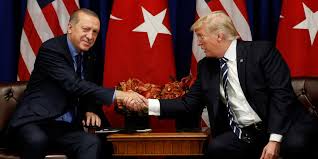
People are wondering why Trump is so responsive to anything the Turkish president suggests. 

Especially how, after only a brief conversation on the telephone with Recep Tayyip Erdoğan, Trump "impulsively" reversed U.S. military policy in Syria and decided to withdraw all American troops, who have been allied with the Kurds, our closest partner in the region, and with whom we have been decimating ISIS fighters.

So outraged about this whipsaw change, Secretary of Defense, James Mattis, who was not consulted by Trump, resigned in open protest.

How could Trump so cavalierly reverse a policy that at relatively low cost in material and casualties ("only" five American troops have been killed in more than four years of fighting) how can such a policy be ended so abruptly after just a few minutes on the phone with Erdoğan, abandoning the field of battle to the Russians, Syria's Bashar al-Assad's butchers, Iran, Hezbollah, and ISIS, which still has at least 15,000 fighters in the region?

The answer is simple. As with so much that Trump initiates, it's all about money. Trump's money. In this case, how much he is making from real estate interests and who knows what else in Turkey, which, in Istanbul, includes a Trump Tower.

It is a twin-tower monstrosity. One tower is an office complex, the other a residential condo with 200 residences. It also includes a shopping mall with 80 shops and a multiplex cinema. These are the first Trump Towers built in Europe.

Most interesting, though, is Trump's principal business partner--

He is billionaire Aydin Doğan. He heads Turkey's largest conglomerate, Doğan Holdings, which includes ventures in energy, media, trade, and tourism in addition to a real estate empire.

As well known in Turkey as he is for his wealth and power is his tendency to evade taxation. For example, his media company, Doğan Media Holding, in 2009 was forced to pay a tax fine of about 3.8 billion Turkish Lira (nearly $2.53 billion dollars).

Sound familiar? Though this only begins to suggest how entangled Trump might be in things Turkish. Could it be that the Turks, whose intelligence operation is world class, like the Russians, who also seem to be able to make Trump dance on a string, have some goods on him?

It would help explain Trump's impulsive response to Erdoğan's "request" that he pull all 2,000 of our troops out of Syria so the Turks can focus on wiping out our erstwhile allies, the Kurds.

As prosecutors are wont to say, "Follow the money,"


Labels: , , , , , ,

Monday, October 16, 2017

October 16, 2017--Whatever Happened to ISIS?

It wasn't very long ago that ISIS or ISIL or the Islamic State caused widespread fear in the Middle East and the West. Very much including in the United States.

Almost daily, for many months, ISIS would release a video of the hideous torture and beheading of captured Americans, Europeans, and Muslims. The map of the area showed ISIS's metastasis occurring as more and more territory fell before its brutal, seemingly unstoppable anschluss.

As recently as 2014, ISIS declared itself a caliphate. Which meant that they claimed religious, political, and military authority over all Muslims. All Muslins worldwide. In the region (beginning in expanding parts of Iraq and Syria) with visions of taking over all of the Middle East and ultimately at least as much of Africa and Europe as the previous caliphate of the 7th through 15th centuries occupied.

This terrifying aspiration did not seem far fetched. 

The Iraqis, torn by internal strife between the Shia majority and the Sunnis (who joined ISIS in large numbers), the Iraqi government and military felt powerless to resist. Syria was torn by a hopeless civil war and resisted becoming involved; and no one in the West, including the United States during the last years of the Obama administration, had a response that felt credible. 

And then there were the Russians who saw this divisiveness and chaos as an opportunity to exert influence and even dominance.

But then toward the end of the Obama years and continued and expanded during the early months of the Trump administration--yes, that administration--the U.S. military did two things that appear to have been decisive--somehow after more than a decade of frustration, we were able to train elements of the Iraqi army to actually fight effectively and supplied close-in tactical air support as they took on the previously unvanquished ISIS fighters. 

Slowly the map of the area controlled viciously by ISIS began to contract. As recently as last week the last of their caliphate strongholds, Hawija, fell to the Iraqis. Thousands while retreating were killed and then, rather than dying a martyrs' death, other thousands surrendered, mainly to Kurdish forces who have been in the mix as critical fighters.

A few things--

First--ISIS will continue to inspire and take credit for individual acts of terrorism. As hideous as this it, it's not a caliphate.

Then--though Donald Trump has a checklist of Obama initiatives and achievements that he has made his agenda--to obliterate Obama's political and historical existence is what more than anything else guides Trump. But in spite of this, in regard to ISIS, his military people saw an effective strategy and Trump doubled-down on it. Soon he will be all over Twitter and the media taking credit for "defeating" ISIS. What he boasted during the election campaign.

He is entitled to some of that credit. This is culminating on his, forgive me, watch. Maybe, doubtful, but maybe he will learn something from this--about the big things (war and peace) he might act more moderately than what many are fearing. North Korea a case in point?

Last--seemingly hopeless situations can at times resolve themselves. 

Hawija

Labels: , , , , , , , , , , ,

Friday, August 12, 2016

August 12, 2016--Russia Is Winning the New Cold War

It is now generally acknowledged that Russia's intervention in Syria has, from a Russian perspective, been effective.

Putin's Russia, unlike Obama's United States, is now seen to be the leading and most influential great power operating in the region. Russia's military and political support for Syria's president, Bashar al-Assad, has effectively ended the rebellion against his government, and so now, since they made this possible, he is "owned" equally by both Russia and Iran, Assad's major patrons.

The United States is now relegated to the insignificant sidelines, unable to figure out which rebel faction(s) to support and is also seen to be impotent in regard to efforts to impose "red lines," topple Assad, or defeat ISIS.

Even in Second Cold War terms, Russia's modernized military is more than a match for ours even though we have outspent them on the development of smart weapons designed for asymmetrical warfare. This represents another miscall by the CIA and our military intelligence operatives--as during the First Cold War when they failed to notice that the Soviet Union's economy was collapsing under the pressure of attempting to compete with us weapon-system-by-weapon-system, this time around they failed to alert us to the power and sophistication of the new Russian military.

Most revealing, as Russia flexes new muscle to protect its borders as well as reduce the power of the United Staes and especially Western Europe, is the new cynical feel-good relationship developing between Russia and Turkey.

Just nine months ago a Turkish jet downed a Russian military aircraft and though it looked as if a hot war might break out between the two nations, in spite of this, earlier this week Turkish president Recep Tayyip-Erdogan was in Moscow to talk with President Putin about putting aside the past and establishing a closer relationship.

They both have skin in the regional game (and both leaders within their own countries need propping up) so going to war with each other would not be in either one's best interest.

Thus, out of mutual need, Turkey is raising questions about its role in NATO--something Putin enthusiastically welcomes--and Russia is helping to cut off the military aid the U.S. is supplying to the Kurds who are eager to carve Kurdistan out of land they live in in Syria, Iraq, and most geopolitically important, Turkey.

Erdogan is blaming America for the recent coup that failed to topple him and is suspicious about our agenda regarding the Kurds, while Putin seeks to destabilize NATO and push its forces, very much including those of the United States, back from its western borders.

Thus the appearance of these unlikely bedfellows. And their mutual interest in the candidacy of Donald Trump who is confounding our freight policy establishment as well as that of our NATO allies when he questions the on-going role of NATO, particularly why the U.S. should underwrite a disproportionate portion of its budget.

A more credible Republican candidate would have a field day with these failed polices of President Obama and former secretary of state Hillary Clinton.


Labels: , , , , , , , ,

Monday, November 16, 2015

November 16, 2105--ISIS in Paris

I may have a different perspective after I, perhaps, cool down.

God knows there have been much worse cases of barbarism, evil during my lifetime. Even quite recently. By the numbers, ISIS's blowing the Russian plane out of the sky over the Sinai killed more innocent people than the seven or eight coordinated attacks in Paris.

Numerically, the terrorist bombings in Mumbai, Spain, Beirut, and of course on 9/11 killed and maimed more people, but there is something different about ISIS than al Qaeda. Something different for me about Paris than even New York.

That tells you how in a rage I am about what happened Friday night.

OK, I used the e-word. Evil.

All of these terrorist atrocities, including the pubic beheadings, are more than "cowardly acts." If there is such a thing as evil, this is it. Have there been worse examples? Of course. Including in France.

The French, among other "civilized" people, during the Second World War rounded up and shipped many thousands of their Jews to certain death in Nazi Germany.

A special definition of evil is necessary to categorize the various holocausts of the 20th century.

But what was perpetrated Friday still qualifies as dastardly. Unspeakable. All too human in its inhumanness.

Words fail.

French president Hollande says this was an act of "war." The Pope said we are in "World War III." Both may be right.

If we are, what then does that mean?

France is a linchpin of the NATO alliance. NATO's charter in effect says that "an attack on one is an attack on all." That includes us. The United States.

That charter was written well before al Qaeda and ISIS existed. It was for a time when there were credible threats of a Soviet invasion of Western Europe. What does it mean now when the definition of war had shifted? Does it mean that the U.S. is also at war? That because France was "attacked," that it experienced more than an evil act of terrorism, we too have been attacked and thus are obligated to act accordingly? To join them in waging war?

I do not know how to think about this. What I do know is that this has struck me deeply. I have even been gathering information about going to France, Paris, this week. As an act of solidarity and defiance.

Rona thinks I'm crazy. She's right. I am.

Minimally I am trying to think about what France should do, more appropriately, as an American citizen what we should do because I do think we are at war.

Yes, I know how we got there. Not solely as the result of President Obama's weak leadership--though he has been weak and that hasn't helped, feeling that the "Arab Spring" would help bring about versions of democracy to the region. This just as naive in its own way as George W. Bush's delusion that toppling Saddam Hussein would do that for Iraq and surrounding dictatorships.

What matters now is what to do going forward.

Drone-guided bombings will not get the job done. Depending on lightly-armed Kurd forces on the ground will not defeat ISIS in Syria and Iraq. Russia's involvement, even if it shifts to confront ISIS rather than Syrian rebels, will not get the job done.

Nothing this simple, this limited will work.

I can hardly believe I am thinking this, but only a massive, boots-on-the-ground force of American troops has any chance of succeeding. Perhaps 100,000 are required. Maybe more.

This would mean many casualties, even the beheading of captured U.S. soldiers. But does anyone have a better, more realistic idea?

I hate this. Hate all of it. But I am feeling radicalized.

ISIS has to be shown to be a failure in order to stem the flow of young lunatics to its "cause." Disaffiliated youth from the Islamic world as well as from Europe and the United States are partly drawn to ISIS because it is perceived to be winning. This encourages those with distorted minds to believe that the apocalypse they seek is near at hand. Defeat ISIS, devastate it, and that belief system will crumble.

I am sorry. I wish I could believe in the effectiveness of diplomacy and financial warfare, including bombing the oil fields and petroleum distribution system in ISIS-controlled territory.

I don't.

As long as they feel they are winning, ISIS fighters can live on fumes. They are that motivated and tenacious.

So they have to be killed. All of them would be ideal. As many as possible is imperative.

Again, I can't believe these worlds are coming from me. I have up to now considered myself to be moderate, essentially pacifistic. Not any more.

Paris on Friday changed that.

When will we too again feel the pain and fear?


Labels: , , , , , , , , , , , , ,

Thursday, June 18, 2015

June 18, 2015--Yugoslavia

Anyone following Behind knows that for years I have been an advocate for a redrawing of national borders in the Middle East. From the political borders imposed on Arab and Islamic people by the victorious Western superpowers at the end of the First World War to others that take history, culture, ethnicity, and religion into consideration.

Broadly speaking, for what we now call Iraq this would minimally mean separate countries for Sunnis, Shia, and Kurds.

Some readers who have communicated with me say it would never work, that rivalries and blood-hatred is so intense that Sunnis would continue to fight with Shia and Turks with Kurds.

That may be but we have been seeing an alternative, deadly scenario playing out with millions either killed or made homeless, stateless.

Others have said to me that they might agree if there were current examples of the successful redrawing of borders.

There very well may be.

Take Yugoslavia as an example.

There is no historic, ancient Yugoslavia. It was a political construct that came about after the chaos of the First World War when territories of the defeated Austro-Hungarian Empire were fused to become the Kingdom of Serbs, Croats and Slovenes. That monarchy was overthrown at the end of World War II and a new "country" emerged, the Federal People's Republic of Yugoslavia, which for decades was dominated and kept from disintegrating by strongman Josip Broz, better known as Marshal Tito.


After Tito died, civil war broke out as Christian Serbs and Croats fought Bosnian Muslims. Many atrocities were committed, especially "ethnic cleansing" by Serbs of Bosnians.

By the mid 1990s, European members of NATO, recalling that World War I begin in Sarajevo, in what was to become Yugoslavia, and also concerned about the slaughter of Bosnians, began to mobilize peacekeeping forces, including eventually convincing President Bill Clinton to participate in bombing Serb forces.

In 1995, through Clinton's leadership, the contesting parties were convened in Ohio and spent weeks in effect confined there until they reached the historic Dayton Accords that once again redrew the map of the Balkans, this time more culturally than politically.


For 20 years, with U.S. and NATO troops still stationed on the ground as peacekeepers, the Accords have more or less held. There is reason to be optimistic that a version of peace will prevail.

This, then, is my best example of what might be possible in the long run in the Middle East if the parties there, left alone by outsiders--very much including the United States, were to stay out to the region and let the natural forces of history unfold and reach, to them, some sort of acceptable resolution.

Labels: , , , , , , , , , , , ,

Tuesday, September 02, 2014

September 2, 2014--ISIS

Most objective historians contend that George W. Bush and, before him, Bill Clinton ignored the many early signs that Al-Queda represented a deadly threat to the U.S. homeland.

Famously or infamously, President Bush was cutting brush at his ranch in Crawford, Texas and didn't want to be disturbed by a National Security memo that warned of an imminent attack by Al-Qaeda on America.

It was a failure to "connect the dots," both critics and apologists said retrospectively. It was at least that. Worse--why did citizens and our government have to learn about the reach and power of Al Qaeda for the first time on 9/11?

Which brings me to today to ISIS, the even more radical successor to Al-Qaeda.

ISIS, the jihadist faction that has recently swept out of Syria, where it was incubated, and is rampaging through central Iraq, slaughtering Shiites, Kurds, and Christians as it expands the borders of its self-procliamed Caliphate is now commanding the attention of Western leaders. President Obama as well as British Prime Minister Cameron cut short their vacations to pay more attention to this dangerous movement.

Where did they come from seemingly so quickly? How did they develop the capacity, apparently overnight, to take on first Syria's army and then roll back Kurdish and Iraqi armed forces? Armies that we equipped and trained for years to be self-sufficient retreated across Iraq with hardly a fight in the face of ISIS's self-trained militias.

Why does it appears that the president and other world leaders are just now learning about ISIS and finally taking action to halt its advance? Including, President Obama implied late last week, seeking them out at their sanctuaries in Syria.


Did we again forget to connect the dots when we began to notice that scores of Americans and hundreds of Europeans were making their way to Syria to join the rebels fighting the Assad regime and then to enlist in ISIS's brigades?

It is understandable that we did not want to get directly involved in arming the rebels in Syria much less supplying air cover or, worse, boots on the ground. The situation is a quagmire, best to remain uninvolved; but if we had evidence that the situation there was an incubator of jihadist terrorists who might ultimately threaten us directly, maybe we should have reconsidered keeping our hands off.

Perhaps we should have learned some lessons from our own history of involvement in the region. First, how we intervened in a surrogate Cold War confrontation with Russia in Afghanistan. How we armed the Mujahideen who in turn defeated the Russians and then, without pausing to thank us, using our weapons, transformed themselves into the Taliban who shortly thereafter supported and provided sanctuary to Osama bin Laden and his Al-Qaeda fighters. As a result there was 9/11.

A version of the same thing is now happening in Syria-Iraq.

After we brought down Saddam Hussein, with the full participation of the American occupying forces, we agreed with the Shiite majority to rid the government and, more importantly, the military of any Sunni Muslims who were members of Hussein's Baathist Party. We took the lead in the de-Baathification of the country and placed our support behind the Shiites who, in the process, disenfranchising this talented group of government officials and military leaders, also doing all they could to publicly humiliate them.

So it should come as no surprise to find them now in leadership roles within ISIS. A major reason ISIS is so effective, so able to fight with discipline and precision, is because of their Baathist allies, who, as in Afghanistan, have taken possession of massive amounts of American arms and weapon systems that they seized from the retreating Shiite forces.

As a consequence, again because of inept American and European leadership, expect to see us engaged soon in various forms of combat in the lands now controlled by ISIS--in Iraq, Kurdistan, and even Syria, where, as a result, ironically, we may wind up helping Bashar al-Assad to keep his grip on power.

Labels: , , , , , , , , , , , , , , ,

Tuesday, September 03, 2013

September 3, 2013: Syria

I don't know how to think about Syria much less what we should or shouldn't do.

On Saturday I listened to President Obama lay out his thinking. I was not impressed. I know he has drawn a red-line, saying that if the Assad regime uses chemical weapons he will have us punish them.

I am wondering, though, why killing 100,000 thus far in the civil war there isn't a red line in itself. I suppose it's how you kill innocent people that counts. If Assad kills them with guns and bombs and rockets the U.S. can stay out of it; if he kills 1,400 with nerve gas we feel compelled to intervene militarily and "degrade" Syria's ability to do so again.

But I recognize that when a leader establishes a red line--which for strategic and even tactical reasons is not a good idea--if he doesn't carry out whatever it is he threatened, other bad people will assume he can be rolled by them as well. Iranians might be inclined to assume they can continue their nuclear weapons programs and the U.S. will back off when that red line is breached.

So to maintain credibility Obama has to launch a "limited" attack on Syria, assuming Congress agrees, perhaps more to send a message to Iran than to Syria.

Of one thing I am certain--that whatever we do or don't do will have many unintended consequences.

All bad.

For starters, there is more than a likelihood that various factions in the region who support Assad will attack Israel, our client state, since they can't attack us directly. If they use poison gas against them, with the Holocaust still very much in Jewish people's minds, Israel will respond massively. What will that reap?

Again, nothing good.

And though various groups of Islamists can't easily attack us in the homeland, it seems likely that there will be a step-up in global terrorist activity. I wouldn't want to be an embassy worker anywhere in the world after we send hundreds of cruise and tomahawk missiles toward Damascus.

Isn't it likely that Iran and Hezbollah will send scores of their fighters and Jihadists to Syria to fight off the rebels as well as to demonstrate their prowess to both Israel and the United States? Will Israel live comfortably with that? The last time they fought in Lebanon and Syria they were effectively defeated by Hezbollah. They have been itching for an opportunity, a justification to have a do-over.

So much of what goes on in that part of the world has to do with posturing and displaying manhood. In other words, behavior there (actually, everywhere) is often emotionally-driven and thus unpredictable since when in the throes of passion all bets are off and individuals as well as peoples often act in ways that appear self-destructive. That is until one deciphers the inner logic.

Suicide-bombing, for example, which might seem the ultimate expression of self-destructiveness (literally so), if one believes that it leads to martyrdom and directly to heaven, makes great "sense."

But here's what really does make sense, though it has no chance whatsoever of happening--

Redraw the map of the region. Actually, redraw the maps of all former-colonial regions. 

The maps we currently live with, which are the cause of much of the religious, nationalistic, and sectarian fighting we are seeing, were drawn up by the victorious big powers (mainly Britain, the United States, and France) at the end of the First World War.

Thus, countries such as Syria, Tunisia, Libya, Iraq, Afghanistan, Israel, and Palestine (to name just some) are all artificial constructs that ignore tribal and cultural borders as well as deep history.

Syria, for example, a forced  amalgam of 140 tribes and clans, some that traverse borders with Egypt and Tunisia, could easily be divided into three to 10 tribal regions. Ditto for Iraq.

Where is Kurdistan? Nowhere. It doesn't exist on any map but it is a large cultural region that spans parts of 1919-created countries Turkey, Iraq, Iran, and Syria.

If we could see redrawn the national borders to create Kurdistan, tensions in that region would ebb significantly.

And if we could see that happen for the rest of the Middle East and, for that matter, all of Africa and portions of Asia, the world be a much more peaceful place.

So, maybe, here's the solution--

Big powers back off. Let the various factions fight it out. Let them exhaust themselves and eventually hope they come to their senses and agree, without the necessity of discussing it that much, to redraw their own borders so that a Kurdistan emerges as well as a few countries for Sunnis and more for the Shia.

Libya, as another example, would disappear and in its place we would have, at a minimum, Barqa, Ubaidat, Mughariba, and Awejeer. Others clans there would undoubtedly demand their own delineated territory and they would have to be accommodated. But being aggregated into a place called "Libya" isn't working, won't work, and eventually will no longer be sustained.

This fantasy of mine would take at least 100 years to be realized. But since this is where we're inevitably headed, we might as well let it start.

That process, among other things, means allowing and encouraging the current simmering and boiling conflicts to stutter to a stalemate. It also means that the U.S. not attack Syria.

Stalemate makes sense since there is no possible way for anyone, any country (us included) to "win."

Things just have to work out. This means waiting for things to revert to their cultural and historical roots--people are by DNA tribal and thus happiest, most satisfied if they are able to live with their own "kind."

For people who wish to live otherwise, there is always Western Europe and the United States.

Labels: , , , , , , , , , , , , , , ,