Monday, February 23, 2015

February 23, 2015--Lines In the Sand

At the end of the First World War, a territorial plan devised by Sir Mark Sykes of Great Britain and Francois Georges-Picot of France established spheres of influence in the Middle East for the victorious European powers. Some compared this to drawing lines in the sand.

Prior to the War, most parts of the region were under the control of the Ottoman Empire. This included all of present-day Turkey, much of North Africa, and virtually all of the Middle East with the notable exceptions of Arabia, today's Saudi Arabia, and Persia, today's Iran.

The Syke's-Picot secret agreement became the blueprint for the dismemberment of the Ottoman Empire after its defeat in the War-to-End-All-Wars. The Great Powers, particularly France and Britain, with the assent of Russia, carved up the former Ottoman territory, creating modern Turkey and the countries that make up the contemporary Middle East, and assigned to themselves mandates and colonial oversight for what became Iraq, Jordan, Syria, and Palestine among other newly established countries.

(The U.S. President Woodrow Wilson was more interested in the establishment of the League of Nations and so effectively kept hands off as the region was carved up and parceled out.)


Based on Sykes-Picot, the Treaty of Paris assigned the blue regions to French authority, the red to British, and the green to Russian.

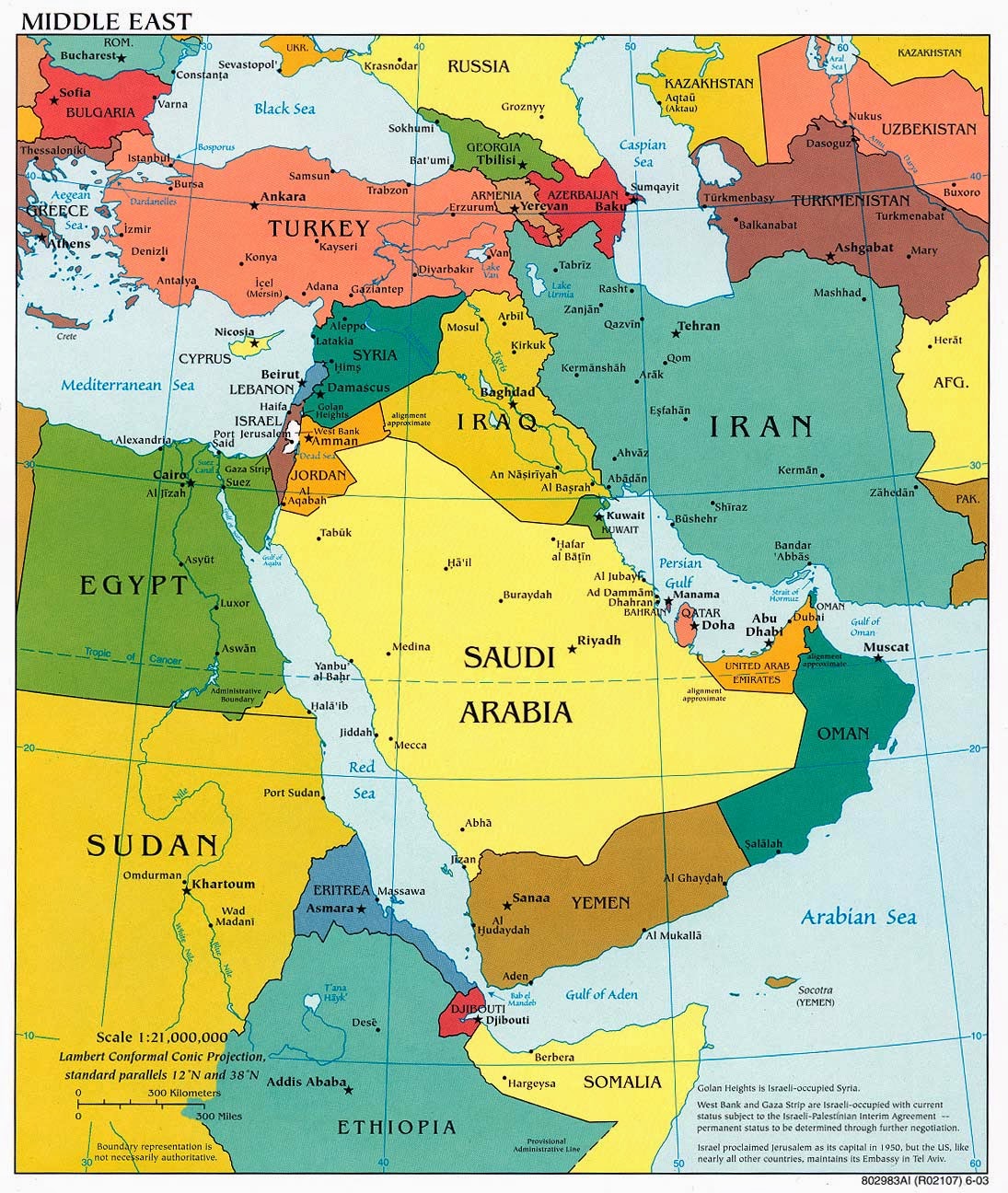
The more delineated map of the Middle East which was derived from the Sykes-Picot accord is the one we live with today. Take special note of those countries that were assigned straight-line borders. It is particularly revealing that some of the countries that are most in turmoil and include restive populations,  jihadists, and other groups of terrorists, are those with these kind of linear borders that do not take geography, culture, or religion into consideration--Syria, Sudan, Egypt, Yemen, Lebanon, Jordan, Iraq, and of course Israel.

Thus, "Iraq" should probably be deconstructed into at least three countries with cultural borders, including Kurdistan, and "Libya" into at least that many. The region, and the world would be much more peaceful if those who met in Paris in 1919 would have established borders that took history, religion, and tribal identity into consideration.

One might counter that there are straight line borders in the United States. Many. In fact, two of our states are virtual rectangles (Colorado and Wyoming), and four meet at the Four Corners (Colorado, Utah, Arizona, and New Mexico), but with the exception of the genocidal  example of what we did to our Native populations, territories that became states were not that culturally diverse and applied for statehood, staking out and suggesting their own borders. These borders for the most part were as viable as others that used rivers and mountain ranges as natural ways to divide and assign territory.


Labels: , , , , , , , , , , , , ,

Thursday, October 30, 2014

October 30, 2014--Time Wars

I hate it it when the clocks spring forward or fall back. I like my routines and this disrupts them.

Sunday they fall back when Daylight Savings Time ends. The worst of it is not a jet-lag-like hangover but the fact that it will be dark up here before 5:00 in the afternoon. Not my favorite thing; but we head for NYC early Sunday, and I suppose it will be light enough when we leave for us to see the first snow of the season that is forecast for then.

But over in the Middle East, as with virtually everything else, one more thing the Israelis and Palestinians aren't on the same page about is Daylight Savings Time.

The Palestinian Authority ended DST two days before Israel, out of stubbornness more than anything else, or as a pathetic declaration of independence, and so for those two days, those few workers allowed to cross the Gaza or West Bank border to get to jobs in Israel, going one way arrived, by the clock, at an earlier time that when they left and their return commute took an hour more of seeming clock time.

According to the New York Times, the website timeanddate.com reports that over the past 15 years the Palestinians and Israelis have changed time at the same time just seven times, for some unknown reason always when springing forward. Making matters even worse--which is difficult to achieve in that fraught region--three times it took a month before their clocks were in sync.

So here's my plan--

Forget entirely about Daylight Savings Time. I have confuted a decidedly unscientific survey and have found hardly anyone all that passionate about retaining it. They tell me that whatever time it is they get used to it. Even darkness in late December in northern places such as Maine that falls by mid afternoon.

On the other hand, I doubt Israel and Palestine would any more agree to this than settlement policy or work permits for Gazans. It seems the more things they have to disagree or fight about the better they like it.


Labels: , , , , , ,

Tuesday, August 05, 2014

August 5, 2014--Brothers Under the Skin

I always wondered why the late Chairman of the Palestinian Organization, Yasser Arafat, looked so much like my Uncle Louie.  Now I know.

We're related!

Take a close look at that punim, that face.


And then take a look at mine--just over there on the right.

Get the picture?

But there is more evidence than just from photos.

According to Wikipedia--
Genetic analysis suggests that a majority of Palestinians, including Arab citizens of Israel, are descendants of Christians, Jews, and other earlier inhabitants of the southern Levant whose core may reach back to prehistoric times. A study of high-resolution haplotypes [DNA sequences] demonstrated that a substantial portion of Y chromosomes of Israeli Jews (70%) and of Palestinian Muslim Arabs (82%) belonged to the same chromosome pool. 
So there you have it.

What is happening in the Middle East is a "family dispute" and we know how ugly these can be.

Labels: , , , , , , , , , , , ,

Thursday, July 31, 2014

July 31, 2014--Blood Feud

This is the first Arab-Israeli war that isn't about territory--about expanding or protecting borders.

It is about hated and blood letting. Pure and simple, killing. That's the agenda. For both sides.

It is about Palestinians associated with Hamas trying to kill or capture any Israelis they can get their hands on purely in order to murder them or use them as bargaining chips. And on the other side, it is about the Israeli military, in spite of its denials, attempting to kill as many Palestinians as possible without regard to the distinction between fighters and civilian innocents.

There is no place to hide in Gaza--all available land is built up and there are no open spaces where refugee camps can be established and declared safe havens for non-combatants. And so those whose homes have been destroyed or live in fear are either trapped where they live, continuing to be subject to bombing, or flee to shelters provided by the United Nations.

But then, while cringing in these, they are not immune from attack. Just yesterday one of these shelters was destroyed and 20 more civilians were killed, many children. This is the third or fourth time a UN facility was destroyed with significant loss of life. In an era of smart bombs this cannot be explained away as "collateral damage."

So the Israelis claim it is the Palestinians themselves who have been attacking what should be sanctuaries. Hamas is doing this to its own people, they say, to make it look as if Israeli forces are intentionally targeting women and children.

The UN says it has evidence that it has been Israeli rockets and bombs that have destroyed these so-called sanctuaries.

And so it goes.

Each day we have updated body counts--remember body counts? More than 1,200 Palestinians have been killed and nearly 100 Israelis.

Both sides are seeing "progress" in those numbers--Israelis believe that if they kill enough Arabs Hamas will give up its struggle to expel Israelis from land they claim to be theirs while Hamas, recently losing power and influence in Gaza, will become resurgent if they kill enough Jews and thereby reestablish their credibility as warriors for the Palestinian cause.

This is thus a blood feud fueled by decades of hatred on both sides--equally vicious ethnic stereotyping and bigotry that is promoted in schoolbooks and popular media. Recall that this most recent conflict began after an exchange of barbaric killings of Israeli and Arab teenagers. It is Old Testament retributive tribal warfare waged lustfully and hatefully by both sides.

Both have legitimate issues. Israeli has the right to live securely within some version of its current borders and Palestinians have the right to a contiguous state of their own. Both have ancient claims to these lands. But both have moved beyond the normal range of political and geographic struggle, even warfare, and descended into hatred-drivien, senseless slaughter.

Labels: , , , , , , , , ,

Tuesday, July 29, 2014

July 29, 2014--Ladies of Forest Trace: Winking

“If you want to talk to me you have to call between winks.”
"Between What?"
“I’m sleeping all the time. Twenty winks.”
“Forty.”
“Forty what?”
“Winks. You’re catching 40 winks.”
“So call me later when I’m awake. When I’m not winking.”
*  *   *
Which I did.
“Did I wake you?”
“No the phone did.”
“That was me.”
“You? I heard the telephone. Not you.”
"That was me calling. So the phone rang and . . .”
“I know. I was sleeping. And it woke me. Not you.”
*   *   *
When I called again, she said, “I’m such a baby.”
“A baby? Is there something frightening you?”
“No. Nothing.”
“But?”
“But, I’m such a baby. All I do is sleep.”
“That’s not true. You nap.”
“Nap, schnap, I sleep. I’m turning into a baby again. They sleep all the time. And do other things I don’t do . . . Yet.” She chuckled.
“You watch the news, read the paper, do the puzzle, join friends for breakfast and dinner, and . . .”
“Sleep all the time.”
Nap all the time,” I muttered under my breath and said, “You are after all more than 106-years-old. And you do need your rest and . . .”
“And sleep.”
She trailed off, breathing heavily.
*   *   *
“While I’m between winks I have something to say.” It is rare now for her to initiate calls.
Is there something wrong I feared?
“I know this is upsetting you,” even on the phone, at 106 she can still read my mind and emotions.
I lied, “Not at all. I love hearing from you. It’s just . . .” I couldn’t hide my anxiety.
“Just that I never call any more. I’m so mixed up by what day it is.”
I wasn’t sure what that had to do with calling.
“I used to call you religiously every Sunday at 12:00. When I say religiously, I don’t mean . . .” She was breathing heavily.
“I know you don’t,” I jumped in, not wanting to tax her—it is now unusual for her to be able to sustain a conversation of more than five minutes. A few back and forths. Actually, with me doing most of the talking, which is easier on her.
But this time, with considerable effort, she pushed ahead.
“I know you are wondering what is keeping me alive.”
“Not really. I know that . . .”
“I’m too old and too smart for you not to tell me the truth.”
“I’m not. I’m . . .”
“Stop interrupting. At my age, this could be the last thing I ever say to you.”
“That can’t . . .”
“Yes it can. So just sit still.”
“I’ll try.”
“We’ve talked about why I got to be this old and you told me it’s because of my IRA.”
DNA, though your IRA doesn’t hurt.”
“Well, I don’t know anything about that. DNA, IRA they’re all the same to me.”
“In terms of the quality of your life that’s probably true. But you’re fortunate to have both.”
“Who’s doing the talking? Me or you?”
“Sorry.”
“Worrying is what keeps me going.”
“Sorry, worrying?”
“About everyone and then the rest of the world.”
“I . . .”
“You know how I always ask you about the young people in the family?”
“Yes.”
“How I am the last one?” I knew she meant of her generation and, now, more and more, even of the next one as her nieces and nephews are aging and . . .
“I worry about them and need to know they will be all right after.”
I held back from asking what she meant about after. I knew.
“And then I worry about what Mama and Poppa will say.” Her parents died nearly 70 years ago.
Will say?” I was having difficulty not responding.
“What they’ll ask when we are together again. If I took good care of everyone. As the last. As they want me to.”
“I am certain they . . .”
“You don’t know them like I do. So I am not so certain.”
“We can disagree about . . .”
“And I also worry about the world. Not just the Jews. Though about them I am most concerned They are not doing the right thing.”
“The right thing?”
“For themselves and their neighbors who have been there for thousands of year. My Poppa always says that it is the responsibility of the strong to show understanding and compassion. Not to make it worse for those who are weak and suffering. Shouldn’t we Jews especially have learned that lesson? After so long being weak and suffering?”
“About this we do agree.”
“So I read, I watch Wolf on CNN, I listen to the girls at dinner, and I know it is not yet time for me to go.”
“I am happy that . . .”
“But I am not happy. I am not happy living this way where I can’t do things for myself. And I am unhappy at what I see. Not with the family. Though I worry about this one and that one I know they are secure and either can take care of themselves or are being helped. This is what to me family means.” She took a deep, raspy breath.
“I am unhappy with what I see in the world,” she said, “Russia. Iraq. Syria, Lydia.”
Libya.”
“Lib-ya, yes, thank you.”
“You are not responsible for any of this. I keep encouraging you not to spend so much time watching the news. It upsets you.”
“What else do I have to do with my remaining time?”
“I understand. Though I have urged you not to dwell on all these troubling things, to do so is who you are. And, I’m sure you’re right, worrying, being concerned about everyone and everything has helped keep you going.”
“Where am I going?”
I chose to not respond since I did not have a good answer for either her or myself. Instead I said, “You can report about all of this to your parents when the time comes.”
“It is coming. But I try every day to live. There is still so much more . . .”

Labels: , , , , , , , , ,

Tuesday, July 22, 2014

July 22, 2014--Terror Tunnels

I've been struggling with what to say about the current Israeli incursion into Gaza and the Hamas rocket attacks on Israel. All precipitated by the savage killing of three Israeli youth by Palestinian terrorists and the equally shocking capture, torture, and murder of a Palestinian youth by three equally-youthful Israeli ultra-orthodox fanatics.

One could say that this exchange of barbarisms was precipitated by many decades of animosity, ethnic and religious bigotry on both sides, and claims and counterclaims about territorial primacy. There is enough blame to go around and around and around and . . .

There is no good solution here.

Actually, there is the idea of one--the so-called two-state solution--but the motivation to agree to this in practice is virtually non-existent. Radicals and hateful people--again on both sides--make any possibility of compromise remote. I almost wrote "hopeless."

Hopeless is the way I feel and thus my reluctance to try to write about the situation. I dislike even the prospect of considering hopelessness.

Anyone who feels that what is happening now will lead to any sort of reasonable progress on all the conflicting but often legitimate concerns knows nothing about the irreconcilable history that stretches back millennia in that fraught region. When people feel that their right to exist and have a homeland in the area--actually, in Palestine or, of you will, Greater Israel--is divinely sanctioned or, in Israeli's case, chosen for them by God, it is hard to think what adversaries might productively say to each other if they could be induced or compelled to negotiate.

In truth, both sides, not just the side represented by Hamas, do not recognize the other's right to exist. Militant Israelis--more and more in charge of the situation--would as much like to see the Palestinians eliminated or, minimally, expelled from the contested region as radical arabs would like to see Israel "pushed into the sea."

It has even gotten to the point where Hamas and Israel do not know how to effectively wage war against each other.

The best current example is Israel's inability--despite it military superiority and high-tech capacity to deploy smart bombs and anti-missile missiles--to suppress the fighting capacity of their decidedly low-tech foe who blend into civilian areas of Gaza when Israeli troops and weapon systems appear.

Israel cannot even wipe out the tunnel system that enables Hamas fighters to manufacture home-made bombs and rockets and, using them, infiltrate into Israel proper to carry out acts of war and terror.

As incredible as it may seem, until the new military regime in Egypt clamped down on them, there were at least 1,200 tunnels connecting Egyptian Sinai and Gaza and many dozens of others linking Gaza with Israel itself. Some of these latter tunnels--ones Hamas calls "terror tunnels"--penetrate nearly half a mile into Israel. Others, reenforced by thousands of tons of concrete, are over 100 feet deep and, for reasons I cannot explain, go undetected by Israeli satellite, inferred, and other intelligence assets.

We are not talking about a 2,000 mile border like the one between the United States and Mexico which is thus impossible to make impenetrable, but rather a relatively short one in a circumscribed geographic area. One would think it would be relatively easy for Israel to know about every one of these tunnels since they have the will and technology to do so. But that appears not to be the case as the Israeli military is right know risking life and limb to find and seal them.

And so when they do finally find and destroy them all, where will things stand?

Pretty much where they were five years ago, a decade ago, a century ago, a millennium ago. There will be a brief halt in the mass killings as both sick step back under worldwide diplomatic pressure, lick their wounds, rearm, rage on about the cruelty of the other side, ratchet-up the hatred, and get ready to do it all over again within the next two to five years.

Just as the sun inexorable rises and sets, this too shall come to pass.


Labels: , , , , , ,

Thursday, July 10, 2014

July 10, 2014--Slovakia

One of the delightful young women at the checkout counter at Reilly's market in New Harbor told us that at the end of the season she will be going home.

"Where's home?" Rona asked, sounding rueful.

"Slovenia," she said.

"Where?" Rona asked not sure she heard correctly or if, for the moment, she wasn't able to locate Slovenia on a map in her mind. "Oh, you mean, part of the former Czechoslovakia. It was peacefully divided in the 1990s into two countries--your Slovakia and . . ."

"The Czech Republic." She smiled broadly, pleased to know that someone way up here was aware of that history.

Later, while driving to town, Rona asked why what happened in Czechoslovakia, a country that was reconfigured at least twice after both the First and Second World Wars, couldn't be a model for other parts of the world. Especially the Middle East.

"We keep talking about how with the exception of Egypt and Iran all the other countries there were created out of nothing more than Western economic need and greed and political maneuvering."

"We've even said this too is true for Israel, which was carved out of ancient Palestine and now includes parts of post-colonial Jordan, Syria, and Lebanon."

"And whenever anyone raises the subject of allowing the remapping of this region people object saying there are no good examples of this occurring with peaceful results."

"But," I said, "the Czechoslovakian division between Czechs and Slovaks occurred with no fighting and, unless I am missing something, there are no current border disputes."

"And then," Rona added, "there's what happened to the former Yugoslavia, another country that post-war was a forced amalgam of many peoples and religions."

"Though that remapping didn't happen peacefully after Tito died. He was the strong man who forced Albanians to live under the same flag as Serbs, Croatians, Bosnians, Montenegrins, and warring Christians and Muslims. There was ethnic and religious warfare with atrocities committed on all sides."

"Including 'ethnic cleansing.' Remember that wonderful euphemism?"

"I sure do. But after the Clinton administration and NATO finally and reluctantly got involved, including militarily, there was a version of peace--which has persisted more-or-less for at least 20 years. And now there are seven or eight countries that devolved from Yugoslavia. If this were final Jeopardy, how many could you list?"

I began to hum the familiar Jeopardy music as Rona raced to tick off, "Croatia, Slovenia, Serbia, Bosnia," and then paused, searching for the others. I kept up my annoying humming. "What about Macedonia? Yes, that's another one and . . ."

"Sorry, time's up."

"OK smart-ass, what are the rest?" And she then began to hum quite loudly.

I stammered and tried to distract Rona but she persisted. "Time's up!" she roared, clapping her hands triumphantly.

When we got home we Googled "the former Yugoslavia" and found that we had forgotten--or had never known--that there were at least two other new countries formed after Yugoslavia collapsed--Herzegovina and Montenegro.

"So," Rona said, "when the nay-sayers claim the Middle East can't be remapped and that there are no current examples of that working, we have at least two to cite."

"I doubt if tomorrow morning we'll get too many folks at the diner interested in talking about Montenegro or Slovakia. If we try to do that, no one will sit with us."

"Good point," Rona agreed, "Let's forget the whole thing."

Later that afternoon, I heard her humming the Jeopardy music from the shower.

Labels: , , , , , , , , , , , ,

Tuesday, June 10, 2014

June 10, 2014--Un-Settling: The Politics of Middle East Real Estate

If you ever for a moment thought that the Israeli government's allowing the building of "settlements" on land claimed by Palestinians is primarily to accommodate population growth, if you imagined that the recent decision by the government to permit 1,500 more housing units to be constructed deep in the West Bank and East Jerusalem was about needing additional apartments for an expanding population, think again.

It's not about living accommodations, it's about the politics of hate and real estate.

The Jewish population has been growing very slowly. Though the ultra-orthodox are having increasing numbers of children, that rest of the Jews in Israel are not growing in number.

There are at least two dimensions to this increase in the number of settlements--the orthodox, the Haredi, are messianic-minded, which means that they are preparing for the appearance of the Jewish Messiah. To them this requires that Jews come to occupy all of Greater Israel--one of the conditions for the Moshiach's appearance--and that includes all of the West Bank, all of Jerusalem, all of Judea and Samaria, the Sinai, and a good slice of current-day Iraq.

The second reason for expanding housing, politically linked to the presence of increasing numbers of aggressive Haredi, is that settlement policy is one vexing arm of the struggle between the current Israeli government and the aspirations of the Palestinian people who want a homeland, a country of their own. And, to present a balanced picture, this to extreme Palestinian  power-players means occupying much of what is currently Israel.

As evidence of the settlements political agenda is the recent move to authorize 1,500 more units in response to the emerging reconciliation between Fatah (moderate Palestinians) and the more radical Hamas, which does not recognize Israel's right to exist.

According to a recent article in the New York Times, the Israeli government was uncharacteristically honest about the new settlement policy. In the past, they would have claim it was to alleviate a housing shortage. But not this time--
By presenting the new building in the West Bank and East Jerusalem as a punishment over the newly constituted government of the Palestinians, who regard that territory as theirs for part of a future state, Israel set itself further apart from international consensus and drew criticism from foreign allies, including Britain, France, and the United States. [Italics added.]
Where we go from here is anyone's guess. Minimally, nothing much will change to alter the Israeli government's aggressive behavior until and unless the United Staes and its allies finally say enough. And act accordingly.

Labels: , , , , , , , , , , , ,

Wednesday, December 18, 2013

December 18, 2013--Professing

Having been one at a number of institutions, from up-close observation, professors are not among my favorite professionals. For the most part, I prefer dentists.

Professors--tenured professors--have about the best job in the history of the world.

With what other kind of work can one make a very comfortable living with generous benefits, work two to three days a week, eight or at most nine months a year, and have frequent vacations? Almost as many as members of Congress. And then every few years have sabbaticals, which for a half to a full year offer full or half salary with no classroom or other university responsibilities. And, perhaps best of all, with tenure a professor can work until he or she drops and in no way be let go. Even for demonstrable incompetence or lack of research and publications.

And with all of this, professors are often among the world's most prolific whiners. About their university responsibilities (many would like to be paid, and paid more, for doing even less); about university politics (usually much to do about nothing or at most very little); about their colleagues and administrators; and about much that goes on in the world.

Criticizing and complaining they are very good at, but doing something about it is another matter.

So I was not surprised when a day or two ago, the American Studies Association, with about 5,000 professors as members, voted by a two-to-one margin to boycott Israeli academic institutions to protest Israel's treatment of Palestinians.

This means they will oppose academic exchange programs and Israeli professors will no longer be welcome as ASA members; invited to ASA-sponsored events; or, if the ASA has anything to do about it, be allowed to have sabbaticals in the U.S.

Next month, the much larger and more influential Modern Language Association will vote to ask the State Department to criticize Israel for allegedly barring American professors from going to Gaza or the West Bank when invited by Palestinian institutions.

The boycott is the first the ASA has ever instituted and what the MLA is calling for is equally unprecedented. They have not seen fit to take similar action in regard to Russian or Chinese academic institutions even though those governments curtail basic freedoms for almost all of their citizens. They did not call for the boycott of South African institutions during the Apartheid years. They are apparently OK with Iranian, Egyptian, Cuban, Venezuelan, Saudi Arabian, and Pakistani academic institutions though basic freedoms are severely restricted in these and, sadly, many other countries.

The fundamental case in favor of lifetime employment--tenure--is to protect academic freedom. To make professors impervious to arbitrary or ideological retribution when they express their contrarian views. So it is more than a little ironic that the ASA, for which one of its principals is the protection of freedom of thought and scholarly activity, would so blatantly, for ideological reasons, take such a censorious position.

The good news is that the major higher education organization in the United States, the American Association of University Professors opposes the boycott, saying that it makes little sense to focus on Israeli universities where criticism of government policy often originates.

Even Palestinian Authority president Mahmoud Abbas opposes the boycott. He said that it is inappropriate, as the ASA did, to compare Israel to Apartheid in South Africa. Further--
We are neighbors of Israel, we have agreements with israel, we are not asking anyone to boycott products of Israel.
But members of the ASA do not perceive any contradictions in their position. One member said that--
People who truly believe in academic freedom would realize protesting the blatant and systemic denial of academic freedom to Palestinians, which coupled with material deprivation of a staggering scale, far out ways concerns we in the West might have about our own rather privileged academic freedoms.
I am having trouble figuring out why we in the West who have the privilege of academic freedom should be immunized from the consequences of denying it to others.

I may have once been a professor, but I need help from other professors to help me understand and parse this tortured tangle of rationalization.

Labels: , , , , , , , , , , ,

Tuesday, September 03, 2013

September 3, 2013: Syria

I don't know how to think about Syria much less what we should or shouldn't do.

On Saturday I listened to President Obama lay out his thinking. I was not impressed. I know he has drawn a red-line, saying that if the Assad regime uses chemical weapons he will have us punish them.

I am wondering, though, why killing 100,000 thus far in the civil war there isn't a red line in itself. I suppose it's how you kill innocent people that counts. If Assad kills them with guns and bombs and rockets the U.S. can stay out of it; if he kills 1,400 with nerve gas we feel compelled to intervene militarily and "degrade" Syria's ability to do so again.

But I recognize that when a leader establishes a red line--which for strategic and even tactical reasons is not a good idea--if he doesn't carry out whatever it is he threatened, other bad people will assume he can be rolled by them as well. Iranians might be inclined to assume they can continue their nuclear weapons programs and the U.S. will back off when that red line is breached.

So to maintain credibility Obama has to launch a "limited" attack on Syria, assuming Congress agrees, perhaps more to send a message to Iran than to Syria.

Of one thing I am certain--that whatever we do or don't do will have many unintended consequences.

All bad.

For starters, there is more than a likelihood that various factions in the region who support Assad will attack Israel, our client state, since they can't attack us directly. If they use poison gas against them, with the Holocaust still very much in Jewish people's minds, Israel will respond massively. What will that reap?

Again, nothing good.

And though various groups of Islamists can't easily attack us in the homeland, it seems likely that there will be a step-up in global terrorist activity. I wouldn't want to be an embassy worker anywhere in the world after we send hundreds of cruise and tomahawk missiles toward Damascus.

Isn't it likely that Iran and Hezbollah will send scores of their fighters and Jihadists to Syria to fight off the rebels as well as to demonstrate their prowess to both Israel and the United States? Will Israel live comfortably with that? The last time they fought in Lebanon and Syria they were effectively defeated by Hezbollah. They have been itching for an opportunity, a justification to have a do-over.

So much of what goes on in that part of the world has to do with posturing and displaying manhood. In other words, behavior there (actually, everywhere) is often emotionally-driven and thus unpredictable since when in the throes of passion all bets are off and individuals as well as peoples often act in ways that appear self-destructive. That is until one deciphers the inner logic.

Suicide-bombing, for example, which might seem the ultimate expression of self-destructiveness (literally so), if one believes that it leads to martyrdom and directly to heaven, makes great "sense."

But here's what really does make sense, though it has no chance whatsoever of happening--

Redraw the map of the region. Actually, redraw the maps of all former-colonial regions. 

The maps we currently live with, which are the cause of much of the religious, nationalistic, and sectarian fighting we are seeing, were drawn up by the victorious big powers (mainly Britain, the United States, and France) at the end of the First World War.

Thus, countries such as Syria, Tunisia, Libya, Iraq, Afghanistan, Israel, and Palestine (to name just some) are all artificial constructs that ignore tribal and cultural borders as well as deep history.

Syria, for example, a forced  amalgam of 140 tribes and clans, some that traverse borders with Egypt and Tunisia, could easily be divided into three to 10 tribal regions. Ditto for Iraq.

Where is Kurdistan? Nowhere. It doesn't exist on any map but it is a large cultural region that spans parts of 1919-created countries Turkey, Iraq, Iran, and Syria.

If we could see redrawn the national borders to create Kurdistan, tensions in that region would ebb significantly.

And if we could see that happen for the rest of the Middle East and, for that matter, all of Africa and portions of Asia, the world be a much more peaceful place.

So, maybe, here's the solution--

Big powers back off. Let the various factions fight it out. Let them exhaust themselves and eventually hope they come to their senses and agree, without the necessity of discussing it that much, to redraw their own borders so that a Kurdistan emerges as well as a few countries for Sunnis and more for the Shia.

Libya, as another example, would disappear and in its place we would have, at a minimum, Barqa, Ubaidat, Mughariba, and Awejeer. Others clans there would undoubtedly demand their own delineated territory and they would have to be accommodated. But being aggregated into a place called "Libya" isn't working, won't work, and eventually will no longer be sustained.

This fantasy of mine would take at least 100 years to be realized. But since this is where we're inevitably headed, we might as well let it start.

That process, among other things, means allowing and encouraging the current simmering and boiling conflicts to stutter to a stalemate. It also means that the U.S. not attack Syria.

Stalemate makes sense since there is no possible way for anyone, any country (us included) to "win."

Things just have to work out. This means waiting for things to revert to their cultural and historical roots--people are by DNA tribal and thus happiest, most satisfied if they are able to live with their own "kind."

For people who wish to live otherwise, there is always Western Europe and the United States.

Labels: , , , , , , , , , , , , , , ,

Tuesday, May 07, 2013

May 7, 2013--Yassar Arafat and Led Zeppelin


When president, toward to end of his second term, in July 2000, stymied on the domestic front as are  all lame duck presidents, Bill Clinton turned to foreign policy and came very close to brokering a deal between Israel and the Palestinian Authority that would have created a Palestinian state side-by-side with Israel that could have led to the possibility of lasting peace, and to Noble Prizes all around.
Clinton was so involved with the intimate details during the Camp David summit—including knowing which streets in Jerusalem would be Israeli and which controlled by Palestine—that he so persuasively overwhelmed Israel prime minister Ehud Barak and Palestinian Authority chairman, Yassar Arafat that they came stunningly close to signing on to the Clinton-negotiated plan.
Sadly, it is claimed that Arafat, at the last moment, after it appeared he would agree to the deal, walked away, fearing the political repercussions back home from more uncompromising Palestinians.
So it comes as little surprise that late last year Clinton attempted to negotiate another diplomatic coup—getting Led Zeppelin to agree to reunite and preform for one night at a benefit for the victims of Hurricane Sandy.
But as with Arafat and Barak, he once again failed.
The CBS "60 Minutes Overtime" webcast reported Monday that the former president was enlisted to ask the British rock stars to perform together. David Saltzman of the Robin Hood Foundation says he and film executive Harvey Weinstein flew to Washington to ask Clinton to make the pitch. Led Zeppelin's surviving members Robert Plant, John Paul Jones, and Jimmy Page were in Washington just before the Sandy concert for the Kennedy Center Honors. But they turned Clinton down.
There is no word on the record as to how Bill Clinton took the rejection. Obviously, less was at stake than at Camp David but, still, poor Bill Clinton can’t seem to catch a break.

Labels: , , , , ,