Wednesday, October 09, 2019

October 9, 2019--Great & Unmatched Wisdom

There have been reasons to be concerned about Trump's narcissism. There have been reasons to be concerned about his out-of-control ego. There have been reasons to be concerned about what it means when he refers to himself, often in the first person, as a "very stable genius."

But as the impeachment inquiry presses in on him, as he is entrapped, including by himself, there are even more reasons to be concerned.

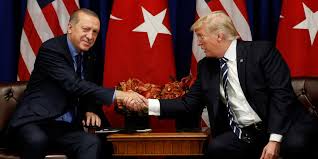
From one of his Tweet on Monday, as evidence of his capitulation to Turkish President Erdogan reached a crescendo and we abandoned our Kurdish allies, it appeared that he is now seeing himself in old testamental, messianic terms.

He wrote-- 

"As I have stated strongly before, and just to reiterate, if Turkey does anything that I, in my great and unmatched wisdom, consider to be off limits, I will totally destroy and obliterate the Economy of Turkey."

Trump the thunderer. Very scary.

Labels: , , ,

Monday, February 23, 2015

February 23, 2015--Lines In the Sand

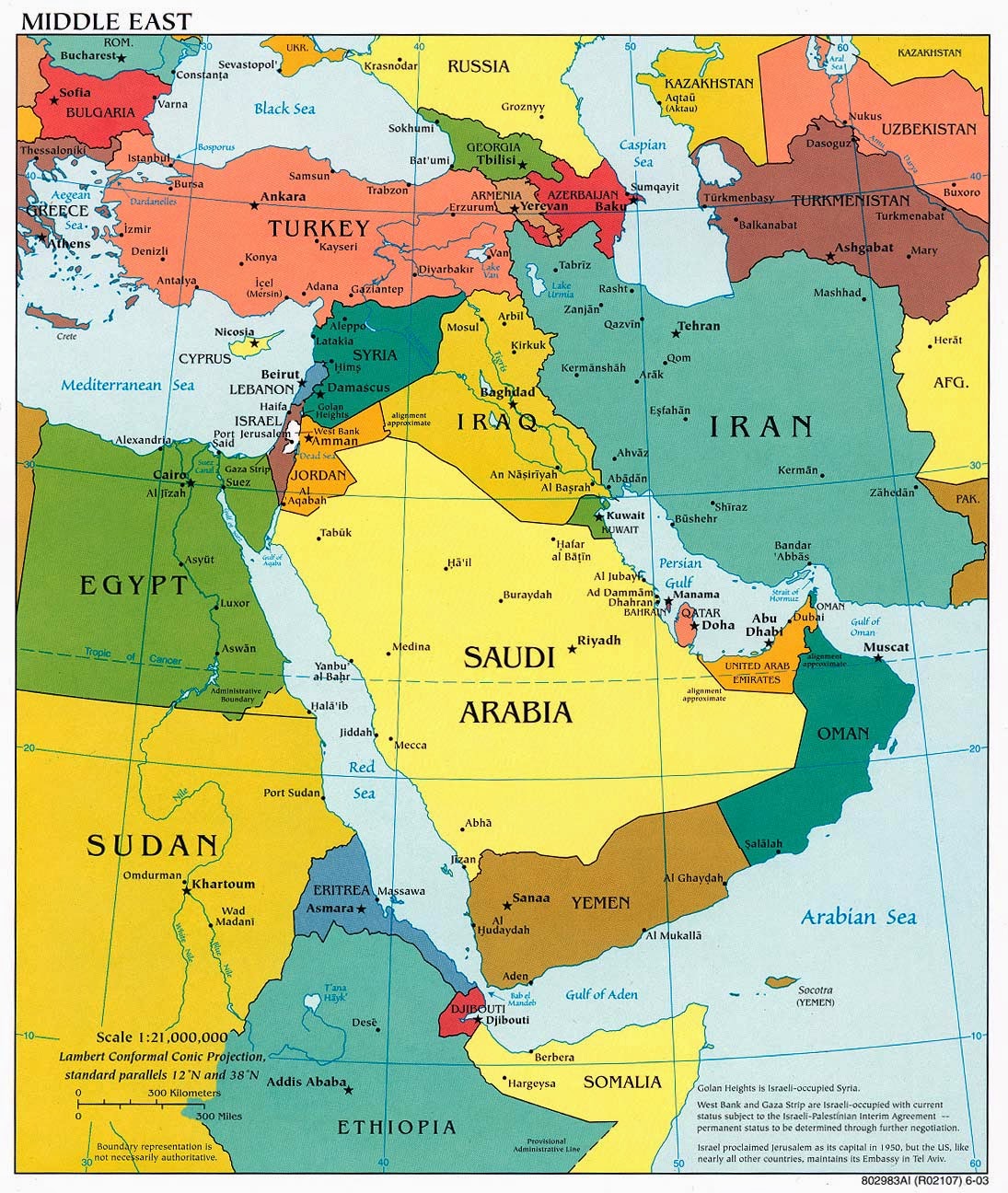
At the end of the First World War, a territorial plan devised by Sir Mark Sykes of Great Britain and Francois Georges-Picot of France established spheres of influence in the Middle East for the victorious European powers. Some compared this to drawing lines in the sand.

Prior to the War, most parts of the region were under the control of the Ottoman Empire. This included all of present-day Turkey, much of North Africa, and virtually all of the Middle East with the notable exceptions of Arabia, today's Saudi Arabia, and Persia, today's Iran.

The Syke's-Picot secret agreement became the blueprint for the dismemberment of the Ottoman Empire after its defeat in the War-to-End-All-Wars. The Great Powers, particularly France and Britain, with the assent of Russia, carved up the former Ottoman territory, creating modern Turkey and the countries that make up the contemporary Middle East, and assigned to themselves mandates and colonial oversight for what became Iraq, Jordan, Syria, and Palestine among other newly established countries.

(The U.S. President Woodrow Wilson was more interested in the establishment of the League of Nations and so effectively kept hands off as the region was carved up and parceled out.)


Based on Sykes-Picot, the Treaty of Paris assigned the blue regions to French authority, the red to British, and the green to Russian.

The more delineated map of the Middle East which was derived from the Sykes-Picot accord is the one we live with today. Take special note of those countries that were assigned straight-line borders. It is particularly revealing that some of the countries that are most in turmoil and include restive populations,  jihadists, and other groups of terrorists, are those with these kind of linear borders that do not take geography, culture, or religion into consideration--Syria, Sudan, Egypt, Yemen, Lebanon, Jordan, Iraq, and of course Israel.

Thus, "Iraq" should probably be deconstructed into at least three countries with cultural borders, including Kurdistan, and "Libya" into at least that many. The region, and the world would be much more peaceful if those who met in Paris in 1919 would have established borders that took history, religion, and tribal identity into consideration.


One might counter that there are straight line borders in the United States. Many. In fact, two of our states are virtual rectangles (Colorado and Wyoming), and four meet at the Four Corners (Colorado, Utah, Arizona, and New Mexico), but with the exception of the genocidal  example of what we did to our Native populations, territories that became states were not that culturally diverse and applied for statehood, staking out and suggesting their own borders. These borders for the most part were as viable as others that used rivers and mountain ranges as natural ways to divide and assign territory.


Labels: , , , , , , , , , , , , ,

Wednesday, November 20, 2013

November 20, 2013--Bomb, Bomb, Bomb . . . Bomb Iran

Here's what has me worried--

As dramatically weakened Barack Obama confronts three more years of his presidency, with the unlikelihood of anything, anything being approved by Congress (it will get even worse after Republican victories in the upcoming midterm elections), as with other presidents who had second-term problems, he will likely be tempted to do something dramatic in foreign affairs where as commander in chief he has considerable independent authority and the ability to act without congressional approval.

This is not in itself a bad thing--plagued by sex scandals, Bill Clinton almost pulled off an historic deal between the Israelis and Palestinians; Ronald Reagan negotiated significant disarmament agreements with the Soviets; and even Richard Nixon made progress in Eastern Europe and the Middle East.

But then there is the wag-the-dog problem--the temptation to get involved in overseas adventures to distract the public or repair tarnished presidential reputations. If was thought, for example, that to change the subject from Monica Lewinski and her blue dress, Clinton was itching to go to war in the Balkans.

Obama is on the ropes. The botched rollout of the Affordable Care Act is just the most recent in a string of failures that has ruined his political reputation and seen his approval ratings sink to George W. Bush levels.

On that list of failures and blunders is his now infamous pledge to draw a red line in Syria--if Bashar al-Assad crossed it and used chemical weapons against the rebels, Obama forcefully stated, the United States would take military action against the regime.

Assad did cross that red line and Obama backed down. He ordered lots os saber rattling but no intervention. The situation was saved by Russian President Putin who put pressure on his Syrian allies to give up their WMD program, which they are proceeding to do under UN supervision.

This failure to follow through has ruined Obama's reputation in that region.

Not only do the Israelis distrust him--if he failed to act in Syria what is his word worth when it comes to Iran where he has drawn another redline about Iran's nuclear capabilities?--now our other allies, the Saudis, Turkey, and Jordan, wonder if we will come to their assistance if the Iranians develop nuclear weapons or there are threats to their survival.

Clearly Obama wants to make a deal with the new, seemingly more moderate Iranian leaders. In fact, an initial, interim agreement may be struck as early as this week. This is not just a good thing for Obama's political reputation but a good thing in itself. We have to find a way to pull back from the brink. If Iran goes nuclear, it is virtually certain that the Saudis, Egyptians, and Turks will as well. This is not a part of the world where we want to see a nuclear arms race.

But beyond diplomacy, with Israeli Prime Minister Netanyahu marshaling local as well as U.S. congressional opposition to any deal with Iran, threatening to take unilateral military action against Iran's nuclear facilities, the political pressure on Obama--at this vulnerable time in his presidency--is almost beyond calculation.

The temptation to show that his word is good--especially when it comes to staking out positions in the world where there are threats to our allies and to our own security--may impel President Obama to want to show some muscle.

He hasn't done very much of that with Congress and other than killing Osama bin Ladin and numerous al Qaeda leaders with drones (which is generally commendable), Obama has been a disengaged, passive leader more including to deliver speeches than exert forceful leadership.

One place where he can take a form of forceful action is in Iran where he can join the Israelis in bombing their uranium enrichment facilities in an attempt to set back their nuclear clock.

This could in time be necessary. But diplomacy may now be working and it will require considerable courage from Obama to fend off pressure from Israel and Congress to keep talking and dealing with the Iranians.

Labels: , , , , , , , , , , , , , , , , ,

Tuesday, September 03, 2013

September 3, 2013: Syria

I don't know how to think about Syria much less what we should or shouldn't do.

On Saturday I listened to President Obama lay out his thinking. I was not impressed. I know he has drawn a red-line, saying that if the Assad regime uses chemical weapons he will have us punish them.

I am wondering, though, why killing 100,000 thus far in the civil war there isn't a red line in itself. I suppose it's how you kill innocent people that counts. If Assad kills them with guns and bombs and rockets the U.S. can stay out of it; if he kills 1,400 with nerve gas we feel compelled to intervene militarily and "degrade" Syria's ability to do so again.

But I recognize that when a leader establishes a red line--which for strategic and even tactical reasons is not a good idea--if he doesn't carry out whatever it is he threatened, other bad people will assume he can be rolled by them as well. Iranians might be inclined to assume they can continue their nuclear weapons programs and the U.S. will back off when that red line is breached.

So to maintain credibility Obama has to launch a "limited" attack on Syria, assuming Congress agrees, perhaps more to send a message to Iran than to Syria.

Of one thing I am certain--that whatever we do or don't do will have many unintended consequences.

All bad.

For starters, there is more than a likelihood that various factions in the region who support Assad will attack Israel, our client state, since they can't attack us directly. If they use poison gas against them, with the Holocaust still very much in Jewish people's minds, Israel will respond massively. What will that reap?

Again, nothing good.

And though various groups of Islamists can't easily attack us in the homeland, it seems likely that there will be a step-up in global terrorist activity. I wouldn't want to be an embassy worker anywhere in the world after we send hundreds of cruise and tomahawk missiles toward Damascus.

Isn't it likely that Iran and Hezbollah will send scores of their fighters and Jihadists to Syria to fight off the rebels as well as to demonstrate their prowess to both Israel and the United States? Will Israel live comfortably with that? The last time they fought in Lebanon and Syria they were effectively defeated by Hezbollah. They have been itching for an opportunity, a justification to have a do-over.

So much of what goes on in that part of the world has to do with posturing and displaying manhood. In other words, behavior there (actually, everywhere) is often emotionally-driven and thus unpredictable since when in the throes of passion all bets are off and individuals as well as peoples often act in ways that appear self-destructive. That is until one deciphers the inner logic.

Suicide-bombing, for example, which might seem the ultimate expression of self-destructiveness (literally so), if one believes that it leads to martyrdom and directly to heaven, makes great "sense."

But here's what really does make sense, though it has no chance whatsoever of happening--

Redraw the map of the region. Actually, redraw the maps of all former-colonial regions. 

The maps we currently live with, which are the cause of much of the religious, nationalistic, and sectarian fighting we are seeing, were drawn up by the victorious big powers (mainly Britain, the United States, and France) at the end of the First World War.

Thus, countries such as Syria, Tunisia, Libya, Iraq, Afghanistan, Israel, and Palestine (to name just some) are all artificial constructs that ignore tribal and cultural borders as well as deep history.

Syria, for example, a forced  amalgam of 140 tribes and clans, some that traverse borders with Egypt and Tunisia, could easily be divided into three to 10 tribal regions. Ditto for Iraq.

Where is Kurdistan? Nowhere. It doesn't exist on any map but it is a large cultural region that spans parts of 1919-created countries Turkey, Iraq, Iran, and Syria.

If we could see redrawn the national borders to create Kurdistan, tensions in that region would ebb significantly.

And if we could see that happen for the rest of the Middle East and, for that matter, all of Africa and portions of Asia, the world be a much more peaceful place.

So, maybe, here's the solution--

Big powers back off. Let the various factions fight it out. Let them exhaust themselves and eventually hope they come to their senses and agree, without the necessity of discussing it that much, to redraw their own borders so that a Kurdistan emerges as well as a few countries for Sunnis and more for the Shia.

Libya, as another example, would disappear and in its place we would have, at a minimum, Barqa, Ubaidat, Mughariba, and Awejeer. Others clans there would undoubtedly demand their own delineated territory and they would have to be accommodated. But being aggregated into a place called "Libya" isn't working, won't work, and eventually will no longer be sustained.

This fantasy of mine would take at least 100 years to be realized. But since this is where we're inevitably headed, we might as well let it start.

That process, among other things, means allowing and encouraging the current simmering and boiling conflicts to stutter to a stalemate. It also means that the U.S. not attack Syria.

Stalemate makes sense since there is no possible way for anyone, any country (us included) to "win."

Things just have to work out. This means waiting for things to revert to their cultural and historical roots--people are by DNA tribal and thus happiest, most satisfied if they are able to live with their own "kind."

For people who wish to live otherwise, there is always Western Europe and the United States.

Labels: , , , , , , , , , , , , , , ,

Friday, August 16, 2013

August 16, 2013--Arab Winter

Fridays in August should be times for languor and light spiritedness. Pass by this then if you want to protect your tranquility, but I cannot resist saying a few words about the escalating crises in the Middle East.

With a state of emergency declared in Egypt--after hundreds there were slaughtered by the military in an attempt to take the country back from the democratically-elected leadership of the Muslim Brotherhood--with continued unrest in Bahrain; democracy under threat in Tunisia, Iraq, Libya, and possibly even Turkey; and an all-out civil war raging in Syria, what ever became of the hope engendered by the Arab Spring that commenced in Tunisia more than two years ago?  The hope that authoritarian leaders from Muammar al-Gaddafi in Libya to Hosni Mubarak in Egypt would topple one-by-one and liberal democracies would take their places?


Isn't this what Barack Obama early in his presidency in a speech in Cairo saw to be the strategic opportunity in the region? And wasn't it for this that he was awarded a preemptive Nobel Peace Prize?

But now we have this--a tectonic nightmare of old authoritarian regimes overthrown and supplanted by radical leaders, many of whom either have ties to al Qaeda or tolerate their presence. Who foresaw that this would be the last gasp of 19th century colonialism and the dawn of a complicated new day in the Muslim world? 

Actually, many did who knew anything about the history of the Arab lands and the contesting forces active in every country throughout the region.

Does anyone doubt that events in Egypt will lead to a civil war there at least as ugly as the one underway in Syria? With the military government so casual about murdering hundreds of protesters isn't it inevitable that this will not suppress the opponents of military rule but motivate and inspire them to become more aggressive, ultimately take up arms, and prevail?

Is there any doubt that at some point in the not distant future we will see similar situations in Jordan and even Saudi Arabia where corrupt monarchies currently rule?

Then what we will have? A region in full turmoil with access to oil severely restricted. What will then be the consequences for the global economy? 

The ideals espoused by Woodrow Wilson, Franklin Roosevelt, George W. Bush, and Barack Obama in historical perspective look naive. 

Not everyone wants a government similar to ours (in fact, a majority of Americans themselves aren't too happy with the state of our own current government), not every country (especially those with arbitrary borders drawn up by the West after the First World War) is culturally set up to embrace democracy. And when they do fight for and achieve the right to vote--with our endorsement--they elect leaders from Hamas, Hezbollah, and the Muslim Brotherhood. 

This is just another sad example of unintended consequences, of the danger of getting what one wishes for.

Labels: , , , , , , , , , , , , , , , ,