Tuesday, November 08, 2016

November 8, 2016--Ladies of Forest Trace: Election Day

They are no longer with us.

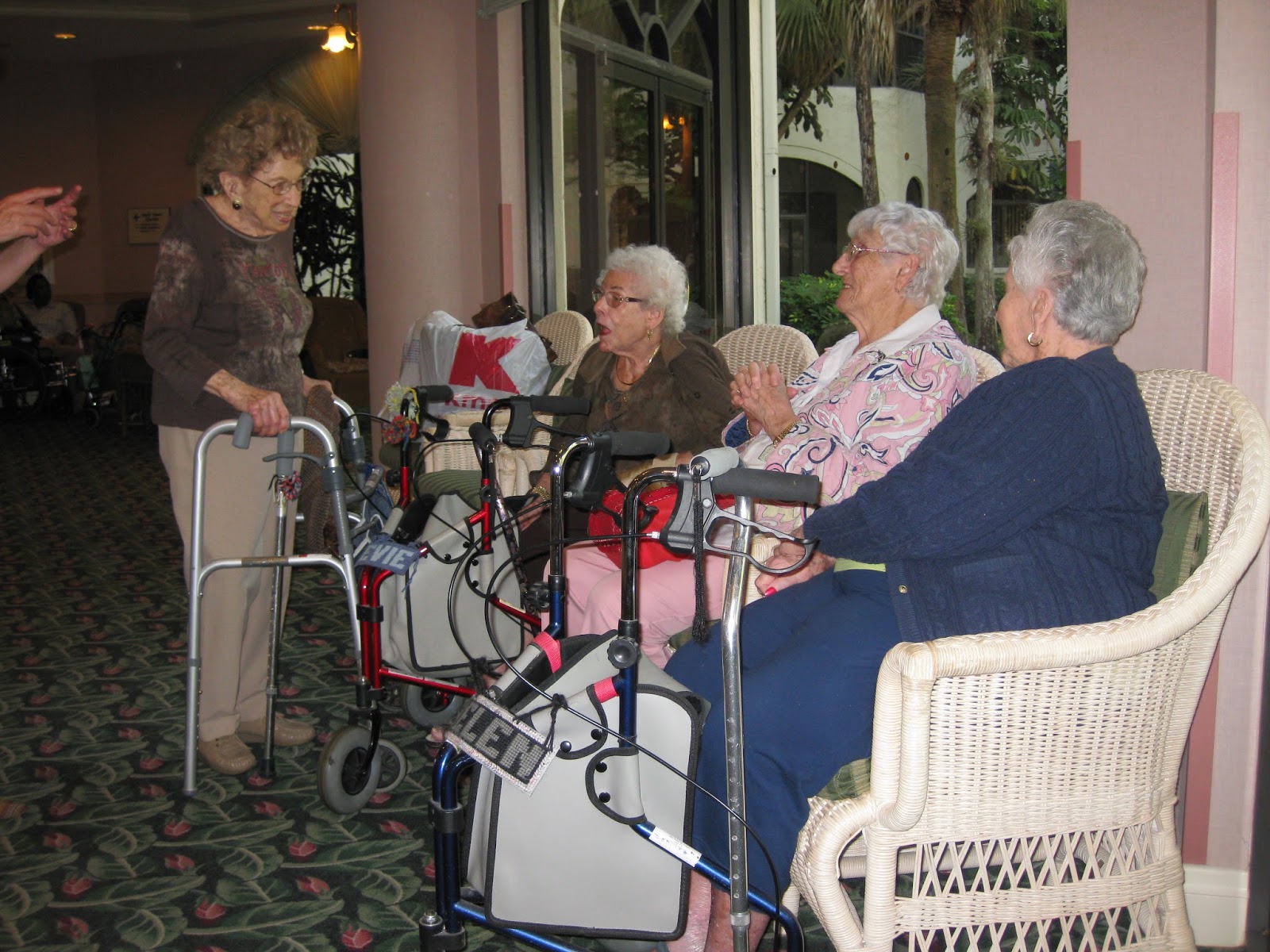
All the Ladies of Forest Trace, my mother and her friends, have moved on. But if there is a way for them to watch from their undisclosed location, through the day today, and especially this evening, they will be tuned in to Anderson Cooper (who they all thought is "adorable") to watch the vote tallies, especially in Florida, because the outcome of the election may again come down to "Florida, Florida, Florida," and some of the Ladies feel they still have some expiating to perform considering it was they as well as many other ladies of South Florida who, in 2000, either mistakenly voted for the anti-Semite Pat Buchanan or hang enough chads on their paper ballots to give the election to George W. Bush.

The rest is history. Sad history.

I know that today, with the opportunity to vote for the first woman to have an excellent chance of becoming our president, that would have been a highlight of all of their very-long lifetimes. My mother would be the oldest of the Ladies--she would be half-a-year more than 108 today--but all of her friends would be old enough to remember vividly when the 19th Amendment to the Constitution was ratified, August 18, 1920, when my mother was 12 years old. In her day, she and other girls were very much women at 12, in my mother's case having been born in a log cabin in the Polish woodlands.

All of the Ladies were disappointed in 2008 not to have had Hillary Clinton as the nominee, having lost in a bitter primary struggle with Barack Obama, but to a person they all came around to feeling good about voting for him because of his progressive views, his ability to promulgate hope, and not incidentally because he was African American. And most lived long enough to enthusiastically vote for him again four years later.

But today is different, very different.

I know that my mother and most of her friends had some "issues" with Hillary. They may have liked many of Bill Clinton's governing priorities but they thought little about his suitability as a husband. Some of the Ladies had issues with their own long-departed husbands and from that they knew a cad when they saw one.

But sharing this with Hillary they understood the impulse they felt to endure, to put up with what most younger women today would not tolerate. But they all lived long enough to understand the behavior and compromises expected of their generation, Hillary's, and of much younger women, who they over time successfully struggled to feel good about.

They also saw Hillary's flaws in her various official roles as First Lady, senator, and secretary of state.  Most were alive for all of that and had the experience and enough accrued wisdom not to deceive themselves because of her gender or feminism. But they saw the same falabilities, or worse, among Hillary's contemporaries and colleagues. These Ladies were not about gilding lilies or for that matter anything. They may not have had the exact words to express this but they were individually and personally viable in the world of very realpolitik.

And so through the day today, one by one they would have stood in line bent over their walkers, declining the offered wheelchairs or help to shuffle to the head of the line.

They had waited more than 80 years for this.

They had stood on many lines over the many decades--at dockside in Bremen, Germany to board the ship that would transport them to America, on lines at Ellis Island, on lines to file citizenship papers, on other lines when food was scarce during the Depression or rationed during the War, on lines while waiting at their children's schools, on lines at heath clinics, on lines in some cases to secure applications for scarce jobs or to apply for subsidized housing, on lines too many to count that led them to pay respects at the caskets of too-many-to-count friends and family members.

So, I know they would have thought today--"This is one final line I want to stand on because I've been waiting all my life to stand on a line to a polling booth where I can vote to make a woman president of the United States."

Then, after lingering with the ballot on which Hilary Clinton's name appears, with tears and pride, they would cast that magical vote and head home to Forest Trace for a nap so they could stay awake late enough tonight to see Florida, Florida, Florida seal the victory for Hillary.


Labels: , , , , , , ,

Friday, July 03, 2015

July 3, 2105--My Favorite "Ladies of Forest Trace" Story

As you might imagine, I have been doing a lot of thinking about my mother. She died two days ago at the age of 107 plus three days.

During the past 7 or 8 years I've written more than 50 stories about her and posted them here with the running title, The Ladies of Forest Trace.  I have received comments from people far and wide, mainly strangers, who have written things such as--
Thank you so much for sharing your mother with us all these years. She is a treasure, and will be part of so many people's memories. I am so sad that she will soon be leaving, after all this time. Clearly it is inevitable, but I did begin to wonder if she might be immortal . . . and I guess, in a way, through these stories, she is.
So here, at the end of her amazing life, is my favorite Ladies story from June, 2008--

Henry Cross

When visiting with my mother on Saturday to celebrate her 100th birthday, I did one of those silly things one is inclined to do on such occasions.

Rather than asking her which invention or technological development that occurred during her lifetime was, in her view, most consequential--electric lighting, radio, TV, airplanes, the Internet--instead, I asked what single lesson she learned that she felt was most important in guiding her.

Without missing a beat, she said, "Do unto others as you would have them do to you."

"I totally agree," I said, once again amazed by her mental acuity and what she chose to offer as her guiding principle.

"I think, without your preaching it to me, that by your example, I learned that Golden Rule and hope I also have been at least partially inspired by it."

She smiled at me as if to say, as I hoped she would say, that she feels I for the most part have been a good person.

To test that, I asked if I could tell her a story about something I had never before revealed to her that has been troubling me for more than 60 years. 

She continued to smile at me.

"A few years after I was born, you returned to teaching and needed someone to care of me during the day. You hired Bessie Cross to do that. You remember her, don't you?"

She nodded and said, "Of course I do. She was wonderful. And do you remember she had a son, Henry, who was about two years older than you?"

"Yes. Of course I do. In fact, my story is about him. Henry Cross. And it is relevant to mention that he was black.”

With my heart beating faster, I continued, "One summer because Bessie Cross had to return to South Carolina to take care of her mother, who still lived on a plantation where she and Bessie as a young girl had picked cotton, Henry came to live with us.

"And since at that time I was an only child and our apartment had just two bedrooms, he slept on the daybed in my room. At night, lying side-by-side, we shared stories while waiting for sleep. 

He became like a brother to me. I liked to hear about his family, especially his Aunt Sis and Uncle Homer who tended the coal-fired boiler and steam heat system in the basement of an apartment building not far from our house. They lived in that basement too, and I loved to visit them with Henry. Aunt Sis would make us chocolate milk and pecan cookies that I can to this day still taste. They were that good."

"I remember your bringing some home for me one day. I had them with a cup of tea. They were delicious. Made with love."

"After his mother returned from South Carolina, for years Henry continued to stay with us on weekends and the two of us would join our friends in street games. Since he and I were good athletes we were among the first to be chosen when it came time to choose up sides.

"When we were done playing the whole gang of us would go to one of our mother's houses for milk and cookies. This went on for some years. But then a terrible thing happened."

"What was that darling?"

"What I never told you about." I took a deep breath. "One Saturday, after a punchball game, we were invited to Stanley Shapiro's house for our usual milk and cookies."

"I remember his mother. She was such a nice woman. I wonder if she is still alive."

"Probably not. That was more than 60 years ago.” We sighed together about the effects of time. “Well, all of us, including Henry, walked over to her porch where she had set up a card table with pitchers of cold milk and stacks of oatmeal and chocolate chip cookies.  As we were passing these around, Mrs. Shapiro came over to me and whispered that she had something she needed to tell me.

"'In the house,' she pointed.

"Puzzled, I followed her inside where her 14-year-old daughter Rosalie was hovering. Mrs. Shapiro leaned close to me and said, 'It is of course all right for you to stay. You are always welcome in my house; but your friend,' she hesitated, 'he has to leave.' Protectively, she glanced over at her unhappy-looking daughter."

"That sounds terrible," my mother said.

"That's only half of it," I said. "I went outside again and saw Henry waiting his turn to get a glass of milk. I took him aside and told him what Mrs. Shapiro had said.

"Henry did not look back at me nor did he say a word in response. Rather, he turned and raced down the steps and then along East 56th Street toward Church Avenue."

I heard my mother inhale.

"I never saw him again," I said, tearing up. The memory of that sweltering summer day rushed over me as if it were yesterday.

When I gained control of my emotions, I confessed that I did not follow after him because I chose to stay behind with my neighborhood friends. I had trouble continuing the story.

"Here's what I've wanted to ask you," I managed to say to my mother on her 100th birthday. "If I had asked you later that day what I should have done after what Mrs. Shapiro whispered to me, what would you have said?"

Again without hesitating, this time in her most loving voice, my mother said, "You should have gone with Henry."

Labels: , , , , ,

Wednesday, April 15, 2015

April 15, 2015--Ladies of Forest Trace--The Battle

The other day when I called my mother sounded quite good. Better than she had for quite some time.

So, I said, "You sound very good today. What's going on?"

Very deliberately she said, "I'm engage in the battle."

I liked that, felt that was enough to say and hear in one day, and so I rang off.

Later, I told a friend about the call. He too knew about having an ancient mother. His died last year at nearly 105.

"Very impressive," he said. "She's still fighting to stay alive. My Mom did as well. Right to the end."

"I'm not sure that's what she meant."

"What then was she saying?"

"She's not fighting just to stay alive. There is that too, but I think she meant much more."

"What's that?"

"That she was also engaged in the battle to have a life. That's not really the same thing as just wanting to live on."

"Sounds right to me," he said. "And amazing."


Labels: , , , , ,

Friday, November 07, 2014

November 7, 2014--Best of Behind: The First Ladies of Forest Trace

Since I am sensing that there will not be too many more "Ladies," I thought to repost the first of them. It appeared on August 2, 2008--

Since whoever wins Florida’s electoral votes is likely to be the next president, rather than checking in with MSNBC or Justice Scalia to see who’s in the lead or who the Supreme Court will choose this time around, to find out how things are looking I call my mother who lives down there in a place called Forest Trace.

Forest Trace is for very senior citizens. The average age of the 400+ residents is about 80 and back in 2000 they were among the voters who punched the wrong sprocket on the paper ballot, thinking they were voting for Gore, but because of either shaky hands or misaligned ballots they hung enough chads, or by mistake punched a hole next to Pat Buchanan’s name, to send the election to the Supreme Court. And, as they say, the rest is history.

My mother has dinner every night with the same five or six friends, all of whom are lifelong Democrats who feel personally responsible for putting George W. Bush in the White House. Thus, this time around they are wanting to make up for what they consider to be their cosmic mistake.

As you might imagine, all but my mother were Hillary supporters. Actually, all but my mother remain Hillary supporters. They are among the disgruntled who feel that the nomination was snatched away from her by the media’s being unfair to her because she is a woman or because Barack Obama did not treat her with appropriate respect—remember, “She’s likeable enough”? They relate to her culturally and viscerally. They too stood by their men when they drifted, forgot their birthdays and anniversaries, didn’t help with the children, and failed to make an adequate living. So Hillary not only felt their pain, to their way of looking at things—forget objective reality—she lived it.

I was thus both curious and worried about what the ladies would think, and more important do, after John McCain rolled the dice and chose Sarah Palin to be his running mate. Would the residue of their feminist resentment be so strong that they would hold their collective noses and pull the lever or punch their chads for McCain-Palin just because he picked someone with the right gonads?

So Friday night, after her dinner, with considerable trepidation, I called my mother to see how McCain’s gambit was playing with my own personal Florida focus group.

She too was worried. She reported that most of the “girls” were very pleased with his selection and were now going to vote. Prior to this, out of on-going anger, to protest, they had been planning not to vote at all. Now, my mother said, they told her they were going to vote for McCain. When, she challenged them, saying both he and more important she were against all the issues and policies that Hillary supported, they shot back, “All we care about is that he chose a woman; and if we ever are going to see a woman in the White House during whatever little is left of our lives, this is our last chance.”

My mother was shaken and so was I. I tossed and turned all night, feeling that in spite of what seemed to be a fairly universal reaction that Palin’s selection would take the “experience” argument “off the table” and thus help Obama; and that any rational side-by-side comparison between Palin and Biden—assuming he didn’t come off condescending and patronizing during the vice presidential debate—that this too would tip the election toward Obama. Thus the ladies had me in a 24-hour state of political panic.

I say 24 hours because when I called my mother the next evening, again after dinner, I could tell by the bounce in her voice that things had changed.

“You sound different, mom,” I said.

“Yes, sweetie, I am feeling better. Much better.”

“Tell me. Tell me. What did the women say?”

“They’re all now going to vote for Obama.”

I resumed breathing. “What happened?”

“You know them, you met them the last time you and Rona were here. They’re all smart and well informed. They read all the papers, including the Times, and watch CNN.” I did recall liking them and thinking that they were still very much “with it.”

“Now that they know more about her,” I knew she was referring to Sarah Palin, “they are feeling insulted. They are now saying that John McCain is, what 72 years old, had serious cancer—and they know all about what that means—and has been saying all along that the most important thing is for him is to have a vice president who is ready on day one to become president.”

She knew I’d get the “day one” reference. “The girls now see that she is not ready if, God forbid, something happens to him. We have wars going on all over the place, terrorists still want to attack us, the economy—including their own pensions--is in trouble, and everyone around the world hates us.”

That was also pretty much my list. “So now that they have taken a second look at her and also realize that she opposes every issue that they fought for all their lives, some of them even marched for--you know Selma went to the South on Freedom Rides—they are saying that they don’t want the United States to be the laughing stock of the world. Things are already bad enough.”

“So? So?” I asked.

“They tell me they’re now all voting for Obama. And that’s not going to change.”

“I’m so relieved to hear that,” I sighed. “I’ll be able to sleep tonight.”

“Please, you need to get your rest. And be sure to eat.” She was still my mother. “I know what happens to you when you’re upset.”

“I will. I promise. I am so happy to hear that they will be voting for Obama. Florida is such an important state.”

“I know. In fact, you also know R___.” I did remember her. “Well,” my 100 year-old mother said in a whisper as if R___ might be able to overhear her, “She is not well. I think she may not be with us very much longer.”

“I’m so sorry to hear that,” I said.

“I told her to get an absentee ballot and to vote next week, because you never know what will be.” Her voice trailed off. “To tell you the truth, all the girls here, me too, should do that.”

I had to admit that made sense to me though I held back from adding anything that would contribute to further discussions about mortality.

It was almost nine o’clock and my mother, again full of enthusiasm said, “I have to go and watch Larry King, but be sure to call me again next week. With these girls, who knows, by then they could be voting for Ralph Nader!”

I could hear her laughing as she lowered the receiver to its cradle, making a note to call her then. I’ll be sure to let you know what the ladies are saying.

Labels: , , , , , , , , ,

Tuesday, November 04, 2014

November 4, 2014--Ladies of Forest Trace: Darling

It is becoming more difficult to determine when it is best to call my more-than-106-year-old mother.

Time is having its inevitable way with her. She is losing vitality and spends more time than in the past resting and napping. So for me to establish a calling routine--she very much likes routines and rituals--is not working well.

Six months ago a good time to call was 12:30, after she had had her lunch. But now, even lunch is losing appeal. She is eating less and less with diminished interest. At times she doesn't rouse herself for it, sleeping until mid-afternoon; and so if I call at 12:30, it is more than likely she will not be available.

I try later in the day--3:00 sometimes works. Most days she goes down for a very early dinner, leaving her apartment at 3:30 precisely. Generally, that routine remains. But calling then can find her resting or not up to talking. I then try to reach her at 5:30 or 6:00 when she is back in her apartment, preparing for bed. On occasion, she is in bed before 6:00 and so my daily call is more frequently becoming an every-other-day occurrence.

Early last week I did reach her at the old familiar time--12:30.

Her aide told me she had a good lunch and wanted to speak with me. My mother, she informed me, in fact was eagerly waiting for my call.

Optimistic, I asked, "How are you today, Mom?"

"Doing the best I can," which is what she always says--true or not--to relieve me of any need to feel anxious and to let me know she is still not needing any more help or concern. Another example of her continuing, lifelong generosity and pride.

"You sound good to me," I said as cheerfully as possible.

"I am, darling." She sounded on the phone as if she were smiling.

"I'm so happy to hear that."

"And how are you?"

"I'm fine. Doing well. The weather is still nice and--"

She cut me off. "I love you darling," she whispered, and abruptly hung up.

I felt a wave of concern. This sounded so final, so conclusive. Would this be the last time I would speak with her? Was she signally something changed about her condition? Something dire she was intuiting?

As it turned out it wasn't the end or even the seeming-beginning of it. I spoke with her two days later--at 5:30--and she sounded even a little better.

"You do not need to worry about me, darling," she again reassured me.

"You know I will," I confessed. "That's the way I am. We are." We are a worrisome people.

Later that evening, over dinner with Rona, I told her about the most recent calls.

"Isn't it wonderful," Rona said, "to be your age and not only to still have a mother, but for her to call you darling. How I . . ."

Overcome with emotion, she couldn't continue.

Labels: , , , , ,

Monday, June 30, 2014

June 30, 2014--Ladies of Forest Trace: Alive and Kicking

It was the day after my mother's 106th birthday and I called to run an idea by her.

"I have a theory."

"A what?"

"A theory, a perception I want to ask you about. It's something I've been noticing for the past number of years."

"How big a number? I'm trying to get used to big numbers. But before you tell me about your ideas, I have a related question for you."

"Shoot."

"Is this the way you talk to a mother? About shooting?"

"Sorry, please, ask me your question."

"How did this happen to me?"

"What's the this?"

"To get to this number."

"Oh, you mean your age."

"What else? What other numbers do I have to think about?"

"I'd say, primarily because of DNA."

"Dee-en what?"

"Genetics. You had two sisters who lived to about 102. So good genes run in your family."

"Good other things too."

"I agree with that. But your getting to 106 is about that and also that you had and have an active and stimulating life. They say that contributes to longevity."

"Longevity, short-gevity, they're all the same to me as long as I feel good. And now that my birthday's over--which I do not like to celebrate, I still have vanity about my age--I can get back to feeling as good as it's possible to feel at these sky-high numbers."

She paused to take a deep breath, which I was happy to see since her breathing has been shallow in recent months. "So, already, shoot." She chuckled at that.

"Here's my theory--Remember what years ago Rona and I said to you when you turned 85, about how  . . ."

"That I don't remember."

"Wait, wait, I haven't gotten to it yet. It's something we said to you about 20 years ago. How at that point in your life, rather than thinking always about other people and what they want and expect of you--something you did, devoted your life to to that point--that it was your turn. That if you wanted to you should say and do whatever was on your mind--not censor yourself or think so much about what others might expect of you--and that we would follow your lead. We would not put any pressure on you to think or say or do anything other than what you wanted and seemed right to you."

"This I remember. Rona said that when she got to be my age she'd start drinking and smoking again. That was funny."

"I'm not sure what we said influenced you at all, but it seems to me that since you were at least 90 you've been--how should I put this--feeling, acting more yourself. You speak your mind more, you do more things that feel as if they are what you really want to do than what you think others want. You speak your mind more forcefully. You seem willing to disagree more than in the past. You seem more focused on yourself than on others."

"And this is a bad thing?"

"No, no. Quite the contrary, I'm saying that this new, more assertive you is a good thing. You spent so many years . . ."

"Doing," she whispered, as if she didn't want anyone to hear, "Doing what other people expected."

"That's how it looked to me."

"Even voting the way your father told me to do. I remember that when we walked to the school to vote he would tell me to vote for this person but not that one." She chuckled again, this time it was mixed with a sigh. "As if I didn't know Republicans from Democrats. But, when I got behind the curtain, I did what I wanted."

"I'm glad to hear this. That curtain sums up what I'm trying to say--you could only be yourself, true to yourself, in private. Away from others' influence and expectations."

"I'll tell you something else."

"What's that?"

"All the women I knew did this." She paused, and I tried not to say anything, not to fill the silence. To let her thoughts flow freely.

"That's the way we were brought up. Not to speak our minds. Not to take the lead. Not to disagree. To hold ourselves back. I had sisters who joined the garment union and Bertha marched to demand the vote. But they were criticized for this. By their husbands and even by their father. My father, who said we should have a home, a husband, children and not work, not picket."

"That was how your generation of women was supposed to behave, but . . ."

"No buts. Though this is what was expected of us, still we shouldn't have gone along with it. Some didn't but most did." Again she paused, not to draw me in but to relive those memories and disappointments.

"This included me. And when later women began to talk about liberation and became feminists still, though I was working as a teacher and even was the acting principal of my school, at home I was a wife and a mother. I loved being a mother but being that kind of wife I didn't like so much."

"You were a wonderful mother and . . ."

"I followed in the news what women half my age were doing and demanding and, though I agreed with the ones who weren't shrill or man-haters, I was too old to join them and burn my bra." At that she laughed so full-throatedly she began to cough. "And if I did," she had quickly regained her breath, "burning my bra would have caused a bonfire." Again she laughed. As did I.

"Your father." Again I heard her inhale. "He was a good man. In his way. In a traditional way.  He worked hard, was responsible, accepted the family, which at first didn't accept or like him. He was born in America. All the rest of us came from Poland or Russia. I liked this about him. His being an American. I was proud of that. They thought he was arrogant for being born here and because his parents came from Austria. Can you imagine?"

"I can. Back then that was not uncommon."

"It's so different now? Where you come from? Not everyone is happy with immigrants. They forget where they came from."

"True enough."

"And your father was a strong man. A strong person. He made me feel secure. I still had fears from my childhood in Poland. From the pogroms. He protected me from that. Not the pogroms. Thank God we didn't have these in America. But places were restricted. Even in the Catskills. Some hotels had signs that said, 'No Jews-No Dogs.' In my lifetime I saw those signs. But they didn't bother your father. He felt as if he belonged and because of him I belonged too. And was safe."

"I know he also could be a difficult man. Severe and harsh at times. Actually, often."

"He was never successful enough for him to feel like a true man. He saw others, including in the family, doing better and it upset him. It made him angry and he took much of that out on me. As if it was my fault. I tried to protect you from his frustrations. But you know . . ." She paused this time to get control of her emotions.

"But you know, though I saw it as my role to do this--to let him be himself, to accept that and to protect you--though I did this, wanted to do it, saw it to be my responsibility to do this, it came at a price."

"I think I understand."

"But back to your theory," she had regathered herself, "which caused me to remember all this. Though my memory isn't what it used to be. You are saying that you are seeing something different in me."

"Yes. Definitely. To use a word many are using these days, you seem more authentic."

"You mean I haven't been?"

"Not exactly. But for some years now you seem to be more your true self. If that's helpful."

"I think I understand."

Though concerned I might be pushing too hard, still I asked, "Do you agree?"

"With?"

"That for the past ten to fifteen years you have been different?"

"I have to think about that for a moment. As I just said, there's a lot I forget. So it's hard to remember myself from so long ago." I sensed her struggling to recall the past. "Maybe, maybe . . ." She trailed off.

"It's OK, Mom, we can talk about this another time. I don't want to overtax you."

"You can tax me all you want. Everyone does. I just paid my quarterlies."

"I meant . . ."

"Maybe I am different. How long ago did you say this was?"

"Ten, fifteen years ago."

"And when did your father die?"

"I'm not good at remembering dates. Maybe 15, 18 years ago."

"So you see?"

"The relationship between Dad and . . ."

"Me, as you would put it, coming into my own."

"That's interesting. Really interesting. What about . . . ?"

"That's just what I was about to tell you." I'm not sure how she knew what I was going to ask. "All the girls here. It's the same thing with them. Those who came into their own. It was after their husbands . . . . They may have loved them but . . ."

"I see where you're going with this. How after . . ."

"It's a terrible thing to admit," my mother said, again after not saying anything for a moment, "Sad how they had to  . . . before . . . I . . . we could . . . But yes . . . I . . . we . . ."

"So I need to amend my theory," I stepped in to interrupt those painful recollections, "To consider the reasons you became, were able to become an active feminist at an older, geriatric age," I opted for that euphemism, "I mean, not just you but some of the ladies."

"Many."

"Many?"

"Many of the ladies. They also are different and . . ."

"And?"

"And if you live long enough it can happen. Anything."

Labels: , , , , , , , , , , ,

Wednesday, August 28, 2013

August 28, 2013--Ladies of Forest Trace: Maureen Shroud


“I’m fed up with her, all the time calling him ‘The One.’”

“I think I know who you mean.”

As usual on Sunday, at the stroke of noon, my more-than-105-year-old mother was calling from Florida. She takes special pride in doing so each week at precisely that time, seeing it as evidence that she, as she puts it, still has her “marbles.” Or, as she has recently come to modify it, in acknowledgement of her very-advanced age, and reality, “at least some marbles.”

“Doesn’t she know what he’s facing? She should know better, that Maureen Shroud.”

“Maureen Dowd,” I corrected her.

Dowd, Shroud, what difference does it make as long as you know what I am saying.”

“I know who you’re talking about but not what you’re saying.”

“If you would stop interrupting and let me catch my breath you’ll know soon enough.”

I could hear the hiss of her oxygen accumulator, which she has taken to using more than usual, and also in the background the voice of Candy Crowley.

“You shouldn’t be reading the paper and watching CNN at the same time. It’s too much for you.”

“There’s so much happening.”

“I know that but you remember what your doctors say.”

“How many of them are 100? When they get there, I’ll pay attention to what they tell me.” She enjoyed that and I could sense her chuckling to herself.

“But as I was trying to tell you about Obama--half of them hate him for we know why.”

“The public? Republicans in Congress?”

“Them.”

“Again, who?”

“Republicans.”

“Do you think it’s about him or would they hate him even if it was someone else?”

“Him. But now you sound confused.” She was right about that.

“And don’t you think,” I pressed, “the Democrats would do the same thing if there was a Republican president?”

“Some.” I could hear her breathing thickly.

“Do you think,” she continued, “the Democrats would be talking already about infringement?”

“If you’re referring to Maureen Dowd’s column, you mean impeachment.”

“That too.”

“I think Maureen got it right. There are these new Republican members of the House and . . .”

“The Senate too. That one from Oklahoma who is supposed to be his friend. The one with the beard. I forget his name. Heartburn?”

“Close, but no—Tom Coburn. And he is as you said from Oklahoma.”

“Is Maureen right that one of the leaders is Santa Claus?”

“Not actually Santa Claus, but he’s in some sort of Christmas business—Kerry Bentivolio, a freshman congressman from someplace in Michigan. He has a sled with his own reindeer. He apparently spends so much time dressed up as Santa Claus that he talks about himself as ‘we’—him and Santa.”

“I was trying to make a joke about him being Santa Claus. Mainly I wanted to tell you about those crazy people in Congress who hate Obama so much they can’t wait to infringe him.”

Not correcting her again, I said, “I thought Maureen Dowd did a good job of . . .”

“That’s why I called--to tell you that because of this morning’s column I forgive her for what she said about the Clintons. (Though Bill was very bad with that woman). And about Obama and ‘he’s The One’ business. She should know what he has to deal with every day. Worse than Clinton. Who at least deserved much of what she said about him.”

“I agree that often she goes too far, looking to be so clever that she comes off as smug. Though as you said, Clinton deserved to be held accountable.”

“But today, she redeemed herself.”

“You mean with how she concluded her column?”

Over the sound of the oxygen machine I could hear her wrestling with the newspaper. “Let me read to you. The last sentence—‘For some of the rodeo clowns,’” she paused, I thought to catch her breath, “That is going too far, isn’t it? I don’t like name-calling even when it’s deserved, but that’s how they talk these days. Even the best of them.” She sighed.

“’For some of the rodeo clowns,’’” she resumed, “’clamoring for infringement,’ I mean, ‘impeachment around the country’—they’re on vacation again and back in their districts. ‘For some of the rodeo clowns clamoring for impeachment around the country, Barack Obama’s real crime is presiding while black.’”

“I couldn’t agree more.”

“And so do the girls who I have dinner with. They may not be such big fans of his, but they can spot prejudice from a mile away. I’ve told you about some of the things they had to experience in their lives.”

“You surely did.”

“So they know. They know it when they smell it.” 

“For certain.”

Her breathing had become more labored and I suggested she lie down and increase the flow from her oxygen accumulator.

“I’m fine,” she said, gasping, trying to reassure me, “but have to . . . lie down . . . This is what it’s like . . . when you’re my age. Hooked up. Sleeping all the time . . . Like being a baby . . . again.”

“Everyone should be like you.”

With that she hung up. And I hoped turned off CNN.


Labels: , , , , , , , , ,