Thursday, June 20, 2019

June 20, 2019--Asylum In Maine

While waiting for our septic system to be pumped out (living by the bay in Maine has its moments), we had a long talk with our septic guy, Donny. We've known him for ten years. He's very bright and full of opinions. The other day many were about asylum seekers. From West Africa, Congo mainly, who he claimed are being welcomed by the political leaders of Portland.

"Can you believe they're getting $1,500 a month for rent and other expenses? My daughter who works two jobs makes about half that. And still lives with us. She could sure use some of that money. Not that I'm in favor of the government giving anyone that kind of money. To be consistent, including my daughter. But refugees when there are Americans who have needs?"

He slapped his thighs in frustration. "And people wonder why Trump was elected. It may surprise you that I didn't vote for him and don't intend to next year. But I share some of his feelings about the asylum system."

"I've been reading about this," I said, "There was a long article about Portland earlier this week in the New York Times."

"So you agree with me."

"Not so fast," Rona said, "The Times didn't say refugees are getting that much money and didn't say that whatever they might be getting in city or state money will go on indefinitely. And there was no mention of the federal government providing money unless someone is admitted to the country as an officially designated refugee. Then, as I understand it, they're entitled to the same services and benefits as U.S. citizens. But that's a relatively small number."

"And that makes sense to you?" Donny said, "That a judge finds they are in danger back in the own country, grants them asylum, and then they get Medicaid and food stamps? Again, while my working daughter, who's an American citizen, has to wait on a very long line to get housing subsides. Again, that makes sense to you?"

We felt the need to do some research.

Yes, it's true Portland has one of the most welcoming of policies. Recently, this city of 66,000 admitted about 200 Africans who were granted asylum by a judge in San Antonio. It took most more than a month to get there but they made the trek because San Antonio is considered to be the easiest place in America to be granted asylum.

Once granted asylum, attempts are made to settle refugees with family members--Maine has a relatively large Congolese community, but it is not large enough to absorb all who are likely to need help with resettlement. And Maine, it is true, is one of only two states where there is taxpayer money available to help with housing. The Portland Community Support Fund uses local government money to provide rental assistance but that Fund is already depleted. So, Donny was misinformed when he said refugees are receiving $1,500 a month in government subsidies. He was right, though, that Portland is welcoming. They, for example, have converted their basketball arena into emergency housing.

"This is really complicated," Rona said, "It is important to admit refugees who are escaping from oppression and violence, but how many is the right number? To relocate and house 200 as in Portland is a generous thing to do but we know there are hundreds of thousands, perhaps millions more worldwide who we cannot accommodate."

"Considering the numbers this feels like a gesture," I said, "But still the right thing to do. Isn't it?"

"Maybe the government should not be in this business altogether, leaving the welcoming and resettlement to refuge organizations and family members. I remember that in the past anyone seeking asylum or refugee status needed to be sponsored by an organization or family member. Didn't that work?"

I said, "I'm not proud to bring this up but there is also the political cost. Trump is mocking Portland's efforts. It continues to be an effective wedge issue for him. I wouldn't be surprised to hear him tell Donny's daughter's story."

"The good news is that in spite of continuing to have this red-meat issue to rile his base, the poll numbers for Trump are not looking good."

"We can continue to talk about this with Donny," I said, "We won't need to be pumped out again this year, but I'm sure we'll see him at the Nobleboro Village Store when we're making a donut run. They still make the best ones in Maine."


Labels: , , , , , ,

Wednesday, February 06, 2019

February 6, 2019--State of the Union: El Paso

During the 1990s, when with the Ford Foundation, I spent many days in El Paso working with the school district and the University of El Paso to fund their efforts to help more students than in the past enter and complete college.

I loved visiting. I enjoyed the diversity of the people and their energy. It felt as if the city had a sense of purpose and proudly was going about the business of improving the lives of all its citizens. Very much including those who crossed the border daily to work or go to school.

After my work day was over I wandered about the city looking for new places to visit and eat. Never once did I feel the sense of threat there that Trump talked about last night in the State of the Union address. And so this morning when I saw what the New York Times' fact-checkers said about El Paso I was not surprised. I quote what they wrote in its entirety--

Trump claimed--

“The border city of El Paso, Tex., used to have extremely high rates of violent crime — one of the highest in the entire country, and considered one of our nation’s most dangerous cities. Now, immediately upon its building, with a powerful barrier in place, El Paso is one of the safest cities in our country.” 
El Paso was never one of the most dangerous cities in the United States, and crime has been declining in cities across the country — not just El Paso — for reasons that have nothing to do with border fencing. In 2008, before border barriers had been completed in El Paso, the city had the second-lowest violent crime rate among more than 20 similarly sized cities. In 2010, after the fencing went up, it held that place.


Labels: , , ,

Monday, November 05, 2018

November 5, 2018--What Are We So Afraid Of?

It is not inappropriate, the day before the most consequential midterm election in memory--perhaps in all of American history--to explore the power of the defining political issue--Fear.

This time around, we really do have nothing but fear itself to fear.

Fear is the central theme, the emotion being evoked by the defining presence in the campaign--Donald Trump, who has nationalized the process. 

Rather than this election being about Congress, which by definition is what midterm elections are--they occur midway through a president's term of office, usually his first term, by its nature it is about 435 separate House of Representatives and this year 35 separate Senate contests--Trump has turned it into something different, something unprecedented. 

Because of Trump's behavior--daily or twice daily rallies, endless political tweets and interviews--this midterm is a version of a presidential reelection campaign. In this case, Trump is seeking something resembling reelection (or minimally a vote of confidence) after fewer than two years in office. 

He has absconded with the electoral process and has tried to make it all about him. 

I suspect he has succeeded. 

Instead of the Democrats having an outside chance to pick up two or three Senate seats (and thus regain the majority), as a result of Trump's endless campaigning the Republicans are likely to flip a couple of seats and thus hold onto the majority, and rather than a Blue Wave that would see Democrats flipping 50 seats in the House, it looks as if 30 is more likely (which thankfully is just enough to regain the speakership).

This is the conventual wisdom. But I worry since this also feels like deja-vu all over again, Remember how "everyone" thought Hillary would easily defeat Trump in 2016? 

Retrospectively we know that fear then was also something Trump was perversely skilled at stoking.

This time, he has focused on the alleged threat represented by a so-called "caravan" of Central Americans heading north through Mexico toward the U.S. border. Taking his talking points from Fox News, Trump, without foundation, tells those attending his rallies that not only do the marchers include "very tough people, "M-13 gang members, but also how many are infected with exotic diseases, including leprosy (which though not easily contagious sounds very frightening and, for the Evangelicals in his base, is the disease most frequently mentioned in the Bible).

Caravans of asylum-seekers are not new. There have been any number of them over the years. Most recently, in April, on Trump's watch, 1,500 headed toward San Diego. About 300 made it. Only 14 were arrested. Almost all others were mothers with young children. Objectively not much of a threat but rich fodder for demonologizing.

The current caravan is estimated to be larger. Still 800 miles from the border, based on the April numbers perhaps 700-800 will reach U.S. Customs at about Christmas time. Impartial observers report that as in the past most are mothers with children.

Nonetheless, this minimalist threat is enough to incite Trump's most fervent followers. His order to send up to 15,000 U.S. troops to join the 20,000 border patrol agents in defense of the border (which is illegal for the military to do) is a fearful over-deployment of resources. But it does contribute to fear about the magnitude of the threat. It is thus more a political than a tactical move. After Tuesday, no matter the results, expect this military ploy to evaporate from the headlines.

More disturbing, what has happened to us? To Americans? Why have we become so fearful? How can it be that this caravan of women and children is enough to paralyze more than a third of the population?

Have Americans who responded so bravely to real threats such as the attack on Pearl Harbor and on 9/11 the World Trade Center, become such wusses that we need the Army to protect us from women and children in flip-flops marching 1,000 miles to seek asylum?

For a depressing number of Americans the answer appears to be yes.


Labels: , , , , , ,

Monday, July 02, 2018

July 2, 2018--Jack: Born On the 4th of July

"Happy birthday!"

"My birthday is in October," I said to Jack who was on the phone, sounding celebratory, "I'm confused."

"I was born on the 4th of July, wouldn't you know it, and I call all my liberal friends to remind them about how it was when America was great. When we had our freedom."

Here we go, I thought, but said, "July 4th isn't until Wednesday and I assume you have at most one or two calls to make, considering I'm probably one of your only liberal friends."

"You'd be surprised," he said.

"I'm sure I would be. But in the meantime, happy July 2nd."

"I assume you've read the Declaration of Independence."

"I sort of know it by heart--'When in the course of human events . . .' We were required to memorize the first few paragraphs in elementary school."

"You mean when America was great," he repeated himself, chuckling, "Before all the political correctness. These days, since the Declaration didn't free the slaves or talk about women's rights it's probably ignored in history class, that is if kids these days even take history."

"About that we probably agree. Not much history is being learned these days. Or evolution." 

He liked that. "You know we conservatives like the Declaration more than the Constitution. The Constitution is about what kind of government we are to have while the Declaration is about what to do when the government becomes oppressive. How to change it. Even how to overthrow it. That was a big deal to Jefferson. Didn't he call for governments to be overthrown every few years? Every generation? I think he called this, 'throwing the government off.'"

"Glad to see you know at least some history. And about the differences between the two documents. We may agree about that too. Though we have differences, other big differences. I don't see the government in general being oppressive. Aspects of it, yes. Especially now with Trump as president, ironically, though he calls for less government in fact many of the things he's been doing are making the government even bigger and more oppressive. Think what it would be like if you were an American Muslim. Or an immigrant Dreamer. You wouldn't feel too free now."

"Speaking of immigrates, have you been to any big political demonstrations lately?"

"What about this past Saturday? Doesn't that count?"

"Not impressive. Relatively few marchers showed up. Sure wasn't like the Pussy thing or the one organized by Parkland High School survivors. Millions across the country participated then. This one was hardly publicized or covered by the press."

"Again, it looks like we agree."

"Just more evidence that you guys are out of gas. If you were serious about protecting your rights--like for women and gays, immigrants and the Supreme Court--shouldn't you be planning a huge 4th of July protest? A massive march on Washington? Reading of the Declaration? To show that you're unified and riled up. Not just heading out to the Hamptons or the Macy's fireworks thing. That you're willing to forgo your BBQs. Of course I'm not unhappy about this, but you and your friends should do some hard thinking about how to rally your people. To have a chance in November you have to out-organzie us. We're all jazzed up again with the prospect of Trump appointing another Gorsuch to the Supreme Court. If that doesn't get you marching I don't know what will. The Supreme Court is one vote away from overturning. Roe v. Wade. I hate that idea, by the way, because I'm a libertarian and support a woman's right to choose."

"It must be your birthday," I said, "Because again I tend to agree with you. We progressives have to get even more serious and mobilized."

"I've got to run," Jack said, "I have more calls to make. In the meantime, fair warning."


Labels: , , , , , , ,

Wednesday, June 20, 2018

June 20, 2018--Getting Through the Week

I've been attempting to get through the week without mentioning Donald Trump. Hence all the donut postings. 

But his administration's policy to separate children from parents who are desperately trying to enter the United States is so egregious, so evil that I cannot restrain myself. Nor apparently can the weaselly Senator Ted Cruz. 

And though to continue to rip children from the arms of their parents is Trump's ultimate responsibility, for which one day he will have to atone, even worse is the wide approval among Republicans for this heartless policy.

A recent Quinnipiac poll found that 55 percent of Republican voters support the president's "zero tolerance" policy. 35 percent oppose it.

Who are these people, this 55 percent? Are they living among us? Are they online ahead of us at the supermarket? Are they at the next table during dinner? Do they love their children? What could they possibly say to them or us to explain themselves? 

How does one come to endorse this shameless policy? How do they come to hate life so much that they are unmoved when they see images of these young children having their lives literally cut in half? Even before their lives have begun? 

I do not want to understand. I do not want to know about or know anyone who could be this vicious.

Yes, what to do about immigrants is roiling the Western world. The German government this week came close to collapse over Angela Merkel's empathetic immigration policies. What to do about those seeking asylum is complicated.

We cannot admit to the country everyone who seeks refuge or simply a better life. But while individual cases are being reviewed and ajudicated families can easily be kept intact. There is no policy or security purpose or justification for this so-called "family separation" policy.

It is based on fear and hatred. Even of the most innocent.

It is as simple and despicable as that.


Labels: , , , , ,

Thursday, January 11, 2018

January 11, 2018--In A Matter of Minutes

After three excruciating hours of trying to stay awake during the Golden Globes--the pervasive feeling of self-congratulations exhausting my willingness or ability to endure--suddenly on screen there was Oprah! 

She was wearing serious eyeglasses so I assumed we were in for a treat. She wasn't about to announce cars for everyone but something better: Hope.

An immediate feeling of hope that she was not running for president but was about to be inaugurated and thereby release us from our long national nightmare.

Immediately, except for the Fox News channel, all of media lit up. They were already talking about what a Trump-Oprah contest would look like and, since they assumed Oprah would win, who she would name to key positions in her administration.  

Forget getting down to measuring the drapes in the Oval Office, would Dr. Oz become Surgeon General? What about Dr. Phil and best friend Gayle King? A new cabinet position, Secretary of Mental Health, for the doctor and maybe chief of staff for her pal? What about Stedman? First Escort?

These feelings of deliverance persist so I should try to calm down and take this seriously. Unlike Trump Ms. Winfrey is an accomplished and self-made billionaire. A real billionaire. And she could have the right personal qualities to be a healing president. Most important, she could actually win. Which, considering the alternative, is a very big deal. During her presidency I could hold my nose for all the self-esteem building preaching. Over my political lifetime I've held my nose for a lot worse.

It took all of eight minutes for this wave of enthusiasm to build during an otherwise dreary awards show. Going viral doesn't begin to tell the story. We almost elected a president in those few minutes.

Then on Tuesday, on live TV, direct from the Cabinet Room in the White House, there was that bipartisan 55-minute meeting about immigration President Trump held with Republican and Democratic members of Congress. 

During meetings of this kind the press is usually allowed to be in the room for a few minutes of innocuous schmoozing. They are then dismissed and the meeting occurs behind closed doors. Tuesday was different.

The purpose of allowing the press to send out a video feed of the meeting was not to showcase transparency but to allow the country and world to see that Trump was in control of his mental faculties. That he was capable of acting like an adult--in this case talking and listening--not the nine-year-old he was represented as being in Michael Wolff's new book, Fire and Fury. With Trump embodying both the fury and the fire.

The subject was DACA, the move to allow a path to citizenship for the 800,000 young people who, through no fault of their own, were brought to America illegally. This should not be too controversial an issue since many Republicans in Congress favor it. Nonetheless, most of the GOP base of voters resist agreeing to even this commonsensical compromise. So it was actually refreshing to see Trump, who has demagogued the subject of "illegals," mostly coherent and seemingly on board for a quick and just fix. 

And, beyond that, more surprisingly, Trump, who wants to build the Wall and deport pretty much anyone here either illegally or without having undergone what he calls "extreme vetting," Trump appeared open to an even more ambitious solution to the problem--a possible path to legal status for all10 million illegal residents. He spoke about "taking the heat," the political heat for such a tricky issue.

Was this simply telling whoever's in the room what he thinks they want to hear? Perhaps. But, then, maybe not, since a version of amnesty is not any Republican's favorite subject.

So, what's going on with this?

It could be that the "liberal," New-York Trump some people thought they were electing has finally appeared. Perhaps made easier for him with the decline and fall of his Svengali, Steve Bannon. If so, for moderates of all persuasions, this could be a rare dose of good news.

Minimally, he once again managed to change the subject when seemingly cornered--no one was talking about the Wolff book, most of the chatter about the dossier and Mueller was on the back burner, he dispelled some of the talk about the need to get ready to roll out the 25th Amendment, and even Oprah was pushed from the headlines. Minimally, as a tactic, this performance was politically adept. 

Rona suggested that perhaps Trump was able to put on such a good show because he was on camera. His favorite place to be. 

If so, let's set up cameras in the Oval Office, Cabinet Room, and in the room in the residence where he watches TV. In other words, have him on camera 24/7.

The first year of his presidency, or in TV terms, the first season, which ends in 10 days has been Steve Bannon & Friends. This coming season, let's hope it will be Oprah


Labels: , , , , , , , , , , , , ,

Monday, March 13, 2017

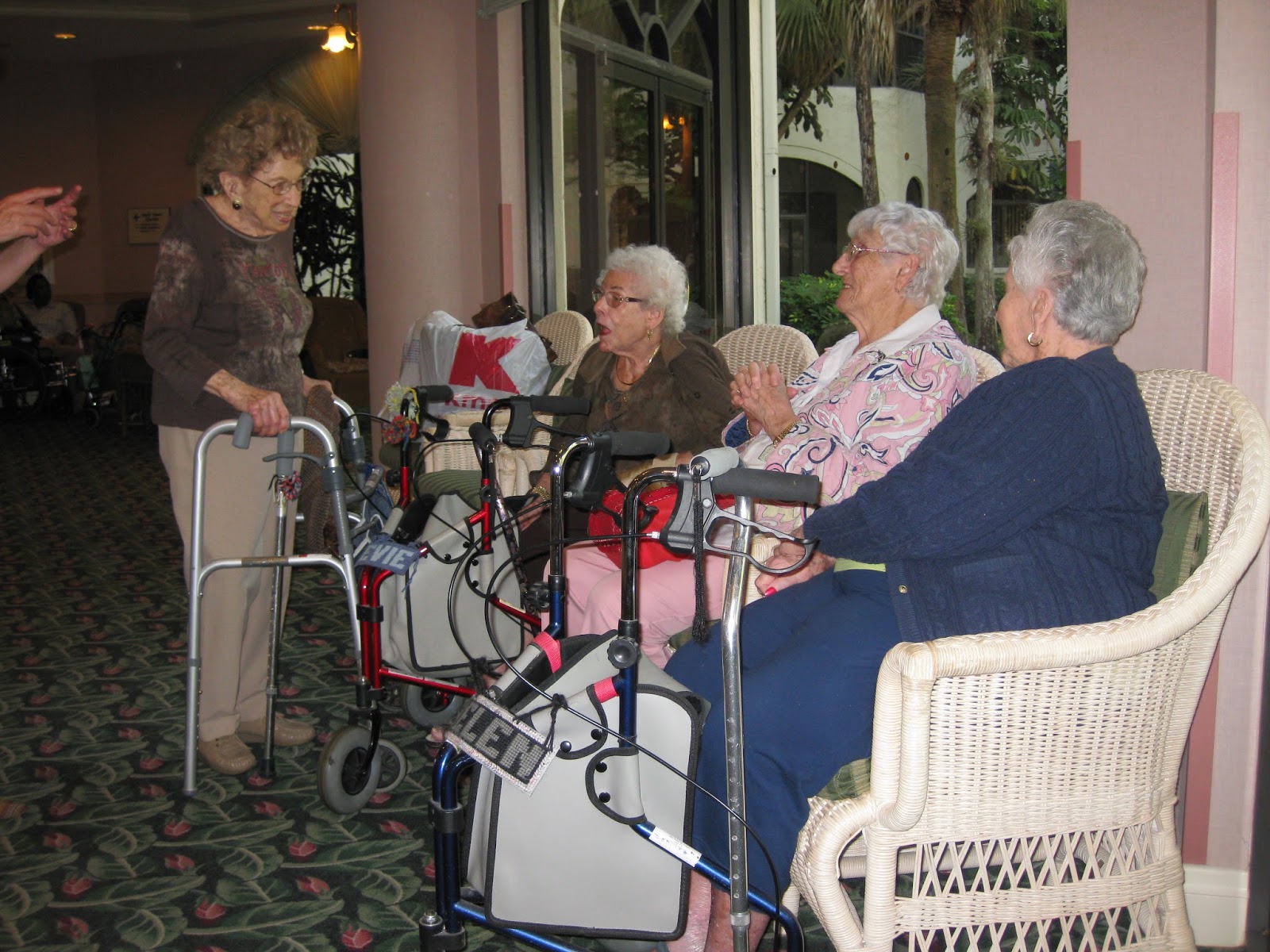
March 13, 2017--Ladies of Forest Trace: Not Resting

The Ladies are in a place of tranquility but they are not in repose.

I know this from my mother, who deserves to be at rest after more than 107 years of life. I discovered her state of agitation during a recent visit to Mt Lebanon Cemetery in Queens.

When I was a child we visited Mt. Lebanon regularly so that she could be with her parents and bring them news of the family and the world. We would sit together on the bench beside where her mother and father were and I would listen while she told them about Bertha's recovery from a stroke, Nina's trip to Israel, Eli's struggles with his creditors, Fanny's plans to move to Florida, news about Stalin, and how things were with my father.

About that, the state of her own marriage, she would whisper so I needed to lean close and strain to hear what she was reporting. Though I could not catch most of the words, I could tell from their tone and her trembling that things were not going well.

"He never . . . He always . . . ," she said and then tearfully would switch to Yiddish to protect me from being swept into her unhappiness. But from this and how she placed her arm around me and drew me close into the protective nest of her body, I knew her pain was real. And that to her I represented a sense of purpose. She was happy I was there with her, with the family.

More than sixty years later I again needed to be close to her and so, though I sat alone on that now crumbling bench, listening to the wind, I tried to pick up her emanations, the comfort she provided, and, on that chilly pre-spring afternoon, her still flickering warmth.


"The girls are so upset," she began. I could hear the pain in her voice.

"Tell me Mom."

"About him."

"Who?"

"Thump, Donald Thump."

I didn't correct her wonderful malaprops, which frequently revealed more than literal truth.

"You've been hearing about him?" I wasn't sure how information was acquired and shared by the Ladies now that they were no longer . . .

"All the terrible things he's doing. With immigrants--wasn't his own father an immigrant?--with minorities, with women, with health. And we are so afraid about Korea and Russia. Especially Russia. We know Russia. Two of the Ladies are from there and I was born in Poland, near the border. Russian Cossacks raided our village, Tulowice, when I was a little girl. My mother hid me and my sisters and brother in the root cellar below the floor of our log cabin. The evil things they did which I cannot tell you about."

"You can tell me, Mom. You can tell me anything."

"You're still young and I don't want to upset you. You should be enjoying life."

Only someone who lived to 107 would consider me to be young. It was this kind of affirmation that I loved and which I greedily still needed.

"You should have your rest," I said, reversing her lifelong admonition to me.

"As your father said, 'There's plenty of time for rest. Later, there's time for rest.'"

"Yes he always did say that. As I grow older I understand it more and more."

"Ruth, who marched so we could vote, the women, is so upset that a majority voted for him--I can't say his name--so many women that I am sure Wolf on TV is saying that if it wasn't for the women voting for him we would have Hillary. Not that she's such a bargain. But almost anything would be better. Even Mike Expense, the Vice President, who we all are hoping will become president. This person, Expense, who doesn't believe in women's health and is too religious for any of our tastes we are wishing for."

"I am hoping for the same thing. Maybe if there's an impeachment or . . ."

"We're both dreaming. The Republicans in Congress, who we know did not support him will keep him in office because he will sign anything they approve--health care, taxes, regulations, pollution and who knows what else."

"It's a long list."

"But, one of the girls, Rose reminds us things have been worse."

"How? He's been in office only two months, though it feels like years, so how can things already be worse?"

"She means in the past. When we and Negroes couldn't vote. They couldn't drink water here in Florida. They had their own colored fountains. We didn't have the Pill but we had world wars. We had Depression but didn't have Xanax for that." She paused to let me know she meant that to be funny. So I wouldn't worry more than I do about her mental capacities.

"And you are old enough to remember the gas chambers. We had family who survived Auschwitz. Cousin Malkie and her family who lived with Aunt Tanna and Uncle Eli when they escaped and came to Brooklyn. You heard those stories when you were seven years old. I tried to protect you from them but you insisted you wanted to know about the world. Even at its most evil. So I let you sit with us at the kitchen table while Malkie and her son, whose name I forgot but whose haunted look I will always remember, told us about the nightmare."

"I remember that. I also wanted to see the tattoos on their arms. I didn't want to be shielded from the worst that life could bring. But I know you felt otherwise and wanted me to have nothing but a happy childhood. One time you told me that was in part because of all the children who were forced to suffer. You wanted me to live for myself but also when I was old enough to try to do things that would make less fortunate children's lives better."

Recalling that I began softly to cry.

"I bring this up," she said, "because I want to remind you that Rose is right. Too many things were worse in the past. Not quite as much so for those who were blessed to be born here or came to America as hopeful immigrants and refugees. We survived and over time many things did get to be better."

"You always say this," I said, knowing I had come to Mt. Lebanon in large part to have her remind and reassure me about that.

"Of course, things here could get worse but worse than Pearl Harbor? Worse than the Cold War? The Depression? The lynchings? I could say more but I know you have to rush away."

"I have a little more time," I said, feeling a bit better, though not yet assured or optimistic, "So tell me whatever else is on your mind and making you and the Ladies so restless."

"This isn't enough?"

"But I thought you brought up the War and women to remind me not to get too overwrought with what is happening?"

"That's my attention. But, yes, there is something else that is very disturbing to us."

"Please tell me."

"You know your history better than we do so I'm sure you have examples."

"Of what?"

"About what I am going to tell you."

"Sorry."

"And it's not all his fault. Though he is the beneficiary of it."

"You're starting to lose me."

"The hate." I waited but she didn't continue.

"The hate?"

"I'll give you a for-instance. When they talk about health there is so much resentment, so much hate for poor and elderly people who will have it taken away from them. They talk as if it's about how much it costs the government but what we really hear is how much the Republicans--and it is them--feel it is people's fault that they are poor and need help. They say they are making the wrong choices about how they spend their money--as if they had so much. Did we hear this correctly--sometimes communications to where we are are not so good--that someone in Congress, Jascha Heifetz, said that if people had enough money to have a telephone . . ."

"Jason Chaffetz, from Utah."

"I don't have my hearing aids with me. But that's him. He said if they have money for those phones they could give them up and use the money to buy health insurance."

"I did hear that. He really did say that."

"In the meantime if so many millions lose insurance how many will die from that? Who was it who talked about death panels? This is like that. Worse."

"Congresswoman Michele Bachmann."

"Who was also running for president. But all this meanness and resentment about struggling people--about children and old people--is very sad and tells us what these Washington people really think. They are so full of anger and resentment and this makes it acceptable for him to say the ugly things he has for years been saying. About Obama, about women, about Negroes, about Mexicans. And what's really worse when he talks this way is that many of the people who support him, who are filled with fear and hate, want to hear this. They give him encouragement and permission to say the ugliest things. They cheer loudest when he does."

"There has been hate and fear at other times in our history, that's true. About the Irish and Italian and Jewish immigrants. And obviously black people. You experienced that when you were a young girl and woman. People are this way when there are hard economic times. And when . . ."

"I'm sorry to interrupt but whatever was or has been is no excuse."

"I agree."

"About that, by now, we should know better."

To that I had nothing to say.

"We're all gone now," my mother whispered, "There is no room left here for anyone else. All the places are filled. Everyone from the family is here. And the Ladies are scattered like leaves. Ruth to her daughter in New Jersey. It's so cold there. Ruth was always shivering. And Rose next to her beloved father also in Queens. In Mt. Hebron. Adele, poor thing, is by herself. She lost all her family in Russia and never married. Never had children or grandchildren. I love her so much. How she made such a good life for herself. The first woman to become a school principal in Brooklyn."

"She was remarkable," I said.

"I could talk all day, but I know it must be getting dark and they close the gates soon. And you don't like to drive after the sun is down. You were such a good driver," I noted the past tense, "When you would take me to the doctor or out for Chinese, I felt so secure. And now . . ." Her words trailed off. Her breathing slowed. I didn't want her to strain herself.

It was time for me to go. I was feeling better. If not about the state of the world about her and how loved and safe she still made me feel.

"And remember, as I always say, be sure to wear your sweater."

It was as if I could see her smiling.


Labels: , , , , , , , , , , , ,

Friday, February 24, 2017

February 24, 2017--Jack, On Immigrants

"So tell me what you and your friends would do about the more than 10 million illegal immigrants."

It was the morning after the Trump administration unveiled a new executive order that outlined plans to round up and deport millions of undocumented workers and their families and Jack was sounding excited.

Before I could respond, he continued, "My boy was back on his heels last week what with the Flynn fiasco, Kellyanne Conway, and that press conference. But with this he's back. And the general he appointed to replace that crazy Flynn is everyone's favorite. Even your crowd's."

"Well I do agree about General McMaster but about the immigration executive order, I'm not so sure."

"Perfect bleeding heart material for you liberals. Feeling sorry for all those displaced Latin Americans. See, I didn't say 'Mexicans.'" I sensed that made him feel good about himself. "But we've got a lot of problems and needs of our own not to have to worry too much about them."

"Well, they're here and for the most part are hard working and law-abiding. I just read that the crime rate among undocumented people is actually lower than among citizens."

"Probably from your New York Times. But aren't they all doing illegal things? I mean, just being in the country without documents or visas is itself illegal."

"So you'd round up everyone? Even the so-called Dreamers? Young people who were brought to America when they were very young children?"

"Maybe not them and as I understand it for some time at least the Trump immigration police will leave them alone."

"Just send their parents back?" I hope he heard my sarcasm.

"You know your American history."

"And?"

"And wasn't it true that when your grandparents as well as mine came to America, because they didn't have the money, many left family members behind? Isn't that a version of the same thing? Isn't it in the nature of immigration itself?"

"I'll have to think about that some more. But it is true that for almost everyone--though they faced a lot of discrimination--they had legal status. They in most cases were sort of welcomed here as laborers, to build railroads, or settle and work on farms in the Midwest."

"Don't we have a guest worker program here that allows people to legally cross borders so they can work on farms and restaurants?"

"We do," I acknowledged.

"But we're getting sidetracked," Jack said. "I come back to my initial question--what would you do about the millions and millions of illegal immigrants? And I should remind you that your president Obama was the deporter-in-chief. He rounded up and sent back about two and a half million. More in total than all his predecessors combined."

"That's true but he didn't do it in the same kind of mean-spirited way. Unlike your president." It upset me that I was beginning to sound like Jack.

"Sure, Obama didn't publicize it because he didn't want to get legal Hispanic-Americans all upset. He wanted their votes. And pretty much got them."

"Can we forget Obama? Trump is now our president, so let's limit ourselves to what he's doing. Not much good as I see things."

"So you're Ok with all the illegals living here, sending their kids to our schools and hospitals, and . . ."

"The evidence is overwhelming that from an economic point of view, from a cost-benefit perspective, immigrants, even undocumented ones, contribute more that they get in government services. In other words, in bottom line terms, we get more in return than we pay out. Also, most of the unassimilated immigrants do work that, forgive the expression, real Americans don't want. Like a lot of the restaurant and field work. How many Americans do you know who want to wash dishes, cut lawns, or pick lettuce?"

Jack was silent so I said, "I take that to mean you don't know too many field hands who are citizens."

"Up here plenty of the farmers are Mainers. But to tell you the truth there are also a lot of Hispanic agricultural workers. Again, we keep getting off the subject. So let me try again--what would you do about the millions of illegals? Just let them be? Make them all citizens?"

"First of all, can you find another name for them. 'Illegals' sounds really nasty."

"Let me come at this another way. You live half the year in New York City, right?"

"Right, but where are you going with this?"

"You're a so-called sanctuary city, right?"

"Right. But again?"

"Which means that you don't cooperate with federal immigration enforcement people."

"Not entirely true because if an undocumented person commits a felony in most cases they do get turned over to the ICE people."

"But basically, if they obey the law, illegals, sorry, illegal immigrants, can stay in the city as long as they want, get drivers licenses, have any kind of job, etcetera."

"Basically true. And most New Yorkers are fine with that. In fact, we feel good about being welcoming and tolerant."

"We're not talking abut refugees, right, but people who came here or overstayed their visas to live and work?"

"Again, I don't have all day so can you get to your point because it feels as if you're building up to some revelation."

"I'll cut to the chase."

"At last." I was feeling exasperated with Jack. I liked him better when he didn't call so much. I did have things I wanted to get to and he has the ability to get under my skin.

"You have any immigrants living in your building?"

"I haven't checked but I assume so."

"They'd have to be rich ones, right, considering how much apartments sell for?"

"That's true," I admitted.

"So you're OK with where you're living?"

"Pretty much."

"It doesn't disturb you that your place isn't diverse?"

"What do you mean by that?"

"That everyone, I assume, is pretty much like you? All rich and . . . "

"There are some who have lived here for decades, before prices shot through the roof, and they are more modest than most of the rest of us. And again, your point is?"

"That you live pretty isolated from your typical illegal immigrant. My guess is, and it's an easy one, that you don't have any Mexicans who snuck across the border living in your building."

"Could be."

"And so this subject for you is pretty theoretical because the only illegals you maybe encounter are working in restaurants, cleaning up after you're finished with dinner?"

"Could be." I was starting to feel defensive.

"I'll bet you don't wake up in the morning and meet any in your elevator when you're heading out for breakfast. Except if someone is renovating their apartment and some of the illegal construction workers are around."

"Could be."

"How would you feel if somehow one morning you woke up and half the apartments in your building were occupied by Guatemalan or Syrian refugees?"

"That is . . . ," I sputtered.

"Go on. You can say it. You'd hate it."

"I don't know. This is all so crazy."

"But it's not theoretical to people here in Lewiston, Maine, where more than 5,000 refugees have been relocated. Altogether, including the refugees, there are only about 35,000 living in Lewiston. Some for generations. They wake up in the morning and see their neighborhoods and downtown turning into Somali enclaves. Ask them, from your Manhattan sanctuary, how they feel about that. And these are good people. But it's not how most want to live."

"But other places like Buffalo, New York, seem to be welcoming refugees and undocumented people because they contribute to their economy. Things are pretty bleak up there and new arrivals rent places, do the work that a lot of local people don't want to do, and buy things from Buffalo merchants. So it appears that it's good all around."

"I read about that too. In your Sunday Times, and I get it. But in just as many places, again like Lewiston, nobody asked the local people what they wanted. Refugees from Somalia just began to show up with the assistance of the U.S. government."

"I can understand that. I want us to be welcoming but local people should have a say in relocation programs. And I'll concede that refugees are not the same as undocumented people."

"As long as they don't move into you building."

I was out of gas and didn't respond.

"I hear you, you've got other things to do. I'll call you next week."

I said to myself, "If you must."
Somalis In Lewiston Maine

Labels: , , , , , , , , , , ,

Tuesday, November 08, 2016

November 8, 2016--Ladies of Forest Trace: Election Day

They are no longer with us.

All the Ladies of Forest Trace, my mother and her friends, have moved on. But if there is a way for them to watch from their undisclosed location, through the day today, and especially this evening, they will be tuned in to Anderson Cooper (who they all thought is "adorable") to watch the vote tallies, especially in Florida, because the outcome of the election may again come down to "Florida, Florida, Florida," and some of the Ladies feel they still have some expiating to perform considering it was they as well as many other ladies of South Florida who, in 2000, either mistakenly voted for the anti-Semite Pat Buchanan or hang enough chads on their paper ballots to give the election to George W. Bush.

The rest is history. Sad history.

I know that today, with the opportunity to vote for the first woman to have an excellent chance of becoming our president, that would have been a highlight of all of their very-long lifetimes. My mother would be the oldest of the Ladies--she would be half-a-year more than 108 today--but all of her friends would be old enough to remember vividly when the 19th Amendment to the Constitution was ratified, August 18, 1920, when my mother was 12 years old. In her day, she and other girls were very much women at 12, in my mother's case having been born in a log cabin in the Polish woodlands.

All of the Ladies were disappointed in 2008 not to have had Hillary Clinton as the nominee, having lost in a bitter primary struggle with Barack Obama, but to a person they all came around to feeling good about voting for him because of his progressive views, his ability to promulgate hope, and not incidentally because he was African American. And most lived long enough to enthusiastically vote for him again four years later.

But today is different, very different.

I know that my mother and most of her friends had some "issues" with Hillary. They may have liked many of Bill Clinton's governing priorities but they thought little about his suitability as a husband. Some of the Ladies had issues with their own long-departed husbands and from that they knew a cad when they saw one.

But sharing this with Hillary they understood the impulse they felt to endure, to put up with what most younger women today would not tolerate. But they all lived long enough to understand the behavior and compromises expected of their generation, Hillary's, and of much younger women, who they over time successfully struggled to feel good about.

They also saw Hillary's flaws in her various official roles as First Lady, senator, and secretary of state.  Most were alive for all of that and had the experience and enough accrued wisdom not to deceive themselves because of her gender or feminism. But they saw the same falabilities, or worse, among Hillary's contemporaries and colleagues. These Ladies were not about gilding lilies or for that matter anything. They may not have had the exact words to express this but they were individually and personally viable in the world of very realpolitik.

And so through the day today, one by one they would have stood in line bent over their walkers, declining the offered wheelchairs or help to shuffle to the head of the line.

They had waited more than 80 years for this.

They had stood on many lines over the many decades--at dockside in Bremen, Germany to board the ship that would transport them to America, on lines at Ellis Island, on lines to file citizenship papers, on other lines when food was scarce during the Depression or rationed during the War, on lines while waiting at their children's schools, on lines at heath clinics, on lines in some cases to secure applications for scarce jobs or to apply for subsidized housing, on lines too many to count that led them to pay respects at the caskets of too-many-to-count friends and family members.

So, I know they would have thought today--"This is one final line I want to stand on because I've been waiting all my life to stand on a line to a polling booth where I can vote to make a woman president of the United States."

Then, after lingering with the ballot on which Hilary Clinton's name appears, with tears and pride, they would cast that magical vote and head home to Forest Trace for a nap so they could stay awake late enough tonight to see Florida, Florida, Florida seal the victory for Hillary.


Labels: , , , , , , ,

Thursday, February 25, 2016

February 25, 2016--Jose the Fanatic

Of the many startling things about Donald TRUMP's decisive victory in Wednesday's Nevada caucuses, beyond the fact that there was an historic turnout and he garnered more votes that Ted Cruz and Marco Rubio combined, was the fact that he also won easily among Latinos.

So much of both parties' campaigns is challenging conventional wisdom--that to win one needs a powerful, big-data-directed ground game (TRUMP has won three of four primaries and caucuses with hardly any ground game at all); that it's all about who can raise the most money (Jeb Bush and Ted Cruz did and look what happened to them--TRUMP raised hardly any, spent even less, and look who's leading); that Americans won't vote for a socialist (Bernie Sanders take note); and Latino voters overwhelmingly vote for Latino candidates (ask Rubio and Cruz about that) the same way blacks tend to vote for blacks, Jews for Jews, and so on.

In Nevada, TRUMP ran away with 45 percent of the Hispanic vote. Note, in 2000, George W. Bush was elected largely as the result of appealing successfully to Latino voters--he got an historic 40 percent nationally.

So TRUMP, who pretty much everyone having access to a microphone said would be lucky to get 10 percent of the Hispanic-American vote considering how he castigated illegal immigrants (mainly, to him, Mexicans) defaming them by labeling them "murderers" and "rapists" and promising that he would deport 12 million, that Donald TRUMP thus far, especially with the Latino-rich voters of Nevada, has run the table. How it might translate to the general election is for the moment another matter.

But his "appeal" to Hispanic voters is worth some thought. Why would any vote for him?

For insight I am reminded of one of my favorite Philip Roth stories--"Eli the Fanatic."

It is also one of his most overlooked, perhaps because of the direct way in which it deals with and excoriates secularized, seemingly-assimilated Jews.

Set in suburban America, it concerns a non-observant Jew, lawyer Eli Peck, who is hired by his Jewish neighbors to convince a recently-arirved group of orthodox Jews to close the yeshiva they established in their midst. The other Jews in town are embarrassed by the visible presence of these Hasids, fearing they will call attention to them and thereby interfere with their desire to blend in among the largely gentile residents of Woodenton.

To make a short story short, Eli fails in his attempts to get the ultra-orthodox to back off, including abandoning their traditional ways of dressing, and, after an epiphany of his own, gives up his normal wardrobe and appears before his stunned and outraged Jewish neighbors in Hasid garb, thereby exposing the ethnic roots of all of them.

Could it be that TRUMP's appeal to a large and growing percentage of Latino voters is because increasing numbers counter-intuitively support his views about illegal immigrants--that many favor building the wall and deporting those here without proper documents?

As in Roth's Woodenton, those Hispanics in the United States for decades and for others in the Southwest for many centuries, from even before Europeans landed at Plymouth Rock, for Latino citizens, for Hispanics who are comfortably "Americanized," having so many other Hispanics here illegally threatens their sense of relatively unobtrusive assimilation.

For Roth's secularized, well-educated, and affluent Jews, having Hasids in their midst, they feared, exposed them to their Christian neighbors who would not distinguish between them and the ultra-orthodox. Seeing them both in the same light and thus out of step with American culture, still rooted in Eastern European beliefs and superstitions, and wanting to live and cling together in self-imposed ghettos.

Perhaps the United States' most successful and assimilated Latinos, who are not self-hating, have some of the same kinds of feelings and support TRUMP as one way of declaring loyalty to the great American immigrant narrative, not wanting their place in society to be confused and conflated with those who came here illegally and live insufficiently in the shadows.

Philip Roth

Labels: , , , , , , , , , , ,

Tuesday, December 15, 2015

December 15, 2015--Ladies of Forest Trace: Mt. Lebanon

We visited my mother on Sunday at Mt. Lebanon Cemetery. It was a little more than five months since her death. It was a beautiful, unseasonably warm day and she was at rest amid the graves of her parents, among her bother, sisters, and their spouses, and next to my father.

Being there reminded me of earlier times at Mt. Lebanon. In truth, often happy, secure times for me when I was a young child. I wanted nothing more than, in one way or another, to be with my family.

I thought to share again something I wrote a few years ago about her final resting place, the family plot in Mt. Lebanon Cemetery--

Shuttling between cemeteries is the way I spent much of my childhood.  One was Mount Hebron, my father’s family’s place of final rest; the other, my mother’s family plot at Mount Lebanon.  Just three miles apart, in the borough of Queens.  It felt like being pressed between the pincers of two grim parentheses.
My mother’s family, the Munyas, arrived in the America in about 1912 from a shtetl town in central Poland, Tulowice.  Her father, Laibusya Munya, was a paymaster in a forest.  This was a job for Jews—they were trusted with the money but not the physical labor of cutting down trees.  That was for the goyim.  Grandpa Laibusya went into Warsaw each week to pick up zloties and brought them back to the forest to pay the men who cut down the trees and schlepped the logs to the river.  With his wife, Frimet, my eventual grandmother, he lived in a log house with his six children, including my infant mother.  When the pogroms became more frequent and bloody, he began to make plans to leave.  As with so many before him, he went first on his own to the New World, established himself as a baker on the Lower Eastside, saved money by existing on rye bread, and then sent for the rest of the family.  They settled within a community of other Polish Jews, most of whom came from the same part of the Pale of Settlement.
They moved from apartment to apartment whenever the landlord raised the rent, but once they were all huddled safely in America, they found a more permanent place to live (a rent controlled third-floor walkup in Bensonhurst, Brooklyn), a store for groceries (Beckman’s, down the block), a butcher (Fleishman’s, next to Beckman’s), a fruit store (Willy’s, across the street), and of at least equal importance, they formed a burial society—a Landsmanshaftn, or a home town association.  There was no time to waste—as my grandfather would say in Yiddish, one never knew when having a plot would come in handy.  And through the years it turned out to be as he predicted--before I was of legal age more family members resided in Mt. Lebanon than Bensonhurst.
Even before finding suitable burial sites, the members of the Landsmanshaftn elected officers—a president, vice president, secretary, and especially a treasurer.  Especially, since the treasurer was responsible for what little money there was—money to pay the cemetery the annual maintenance fee and to write checks for the “perpetual care” for the ground around and on the graves.  Also, the treasurer, because of these fiduciary responsibilities, was the only one who was compensated.  At first five dollars a year.  And thus it was a coveted honor and contested fiercely, particularly as time went by and the annual stipend was raised to $25. Real money when a dollar was still a dollar.
The Tulowice Landsmanshaftn somehow managed to strike a good deal with Mt. Lebanon in spite of great demand-side pressure: Jews were arriving in New York in such numbers during the first two decades of the twentieth century, and dying at such a rate thanks in part to the unchecked influenza, that more and more dairy farms in Queens were being converted into cemeteries and plots were gobbled up as fast as pastures could be converted into graves. 
Mt. Lebanon was established in 1919.  Perfect timing for the Tulowicians who were able to get in on the ground floor during the year of the most virulent and deadly flu epidemic.  They were able to buy a reasonably contiguous cluster of thirty or so plots in a desirable, hilly, shady corner.  It came with a pine tree and a view of the new Interboro Parkway.  As evidence of how desirable a location, Richard Tucker, the famous cantor turned Metropolitan Opera star came to occupy a nearby plot of his own as did Nathan Handworker, founder of Nathan’s Famous in Coney Island.  So the family was in good company and assured of eternal upward mobility.
Exactly what they had come to America for. The streets may not have been paved with gold, but to forever be across from the “biggest” tenor and the hot dog king showed that they had “arrived.”
On the other hand, the Zwerlings, my father’s family, claimed they came to America from Austria, not from the downscale Pale in Poland (although there are in fact no extant papers to prove this assertion).  Full of pride they boasted they were from Vienna, spoke German, and arrived well before those Eastern European shtetal Jews showed up at Ellis Island with their cardboard suitcases.  In fact, unlike the Munyas, who had the good fortune to have had an Irish immigration officer convert Munya to Mooney, the Zwerling needed no such transmutation—the German-sounding “Zwerling” was fine just as it was.  Though hardly of the Our Crowd crowd, the Zwerlings prided themselves on the fact that they were born in America, owned their own house, and didn’t understand Yiddish, much less speak it.  So when it came preparation for dying, they had a different approach than the Malones. 
The cemetery they selected and in which they bought real estate (that is how they viewed it—as a real estate transaction), Mt. Hebron, was founded by assimilated German Jews in the late 1880s.  In contrast to the other Mount, there were no burial societies, none of the carving on the tombstones were in Hebrew--everything in Mt. Hebron was ostentatiously in English--the roads weaving among the graves were wider (Mt. Hebron families had cars), there was abundant parking, the above-ground mausoleums were more elaborate and spacious, and there were even well-tended restrooms.
However, though in all other ways the Zwerlings and Mooneys lived cultural worlds apart, they did share one thing in common—an absolute obsession with illness, dying, death, and above all their final arrangements.  And no one was more obsessed with final matters than my father. 
But first I need to say more about how my mother’s family devoted themselves to their sixteenth of an acre of American soil.  First, with a name like Mooney they had to convince the Mt. Lebanon authorities and that they were in fact Jews and thus eligible to be laid to rest in ground consecrated exclusively for people of the Old Testament.   With their Irish-sounding name they were suspected of being goyim and had to show not only their Ellis Island papers but also those they brought along with them from Poland that identified them as Munyas, and thus Jews.
After successfully making that case to the Mt. Lebanon council of rabbis and being allowed to erect a tombstone with the gentile name “Mooney” chiseled on it, they then needed to consider how to care for the plot itself.  There was the “Perpetual Care” option, but neither the family nor the Landsmanschaftn as yet had the hundred dollars necessary to arrange for it.  That would come later when Uncle Jac did well enough and could afford to underwrite the tending of all thirty plots.  Even then, because of their experiences with pogroms and subsequently the Holocaust, the Mooneys were suspicious of institutions, including cemeteries (after all they too were businesses) and thus were congenitally incapable of trusting them to provide care perpetually (enough of them by then knew English sufficiently to understand how long perpetual in truth was) much less trust the cemetery owners not to run off with the hundred dollars before the clock on perpetual ran out.
Thus, during the spring and summer growing season, we went to Mt. Lebanon every Sunday.  Not to visit Grandpa and Grandma Mooney, who at the time were the only ones in permanent residence, but to care for the gravesite itself.  As the youngest and most agile that meant I was designated to crawl around among the tombstones to pull weeds and cut grass with the pinking shears my Aunt Tanna always had in her pocketbook.
Sitting on the bench to supervise, her sister, my Aunt Fay, would watch with pride as I scampered from head- to foot-stone, kvelling, “Look at him, look at how little Steveala is clipping Papa’s grass and plucking Mama’s weeds.  He has such hands.  With those hands one day he could be a surgeon, be rich,  and make everyone proud.” 
At her older sister’s words praising my skills and predicting my promising future, my mother would swell with maternal satisfaction and say to me, “When I am buried here, Steven, with the family, I know you will come to take good care of me.  And you will tell me about your own wife and your own children and grandchildren.  And about your patients and their appendectomies. Just like I talk to Mamma and Poppa.” 
Though this was more than I wanted to contemplate, any aspect of it—I was already burdened at school with spelling and the six-times table--I nodded and continued to clip away. I moved among the grass and weeds as if born to the task, wielding the pinking shears, which I was told were the only scissors in the family with enough heft to cut through thistles.  So when I had completed my pulling, chopping and cutting with those slotted shears it looked as if the grass had been Marcelled.  As a result, the Malone wavy gravesite was reputed to be the envy of the two burial societies that owned adjacent plots.
In truth I loved this first adult responsibility.  And since none of us had the wherewithal to ever get to real mountains during the hot weather, going to Mt. Lebanon was our version of a trip to the country. 
While I scooted among the tombstones, my aunts would sit on the bench and talk to their Momma and Papa, telling them about what had happened during the week.  There was a lot to report since the family apartment was the site of a constant shuffle of relatives and friends from the Camps in Europe, distant New Jersey, and even the occasional refugee on the way to Palestine.  For the latter, Aunt Tanna would collect money for their passage or to help them buy a car or icebox.  All that news was duly recounted to my grandparents at rest nearby.  But since it was in Yiddish, I could gather little of what they reported.  My ears perked up, however, and my nearly non-existent Yiddish improved, when they whispered about “That Rifka. Not quite a relative but a distant cousin of a friend of my grandparents, Rifka was someone they referred to as a nafke, which even with my limited Yiddish I knew meant tramp.  I made a mental note that when I was old enough I would make an effort to meet that Rifka.
My father’s obsession with his family’s cemetery, however, was of quite a different sort. 
Among the Zwerling, he was the only one preoccupied with the family plot.  To the others it was just that place in Queens where they might eventually have to be taken after marrying off the children and retiring to Florida.  But to him it represented a different order of reality.  Again, in the tradition of the Zwerling, it was more about real estate than visiting the departed and reporting to them life’s quotidian events. To him it was a matter of being sure there was a physical place for everyone entitled to be there.  And that the arrangement of those places, the individual gravesites, were appropriately hierarchical. 
Proximity to the family patriarch, Louis, his father, my grandfather, and mother-grandmother, Anne, was, as it should be, where the hierarchy began, with the sons and their wives and the sisters and their husbands arranged in descending tiers by birth-order and gender.  As the oldest, the first-born male of a first-born father, this meant my father would reside right below his father and mother, and so on down the Zwerling family genealogy.
An awareness of the shape of the Zwerling Family Plot would immediately see that the task my father set for himself was not so easily accomplished.  If they had been able to purchase a plot with hierarchy and primogeniture in mind, they would have bought something more in the shape of a pyramid.  But in the gridded-out reality of Mt Hebron, obtaining a family plot in this anthropological configuration was impossible.  So my father, the arranger, had to work with the rectangle that was bequeathed to him by his father, Grandfather Louis.
He spent endless hours with an outline of the full plot inscribed on a large sheet of oak tag, and within it, using an architect’s triangle and ruler, drew a series of perfectly scaled grave-shaped rectangles, in various combinations and permutations until he had it laid out as appropriately as he could, considering the restraints imposed on his grand design by the unyielding boundaries of the plot.  And when he had his plan worked out as much as possible in primogeniture order, he made a final rendering, using draftsman’s indelible ink; and at a series of family meetings with his brothers and sisters and their spouses, he got each to initial the rectangle assigned to them until all were duly filled in and signed off on.
And thus the responsibility his father bequeathed to him was done. . . . 
That is until his sister, my Aunt Madeline began to upset the scheme by marrying a series of husbands who in turn died shortly after each wedding, and, most critically, were buried, one by one by one, side-by-side in the Zwerling plot.  
By the time Husband Number Three was interred, my father began to worry.  As you by now would expect, he worried not so much about his carefully crafted plan, but, in frankness, more about his own eventual fate.  If Madeline mainatined her current pace, by the actuarial time my father would need the full services of Mt. Hebron, there would no longer be room remaining for him.
Thus, he convened an urgent Zwerling family gathering and laid out the issue squarely and frankly.  Madeline was understandably distraught, having lost her third husband, Morty, just the previous month. He had jumped off the roof of their apartment building—it was well known that she was not easy to live with. 
But in spite of Madeline’s grief, with at least the appearance of sympathy, my father was able to forge ahead and succeeded in mobilizing a majority of sibling and spouse votes to let Madeline know there were no more places at Mt. Hebron for subsequent husbands.  That is unless she was willing to relinquish her own plot.  Or, perhaps she would prefer to have my father arrange to move one or two of her husbands to a different part of the cemetery. 
Considering her options, Madeline agreed that though there would likely be more husbands (that was not open to family discussion) there would be no more places for additional deceased husbands.
That should have been the end of the story.  But again there is more.
As it turned out, there would be room for two more husbands because my father, when his time arrived, did not after all require his place in Mt. Hebron. Nor would my mother.
When a Jewish person dies, it is considered desirable that the person be buried as quickly as possible.  The dust-to-dust imperative is very strong indeed and thus the sooner the better.  As might be expected, to expedite the process, my father had arranged for a prepaid funeral. For him it was also an opportunity to shop for his own casket and arrange for the limousines and memorial service, including that there be nothing that involved a rabbi or any prayers in any language—he was an outspoken lifelong atheist.
His place next to his father’s side at Mt. Hebron awaited, but my mother had a different plan in mind—something more indelible than the ink he had used to make the oak tag diagram.
During their 60-year marriage, she had participated in dozens of discussions about Mt. Hebron.  Or, to put it more appropriately, my father’s plans for them at the Zwerling plot.  She had only hinted to my father how much she did not look forward to spending eternity with The Zwerlings.  It was an era when wives hinted at things that concerned them. She, in truth, dreaded the thought that she would not be with her parents and her real family.  She also hated the idea that she would have to spend her afterlife listening to the Zwerlings arguing, talking simultaneously at the top of their voices, literally forever. 
And so she directed the funeral director--“Let’s put him in Mt. Lebanon.” 
Fortunately there was still room.  Again, in the informal shtetl ways of the Tulowice Landsmanscahftn, without the existence of a notarized plan, she was able to get her remaining siblings to agree to find a space for him and one beside him for her. 
She did feel some guilty that this new arrangement placed him right next to his family rival, brother-in-law Harry.  They had been in a series of failed businesses together and had not only fought about money but about such things as how many spare light bulbs to have on hand—my father thought six were enough; Harry always believed in buying by the gross. She knew, as a result, that there would be family tension right there at Mt. Lebanon. About light bulbs and also who was at fault for driving customers away from their last deli. (She personally blamed my father.)
But she also knew she would be in the warm vicinity of Mamma and Papa. And, when her time came, being separated by my father from Harry, would bring her more peace than she was accustomed to in life. In any case, she assertedly thought--Who cares. Let them fight.


Labels: , , , , , ,