Tuesday, October 01, 2019

October 1, 2019--2018 Midterms

If one needs evidence about the importance of voting, look no further than the 2018 Midterms.

If people hadn't turned out the Democrats would not have gained control of the House of Representatives and if that hadn't occurred we wouldn't know about Rudy Giuliani freelancing in Ukraine; we wouldn't have learned as we did yesterday that Secretary of State Mike Pompeo was on the line in July when Trump attempted to get the Ukrainian president to come up with dirt about Joe Biden and his son; and we wouldn't have heard about Attorney General Bill Barr's intentional mischaracterization of the Mueller Report and all the other scut work he has done to protect and cover for his president.

And who knows what breaking news there will be today.

So, if you know of anyone who says they are not planning to vote unless Bernie or Mayor Pete or Elizabeth Warren or Joe Biden is nominated, take them aside, put an arm on their shoulder, and remind them of this.


Labels: , , , ,

Tuesday, November 08, 2016

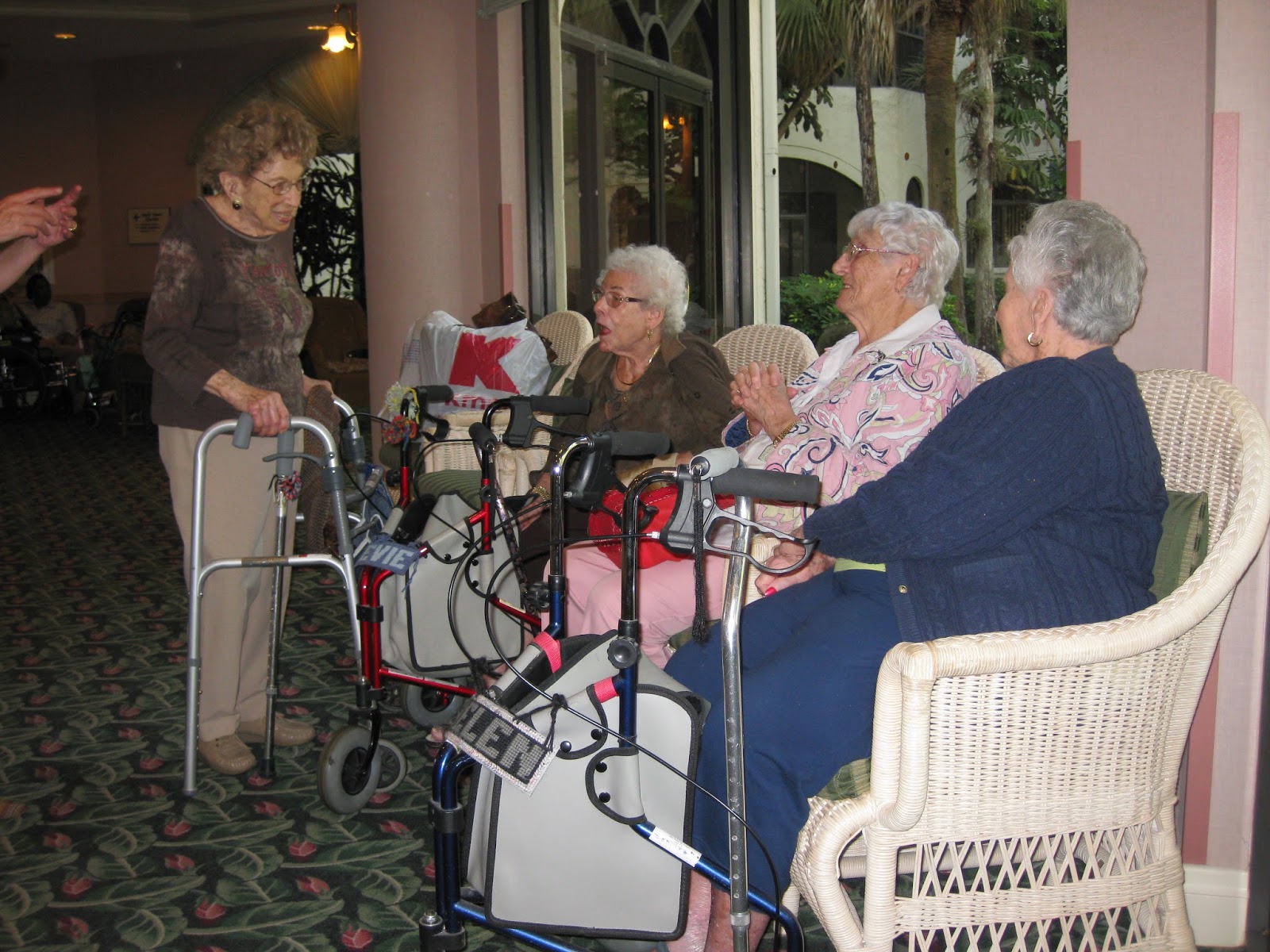
November 8, 2016--Ladies of Forest Trace: Election Day

They are no longer with us.

All the Ladies of Forest Trace, my mother and her friends, have moved on. But if there is a way for them to watch from their undisclosed location, through the day today, and especially this evening, they will be tuned in to Anderson Cooper (who they all thought is "adorable") to watch the vote tallies, especially in Florida, because the outcome of the election may again come down to "Florida, Florida, Florida," and some of the Ladies feel they still have some expiating to perform considering it was they as well as many other ladies of South Florida who, in 2000, either mistakenly voted for the anti-Semite Pat Buchanan or hang enough chads on their paper ballots to give the election to George W. Bush.

The rest is history. Sad history.

I know that today, with the opportunity to vote for the first woman to have an excellent chance of becoming our president, that would have been a highlight of all of their very-long lifetimes. My mother would be the oldest of the Ladies--she would be half-a-year more than 108 today--but all of her friends would be old enough to remember vividly when the 19th Amendment to the Constitution was ratified, August 18, 1920, when my mother was 12 years old. In her day, she and other girls were very much women at 12, in my mother's case having been born in a log cabin in the Polish woodlands.

All of the Ladies were disappointed in 2008 not to have had Hillary Clinton as the nominee, having lost in a bitter primary struggle with Barack Obama, but to a person they all came around to feeling good about voting for him because of his progressive views, his ability to promulgate hope, and not incidentally because he was African American. And most lived long enough to enthusiastically vote for him again four years later.

But today is different, very different.

I know that my mother and most of her friends had some "issues" with Hillary. They may have liked many of Bill Clinton's governing priorities but they thought little about his suitability as a husband. Some of the Ladies had issues with their own long-departed husbands and from that they knew a cad when they saw one.

But sharing this with Hillary they understood the impulse they felt to endure, to put up with what most younger women today would not tolerate. But they all lived long enough to understand the behavior and compromises expected of their generation, Hillary's, and of much younger women, who they over time successfully struggled to feel good about.

They also saw Hillary's flaws in her various official roles as First Lady, senator, and secretary of state.  Most were alive for all of that and had the experience and enough accrued wisdom not to deceive themselves because of her gender or feminism. But they saw the same falabilities, or worse, among Hillary's contemporaries and colleagues. These Ladies were not about gilding lilies or for that matter anything. They may not have had the exact words to express this but they were individually and personally viable in the world of very realpolitik.

And so through the day today, one by one they would have stood in line bent over their walkers, declining the offered wheelchairs or help to shuffle to the head of the line.

They had waited more than 80 years for this.

They had stood on many lines over the many decades--at dockside in Bremen, Germany to board the ship that would transport them to America, on lines at Ellis Island, on lines to file citizenship papers, on other lines when food was scarce during the Depression or rationed during the War, on lines while waiting at their children's schools, on lines at heath clinics, on lines in some cases to secure applications for scarce jobs or to apply for subsidized housing, on lines too many to count that led them to pay respects at the caskets of too-many-to-count friends and family members.

So, I know they would have thought today--"This is one final line I want to stand on because I've been waiting all my life to stand on a line to a polling booth where I can vote to make a woman president of the United States."

Then, after lingering with the ballot on which Hilary Clinton's name appears, with tears and pride, they would cast that magical vote and head home to Forest Trace for a nap so they could stay awake late enough tonight to see Florida, Florida, Florida seal the victory for Hillary.


Labels: , , , , , , ,

Wednesday, November 04, 2015

November 4, 2015--Election Day: Carol

The diner is right across the road from Town Hall where people came yesterday to vote.

"Is it a terrible thing that I don't vote?" Carol asked shyly. "I mean, I think I'm a good person and should vote but . . ."

"But what?" Rona asked.

"Shouldn't everyone vote?" She said.

"Maybe yes, maybe no," I said, "I'm OK with people not voting if they have no confidence in the candidates or as a form of protest."

"To tell you the truth, I'm nor sure I agree," Rona said, I think it's important to be an active citizen. Not that I'm criticizing you," she said to Carol who avoided eye contact.

"But in a way you are," Carol said. "That's what I was saying. That I should. So I deserve the criticism. Though . . ." she trailed off. "I mean, like I said. I'm conflicted. And you're right. If I live and work here and pay my taxes here, I should be a better citizen."

To shift the conversation, I said, "Well, what's on the ballot this year?"

"I'm embarrassed to say I don't know. Do you?" she asked Rona.

"You got me," Rona said smiling. "I suppose it's no excuse that we're here only half the year and are registered to vote in New York so . . ."

"So what's on the ballot today? In New York I mean?" Carol smiled.

"You got me again," Rona said, also smiling.

"Can I get you a refill?" Carol asked. "That's part of my problem," she said.

"Your problem?"

"I work all the time. Waitressing here and at the other place in ___ . I barely have time to put gas in my car much less think about voting. I mean learning about all the issues." She shrugged and turned to get more coffee.

When she returned, voting was still on her mind.

"I think there's something on the ballot about the minimum wage."

"I think so too," I said.

"That should motivated me. I mean, to vote. I couldn't live on the minimum wage. I would like to have a baby but even making what I make, thank God more than the minimum, I can't afford it. I'd need childcare or preschool but they charge so much I'd be working to pay them. I wouldn't have enough left to pay rent for a decent place. Forget for now my being able to buy a place."

"I don't know how people do it," Rona said, "Having kids, paying for a place to live, heat one's house, and as you said, afford childcare. Unless you have a mother who can help out . . ."

"My mom works harder than me," Carol said. "I have this friend. She has a two-year-old. Her husband, the baby's father, died when she was in her eighth month so after the baby was born there was obviously less income than they had been planning. If it wasn't for the two sets of grandparents chipping in to help--with money and babysitting--I don't know what would have happened. My friend's not comfortable with food stamps and things like that. She feels it's important to work and pay her own way. But, it's so hard. So hard."

"Like I said, I don't know how people do it. And I do know that many people are not comfortable asking for help. Especially not from the government. Partly because of all the nasty comments from some of our politicians about people taking advantage of the system. Not wanting to work to support themselves."

"There has to be a better way," Carol said. "I mean I don't begrudge people making a lot of money. I'm not in favor of everybody making the same thing. People who go to college, people who became doctors, shouldn't they be allowed to make more than someone working in a restaurant or whatever? I'm for that. But in this country shouldn't everyone without having to ask be allowed to make a least a living wage? So they can have a kid if they want to?"

Mentioning that again, I sensed how deeply she was feeling that desire. "You would be a wonderful mother," I said.

"You know, I'm thinking," Carol said, "that maybe I do have something to vote for. Maybe I need to find the time to inform myself about what's on the ballot. If it's to increase the minimum wage here I should be supporting that. But first I need to know more. I can't just complain about things and should be--how did you put it--an active citizen. I think I'm beginning to like that idea. And, you know, I think if I could get myself going, I'd be pretty good at it."


Labels: , , ,

Tuesday, February 18, 2014

February 18, 2014--Snowbirding--VOTA

"VOTA? VOTA 12 de Marzo? What you make of that?"

Our car needed a major service and, since we have just one, the mechanic, clearly agitated, had come to pick us up to retrieve it after he had completed the work.

Sputtering, he was pointing to a sign in the median on Federal Highway.

"I suppose," I said, "it's to remind people to vote March 12."

"But VOTA? Marzo?" He said with a heavy accent.

"Well," I said as if to myself, knowing where this was likely headed, "It also says VOTE March 12th."

"And," he bellowed toward Rona who was in the back seat, "It also say VOTE 12 Mas. What this Mas business?"

Our of the corner of my eye I saw her twist toward the window on the other side of the road away from the sign. To look as causal and unengaged as possible, as if she hadn't heard him.

I was sitting to his right and it wasn't possible for me to pretend we had been talking about the weather. Which we had been until he noticed the sign.

"If they can't reading English, because that's what is going on, why they allowed to vote? Isn't it enough we let them in country? And put them on welfare? And give food stamps? And health."  He looked over at me, wanting me to get involved. It was clear he intended this to be more than a rant. Still, I tried to ignore him.

"You have to be citizen to vote, no?" I tried not to look at him. "I assume still that's true. But considering what going on here, you never know. Maybe these days they get off the boat and they take them right to vote."

"Rona said, "Aren't those new condos?" She was pointing to a new building development well off to the right, hoping to deflect his line of thought.

"Some country we become. To vote you no longer need to speak English. Vota, Marzo, Mas. When I came from Russia no one give me nothing. Nothing. What I have," he gestured at his Mercedes SUV, "this car, everything, I work hard to get. Nobody gave me nothing."

"Maybe the opportunity?" I mumbled.

"Speak louder. I cannot hear. I deaf in this ear."

Not knowing what possessed me to get involved, I repeated, louder this time, "Maybe what America gave you was an opportunity?"

"To work hard. No handouts. No Russian signs to vote. I had to become citizen first. And to be citizen I had to take test. Test in English. What language is that Marzo in?" he asked, seemingly calmed down. Perhaps because I had responded.

"I think Spanish," Rona said from the back seat.

"So if Spanish," he said, "What Mas?"

"I'm not sure," she said, "Could be Haitian."

"Haitian! They let Haitians vote though they can't read sign in English?" He slammed his hands on the steering wheel. The car swayed side-to-side.

"First they let them sneak into country, then they take them to polling booth. Like in Russia."

"What do you mean?" I ventured.

"They have what they call elections there and then don't let half people run for president who want so what does vote mean? It's just like what is happening here. America is soon to be like Russia. Where I have to go next?"

"I think this is hardly a fair comparison," I said.

"You call that fair?" He pointed at another voting reminder sign as we approached Delray.

"I don't remember these kinds signs when I was first here six years ago."

"I seem to," I said, again under my breath. We still had about five minute to go before getting to his garage and felt we had already gotten into this deeply enough.

"It's because of him." I now knew for certain where this was headed. "Him." He pointed north as if to Washington and lapsed into a silent rage. Though, shaking his head, I thought I heard him mumbling something in Russian.

"Look at my hands. These" he took both hands off the steering wheel and held them toward me. The car, clearly perfectly maintained, did not waver. "You see grease." His finger nails and knuckles were in fact deeply stained. "From vorking, not voting." For the first time he smiled, which calmed me.

"That's my point," I tried. "How America gave you the opportunity to . . ."

"Vork like monkey." His smile broadened. "Look, I'm not bigot. I wish for these people same that I had. To vork hard, have a nice place to live, children, nice car just like mine." He gently stroked the steering wheel. "Become Americans. Like me. Real ones. Not with this Vota and Marzo. I do not grudge them voting if they are citizens, but signs like this we not need. Not need helping with everything you need. Food, health, house. Everything." He nodded his head, now grinning, as if he had made an unassailable case. "Need to vork for that."

"There is a point to what you're saying," I acknowledged. "That I'll grant you. But for me there has to be a balance between providing opportunities and making sure people who live here--especially if they are legally here or citizens--don't fall through the cracks and that the playing field is level."

"You're spouting clichés," Rona said leaning forward and sounding frustrated. "'Falling through the cracks.' 'Level playing fields.' "Liberals like us have to have better arguments than that. Just offering clichés is not persuasive or fair to people who are working as hard as Alex." I was impressed she remembered his name.  "Is it fair to say to him, who clearly has worked hard for everything he has, who probably never got anything for free, who maybe is having trouble paying for health insurance and his mortgage and . . ."

"That's me," Alex said. "My house, how you say, is underwater."

" . . . and wants to play by the rules, drives around with four-dollar-a-gallon gas in his car and sees signs in Creole reminding people to vote. We have to do better than responding to his frustrations by offering clichés about opportunity and fairness. Because I suspect to him, things are not looking all that fair. Why should they? Do you," she meant me, "Do you think things are fair? Even to you?"

"You're making my points better than me," Alex said, twisting toward Rona.

We rode the rest of the way in silence. Our car was indeed ready and immaculate.

Driving home, I asked Rona, "Does his asking to be paid in cash so he and we could save on paying tax qualify as leveling the playing field and playing by the rules?"

"He probably would say he wants to play by the same rules as the big boys on Wall Street.'

"Touché," I said. "I suppose in America these days equal opportunity also means everyone being able to look for every loophole they can find."

"Alex couldn't have said it better!"

Labels: , , , , , , , , , , , ,