Friday, August 30, 2019

August 30, 2019--Trump's Second Thoughts

If I believed he had first thoughts I might feel a bit optimistic that Trump is having second thoughts about his ill-begotten China tariff policy which, if implemented, would drag the global economy down to the same level England will shortly experience after they Brexit.

For weeks Trump has been in full Twitter as he excoriated China and its leaders and how they dishonestly manage their economy. All to our disadvantage, Trump has been fulminating.

But then last Friday when the Dow Jones Average shed 700 points Trump hit the panic button. He has been using the Dow as his personal barometer of how well the economy has been doing on his watch. 

Not so good the bears were now saying. Talk of inflation was also in the air. Not the kind of economic news any president wants to run on when seeking reelection.

And so he had second thoughts. 

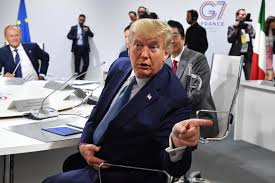
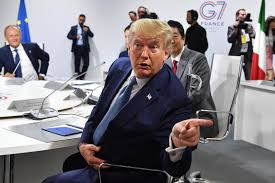
When asked about the tariffs during the G-7 meeting in France he said that sure he is having second thoughts. He has them all the time about everything. And "that's a good thing." 

It is easier, of course, to have multiple thoughts about everything if you don't believe in anything other than your own wellbeing. 

But as with so much, it depends on the second thoughts. To rethink engaging in a ruinous trade war, having real second thoughts is a good thing. With emphasis on "real." 

What is in fact underway with China is not anything resembling normal negotiations or diplomacy but rather a play on Trump's part to enhance his domestic political standing. Period.

Here's how it is working with the tariffs but it equally applies to how he approaches background checks or immigration. Actually, with Trump how it applies to everything.

He's a master of having it both ways, or even more than both ways. In his case, this is easy to get away with since his supporters (a shrinking pool polls are now showing) are low-information voters (I'm trying to be kind) and as such are not as concerned as evidence-based voters when it comes to flip-flops and contradictions and facts.

For Trump's people he is incapable of flip-flopping or acting inconsistently. Wherever he says, whatever he does is by definition true and consistent. If it comes from him, truth is not the issue. Though in a perverse way it is because, ex cathedra, whatever he says or does is or becomes the truth.

Then there are direct political advantages for him to having multiple thoughts about the same thing--it gives his believers (and  I consider them believers) more to embrace, more to accept, more rituals and incantations by which to be guided.

So, when it comes to tariffs some of his supporters can be for them while others can oppose them, all the while both being for HIM. Which after all is the point.

Labels: , , , , , , ,

Wednesday, July 18, 2018

July 18, 2018--President Munchausen

We were in New York City most of last week to do some routine doctoring and to see a few close friends and family members.

Good news on all fronts though it seems, without symptoms, I may have Lyme Disease again and either had or have Shingles.

One other thing--we were reminded again that while up in Maine we spend very little time watching cable news or pretty much anything else but when in NYC we watch too much. And, so, in town we did some reverting. At 6 a.m. I automatically turned on Morning Joe and we found ourselves watching Nicole Wallace's show later in the day.

This brought Trump front and center back into our lives. 

Halfway into Morning Joe Monday morning we realized why we keep the TV off most of the time during the six months we spend in Maine--what's available is too boring and/or too depressing.

Monday was all about Trump in Europe. First, there was a live feed from the NATO meeting in Brussels where over what appeared to be breakfast without food Trump in a monologue berated NATO members for not spending enough on their own defense. How they take advantage of us, expecting America to pick up the tab while they devote much of their GNP to overgenerous welfare programs for their citizens and the millions of refugees they foolishly allow to flood into their countries. 

The headline from that meeting was Trump slandering Germany and chancellor Angela Merkel for being held "captive" by Russia since Germany spends "billions and billions, many billions" of dollars for natural gas that flows into Germany from Russia. Germans, Trump claimed, get "70 percent" of their energy this way and thus are in effect hostages of Russia.

When I said to Rona that this figure is much too high (it turns out to be that "only" 13 percent of German's energy is supplied by Russia), she said, "More Munchausen Syndrome."

"You've referred to that before," I said, "Since I never heard of this I should have looked it up. Tell me, what is it?"

"It's a fictitious disorder, a mental disorder in which a person repeatedly and deliberately acts as if they have an illness when he or she isn't really sick."

"Like being a hypochondriac."

"Similar but there's a key difference--people with Munchausen's know they are faking it whereas hypochondriacs believe they are sick."

"So how does this work with Trump, who you say has a version of Munchausen's?"

"In many cases people with Munchausen's make illnesses up in part to elicit sympathy but also to 'cure' themselves when they want to boast by 'getting over' illnesses which they in fact never had. Like Trump does with facts or the truth. Unless he is more pathological than most people think, he knows he's making this stuff up. Like with Germany and Russian gas."

"Interesting but are their also parallels between classic Munchausen's where people 'cure' the illnesses they made up and Trump's relationship to the truth?"

"Take the business with Angela Merkel. He made up the 70 percent number, using it to verbally beat her up all day and then after they met one-on-one later that day or on Tuesday, he backed off from criticizing her and was full of praise for her and Germany. So among his followers he got credit for what he claimed while lying (his people hate the Europeans) and then later among the better informed, more serious crowd, he got some begrudging credit for appearing to have listened and moderated his position."

"I like this," I said.

"He did the same thing with British prime minister Theresa May. First he mocked her for getting in trouble when trying to implement Brexit because she didn't 'take his advice' but then after private meetings with her later in the week in England, he took much of it back, praising her for the way she is struggling with this complicated issue. First he made up the situation (her not taking his advice) and then took it back--in a sense overcame it in true Munchausen fashion."

"Is Munchausen a real person?"

"Of course not! That's half the fun. There's a fictional Baron Munchausen, an 18th century German nobleman who made up stories about the remarkable feats he performed like riding a cannonball or fighting a 40-foot long crocodile. Much like Trump's boasting. Then when caught in the lie that he knew was a lie he simply backed off.

"And when in the 1950s it came time to study and then name a new syndrome that had Munchausen-like aspects to it the psychiatrists named it for him. If they were doing that now I suppose it could be called Trump Syndrome."

Now, back in Maine, the TV is off except for Wimbledon and the World Cup. Thankfully, both are over.

But then there was the disastrous meeting with Vladimir Putin and . . .

Baron Munchausen

Labels: , , , , , , , ,

Monday, November 14, 2016

November 14, 2016--Election Postmortem

I called an old friend late last week to commiserate about the results of the election.

It was three days after the fact and she was still morose. "I'm too old to move to Canada or Europe. Friends in England called to invite me to stay with them for at least Trump's first six months. They said his first hundred days would be over by then and it would be possible to see how bad things were going to be. They said if by then he overturned most of Obama's major accomplishments, I could apply for asylum in England. But then of course there would be Brexit to deal with."

"Really?"

"Really. I'm thinking about it."

"Do you think things are that bad?"

"Potentially. Did you see who's on Trump's short list of possible cabinet members?"

"There's a lot of speculation but . . ."

"Forget 'but.' How does Sarah Palin as secretary of the interior sound? Say goodbye to our forests. Remember 'drill, baby, drill?' Or how does John Bolton for secretary of state sound? I think his favorite quote is John McCain's 'bomb, bomb, bomb, bomb Iran.' McCain was probably making a joke but for John Bolton it could sum up his foreign policy agenda."

"Sounds like a nightmare."

"And worst of all, as a lifelong feminist, I hate what Trump and his even-worse vice president, Mike Pence, say they want to do about women's rights. Say goodbye to Roe v. Wade. That alone is making me sick and depressed."

"I hear you," I said, then, "Therefore this may not be the best time for what I want to say but . . ."

"Say it. There's nothing you could say to make me feel worse."

"I'm not sure about that. But you know on my blog I've been writing critically about progressives who I feel did things to unintentionally help elect Trump."

"Too many didn't turn out to vote."

"That's part of it and related to my critique. For me a big part of the problem was that too many liberals lost touch with what was smoldering in that part of America they don't know because they live in isolated urban coastal enclaves, live comfortably, and look down on people who have different lives and value different things. Also, we have lost touch with people who are finally fed up with the false promises that have been made to them for decades by both Democrats and Republicans. In many ways Trump was like a third-party candidate."

"So far I don't disagree with you. We've grown very complacent."

"Worse, in that complacency and out of feelings of superiority, we've lost the activist spirit. I was looking again at Kevin Phillips' Emerging Republican Majority written way back in 1969 after Nixon in '68 won all but one of the southern states. He lays it all out there and conservatives have been using it successfully as a kind of playbook since then about how to take control of governments at all levels from the local to the state and now the federal. All three branches."

"I remember that. Isn't he now disenchanted with the right wing he helped empower?"

"He is, but it's a little late. Among other things he wrote about how the so-called silent majority should begin the process of dominating all levels of the government by running for school boards and then work their way up the political food chain. They've done this successfully so that now they control 33 of 50 governorships and most state legislatures."

"Fair points," my friend said.

"But here's the even harder part--I know you really well and how you live and what activates you. So let me ask you a tough question."

"Fire away."

"You're very passionate about preserving the reproductive rights of women from being able to get contraception to . . ."

"And Mike Pence," she snarled,"wants to block that."

"Totally terrible," I said, "But people who agree with him about that and who are also obviously anti-abortion, have for decades set up picket lines at abortion clinics, harassing women who are seeking to terminate pregnancies. I've visited and worked in almost all the states and pretty much everywhere I've seen those nasty pickets. But, you know one thing I haven't seen?" I paused but my friend remained silent, "I've never, not once seen a picket line of pro-choice people there to help women enter the clinics." More silence.

"This to me is a terrible and condemning reality. And I'm including myself. I never was out there trying to offer support for those brave but harassed women. And while I'm on a roll, have you ever . . . ?"

"Never," my friend whispered, "I should have but now I'm old. Too old for that".

I let the silence remain uninterrupted between us.

"You could be right," she finally said.

"I think I am," I said, "And if I am, by our inactivity--maybe excluding some check writing to Planned Parenthood--we left this political opening to the more motivated people who are trying to take away rights that we believe are protected by the Constitution."

"My biggest worry is the Supreme Court."

"We should be worried. But here's my bottom line--Progressives are very good at marshaling facts and articulating opinions, but not so good as fessing up to how we've become complacent, waiting for government to take care of and protect us, much less getting mobilized and activated in support of the things we value. And until we do, what happened last Tuesday should not be a surprise. Also, though it may be hard to acknowledge, as I said, through our inactivity we helped bring about the debacle. And worst of all," I concluded, "too many of us secretly agreed with Hillary that Trump's people are deplorable."

Before I finished I heard the sound of my friend hanging up.


Labels: , , , , , , , , , , , ,

Friday, July 22, 2016

July 22, 2017--Europhiles

I know many progressives who are again saying they are giving serous thought to moving to Canada if Donald Trump is elected.

I say "again" because many of these same people said this when Nixon was elected and then when Ronald Reagan became president and even while contemplating a George W. Bush presidency.

But as far as I know, these friends remain comfortably in America though they are still grousing.

The grousing is not situational--it does not emerge only every four years like some locusts.

Not so between the lines, they disparage America no matter who is in office.

They see us as culturally, intellectually, and governmentally inferior not just to Canadians but, more pervasively, to Europeans.

These frankly anti-American liberals have such an elevated opinion of themselves that they turn to Europeans for special forms of friendship, appreciation, and emulation. They see the Brits and French and Germans, particularly, to be more nuanced in their thinking and how they conduct themselves in a globalizing world.

They like the books they read and the movies they make.

In sum--those who live in these countries are civilized; we are not.

If we were civilized, they wonder, how could Donald Trump be running nearly neck-and-neck with Hillary Clinton. The best explanation--most Americans know nothing about history, world affairs, or social policy. In fact, there is a longstanding, deep strain of anti-intellectdualism and paranoia pervasive in American culture. And above all else, these of my friends are horrified that perhaps 30-40 percent of the American population is fully anti-science and directed in their personal and political lives by their  religious beliefs.

Some of this is true and helps explain why many accomplished Americans look across the Atlantic for a more enlightened approach to life in the 21st century.

Yesterday I wrote satirically about socialist French President Francois Hollande and his capitalist $10,000-a-month hairstylist.

Today, I refer you to Great Britain's new Foreign Secretary, Boris Johnson, former mayor of London and principal proponent of England's exit from the European Union. He is the one, in case you missed this news of his appointment, with a version of Donald Trump's signature hairdo.

On Wednesday he held a joint press conference with Secretary of State John Kerry.

Previously, Johnson had said very disparaging things about President Obama and Hillary Clinton and so this was an awkward moment for Kerry, who somehow managed to maintain a stiff upper lip.

Johnson recently called Obama a "part Kenyan" with an "ancestral dislike of the British Empire." A few years ago, he compared Hillary Clinton to Lady MacBeth, writing that she's "got dyed blond hair and pouty lips, and a steely blue stare, like a sadistic nurse in a mental hospital."

He didn't say anything about how he knows so much about what nurses look like in mental institutions.

That's not all. Boris compared Vladimir Putin to Dobby the Horse Elf from Harry Potter, and, more outrageously and riotously, claimed that President Recep Tayyip Erdogan of Turkey had sex with a goat.

Again, we do not need to know how Foreign Secretary Johnson knows about that.

And then there is Germany, where the far-right . . .

So, I say to my Europhile friends, before emigrating to Canada or Western Europe, take a close look at what is really going on in your favorite country. By comparison, America might not look all that bad. Which, I suppose, is why no one I know has expatriated.

Boris Johnson

Labels: , , , , , , , , , ,

Thursday, June 30, 2016

June 30 2016--Little England

Until recently I never thought much about what the Great in Great Britain meant.

Of course I knew about the British Empire where the sun never sets, though by the time I was a young adult coming into political consciousness, most British colonies had broken away and were linked mainly though trade agreements, immigration policy, and as members of the British Commonwealth. With emphases on common and wealth.

Now, after the Brexit vote I am understanding that what is likely to remain of Great Britain or the United Kingdom will no longer be so united or so great.

Scotland and Northern Ireland, the major components with Wales of what is united and left of that kingdom, will figure out ways to secede and on their own, either, as in the case of Northern Ireland, unite with the rest of Ireland, while Scotland is likey to form an independent nation of its own and in both cases will, one way or another, affiliate with the E.U.

What remains will coalesce into just England, which wags and British haters (there are many on the continent, which compounds the problems) are now referring to gleefully as Little England.

From Great Britain to Little England. What a comeuppance. Or comedownance.

The European Union in its inception was supposed to accomplish a number of things.

First--and this attracted most of the ultimate E.U. countries to affiliate and for many of these adopt the euro as the common currency--first, there were the obvious economic advantages. To create the ultimate free trade zone and in that way, though far from forming a true United States of Europe, forge the world's largest trading block and collective economy.

Then there were the political reasons to build an E.U. Many of the future members had made war with each other at various times over many centuries. Most dramatically the First World War (which up to that time produced the most military and civil casualties in history) and then the even bloodier Second World War which were fueled by collapsed economies and rampant, virulent, and rivalrous nationalisms.

The thought was that if these historic enemies could become entangled for mutual advantage in an integrated economy and open their borders to commerce and people, making money together (not love) would overcome their seemingly genetic impulse to make war.

With many caveats, what was envisioned by E.U. founders such as Jean Monnet, up to now has worked. There are many spats to be sure, especially in recent years, as prominent examples, about the admission to the E.U. of Islamic Turkey and immigration and refugee policy (not unrelated), there have been no wars (trade or military) and relative prosperity, especially for the countries with the largest economies--Germany, England, and France.

But enmities remain and have been largely papered over. Xenophobic nationalistic inclinations persist and historic rivalries lurk just below the surface.

The Brits voted to leave the E.U. just a week ago and already German and French leaders, among others, are pushing the UK to leave the E.U. by the end of next week, not next year or two or three years hence.

I am exaggerating to make the point that not only do Germany and the current French leadership want to set an example of harsh and unyielding treatment of Britain to discourage others from thinking about following suit (including France where an emboldened Marine Le Pen is already calling for France to exit--Frexit), but also because of a still vibrant dislike of things British. Especially perceived English arrogance, moral superiority, and--this is important and closer to home--having served since at least the early 20th century as the United States' poodle.

For us that poodle has been important. With much of Europe suspicious of America's agenda, the UK has served as an essential bridge for us to the continent. Our "special relationship" with Britain has included not just an almost always willing partnership in global adventures and interventions (including support for the Vietnam and Iraq wars) but also as an eager partner in intelligence gathering and fiscal and cultural policy.

If as many say (fear as well as look forward to) Great Britain's fall in status and stature, the prospect of Little England, is both real and confounding. For us, there will be estrangement and thus less influence as Russia and others grow restive and flex their muscles.

Which means that over time we may be also heading to become Little America.

Jean Monnet

Labels: , , , , , , , ,

Monday, June 27, 2016

June 27, 2016--Brexit

From two conversations--

The first, Friday evening at a party where I was approached by a neighbor who formerly owned a number of local businesses and who now spends nearly half a year in Africa working with Doctors Without Borders.

"It may surprise you to know that I supported Brexit. That the UK should withdraw from the European Union."

"I don't know you well enough to be surprised," I said, being sure to smile so he wouldn't think I was giving him attitude. In truth, I suppose if I were a Brit, I would have voted to stay so perhaps I was sending some attitude his way. Trying to sound neutral, I asked, "Why's that?"

"The EU government in Brussels is controlled by Europe's ruling elites and represents corporate and financial institutions' interests more than what might be good for average citizens. It's not so different from what Bernie's been saying about the banks and the establishment. I'm a Bernie person, by the way."

"And do you see any similarities between what many people are saying about the EU in other European countries and what Donald Trump is saying about us?"

He waved that off. "Trump's a jerk and maybe even a fascist."

Not wanting to talk about Trump, I said, "To tell you the truth, I'm embarrassed to say I don't really know that much about the EU, especially the Brussels-situated government. I've been trying to learn more the past few days and it does look as if that government has real power over the lives of all people and institutions in the 28 EU countries."

"And not unlike with our business-dominated government very little good trickles down to hard working people."

"But what about the immigrant issue? Isn't that similar to what many people here are all agitated about?"

"That is a huge compounding factor in the generalized anger and fear. Worse, to be sure, because none of the EU countries have really welcomed immigrants. Temporary workers have been needed since the birth rates have gone way down across Europe and places like Germany need to import workers. Remember the Turkish 'guest workers' that the Germans welcomed but expected would go back to Turkey after a year or two?"

"I do remember that."

"How did that work out?"

"I suppose not that well. I mean, from a German perspective. So many stayed."

"But the immigrant situation there, like here, is a distraction from more fundamental issues. People are not feeling they are doing well and rather than blame the system itself look for scapegoats. Immigrants front and center."

"I get your point about Trump."

"There's also something interesting going on that is best understand through the lens of developmental economics--how emotions affect economic behavior."

"Go on."

"Millions of people in the UK, a majority, knowing there would likely be personal downside consequences from bringing about Brexit still voted for it. One might say, against their own economic self-interest. Classic developmental economics on a huge scale."

"I have been thinking that too."

"Here's one more thing--and I think it's also true for the US."

"What's that?"

"People who are struggling to get by and feel their governments and institutions are not taking care of or responding to their needs and feeling are fed up to here," he gestured, "with how they are looked down upon and simultaneously pandered to be all sorts of so-called 'experts,' especially those who proclaim themselves to be experts who know better than the people themselves what's good for them. How would that make you feel?"

"No good," I said, and with that he caught the eye of another neighbor and moved on.

*   *   *

The second conversation was at the Bristol Diner Sunday morning with a very skilled and highly sought after expert about railroad systems and supply chains. He does consulting all over the world, especially until recently in Brazil. When not on the road he works from his Victorian-era farmhouse and barn in Bristol.

He came over to our booth to talk. After an exchange of the usual pleasantries, he said, "We just were skyping with friends from Aberdeen. Aberdeen Scotland."

"After what just happened there, that must have been interesting."

"It was, but also surprising."

"In what ways?"

"That unlike the vast majority of other Scots they voted to leave the EU. Demographically I would have thought they would have voted to remain. They're highly educated, successful professionally, and financially in good shape. From that alone one would expect they would have voted to stay in the EU."

"From what I have been reading, I agree. So what's their story? Did they talk about it?"

"Indeed they did. Lynne, the wife, is a senior hospital administrator and told me about something that really got under her skin that she feels represents the nature of the EU problem. She was gathering patient data and noted on one form that there were a series of EU-required question about how patients prepare and drink tea."

"What?"

"Things like do they use a teabag and if so how long do they let it steep. Or if they use loose tealeaves what kind of kettle and tea brewer do they use. Do they put milk in their tea and if so, hot or cold. Sugar. Artificial sweetener."

"Maybe this was for some epidemiological study like the relationship between tea drinking and esophageal cancer."

"I guess that's possible but not from what Lynne reported. It was more like asking if a patient has any food preferences or allergies. From her perspective it was not part of a careful study but just arbitrary information gathering. Totally unnecessary EU-intrusive bureaucratic work. Again, this specific thing is not why she voted to exit but for her was a way of emphasizing how out of control the EU government is and how hundreds of things of this kind that impinge on people's lives in the aggregate have made many clearly feel disenfranchised and controlled by external, not-voted-for officials and institutions."

*   *   *

I need to do more reading about what just happened in the UK and what the underlying issues are and how widespread they are in Europe and, for that matter, here. I know some feel what happened helps Trump. Others, that it hurts his chances. I think more the former.

But in the meantime, something tectonic and under-anticipated is happened in Europe and of course here--who would have thought that Trump would have a chance to be elected president. And in France Marine Le Pen?

One thing is certain--those of us who are or feel we are part of the elite (better educated, more professionally successful, affluent, travelled, highly regarded) need to take a close look at our behavior to make as sure as we can that we are not feeling superior to the Brexit and Trump people and thus looking down our noses at them. From what we just witnessed, we are being identified by them to be part of the problem.

Above all else, we need to realize we do not know what is best for other people.

Another thing is certain--borders throughout the world--especially in Europe and the Middle East--are being redrawn. Mainly not elegantly or comfortably. One hundred years from now, people will be pointing to these massive forces in the West and the former colonial world as responsible for the new world in which they will then be living.

What we are witnessing then may be one of history's periodic, messy, but necessary cataclysms.

Labels: , , , , , , , , , ,