Monday, June 11, 2018

June 11, 2018--Ladies of Forest Trace: President Grump

The phone rang as we were in the midst of preparing dinner. 

"Who would call us at this time?" I asked. "Anyone who knows us knows we have dinner about this time."

"Maybe it's a robocall," Rona said. "Check the caller ID."

I did and said, "It's from an unfamiliar area code--123."

"Pick it up. Maybe an actual person is placing the call. Not a computer. We've had an increase in the number we've been receiving. Maybe you can get them to take us off their caller list."

"Forget that," I mumbled. I was just about ready to add the spice mix to the vegetarian chili that was simmering on the stove. 

Rona said, "I thought no area codes are allowed to start with a 1."

"With telemarketing and hacking," I said, "I assume anything goes. So maybe I shouldn't answer it. We don't want to get drawn into anything that will take over our computer or phone."

"Now you have me curious," Rona said, "I wouldn't worry too much about that. I'll add the spices. You answer the phone. Let's see what this is."

"You would think I have all day." On the phone it was a woman's voice that sounded vaguely familiar."

"Who is this?" I asked tentatively.

"Have I changed that much in three years?"

"Who is it?" Rona mouthed.

Shrugging, I shook my head.

"Well, in fact I do have all day," the caller chuckled.

"Tell me what this is about. We're in the middle of preparing dinner. Chili." I was poised to hit the phone's Off button.

"How can I be at rest while that Grump is making himself a king?"

"Is this . . . ?" I began to tremble.

"Who else calls you when you're hiding in Maine?"

"We're not hiding . . . " I couldn't catch my breath but finally said, "Mom?"

"This is not the time to be hiding away. It wasn't easy, but if I could get permission to call you between now and November the least you can do is put down your potholder."

"Is it really . . .?"

"The girls and the people who run this place are very concerned with what is happening."

"In Maine?" I didn't know what to say. My heart was thumping and I thought I was about to pass out or have a stroke. 

I collapsed in a chair and Rona rushed over to see if I needed help. I signaled that I was OK. Just overwhelmed with emotion.

I mouthed, "I think it's my mother."

"How can that be?" Rona said so loud that my mother or whoever was on the phone could hear her.

"Tell my darling I love her and not to worry about me. They take very good care of us here. Even better than Forest Trace. Especially the food. Last night we had flanken with horseradish. It was delicious, I could chew it, and best of all it didn't give me gas."

Rona reached for the phone but I pulled it away. So she ran into the living room and snatched the other one from its cradle.

"Mom?"

"It's so good to hear your voice. I miss you every day."

"I think about you all the time. What an inspiration you have been and continue to be. So now you're here to . . . ?"

"Help with the election. We don't have newspapers or cable so I can't listen to Wolf or read Maureen Shroud. It's been difficult to keep up with the news. But we do know who was elected and can't believe what his people are doing to our  country. The same country that rescued so many of my family who fled the pogroms before the Nazis took over. Today, Grump would want to arrest us and send us back to Auschwitz."

"It isn't that bad," I said, and then after a pause added, "Yet."

"That's what they said in Germany. Things are bad but we will be safe. All we have to do is not make trouble. We're Germans, yes Jews, but we have always lived side-by-side with gentiles and they won't allow the worst to happen." She took a deep breath and said, "And then the worst happened. More than the worst."

"And so?"

"So, we have to make trouble. That's why I got permission to call. To make sure you and your friends--not just your Jewish friends--make trouble."

"Which means?"

"Working every day to make sure good people get elected. If he wins in November I fear for the future. It will say the American people agree with what he has been doing. What a message that will be to the world. And how it would encourage him to continue doing all the things he is doing. What will this mean to young people? I was a teacher and a mother all my life. My heart breaks when I think about what the future will be like for young people. They will lose hope. For the young, that would be the worst thing. Not to look forward to the future."

"That would be a tragedy," I agreed, "But young people are activated and it seems are eager to vote in November."

"They didn't vote two years ago. Not enough of them. They wanted Burning Sanders and when they couldn't have him they didn't vote. And what about women? I remember when we couldn't vote. I was 12 years old when they passed the Amendment. My sisters were suffragettes. They marched and marched and marched. In the heat and the rain and the snow. But now too many women didn't vote for the first woman running for president. Hillary. Not my favorite but better than him, no?"

"Much better," Rona said, "Especially as we see what he is doing. At least with her things wouldn't be this bad. But more than 50 percent of white women voted for Trump. So it was white women and young people more than anyone else who helped elect him. But we are organizing and demonstrating. Just last week we did well in primary voting in California."

"I hadn't heard about that," my mother said, "That is good news but unless Democrats won by big numbers it may not be good enough. And when I think about the demonstrations I am not impressed. How long has he been in office?"

"About a year and a half."

"And what did you have? Two marches? One right after he was sworn in, the Pussy Cat march (I'm old fashioned and hated the name), but it still was good and then there was the one organized by the Florida children after 17 of their friends were killed. Also very good. But I didn't make all this effort to be able to talk with you to pretend to feel good about two marches."

"What would have made you feel good?" I asked.

"A march every week or at least every month. That would be at least 18 marches already. I know the news people would stop talking about it but if it went on and on they would have to pay attention and it could make a difference. It would keep the drum drumming  It would also show that people, including young people, care about the future of America and the world. Their country, their world. Not mine and too soon not yours.

"What do you mean 'too soon'"? I asked, fearing she knew something I didn't.

"Time. Time is marching even if Americans aren't. Time doesn't need to do much or really anything to keep moving along. Time and tide. Look out your window up there and pay attention to the tide."

I glanced at Johns Bay and was about to ask about the tide since it ebbs and flows, first north and then it swings around to the south. I wasn't sure why this was significant to her. But before I could enquire, she told us she needed to pass the phone to one of the Forest Trace ladies who was waiting in line. She promised, until November, to try to call every few weeks. Maybe, she said, on her birthday, June 28th, when if she were still here she would be 110. Not, she said, that they make a big fuss there about birthdays. Or that 110, considering where she is now, is a big deal.

But before yielding the phone, she asked "Doesn't chili give you gas?"
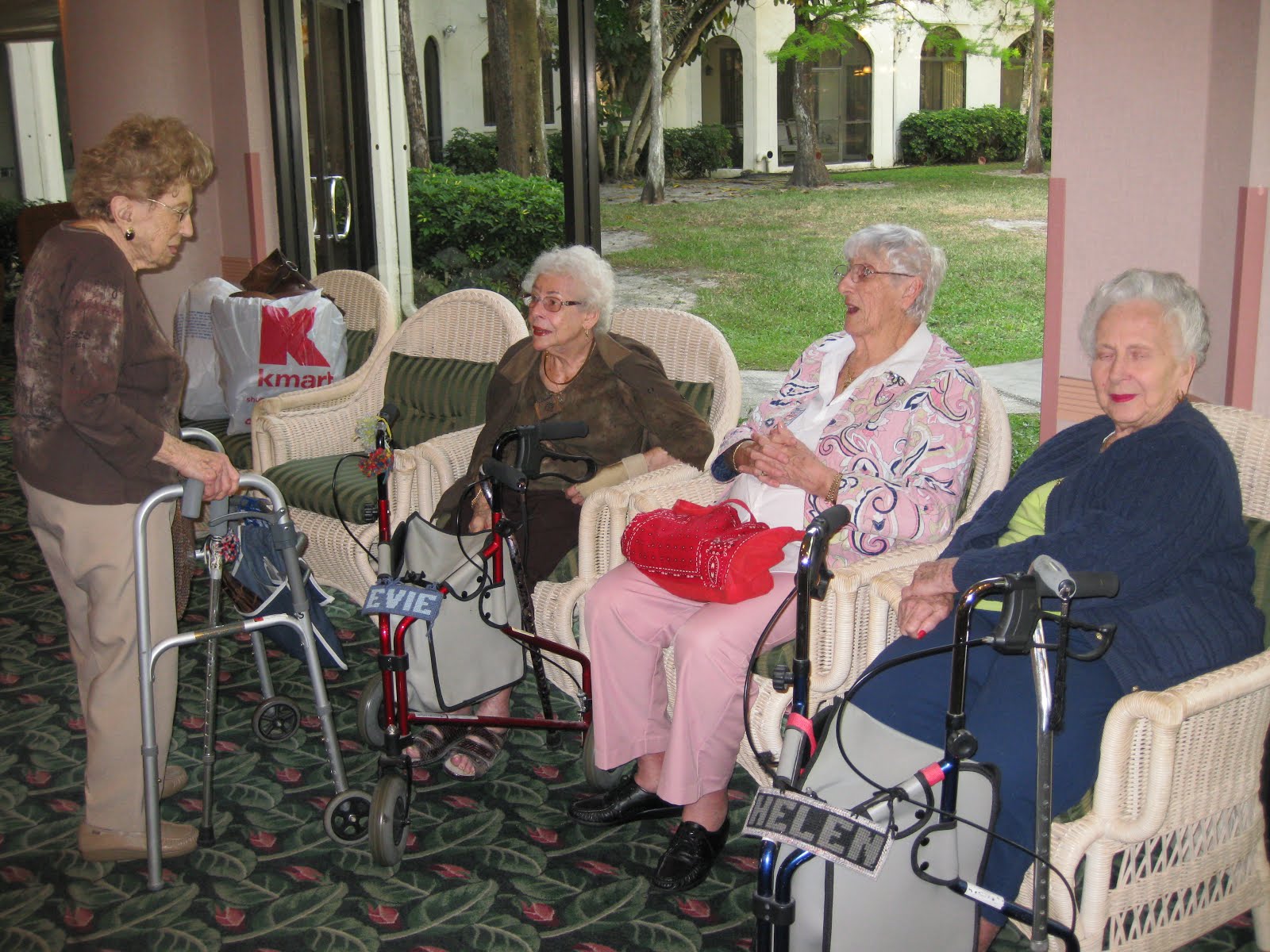
The Ladies of Forest Trace (Mom Standing)

Labels: , , , , , , , , , , , ,

Thursday, October 20, 2016

October 20, 2016--Meanwhile, In Leipzig . . .

Before and during this year's political campaigns, every time as in San Bernardino there was a massacre carried out by Islamists, we heard in a mainly bipartisan way, that in order to thwart these tragedies in advance, relatives and friends of the terrorists need to step forward and alert officials to the potential threats.

Candidates have been saying--

"Didn't their parents know they were making bombs in the garage?"

"Didn't anyone see early evidence that their son/brother/husband/friend was becoming radicalized?"

In the case of the recent New York/New Jersey bomber his father did alert the FBI but the agency dropped the ball and thus failed to follow up effectively. But at least there was the warning from the father.

Then there is another kind of example from Leipzig, Germany.

From the New York Times last week--
The German police arrested a Syrian man [Jaber al-Bakr] early Monday who was suspected of plotting a bombing, bringing an end to a weekend manhunt that renewed fears about a threat posed by extremists among the nearly one million refugees and migrants who arrived in Germany last year.
Fine. But here's the backstory of how the police found the suspect--
The head of the state police in Saxony said that Jaber al-Bakr had been arrested in Leipzig in the apartment of other Syrians who had recognized the man from photographs circulated by the authorities over the weekend.
Now, here's my favorite part--
The Syrians tied up the suspect and took a photograph of him with a cellphone, which one of them took to a nearby police station before urging officers to come and arrest him immediately.
The police indeed did so.

Case closed.
Jaber al-Bakr

Labels: , , , ,

Thursday, June 30, 2016

June 30 2016--Little England

Until recently I never thought much about what the Great in Great Britain meant.

Of course I knew about the British Empire where the sun never sets, though by the time I was a young adult coming into political consciousness, most British colonies had broken away and were linked mainly though trade agreements, immigration policy, and as members of the British Commonwealth. With emphases on common and wealth.

Now, after the Brexit vote I am understanding that what is likely to remain of Great Britain or the United Kingdom will no longer be so united or so great.

Scotland and Northern Ireland, the major components with Wales of what is united and left of that kingdom, will figure out ways to secede and on their own, either, as in the case of Northern Ireland, unite with the rest of Ireland, while Scotland is likey to form an independent nation of its own and in both cases will, one way or another, affiliate with the E.U.

What remains will coalesce into just England, which wags and British haters (there are many on the continent, which compounds the problems) are now referring to gleefully as Little England.

From Great Britain to Little England. What a comeuppance. Or comedownance.

The European Union in its inception was supposed to accomplish a number of things.

First--and this attracted most of the ultimate E.U. countries to affiliate and for many of these adopt the euro as the common currency--first, there were the obvious economic advantages. To create the ultimate free trade zone and in that way, though far from forming a true United States of Europe, forge the world's largest trading block and collective economy.

Then there were the political reasons to build an E.U. Many of the future members had made war with each other at various times over many centuries. Most dramatically the First World War (which up to that time produced the most military and civil casualties in history) and then the even bloodier Second World War which were fueled by collapsed economies and rampant, virulent, and rivalrous nationalisms.

The thought was that if these historic enemies could become entangled for mutual advantage in an integrated economy and open their borders to commerce and people, making money together (not love) would overcome their seemingly genetic impulse to make war.

With many caveats, what was envisioned by E.U. founders such as Jean Monnet, up to now has worked. There are many spats to be sure, especially in recent years, as prominent examples, about the admission to the E.U. of Islamic Turkey and immigration and refugee policy (not unrelated), there have been no wars (trade or military) and relative prosperity, especially for the countries with the largest economies--Germany, England, and France.

But enmities remain and have been largely papered over. Xenophobic nationalistic inclinations persist and historic rivalries lurk just below the surface.

The Brits voted to leave the E.U. just a week ago and already German and French leaders, among others, are pushing the UK to leave the E.U. by the end of next week, not next year or two or three years hence.

I am exaggerating to make the point that not only do Germany and the current French leadership want to set an example of harsh and unyielding treatment of Britain to discourage others from thinking about following suit (including France where an emboldened Marine Le Pen is already calling for France to exit--Frexit), but also because of a still vibrant dislike of things British. Especially perceived English arrogance, moral superiority, and--this is important and closer to home--having served since at least the early 20th century as the United States' poodle.

For us that poodle has been important. With much of Europe suspicious of America's agenda, the UK has served as an essential bridge for us to the continent. Our "special relationship" with Britain has included not just an almost always willing partnership in global adventures and interventions (including support for the Vietnam and Iraq wars) but also as an eager partner in intelligence gathering and fiscal and cultural policy.

If as many say (fear as well as look forward to) Great Britain's fall in status and stature, the prospect of Little England, is both real and confounding. For us, there will be estrangement and thus less influence as Russia and others grow restive and flex their muscles.

Which means that over time we may be also heading to become Little America.

Jean Monnet

Labels: , , , , , , , ,

Monday, June 27, 2016

June 27, 2016--Brexit

From two conversations--

The first, Friday evening at a party where I was approached by a neighbor who formerly owned a number of local businesses and who now spends nearly half a year in Africa working with Doctors Without Borders.

"It may surprise you to know that I supported Brexit. That the UK should withdraw from the European Union."

"I don't know you well enough to be surprised," I said, being sure to smile so he wouldn't think I was giving him attitude. In truth, I suppose if I were a Brit, I would have voted to stay so perhaps I was sending some attitude his way. Trying to sound neutral, I asked, "Why's that?"

"The EU government in Brussels is controlled by Europe's ruling elites and represents corporate and financial institutions' interests more than what might be good for average citizens. It's not so different from what Bernie's been saying about the banks and the establishment. I'm a Bernie person, by the way."

"And do you see any similarities between what many people are saying about the EU in other European countries and what Donald Trump is saying about us?"

He waved that off. "Trump's a jerk and maybe even a fascist."

Not wanting to talk about Trump, I said, "To tell you the truth, I'm embarrassed to say I don't really know that much about the EU, especially the Brussels-situated government. I've been trying to learn more the past few days and it does look as if that government has real power over the lives of all people and institutions in the 28 EU countries."

"And not unlike with our business-dominated government very little good trickles down to hard working people."

"But what about the immigrant issue? Isn't that similar to what many people here are all agitated about?"

"That is a huge compounding factor in the generalized anger and fear. Worse, to be sure, because none of the EU countries have really welcomed immigrants. Temporary workers have been needed since the birth rates have gone way down across Europe and places like Germany need to import workers. Remember the Turkish 'guest workers' that the Germans welcomed but expected would go back to Turkey after a year or two?"

"I do remember that."

"How did that work out?"

"I suppose not that well. I mean, from a German perspective. So many stayed."

"But the immigrant situation there, like here, is a distraction from more fundamental issues. People are not feeling they are doing well and rather than blame the system itself look for scapegoats. Immigrants front and center."

"I get your point about Trump."

"There's also something interesting going on that is best understand through the lens of developmental economics--how emotions affect economic behavior."

"Go on."

"Millions of people in the UK, a majority, knowing there would likely be personal downside consequences from bringing about Brexit still voted for it. One might say, against their own economic self-interest. Classic developmental economics on a huge scale."

"I have been thinking that too."

"Here's one more thing--and I think it's also true for the US."

"What's that?"

"People who are struggling to get by and feel their governments and institutions are not taking care of or responding to their needs and feeling are fed up to here," he gestured, "with how they are looked down upon and simultaneously pandered to be all sorts of so-called 'experts,' especially those who proclaim themselves to be experts who know better than the people themselves what's good for them. How would that make you feel?"

"No good," I said, and with that he caught the eye of another neighbor and moved on.

*   *   *

The second conversation was at the Bristol Diner Sunday morning with a very skilled and highly sought after expert about railroad systems and supply chains. He does consulting all over the world, especially until recently in Brazil. When not on the road he works from his Victorian-era farmhouse and barn in Bristol.

He came over to our booth to talk. After an exchange of the usual pleasantries, he said, "We just were skyping with friends from Aberdeen. Aberdeen Scotland."

"After what just happened there, that must have been interesting."

"It was, but also surprising."

"In what ways?"

"That unlike the vast majority of other Scots they voted to leave the EU. Demographically I would have thought they would have voted to remain. They're highly educated, successful professionally, and financially in good shape. From that alone one would expect they would have voted to stay in the EU."

"From what I have been reading, I agree. So what's their story? Did they talk about it?"

"Indeed they did. Lynne, the wife, is a senior hospital administrator and told me about something that really got under her skin that she feels represents the nature of the EU problem. She was gathering patient data and noted on one form that there were a series of EU-required question about how patients prepare and drink tea."

"What?"

"Things like do they use a teabag and if so how long do they let it steep. Or if they use loose tealeaves what kind of kettle and tea brewer do they use. Do they put milk in their tea and if so, hot or cold. Sugar. Artificial sweetener."

"Maybe this was for some epidemiological study like the relationship between tea drinking and esophageal cancer."

"I guess that's possible but not from what Lynne reported. It was more like asking if a patient has any food preferences or allergies. From her perspective it was not part of a careful study but just arbitrary information gathering. Totally unnecessary EU-intrusive bureaucratic work. Again, this specific thing is not why she voted to exit but for her was a way of emphasizing how out of control the EU government is and how hundreds of things of this kind that impinge on people's lives in the aggregate have made many clearly feel disenfranchised and controlled by external, not-voted-for officials and institutions."

*   *   *

I need to do more reading about what just happened in the UK and what the underlying issues are and how widespread they are in Europe and, for that matter, here. I know some feel what happened helps Trump. Others, that it hurts his chances. I think more the former.

But in the meantime, something tectonic and under-anticipated is happened in Europe and of course here--who would have thought that Trump would have a chance to be elected president. And in France Marine Le Pen?

One thing is certain--those of us who are or feel we are part of the elite (better educated, more professionally successful, affluent, travelled, highly regarded) need to take a close look at our behavior to make as sure as we can that we are not feeling superior to the Brexit and Trump people and thus looking down our noses at them. From what we just witnessed, we are being identified by them to be part of the problem.

Above all else, we need to realize we do not know what is best for other people.

Another thing is certain--borders throughout the world--especially in Europe and the Middle East--are being redrawn. Mainly not elegantly or comfortably. One hundred years from now, people will be pointing to these massive forces in the West and the former colonial world as responsible for the new world in which they will then be living.

What we are witnessing then may be one of history's periodic, messy, but necessary cataclysms.

Labels: , , , , , , , , , ,

Thursday, April 16, 2015

April 16, 2015: Germany, Japan, Cuba & Iran

They bombed Pearl Harbor and after we defeated them in World War II, with great loss of life and limb as American's invaded island after bloody island in the Pacific, after just few years of occupation, Japan became one of our closest allies.

They invaded and conquered most of Western Europe; exterminated more than 6.0 million Jews, homosexuals, and gypsies; and mercilessly bombed civilian populations in England and elsewhere. After we entered the war, they killed more than 300,000 U.S. soldiers. And yet, again, after the allies defeated them and after just a relatively few years of occupation, with our help Germany was rebuilt and became one of our closest allies.

As with Japan, this relationship endures.

So why is there such a big problem with Cuba and Iran?

We were versions of allies with both until 1959 when Fidel Castro seized power and quickly thereafter announced that Cuba was in fact a client state of our Cold War adversary, the Soviet Union. And, in Iran's case, we related well (perhaps too complicitously) until 1979 when the Islamic Revolution erupted and the new government, dominated by ayatollahs, captured and held hostage 66 American embassy workers.

Now, via his executive power, President Obama is moving rapidly to resume normal diplomatic relations with Cuba and there is evidence that Iran wants to make a deal with the West by agreeing to scale back its nuclear weapons program.

The former, normalized relations with Cuba, is long overdue and now all but certain to occur. The most significant resistance to such a deal is the demagogic posturing of presidential candidate Marco Rubio, whose parents were born in Cuba, and his pandering to the remnants of the Cuban-American community in the hope that they and other American Latinos will rally to support his ambitions.

There are also Cold-War-minded dead-enders who are still fighting the Soviets through its former proxy, Cuba.

Then of course there is the on-going resistance to anything Barack Obama wants to do, especially if it is potentially historic and would burnish his image as president.

Much more troubling is the widespread opposition among virtually all Republicans, and sadly many Democrats, who oppose the semblance of any deal with Iran, out of fear that they will be smitten politically by the Israeli lobby or yelled at by Benjamin Netanyahu.

If things were not to work out with Cuba, it would not be catastrophic. They are not strategic players and are no longer military allies of the Russians. No Soviet missiles with atomic warheads remain on the island and they are not in any way a threat to our security.

But unless the West is able to consummate a deal with Iran it is likely that we will be maneuvered into a war with them, siding with the Israelis and egged on by congressional hawks and passionate evangelical supporters of Israel. So this is quite serious and should not be a venue for political striving and demonologizing.

If we managed to overcome our hatred for the Japanese and Nazis and established sound and enduring relations with them, we should be able to do something similar with Cuba and especially Iran. But it is very much a we'll-see situation.


Labels: , , , , , , , , , , ,

Thursday, August 07, 2014

August 7, 2014--Israeli (Jewish) Exceptionalism

The outrage and debate continues over civilian casualties in Gaza and Israel. More accurately, about what has been happening in Gaza. There have been relatively few Israeli civilian causalities and, even if there were many more, the outrage would, by comparison, be muted.

Hamas and the Palestinians are not just the underdogs in this fight--improvised rockets versus jet fighters and smart bombs--but they are also not Jews.

This must be said--being not-Jews means less is expected of the Palestinians.

More is expected of the Jews (and I mean Jews as distinguished from Israelis) because of the Holocaust. Because of it, it goes, Jews should know better when it comes to inflicting harm and worse on innocents--people who are killed or wounded not because they are enemy combatants but because of who they are.

Jews were rounded up and mass murdered in Germany, and in much of the rest of continental Europe, because they were Jews. Not soldiers, not resistance fighters. For this reason, Jews should know better. But they also know that the world stood by largely silent. And thus were complicitous. This complicates matters.

By this logic Israeli Jews, and the rest of us who are Jews, should be very careful about setting upon anyone just because of who they are. We should know that if we allow this, worse perpetrate this, "they" will come for us next. As they have for millennia.

This is the Jews' patrimony. Mine as well.

So here we are today seeing the slaughter of innocents in Gaza. Carried out by Israelis. By Jews.

That is not our patrimony nor the lessons we should have learned from our own history.

All right. Point made.

But there is another, related point to make--

To expect Jews, Israelis to act as if there is something often referred to as Jewish Exceptionalism is to apply a higher standard to them than to any other nation or people.

Where is the equivalent outrage about the United States being responsible for hundreds of thousands of civilian deaths in Iraq and Afghanistan? Yes, a few human rights group keep that tally and attempt to grab an occasional headline. But beyond that there is, again, silence.

How much "collateral damage" (that hideous euphemism that means killing of innocent people), how much has there been in South Sudan or Eastern Ukraine? How widely reported has that been? And what martial etiquettes have been assigned to the Russian-backed forces or the Sudan People's Liberation Army? Certainly not the same as those imposed on Jews and Israelis.

But stories about the 1,400 Palestinians who have thus far been killed--admittedly at least half of them noncombatants--have been on the front page of the New York Times for days. Including yesterday, explicitly, with multicolored graphs distinguishing among different categories of the dead, "Civilian or Not? New Fight in Tallying the Dead in Gaza."

This has the tincture of anti-Semitism.

It is no coincidence that anti-Semetic rallies and confrontations have been erupting in many places in Europe, horrifyingly also in Germany. This derives not just from a long history of festering hatred but from the conflation of Israel and Jews--of a nation with a people.

They, we are not one and the same. Many Jews, including me, though we recognize the existential threat to Israel that Hamas and its tunnels and rockets represent and Israel's right to defend itself, not all Jews support a separate state of Israel or the current reactionary, repressive government.

And thus to expect us to be any better than other people is unreasonable. And since it it expressed so one-dimensionally, and leads so quickly to condemnations and worse, all Jews are wise to have their radar tuned to high. Danger of the old sort is lurking.

Labels: , , , , , , , , , , , ,

Friday, July 11, 2014

July 11, 2014--Best of Behind: In the Sunlight of Horror


From September 21, 2007. Not your usual light-spirited Friday posting but . . .
Some years ago I was in Munich. Primarily to visit the museums, but also to take in whatever remained of the atmosphere out of which Hitler emerged. My idea of fun!
So I visited the beer hall, the Bürgerbräukeller, where in 1916 he made his famous speech and launched the putsch that brought him and the Nazi party to prominence. I must admit, though decades had passed since that infamous night, when up in the private room where the early Nazis gathered, to hear the same songs from his day filtering up from the huge hall below, it was not difficult to project myself back in time. In my mind’s eye I could see Hitler surrounded by Rudolph Hess, Alfred Rosenberg, and Herman Göering.
The following day, as a part of my Nazi tour, I wanted to visit the Dachau concentration camp since I understood it was nearby and because it was among the first of the camps. I didn’t have a car so I tried to find out if there was a way to get there by public transportation. It was not easy to find someone to direct me much less get anyone to look me in the eye so I knew it and concentration camps in general were still not discussable subjects in Bavaria. But I did manage to find my way to what was in effect a commuter train—Dachau, you see, is only 16 kilometers (10 miles) from downtown Munich.
Thus, in a mere 20 minutes, on a beautiful sunlit day, I arrived in the town of Dachau; and since I assumed I would need to take another train or taxi to wherever the camp was located—considering what had gone on there I assumed it would be at a considerable distance—I wandered around again seeking directions. I was not ignored because of my halting German, though it was pathetic. I suspected it was more because no one in Dachau wanted to even hear mention of the real Dachau—the camp.
I did, though, eventually find a taxi driver who agreed to take me to it. I got into his car and sat slumped in the back seat not wanting to draw too much attention to myself by looming as a presence in his rearview mirror—I was happy enough that I was able to find someone willing to drive me there and didn’t want to put any pressure on him to have to acknowledge me.
But without any provocation he asked, “Would you like me to take you to the camp by the road along the railroad tracks?”
I didn’t immediately understand the implication of this, thinking only that I did not have much cash and since getting to the camp would be a long and expensive ride I didn’t want him to take a route that would run up the meter. So I said, “Whatever you prefer is fine, as long as it’s the shortest one.”
He chuckled at that and said, “Along the tracks is the shortest.” And added, “You see, they located the camp as close to the tracks as possible. They prided themselves on being efficient.”
Along the tracks we drove, following them as they wound their way right through the center of this medieval town. “You see where we are,” he said, “Where everyone could see.”
Again not understanding, I asked, “See what?”
What was going on,” he said.
Embarrassed that it had taken me so long to get what he was trying to tell me, I muttered, “Ach, I understand,” and pulled myself up in my seat so I could get a better view of things.
“The trains went right through the town. In the morning they were packed full of prisoners. In the afternoon they returned empty.” For the next few minutes we rode in silence. “And then at night, everyone could smell what was going on. You will see why because we are almost there. It is not far and the prevailing wind blew the smoke right over the city.”
We had been driving for no more than a total of ten minutes when he stopped at the entrance. “This is as far as I can go,” he said.
He refused to take any money from me and then looked back over his shoulder toward where we had been. The town of Dachau was clearly visible. 
He pointed. “Now you understand, yes?”
I did. 

Labels: , , , , , , ,

Thursday, March 13, 2014

March 13, 2104--Ladies of Forest Trace: The Wimp


“You know how much your mother likes us to come for dinner with her and her friends.”
“Didn’t we . . .?
“We didn’t,” Rona said. “At least not this year. Last winter once or twice but . . .”
“We should,” I quickly agreed, knowing we would wind up there for dinner no matter what excuses I might make. Among other things I hate eating at 5:00. And then there is . . .
More about my resistance I am reluctant to reveal. So we made arrangements to join my mother and the “girls” last week.
“The menu isn’t that bad tonight,” my mother assured us in the passive voice and without much conviction. “But there’s always the chicken. I like it without skin. Which is the way they serve it. Without any sauce. Too much salt.”
This didn’t excite my appetite. But as Rona has said in the past, it’s not about the food. “And you should think about eating at 5:00 as late lunch. Just nibble and then at 7:30 we can go to Toa Toa for some wonderful dim sum. You know, your favorite, chive dumplings.”
I love Rona, especially when she tries to encourage me to see things in the best possible light.
Bertha ordered the brisket (“I can still chew it if it’s not stringy”), Rose the vegetable plate (“I’m eating healthy these days”), and Ruth the fish (“I know it’s frozen. But I can use the brain food”).
My mother, Rona, and I ordered the chicken. “Do you have any with skin?” I asked, “I like skin. And, for me, please include the sauce. I like salty food.”
Rona and my mother exchanged glances.
“So what have you been doing with yourselves?” Ruth asked as she dug into her side salad. I was fascinated by someone having such an appetite in the middle of what felt to me like the afternoon.
“A little of this, a little of that,” I said. Rona kicked me under the table. “Taking beach walks, seeing family and friends,” I continued, “Also, getting a lot of reading and writing done and . . .”
“Reading what?” Rose asked.
"And writing what?” Bertha wanted to know.
“A little of this, a little of that,” I said and again got kicked. This time a little harder.
“I just finished a book my brother-in-law recommended. About the American ambassador to Nazi Germany just before the war started. It’s . . .”
“I read that too,” Rose said. “I forget the title. These days I forget everything. Including who I am.”

“You do not,” my mother assured her. “You have an excellent memory. And you know who you are. Rose is who you are,” she added with a gentle smile, wanting to remind Rose in case she in fact, for the moment, did forget her own name. Which sometimes happens. Rose is nearly 100. Yet, amazingly, a full six years younger than my mother.
“I think it’s called A Beast In the Garden.”
“Actually,” I offered under my breath so only she would hear, “It’s In the Garden of Beasts, which in German is . . .” Once more I was kicked.
“In German it’s tiergarten. When we were in Berlin, Jake and I went there for a stroll. It’s Berlin’s Central Park. Though why he dragged me to Germany I’ll never know.”
“Did you like it?” Rona asked.
“The book or the trip?”
“Well, the book.”
“Not really. I already know too much about Germany.”
“You’re always reading about Germany,” my mother said.
“Not that much. I let myself read just one Nazi book a year. I don’t need to be reminded. Half my family I lost there. Actually, in Poland, where it was even worse for the Jews than Germany, if you can believe it.”
“So the Garden of Beasts was your Nazi book for this year?”
“I guess you could say that,” Rose said with a faraway look. I didn’t know if she was thinking about Jake or the Nazis.
“It was interesting I suppose,” Rose said, “to focus on the ambassador and his family. His daughter was the most interesting. She was jumping into bed with every American, Russian, and German she could get her hands on. And threw in a few from France.”
“Sounds good to me,” Bertha said with a chuckle. “I could use a little spice. On the brisket too, for that matter.” All the ladies joined her in laughter.
“The book reminded me again,” Rose resumed, “what anti-Semites there were in our State Department. The Secretary and all his assistants. Roosevelt wanted to let more Jews come to America but they blocked it. They should all rot you-know-where.”
“I say Amen to that,” Ruth added quietly, “I lost most of my family in the camps.”
All the ladies joined her and said “Amen.”
“Can you believe what’s going on today?” my mother said.
“About what?” Ruth said. “There’s so much it’s hard to know where to start.”
“In the Ukraine with the Rushkins.”
“You mean the Russians in Ukraine?”
“Yes, there. It’s terrible.” She shook her head side-to-side, sadly. “More anti-Semites.”
“You know what’s making me so upset about that?” Rose asked and before anyone could answer said, “What they’re saying about Obama.” The other ladies, knowing where this way going, nodded in agreement.
“They say he can’t do anything right,” Ruth said, “First he’s a dictator, he wants to be the king, and then the next day they say he’s weak.”
“A wimp,” Bertha said. “Didn’t that Graham senator call him that?”
“I’m not sure it was him, but it was him for sure,” Ruth said, “ who said that America, Obama should put a rope around Putin’s neck. He should talk like that considering he’s from Georgia. The Georgia in America where no one should talk about putting ropes around people’s necks. I know. I went on Freedom Rides.”
“He’s just worried about getting reelected,” Rose said. “Not that that should excuse him.”
“He and his sidecar, McCain, are so angry,” my mother said. “When they talk about Obama you can see how much they hate him. Not just disagree with him, but hate him.”
“At least they were in the army, McCain and Graham,” Ruth said, “But what do you make of the others who did not go, who are calling Obama weak and . . .”
“An appraiser,” my mother said.
Appeaser,” Bertha corrected her.
“That’s what I meant. Sometimes I get so mixed up. They should only know from appraising. You’re too young to know about that darling,” she said to Rona. “And be thankful for that.”
“I know what you’re talking about Mom. About how so many in England and America thought they could buy peace by appeasing Hitler.”
“See how I told you she knows everything?” my mother said to the ladies. “Everyone in my family is so smart.”
“There she goes again,” Rose said, winking at Rona, “How she loves her family.”
“Here’s what I think,” my mother said so softly that all the ladies needed to huddle together to hear her. I joined them in leaning forward. My hearing is not that much better than theirs.
“These days if you’re the president,” she whispered as if she was saying something conspiratorial and did not want to be overheard, “it takes more courage to let people think you’re a so-called wimp than bluster about military options. That’s easy to do.”
“I’m confused,” Ruth said. “Which for me,” she shrugged, “is most of the time.”
“Not true, dear,” my mother assured her, “You still have left at least half your mind. What I mean,” she continued, “is that it’s easy if you’re just in the Congress or on TV to talk about getting tough with the Rushkins. What are we going to do? Bomb them like that fool Sarah Palin said? That’s meshuga.”
“You’re making wonderful points,” Bertha said. “Rachel on TV couldn’t make them any better. She’s the smartest. Her mother must be so proud of her.”
“With Obama weakened,” my mother pressed on, “because he only has two years left and, to be fair, got all tangled up with those red lines in Syria, it takes a lot of maturity, with the pressure he’s under, not to go off the steep end. When you are as strong as America is—and we are still very strong—as I said, it takes courage to hold back and look for a solution without threatening to shoot and bomb. We’ve had enough of that. Just look at the mess doing that made.”
“That sounds like the right thing to me,” Rose said.
“How’s the chicken?” Bertha asked, having has enough of political talk. “My brisket is chewy but tasty. I like the sauce they serve with it.” She stole a glance in my mother’s direction and then smiled at me.
I had picked away at the chicken but was looking forward to the chive dumplings.

Labels: , , , , , , , , , ,