Wednesday, October 21, 2015

October 21, 2015--Teakettle Game

In Mrs. Peterson's 6th garde class at my elementary school, PS 244, to get us interested in vocabulary and spelling (not an easy matter), every few days she let us play the Teakettle Game. More technically, the Homonym Game.

When it was your turn you would try to challenge and frustrate your classmates (more the latter) by posing the following kind of question--

He teakettled down the canal rather than driving on the teakettle.

The other kids, from the context, were supposed to come up with the two words for which the teakettles stood. If they couldn't, you'd give them another sentence--

She parked the car on the teakettle and then teakettled in the lake.

That was usually enough for the smartest girl in the class, waving her raised hand frantically, to shout out and spell--"road" and "rowed."

It would then be her turn to come up with a stumper.

I later learned that some homonyms were of a different sort--they were pronounced the same, as road and rowed, but unlike these that are spelled differently, others are spelled the same but pronounced differently. Technically, they are homographic homonyms.

For example, lead (as in the metal) and lead (when it means being at the head of a line) are homographic homonyms.

Got it?

To see if you do, here are a couple of more Teakettle posers, homonyms of different sorts--

I will teakettle a letter with my teakettle hand.

In my hotel teakettle I bought a teakettle from the minibar and then listened to a Bach cello teakettle on the stereo.

Three or more in a sentence makes it easier to solve but is fun to construct.

There are so many of these various kinds of teakettles, sorry, homonyms, that for some time there has been a movement to simplify the spelling of some English words to limit confusion and make it easier for both native born and second-language people to learn and perfect English.

(Perfect itself, of course being a homographic homonym.)

In fact, playwright and over-all curmudgeon, George Bernard Shaw called for the development of an alternative to our 26-letter alphabet, contending that a phonetic one of at least 40 letters and orthographic symbols would make it easier to spell tens of thousands of English words. In the 1930s he sponsored a contest to attract interest in this project.

There are as a result quite a few examples of Shavian Alphabets but none caught on any more than attempts to get Britain and the United States to switch to the much more rational metric system.

Wouldn't tawt work better than taught? But then tawt would be a homonym for . . .

Here it is in one last teakettle example using tawt--

He was teakettleed to be certain the sheets were teakettle when making the bed.

Labels: , , , , , , , ,

Tuesday, February 10, 2015

February 10, 2015--Latest Homograph

Reading about the Pax Romana early yesterday morning in David Abulafia's The Great Sea, I came across, for me, a new homograph--two words with different meanings and pronunciations but spelled the same way.

Refuse as in to turn something down and refuse as trash, something to throw away.

Etymologically, they come from similar Old French sources--

Refuser, in the case of the verb refuse meaning to reject, literally to avoid; and with the homograph noun pair refuse or trash, etymologically from refus, meaning waste product.

As I have wondered here in the past, how puzzling, how strange, how truly unnecessary that with English so rich with more than 1,025,109 words, and new ones being created every day, that we have any homographs at all. Why not have refuse just mean to turn something down and another word entirely to be a synonym for trash. Say a portmanteau word such as refrash?

But there could be a problem with that since when googling refrash this came up--

Mooning with refrash shout out to Refrash of Nebula

Whatever this means. I think perhaps something having to do with an electronic game. But you get my point.

I do, though, have a speculation as to why we still have homographs.

The Old French etymological roots of refuse/refuse go back to the 14th century when our language was a lot less nuanced and so, at that time, for the sake of efficiency, and since people were busy just trying to survive, there were many homonyms, homophones, and homographs. Over time, as living conditions improved, English filled out exponentially (thanks in substantial part to Shakespeare who was both a wordsmith and multi-thousand word-creator), it would have been easy to clean this up. But English speakers decided not to do so.

Perhaps to leave traces of where we have been as a people, how much we "advanced," and how much ambiguity and mystery we wanted to retain in our language. Linguistic footprints in our amazing English, which, when you think about it, is a magical collective creation. As are all the world's other 7,000 extant languages.

There is no organization, business, or government entity whose job it is to generate new words in response to changing circumstances. Even in language-obsessed France!

We all pitch in from IT entrepreneurs to hip-hop artists to kids on the street.


Labels: , , , , , , , , , ,

Tuesday, September 30, 2014

September 30, 2014--Homographs

I'm the world's worst spella but love word games and langauge oddities.

A longtime favorite is idioms. Not so much what they metaphorically mean but their literal meanings and orijins. From time to time I've written about them here.

But among my favorite language quirks are homographs, words that are spelled the same but have more than one meaning--words such as bear/bear; left/left; and, one of my favrites, skate/skate/skate.

Unlike these, a homograph that is pronounced diferently is a heteronym--words such as wound (meaning wound up) and wound (a cut) that are spelled the same way, but pronounced differently and have different meanings.

I haven't a clue as to why English and a few other langages include homographs. It would be easy to have wound (wound up) and wooned (a cut), but instead we have wound and wound. Maybe it's for the sake of efficiency. Who knows.

Thus learning a language with lots of idioms and homographs is extra hard. What would a native French speaker make of match (to light a cigarette) and match (to make a pair)? Or rock (as in a stone) and rock (as in a cradle) or even rock (as in music)? All are not just homographs but homonyms because they are pronownced the same way. Get it?

And when it comes to learning or understanding idioms what is that same French speeker to make of "Bring home the bacon" or "Hide one's light under a bushel"?

Or, for that matter, what would an English speaker struggling to learn French think about Appeler un chat un chat? Literally, to call a cat a cat, which colloquially means something similar to the English idiom "to call a spade a spade." Or Au pif? Literally, "at the nose," meaning a general estimate.

There are also French homographs. Mainly as a result of words that are graphically the same but have accents in different locations. For example--

arriéré--overdue or backward
arrière--rear or aft


jeune--young
jeûne--fasting


marche--walking 
marché--market


Then, of course, there are the Chinese homographs--


便宜  (pián yi)--which as an adjective means cheap or inexpensive; while as a noun it means something undeserved that you're not supposed to get; and then as a verb it means to benefit.

This is about as far as I can take you. For other Chinese homographs you're on your own.


Though I can tell you about the meanings of my newest favorite homograph--minute and minute with the first a measure of time and minute, with the "i" pronounced differently and accent on ute, meaning tiny. I especialy like the relation between the too--in the largher scheme of things, a minute realy is minute.


Labels: , , , , , , ,

Wednesday, June 12, 2013

June 12, 2013--Homographs and Heteronyms

Needing a break from the Patriot Act and the FISA court, I happily became obsessed with homographs--words that are spelled the same, pronounced the same, but have different meanings.

Words such as--

Bat
Bear
Change
Cool
Rock
Sign
Update

I have no idea how this popped into my head, but it did and I was grateful for it. I needed distractions.

Then, when thinking about homographs and why they even exist, I was at the same time drawn to heteronyms, hundreds of words that are spelled the same, have different meanings, but are pronounced differently.

For example--

Abuse
Address
Attribute
Bow
Can
Close
Convert
Retard
Tear
Wind

It would be easy for the English language to be "cleaned up" so there would be no more non-phonetic words such as though, trough, said, friend, guest, and again to madden poor spellers such as I. And, if we wanted, there would be no homographs or heteronyms. But our wonderful language is far from logical. Thus, no wonder so many native English speakers have trouble with spelling and grammar and why so many for whom English is not their first language have such difficulty learning it.

And this complexity does not even include the trove of idioms that enrich our language. Idioms whosee literal meanings have nothing apparent to do with their connotative meanings--

To have a chip on one's shoulder.
To rub someone the wrong way.
To get down to brass tacks.
To jump the gun.

I love these! Idioms are the most creative, most vivid, most hermetic manifestations of English and virtually every other language.

Who cares that to jump the gun is derived from the gunshot that is used to signal the start of foot races and to "jump" it means to get off to too quick a start, to an illegal start? The idiomatic meaning, not its track-and-field source, enriches our language and slips a bit of poetic mystery into even the most mundane prose.

I was an awful speller, always among the first to be publicly humiliated in elementary school spelling bees where I was unable to spell separate (I could never get all the e's and a's where they belonged) or cemetery (I always inserted an a somewhere) or surgeon (where I never got the sur quite right).

I still can't spell but thanks to SpellCheck I can get by and do not need the help of the Simplified Spelling Society's efforts.

The playwright George Bernard Shaw was devoted to this movement--he too was a notoriously poor speller. In fact, after he died, he bequeathed the bulk of his estate to it. The society's idea, and that of any number of other similar efforts, was to simplify written English using various phonetic alphabets, including some that add a dozen or so new letters to our existing 26 letter alphabet; or, to use the same kinds of symbols used in pronunciation dictionaries: for example, substitute kf for cough.

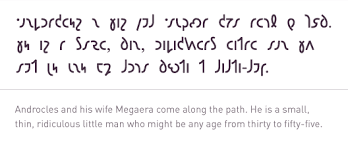
More radically, there is a Shavian phonetic alphabet that looks like this--


Perhaps these approaches would have served me well in 5th grade (though do not ask me to translate this illustration of how Shaw would have had us represent the English language); but looking back, leaning as early as the 5th grade to take a licking (idiom) in public was good training for adult work situations and now with SpellCheck . . .

Labels: , , , ,