Thursday, January 09, 2020

January 9, 2020--Trump the Nation Builder

Virtually all presidents shy away from talking positively about nation building. They know from experience and history (a few presidents actually know something about American history) that more frequently than not it doesn't work and that the nation attempting to carry out the nation building usually winds up paying a huge political price.

Lyndon Johnson and Richard Nixon come to mind. Both presidencies collapsed as the result of sinking into the quagmire that was the Vietnam War. 

And then we have George W. Bush who, during the October 2000 presidential debate with Al Gore, when asked by Jim Lehrer about nation building, said--
I think what we need to do is convince people who live in the lands they live in to build the nations. Maybe I'm missing something here. I mean, we're going to have kind of a nation building core from America? Absolutely not. Our military is meant to fight and win wars. That's what it's meant to do. And when it gets overextended, morale drops . . . I strongly believe we need to keep a presence in NATO, but I'm going to be judicious as to how to use the military. It needs to be in our vital interest, the mission needs to be clear, and the strategy obvious.
Then, ignoring his own advice, Bush authorized nation building after invading Afghanistan and Iraq. In both instances this turned out to be an expensive, bloody disaster that to this day many years later continues to fester.

And now we have Trump who as a candidate and later as president spoke contemptuously about his predecessors' nation building efforts.

Trump though now finds himself in an ironic situation. Like it or not, after mocking Obama and Bush he too finds himself supporting nation building in Iraq, Afghanistan, and now Iran where neo-con advisors such as Secretary of State Mike Pompeo have been pressing him to abrogate the de-nuclearization deal struck by Obama and a number of allies and to act more confrontationally.

I refer to current pressures that Trump is placing on Iran as ironic because the demands he is making and the aggressive military actions he has authorized are having unanticipated consequences.

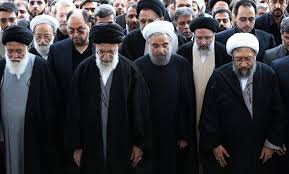
Until Trump turned up the volume of threatening talk, bragging that we have the capacity to bring down the current regime and devastate the country, there were dissident political factions in Iran that might very well, with the right kind of support, have had enough power to challenge the ruling ayatollahs.

But the decision to assassinate general Soleimani so inflamed Iranian national pride that the contesting factions are now fully united in their hatred of Trump and America. Now everyone in Iran is chanting "Death to America."

For this example of nation building they and we have Donald Trump to thank.


Labels: , , , , ,

Tuesday, November 27, 2018

November 27, 2018--South of the Border

Silly me, all along I thought Trump would wag the dog when Robert Mueller's findings were about to be published by bombing nuclear installations in North Korea or Iran. To distract from the main Mueller takeaway--the indictments of half the Trump family--he would start a war either place and watch his approval ratings soar. 

Don't they always when a president shows muscle? Like Lyndon Johnson and Richard Nixon did in the early days in Vietnam, Ronald Reagan did in Grenada, as George H. W. Bush did in Panama and Iraq, as Bill Clinton did in Bosnia, and George W. Bush did in Afghanistan and again in Iraq. Approval numbers in all instances went off the charts. 

But then (is there a lesson here?) in almost all cases the numbers came crashing back to earth. In fact so low for LBJ and Nixon that for this and other reasons they both wound up having to resign the presidency. (Lesson here as well?)

But now I think Trump's first (note that--first) wag situation will not be with Iran or North Korea but along the 1,900 mile border with Mexico.

With our border patrol people already using teargas and rubber bullets à la Israel to contain asylum seekers and Trump authorizing the use of "lethal force" if they or the military he has deployed to the area have rocks thrown at them, the visuals are already so intoxicating to the cable-news-addicted president that how can he be expected to resist a wider, more telegenic little war? And of course not have to worry that these fleeing Guatemalans might lob nukes on San Francisco or Trump Tower in New York City.

While all this excitement is going on who will care about the beans spilt by former campaign manager Paul Manafort or former fixer Michael Cohen? Who will notice that Trump pardons Don Junior, son-in-law Jared, and Ivanka? Who will pay attention to the legal spatting about the constitutionality of subpoenaing or indicting a sitting president?

After running this riff by Rona, she said, "A little snarky, don't you think?"

"Maybe a little," I said, "But this is serious."

"And for something this serious you think snark is the right tone? Thousands in the caravans are suffering and back in their home countries there are millions more being preyed upon by violent gangs, collapsed economies, and governmental corruption."

"So what are we supposed to do? Open our borders and let anyone in who wants to work and live here? I agree the situation is serious but what are we realistically supposed to think much less do? I get the demagoguery and the rhetoric, how Trump is playing with these people's lives for his own political purposes. To feed his base of terrified haters. If you were president what would you do?"

"It is very complicated," Rona said, "Look at what happened to poor Hillary the other day. When she said in an interview in The Guardian that 'Europe needs to get a handle on migration because that is what lit the flame' of nationalism in England, Western Europe, and with Trump the U.S. too. She got beat up, most claimed, for not getting off the stage and letting the next generation of Democrats move into the spotlight. But I think she was castigated because she told the truth. The truth that American liberals don't want to deal with because they fear it will alienate some members of their own base--those who want more open borders and a permissive approach to immigration."

"What we need," I said, "Is a whole new immigration policy. It needs to be humanitarian and efficient but also has to place limits on who we can admit to the country and need for our economy. That's the hard part."

"We can and should talk more about this because I can't figure out what I would like to see. But in the meantime I agree with you about Trump. You can safely bet your last two dollars that he's hoping for some significant violence along the border to justify a more and more aggressive response by our security forces. Sort of like how Lyndon Johnson jumped on a supposed incident in the Gulf of Tonkin off North Vietnam to justify a major ramping up of our commitment to defeat the Vietcong. My guess is that Trump is looking for his Gulf of Tonkin opportunity to take the focus off Mueller."

"In the meantime," I said, "Back to the snark."


Labels: , , , , , , , , ,

Monday, August 27, 2018

August 27, 2018--As He Lay Dying

A day or two before the end, as his old best friend, John McCain, lay dying, as we have seen Lindsey do before, he couldn't keep his hands off his new best friend, Donald J. Trump. 

Senator Lindsey Graham is such a suck up for hunky men that when he encounters one, or one pretending to be one, he seemingly can't control himself.

This time, with Trump, the gift he brought was to clear a path that would enable him to fire the Attorney General with minimal political dissent or outrage. This he gift-wrapped for Trump, the one man John McCain clearly despised. At least he could have waited until after the funeral. We know Trump won't show up, isn't welcome, and now I wonder about jilted-by-death Lindsey. Will he have the cajones to show his face at the service. 

This gift about when and how to dump Sessions was hand delivered by the same swooning Lindsey who only a few months ago said that if Trump fires Sessions there will be "holy hell to pay."

Late last week Graham noted that Sessions has clearly lost Trump's confidence (this is news?) and that he, Lindsey, a leader in the Senate, did not necessarily object to Trump replacing him after the midterm elections. 

Presumably the congressional elections will result in deep loses among Republicans and, Graham suggested, as presidents in the past have done, Trump should "reshuffle" his cabinet mainly to deflect blame for the election results from himself to his hapless underlings. 

And by reshuffling Graham means dumping a few cabinet officers, not just Sessions, so he won't stick out so much. It would appear to be more a house cleaning than retribution because Sessions recused himself from the Russia investigation and refused to see his job as protecting Trump from his own worst proclivities.

I suppose this advice constitutes something other than what Lindsey considers hell to pay.

Think Clinton in 1994, George W. Bush in 2006, and Barack Obama in 2010. All of whom reshuffled their cabinets after off-cycle election results.

And think how President Lyndon Johnson got around being pressured to make Bobby Kennedy his running mate in 1964. LBJ despised RFK even more than McCain hated Trump or Trump hates Sessions. 

He announced that his choice would not be from anyone serving in his cabinet (Bobby was still Attorney General) because there was so much work to do that he couldn't spare anyone's full-time attention. 

Everyone at the time knew what he was really doing--jettisoning Kennedy--and before long Johnson had become so politically toxic that he little choice but to withdrew from the 1986 race.

If only history could in this case repeat itself.

Rona has another theory about what Lindsey Graham is up to--

She thinks he is too smart and weaselly to give into his infatuation and is trying to trick Trump into not firing Sessions until after the midterms. He believes that Trump firing Sessions before November would so inflame voters that the Republicans would do even worse than is currently predicted.

Interesting. 

In that case let's hope Trump fires Sessions at the end of  October. Let that be the October Surprise. That would be better than bombing North Korea.

Then we could begin to speculate who Trump will attempt to appoint (I say "attempt" because Democratic senators will filibuster).

Top of the list could be Rudy or Chris Christie (remember him?). Or perhaps from Trump's world of reality TV--Judge Judy, Judge Jeanine, Judge Nepolitano, or Laura Ingraham who is a lawyer.

Perhaps most confirmable by the Senate is, why not, Lindsey Graham.

Labels: , , , , , , , , , , ,

Tuesday, June 13, 2017

June 13, 2017--Jack: Stolen Elections

"I know you're fed up with me and I assume so are most of your readers." Jack was more than half right.

"Most for sure, but not all," I said. "I don't know this for certain, but most people who read my stuff are on the progressive side of issues and, I suspect, don't have too many people like you among their friends or acquaintances. In fact, some tell me that political things have gotten so heated and ugly that they don't want to have anything to do with Trump supporters. That would include people like you."

"'People like me'? I think I know what you mean, but enlighten me."

"Arch conservatives. Donald Trump voters. People I hear from tell me that you aggravate them. You upset them with your willingness to overlook and rationalize the crazy things Trump does. I know you won't admit it, but a lot of what he says and does is really crazy."

"To tell you the truth I am not so eager to talk to them either. They look down their noses at me. To them, maybe you too, I represent the uneducated unwashed. You think you understand me, have me all figured out. Actually, you have me stereotyped and . . ."

"You don't have your own stereotypes?"

"Could be. I'll have to think about that. But there is one thing I am certain of."

"What's that?"

"When it comes to being obsessed with the Russians meddling in our elections your people are a bunch of hypocrites. You too."

"This doesn't concern you?" I said, "That Russia, which could be considered and enemy of ours, may have interfered with our presidential election? Maybe even influenced the outcome? You're OK with that? You call that hypocrisy?" I was outraged.

"You guys have a big problem with this because your candidate lost. If she had won, I'll bet you and they wouldn't be so apoplectic about the Russian hacking business."

"I beg to differ. As an American, not as a Democrat or Republican, this is a very big issue."

"Let me come at this a different way. You're old enough, right, to remember the 1960 election? Kennedy versus Nixon?" I nodded. "Tell me how Kennedy won?"

"What do you mean? He won the popular vote and the Electoral College vote."

"And how did he manage to do that?"

"I think I know where you're going with this."

"A lot of credible historians, and not just liberal ones, feel that his running mate, Lyndon Johnson, rigged the election in Texas and Kennedy's father Joe paid off Mayor Daley in Chicago to steal the vote in Illinois. With Texas' and Illinois' Electoral votes Nixon would have had enough to get to a total of 270, one more than the 269 needed to win a majority in the Electoral College. In other words, plain and simple, your party stole the election."

"First of all, there's a big difference between a foreign power meddling in our election and . . ."

"And," Jack said, finishing my thought, "if the candidates win by playing conventional dirty tricks on each other, like buying votes in Chicago, that's OK with you? To me this sounds like splitting hairs."

"This is something we'll never agree about. I see a big difference between the two situations."

"And I see hypocrisy. OK, so answer me this, and tell the truth--you're sort of all right with what happened in 1960 because your guy won but are furious now because your candidate lost? If Hillary had won with Russian help, would you be so insistent that we have to get to the bottom of this?"

"I hope so."

"One final thing--back in 1960 did any Democrats or liberals speak out about how essential it was to find out if Johnson and Daley cheated? Stole the election for Kennedy?"

"I don't remember it that well," I said, not feeling I was on solid ground.

"Well," Jack said, "I looked it up and couldn't find anyone from your side of the aisle clamoring for an investigation or anything like that. Maybe I missed something. Perhaps one of your friends who read what you'll write about our conversation will find something to contradict me. My two dollars says they won't."

Labels: , , , , , , , , , ,

Tuesday, April 18, 2017

April 18, 2017--Presidential Daddy Problems

Since John F. Kennedy almost all of our presidents and aspirants to the presidency have had Daddy problems.

This struck me again recently when watching Donald Trump, pose in the Oval Office to sign an executive order to gut one more Obama initiative. This one I think having to do with environmental protection regulations.

President Trump has not given much attention to making the White House office his own. The shelves are deplete of books with the exception of an impersonal row or two of leather bound volumes purchased by the foot. Probably an ornamental set of Dickens novels. His desk has a messy stack of papers and files but no visible tchotchkes. And on the credenza behind his desk where all presidents array at least a dozen pictures of their families (even Nixon did this!), on Trump's credenza there is just one picture--a severe black-and-white photo of his Germanic-looking father, Frederick. And, yes, there is also a stack of souvenir golf balls. I assume one from each of his 17 courses.

When thinking about presidents and their fathers, there are reasons to begin with Barack Obama. His Daddy problem stemmed from the fact that he essentially didn't have one. I believe he met his Kenyan father just once when he was 10 years old. The title of his first book, Dreams From My Father, says it all. In fact, it could serve as the title of books by at least a dozen of our presidents--how they each were either in search of their fathers or coveted their involvement, love, and acknowledgement. In Barack's case all of this was missing and that contributed to the kind of adult and president he became.

Of presidents Kennedy had a pathologically involved and controlling father. From early on Father Joe unrelentingly prepped his sons for public life. His oldest boy, Joe Junior, was slated to become president and when he was killed in action in World War II Joe Senior's attention immediately turned to second son Jack, who he pushed to get into politics (JFK was reluctant) and for whom he then behind the scenes bankrolled his career and, it is generally agreed, not only promoted his various runs for office, but in 1960 spread enough money around to assure his winning the nomination and then conspired with political bosses in key states, including bribing them, to fix the vote count to assure his son's election to the presidency.

And once elected, Joe Kennedy, out of public view, played a major roll in influencing policy. It is now also fully known that President Kennedy on a daily basis sought his father's guidance and was powerfully motivated to please him and seek his approbation. Some biographers even say that JFK's hawkish inclinations were in large part to demonstrate manhood to his philandering Daddy.
Joseph and John F. Kennedy
Lyndon Johnson succeeded Kennedy. His father was a major player in the Texas state legislature but a poor businessman. So much so that when his finances collapsed the Johnson family lived for decades in dire poverty. Sam Johnson was a very severe man and never showed son, Lyndon, much affection or offered encouragement or praise. Robert Caro, Johnson's remarkable biographer, writes at length about how LBJ sought to please his father even well after he died. Much of what Johnson did was an attempt to make up for his father's failure and ultimately to surpass him.

Then there was Richard Nixon. No one had a more clinical Daddy problem than young Dick. There is no evidence that his censorious father ever praised him for any of his accomplishments. Quite the contrary. Dick was also raised in virtual poverty--his father's various business schemes for the most part failed and he took his frustrations out on his children, especially the bright, hardworking, and eventually successful son. Desperate for his father's praise and encouragement, he pushed himself beyond sensible or legal limits and brought himself down in the process. The disparagement and constant criticism he felt from his father was a large part of what motivated Dick--to show by his dogged success that he was worthy.

Jimmy Carter's father, according to his biographers, was also a withholding patriarch for whom his son, Jimmy, could never do enough to win his affection or praise. One even goes so far as to say that Carter's propensity to laugh without seeming motivation when speaking in public was the result of a lifetime of accumulated anger. Much of it derived from his father's severity. It was, in a manner of speaking, a nervous laugh that attempted to obscure the frustration and anger he felt from an unhappy, caustic childhood relationship with his Daddy.

Ronald Reagan's father was a lifelong alcoholic who moved his family from town to town across the Midwest in an attempt to find work and change his luck. He was unsuccessful in many ways--never able to provide for his family, establish a sustainable relationship with his wife, or provide emotional support for his children. Son Ronald was so wounded by his upbringing, though he was a great storyteller, that he barely mentioned him. It was as if these memories were so painful that he excised his father from the narrative of his life in an attempt to get out from under the memories of his gnawing presence.

Both Bush presidents, though they achieved the ultimate political prize, never felt they were worthy of their fathers' love or pride. George H.W. Bush's father, Prescott, was a successful financier and later, when elected to the U.S. Senate, was held in high esteem by his congressional colleagues. To him, his children could never do or accomplish enough to earn his fulsome praise. No matter how much George achieved it was never enough. Like many presidential fathers he was emotionally aloof from his boys, never making them feel appreciated or affirmed.

Bill Clinton's biological father died three months before Bill was born. His mother some years later remarried and Bill took his stepfather's name. But the marriage to his mother did not last and after she divorced him, he drifted out of young Bill's life. So in many ways Bill Clinton was fatherless and many who have studied his life and written about him claim that the emotional void that was the result of this unsatisfying family life helps explain his undisciplined nature as a politician, family member, and man.

George W. Bush, son of the 41st president, also felt his father's emotional coolness and thus tried desperately to please him. Many say that his decision to invade Iraq and overthrow Saddam Hussein was to "finish the job" his father left unresolved when he had American troops come to the aid of Kuwait, which had been invaded by Iraq, and to surpass him as a wartime president. Also, some historians feel that his turning to Dick Cheney to serve as his vice president and cede to him so much of the power of the presidency was the result of Bush's impulse to seek substitutes for his biological parent, in the hope that they would offer him the affirmation he so desperately needed.

Other than as a curiosity should any of this interest or concern us?

It could well be that so many of our presidents having Daddy problems of this kind is a problem.

Seeking acknowledgement to salve fragile self-esteem may in the first instance be what motivated most of them to seek the power of the presidency. Not the desire to protect and improve the lives of those who elected them. If emotionally compromised as a result of the influences of their fathers, it also may be that allowing unresolved intra-psychic issues to influence decision making, particularly in crisis situations, gets in the way of their using their best, most rational judgement. We do not benefit by our presidents, when stressed by the consequences of dangerous decisions, to be so emotionally influenced.

One can only wonder what Frederick "Fred" Trump (ne Drumpf) might right now be thinking as his son attempts to deal with the North Korean threat. It could be that son Donald's boundless ego and insecurity are more on display and influencing his decision-making than any of his predecessors.

I would feel better about the situation if President Trump had a full array of family pictures on his Oval Office credenza, not just the one of Fred. Especially pictures of his children and grandchildren because what he decides and authorizes will affect them and their generation more than Trump himself or those of us who have already had full lives.

Fred and Donald Trump

Labels: , , , , , , , ,

Monday, May 23, 2016

May 23--Fear On the Left

Again we're being inundated with nuanced columns as well as rantings all claiming that if Donald Trump figures out how to get elected president, this assures that fascism is coming to America.

This concern is mainly from pundits on the left but not exclusively. For example, neo-con Robert Kagan, one of George W. Bush flacks who contributed significantly to bringing preemptive war to Iraq, in a recent column in the Washington Post, summed it up in his title--"This Is How Fascism Comes to America."

In addition to worthwhile insights, Kagan's speculation is that Trump's supporters are so riddled with fear and rage that they do not care about traditional policies or politics (they have no interest, for example, in reforming the Republican Party) and in their fear-stoked blindness are wanting to turn the government of the United States over to a crypto-fascisit who has no policies to present but only the promise that as a classic fascist strongman he will eliminate the deepest threats to America--immigrants, Islamic terrorists, economic stagnation, and the like. Just as Mussolini did in Italy in the 1920s.

Kagan goes even further, comparing a potential Trump presidency to the Reign of Terror during the French Revolution and with a whiff of innuendo suggests that Trump's supporters seem apocalyptically like those attracted to Stalin--
They [their followers] praise the leader's incoherent speeches as the beginning of wisdom, hoping he will reward them with a plum post in the new order. There are those who merely hope to survive. Their consciences won't let them curry favor so shamelessly, so they mumble their pledges of support, like the victims of Stalin's show trials, perhaps not realizing that the leader and his followers will get them in the end anyway.
With Trump we're apparently so far along the road to fascism that we should already be worrying about show trials. What a fevered imagination Kagan has.

Not to be outdone, former governor of Massachusetts, Bill Weld, running for vice president on the Libertarian ticket, is so worried about Trump's immigration policy that he crossed a big line during his first interview last Thursday. According to the New York Times he worried that "I can hear the glass crunching on Kristallnacht in the ghettos of Warsaw and Vienna."

Godwin's Law in full flower.

Here's what I do not understand--

Why do many progressives feel it is permissible for critics to label Trump supporters as so paralyzed by fear that they are willing to turn their lives over to a potential autocrat while at the same time not acknowledging their own fears?

It is true that many Americas are fearful. Understandably. A glance at hot spots and threats around the world validate that as do economic dislocation and uncertainty in the homeland. But then the Kagans and Welds of the world are just as fear-plagued. About different things of course, but they are fear-driven nonetheless.

And much of this fear, both on the right and left, is not objectified, but speculation-based. Which is fine, but it should be labeled as such. Again, on all sides.

We do not in fact know what a Trump presidency would be like nor for that matter Hillary Clinton's. Presidents and Supreme Court justices once in office have a long history of surprising us.

Take Dwight Eisenhower as one example. He was represented in the liberal media as a bumbler uninterested in the presidency, more interested in playing golf with his chums than leading or governing. But, among other things, at the height of the Cold War, at least eight times his cabinet and the Joint Chiefs pushed for a preemptive nuclear attack on the Soviet Union. Thankfully, eight times Eisenhower demurred. And at the end of his eight years in office, this former Allied Supreme Commander warned about the growing power of the "military-industrial complex." A warning still well-worth heeding.

Ronald Reagan was also thought to be a lightweight. Showing no interest in policy much less specifics,  whatever one otherwise thinks of him, he was a transformative president. Barack Obama during the 2008 campaign said that and was roundly criticized by fellow Democrats, with Hillary Clinton leading the charge.

Harry Truman and Lyndon Johnson, two vice presidents who assumed the presidency, also were misunderstood and underestimated. Who thought at the time that the haberdasher from Independence, Missouri would turn out to be a forceful and effective leader and who knew that LBJ, a political operative from South Texas (and a corrupt one at that) would transcend his background and public record to become the most progressive president of his or perhaps any era.

Before rushing to judgement this time, it might make sense to defuse the rhetoric and take Donald Trump on on the issues where he is severely deficient and vulnerable. It is hardly necessary to give into one's own fears, and out of that, make up fantasies about "the road to fascism." Things are bad enough as it is.

Robert Kagan

Labels: , , , , , , , ,

Friday, April 24, 2015

April 24, 2016--Someone Other than Hillary

The about-to-be-published Clinton Cash, Peter Schweizer's critical examination of the nexus between the cash pouring into the Clinton Foundation; their out-of-sight speakers fees; and, the politically most damaging allegation--that by contributing to the foundation big donors could not only "buy" access to Bill and Hillary but could also influence her official behavior when secretary of state, what is revealed in the book may wind up destroying her campaign for the presidency.

As my grandmother used to say, with yesterday's detailed disclosure in the New York Times that major Canadian donors to the foundation were able, with Hillary's support, to sell their uranium company to Russia even though that gave them control of 20 percent of America's access to enriched uranium, as she would say, "Something about this stinks to the high heavens."

Hillary may still manage to win the nomination (more about this in a moment) but with detractors such as the Koch Brothers willing to spend many hundreds of millions to tear her down and support their current favorite, Scott Walker, she may be seriously vulnerable.

Vulnerable because many of the allegations may be true, vulnerable because even if only half-true they support the narrative that the Clintons play by their own rules, are secretive about things that the public has a right to know, and that they have only self-interest at heart while posing as public servants and concerned citizens of the world.

Recall, when leaving the White House after eight years, they were "caught" loading moving vans with furniture that belonged to the American people. It was a metaphor at the time about what they at essence were. And perhaps continue to be.

Clinton Cash is no Whitewater (an insignificant though phony Arkansas real estate deal) or cattle-futures scandal (where Hillary netted $100,000 with a $1,000 "investment"). It's not Travelgate (where the Clintons purged the White House travel office staff so they could install cronies in the vacant jobs). It is not even Benghazi or e-mail-gate. It may turn out to be much more serious than any or all of these small tempests. What is apparently about to be revealed in the Schweizer book goes to the heart of the Clinton problem and may have enough smoking guns to bring her down.

So rather than Democrats waiting around to see where all this may lead, isn't it time for someone to step forward to challenge her for the nomination? Someone like a Eugene McCarthy who challenged Lyndon Johnson for the 1968 nomination. And ultimately drew Bobby Kennedy into the race. For Democrats then, they offered an alternative to LBJ who otherwise would have secured the nomination without a struggle, without any opposition, and then would have gone on to be defeated because of the public's disenchantment and lack of support for his Vietnam policies.

Democrats not ready for Hillary need a place to register their dissent from yet another Clinton, especially a Clinton who could realistically be defeated by Scott Walker or Jeb Bush.

Those disaffiliated Democrats include me. My problem, our problem is as always the who. Joe Biden? A certain loser. Elizabeth Warren? Plausible but timid. Jim Webb? Who's he? Andrew Cuomo? No chance. Bernie Sanders? Dream on.

Get the point? That's why, help us, I continue to predict Walker in 2016.

Labels: , , , , , , , , , , , , ,

Thursday, April 09, 2015

April 9, 2015--Running Against Washington

It is tempting to do so. Pretty much everyone thinks that "Washington" is broken and that to run against it as a presidential aspirant is a smart political idea.

Ronald Reagan did so successfully ("Government is not the solution to our problem; it is the problem") as did Jimmy Carter, George W. Bush, and Barack Obama. And now we have Scott Walker, Ted Cruz, Rand Paul and other Republicans proclaiming that they are outsiders (though at least two thus far are government employees, U.S. senators) and will either get the government to work, get it off our backs, or promise to do a combination of both.

I was reminded of this when reading, in The New York Review of Books, about David Axelrod's political memoir, Believer: My Forty Years in Politics.

In 2008, in a debate before the New Hampshire primary Axelrod recalls Hillary Clinton, by implication criticizing Barack Obama, declaring that she had been fighting for change all her life and "We don't need to be raising the false hopes of our country about what can be delivered."

Axelrod, and through him his candidate, seeing the political opening, jumped on her claim that it is difficult to bring about real change. He writes--
I recognized the opportunity that Hillary handed us. She was too much a part of the system in Washington ever to change it--and without changing the politics in Washington, real solutions to big problems would never come.
This may be a good way to win nominations and even get elected but it is a terrible approach to governing.

Like it or not, if we are to have a government (and even Tea Party people want some government--their Medicare, their Social Security, their military, their border police, their courts, their jails, their tax cuts) the only way for it to function is through various forms of bipartisan deal making. Deals between the President, his (or her) administration, and Congress, whichever party controls it.

Hillary was right--you have to be part of our system to get anything done. Forget changing it. And maybe she'll get a chance to try to function the old fashioned way. She may be boring, less than likable, and past her prime, but when she was a senator she did work this way and was able to get quite a lot accomplished.

The three presidents who got more of their agenda approved than any of their successors (whether or not you like their policies) were able to figure out ways to work with Congress. Franklin Roosevelt, Lyndon Johnson, Ronald Reagan. Privately, very privately, for the most part they expressed little respect for specific members much less the system itself. But they held their noses and figured out ways to work with Congress, including, if they could, through intimidation.

To get things done, the lessons of history suggest, those willing and adept at working the system do better than those who claim to be outsiders. It's not sexy but it works.

Labels: , , , , , ,

Wednesday, January 28, 2015

January 28, 2015--"Selma"

As award season unfolds there is controversy surrounding the film Selma. Some are asking why, if it was nominated for an Oscar for best picture, why weren't the director, Ava DuVernay, and David Oyelowo who plays Martin Luther King nominated? Could it be, it is being whispered, because of Hollywood's racism? Forgetting for the moment that last year, Twelve Years A Slave won for best picture.

An additional controversy surrounds the depiction of Lyndon Johnson, who was president at the time. In "Selma" he is represented as resisting King's efforts to secure legislation to strip away impediments to Negroes being able to register and vote in the South and is shown needing to be pressured and even forced to support this struggle.

The historical record reveals this to be untrue and thus the film presents a seriously unfair picture of LBJ and his position on voting rights. In fact, some former Johnson aides and historians are claiming that the idea to march in Selma was more LBJ's than King's and they marshall evidence from audio tapes of White House conversations between MLK and Johnson to support that view.

Here, from the transcript of a taped telephone call between King on Johnson on January 15, 1965 (two months before the King-led Selma campaign) is that evidence of LBJ's commitment and how he suggested the strategy--
JOHNSON: We take the position that every person born in this country, when he reaches a certain age, that he have the right to vote . . . whether it's a Negro, whether it's a Mexican, or who it is . . . . I think you can contribute a great deal by getting your leaders and you, yourself, taking very simple elements of discrimination; where a [black] man's got . . . to quote the first 10 Amendments [in a voter registration literacy test], . . . and some people don't have to do that, but when a Negro comes in to do it, and if we can, just repeat and repeat and repeat. 
And if you can find the worst condition that you run into in Alabama, Mississippi or Louisiana or South Carolina . . . and if you just take that one illustration and get it on radio, get it on television, get it in the pulpits, get it in the meetings, get it everyplace you can. Pretty soon the fellow that didn't do anything but drive a tractor will say, "Well, that's not right," and then that will help us on what we're going to shove through [Congress] in the end. 
KING: Yes. 
JOHNSON:  And if we do that we will break through. It will be the greatest breakthrough of anything, not even excepting this '64 [Civil Rights] Act, I think the greatest achievement of my administration.
This does not sound like LBJ needed to be dragged kicking and screaming to support the voting rights agenda.

What would have been the problem to represent King and Johnson as partners, albeit wary partners?  Let's see what the film's director had to say about this distortion of history.

When asked, Ava DuVernay said that the original screenplay needed "extensive rewriting" because it was a script for a "traditional bio-pic" that presented "antiquated and patronizing" ideas about history and the civil rights movement.

In her words--
If, in 2014, we're still making 'white-savior movies' than it's just lazy and unfortunate. We've grown up as a country and cinema should be able to reflect what's true. And what's true is that black folks are the center of their own lives and should tell their own stories from their own experiences. [My italics.]
Even if what is represented as "true" isn't.

It is a shame that this otherwise inspiring and meaningful movie is being shown to young students as a full and accurate history of that brave era. I think it might have been the Reverend King himself who many times reminded us that it is only the truth that will set us free.


Labels: , , , , , , , , ,

Thursday, August 14, 2014

August 14, 2014--Hillary's Presidential Checklist

Here's how you can know for sure that Hillary Clinton is actively running for president. Check out her checklist--

Over the weekend, in an interview with Jeffrey Goldberg, a writer for The Atlantic, she caused a stir by creating some distance between herself and Barack Obama. On foreign policy.

Recall, she was Secretary of State during his first term.

She said that a president (are you listening, a president) needs to provide the nation with "organizing principles" when it comes to our relations with the world, that it's not enough to, as Obama put it, just to not "do the silly stuff." He said that about silly stuff in a major speech at West Point as part of his comprehensive overview of the principles that organize his approach to foreign affairs.

Disagree with Obama as one well might (and "silly stuff" is silly)--including that Clinton is not required to agree with him about everything even though she served in his administration (actually, the opposite, to dissent is the best way to serve)--it is more than a coincidence that just as the midterm elections are heating up and the scramble for the presidency two years hence is accelerating that Hillary, after her memoirs failed to interest anyone, would be creating this opportunity to tell us that she should not be perceived as coupled to Obama's foreign policy initiatives, especially when they are feeling feckless and inept.

Anyone with an interest in the American presidency knows that Richard Nixon in 1960, when he ran for the presidency, lost in part because he did not sufficiently distance himself from President Eisenhower; and poor Hubert Humphrey in 1968 lost to Nixon in large part because he was seen to be Lyndon Johnson's policy lapdog.

The Humphrey example is the operative one now--Hubert, with only a few weeks to go before Election Day, finally expressed some tepid criticism of LBJ's Vietnam policy and, as a result, almost fully closed the gap in the polls, losing to Nixon by less than one percentage point.

Hillary does not want to make that mistake. So a full two years in advance she is acting to distinguish herself from the increasingly-unpopular Obama. She does not want to be the Nixon of 1960 nor the Humphrey of 1968.

This distancing shows her in the middle of her presidential checklist--

(1) Serve as Secretary of State for only four years to give herself time to run away from her foreign policy blunders ("resetting" relations with Russia, Benghazi, etc.) and even to physically separate herself from the State Department and the president she served.

(2) Take a month off to get some rest and, who knows, maybe do some Botox.

(3) Strike a $8.0 million book deal and get help writing a bland, no-drama 635-page tome.

(4) Hit the talk show circuit to pitch the book and remind people she's still around.

(5) Just as midterms approach, find someone gentle to interview her about foreign policy and give her the chance to do a little subtle and not-so-subtle Obama dissing.

(6) See where the chips fall in November and keep an eye on Elizabeth Warren and any others who might step forward to stand in the way of her march to the nomination. (I predict she will have some significant challengers from the left.)

Based on the numbers, or who steps forward, continue to act as the incumbent or, if necessary, announce sooner than currently planned and hit the campaign trail to test her messages and hone her debating skills. And, of course, put down her opposition.

(7A) About a year from now, since Obamcare will probably still be widely unpopular, have Jeffery Goldberg interview her about domestic issues and take that opportunity to take a few pot shots at the Affordable Care Act. If somehow by then it is more popular than at present, take credit for it--claiming that it's the very same healthcare program she came up with as First Lady.

(7B) And if Obama is able to strike a deal with Iran to give up their nuclear weapons program, take credit for that too. No one will remember that she voted for the war in Iraq and was pretty much in agreement with John McCain when it came to wanting to bomb, bomb, bomb . . . bomb Iran.

(8) And perhaps most important, raise money, raise money, raise money.

I mean for the campaign. The Clintons by now have more than enough for themselves, Chelsea, and the soon-to-be-born grandchild.


Labels: , , , , , , ,

Tuesday, March 11, 2014

March 11, 2014--White Men

Democrats finally are paying attention to the fact that in the 2012 election Barack Obama received just 35 percent of the white male vote, down from 41 percent four years earlier.

He won the election because he received more than half of women's votes (55 percent), 93 percent of the African-American vote,  71 percent of the Hispanic vote, 75 percent of the Asian vote, and 60 percent of voters between 18 and 29. That was his winning coalition.

But in the meantime, though Democrats kept the White House, largely because the overwhelming percentage of white male votes went to Republicans, the GOP maintained its majority in the House of Representatives and are threatening to wrest control of the Senate later this year.

This should not be new news. No Democrat running for president has received a majority of white men's votes since 1964 when Lyndon Johnson trounced Barry Goldwater, carrying 44 states.

What's the problem?

These men voted for Democrats for decades--from at least Franklin Roosevelt's time to LBJ's. But then they began to drift toward the right. Most notably, Ronald Reagan was elected not just because Jimmy Carter and four years later Walter Mondale were weak candidates but because he figured out how to appeal to what came to be known as Reagan Democrats--disaffiliated white men.

Many of these white men felt abandoned by the Democrats because the party began to be perceived as too devoted to civil and women's rights. These men who felt they had worked hard to achieve middle-class status were appalled by their perception that New Deal and subsequent Great Society programs, including affirmative action, were unfair to working people. And, of course, there was a healthy dose of racism and misogyny in the mix.

On the other side of the political spectrum, liberals and progressives began to caricature these men with equal passion and overstatement. If liberals were not tree-hugging N___ -lovers, conservative white males were not all redneck, trailer-trash six-pack guzzlers. In fact, characterizing these Reagan Democrats as such only drove more of them further right as they felt mocked and ignored.

Fellow progressives, let's be honest--we do tend to show not-so-thinly-veiled contempt for these white men. We do not want to engage as equals the less-educated and the unwashed. In our hearts we know too many of us feel this way and those who we largely mischaracterize are not unaware of what we think about them. From this kind of contempt, one cannot expect to widen one's political coalition.

The Democrats' plan seems to be to let demographic changes solve their problem. Hispanics are among the fastest growing segment of the population and as soon as there are enough of them in, say, Texas, just carrying Texas, New York, and California will give Democrat presidential candidates a leg up on an Electoral College majority.

But--and this is a big but--just as we might expect to see a series of Democrats elected to the presidency, we will simultaneously see increasing Republican majorities in Congress.

Waiting for demographics to overwhelm white men, then, will not get the job done. So what to do?

First, acknowledge that the 35 percent of white men's votes Obama received in 2012 (as unpopular as he was and as African-Ameircan as he is) is not insignificant. Nor was the 41 percent in 2008. The challenge for Democrats, then, is how to at least retain that 35 percent and inch back to Obama's 2008 41 percent.

To begin to do this we have to stop making fun of, showing contempt for these frustrated and unhappy men. In addition, we should try to figure out why they feel so disaffiliated. Polls tell us that they think the Democrats are the Mommy Party, more concerned about giving everyone food stamps and welfare than standing up to the unions, communists, and terrorists.

We shouldn't go along with the call to keep the "military option" on the table when confronting Russia in Ukraine; but we should listen respectfully to that argument and not mock it.

When they chastise liberals for pandering to gays, we should calmly state why gays should be given the same rights as the rest of us, and not make fun of their alleged homophobia. We should back off from accusing them of "waging war on women" (war is not the most appropriate or fairest metaphor) and talk with them about their hopes for their daughters.

And in the policy realm, Democrats should look to embrace approaches that would address the concerns and needs of these men. There should be tax breaks as much for them as for the wealthiest. We should make it easier and less costly for their children and grandchildren to go to college. We should improve veterans benefits and emphasize health care that focuses on men's issues, not just reproductive issues.

Above all, we should emphasize approaches to helping low-income people become self-supporting. We should agree with these men that it is not a good thing for people to need government assistance. It should be the last resort. A guaranteed annual income, for example, which many conservatives support, would obviate the need for most of our current safety net programs and offer dignity to those unable to fully support themselves.

For the progressive in me, to come up with a list of viable policy suggestions is not easy. Better minds than mine should be able to come up with an agenda, which isn't pandering, that could increase Democrats' appeal to these alienated white men. Fairness requires this as does smart politics.

Labels: , , , , , , , , , ,

Monday, January 27, 2014

January 27, 2014--Chris Christie Is Not a Bully

Pretty much universally New Jersey governor Chris Christie has has been declared a bully.

If you tune into MSNBC, beginning early with Morning Joe, it's been wall-to-wall Chris Christie and the Christie coverage does not end until 11:00 when Lawrence O'Donnell finally signs off with the Last Word. Although Joe Scarborough is a proud Republican and has attempted to find ways to see Christie in the best light, even he has made note of what even he refers to as bullying tactics.

For the rest of the MSNBC crew, it's case closed. Curtains for Christie. As one said, "He's toast."

Admittedly it's a juicy story and a politically important one, especially for Democrats and Independents who want Hillary Clinton elected president. If Christie, seen to be her most powerful challenger, can be brought down, it clears the way for President Hillary Rodham Clinton.

But in my household, someone is saying, "Hold on."

That would be Rona.

"I do not think he's a bully," she said to my considerable surprise.

"You say that in spite of the claim that when he allegedly had his lieutenant governor tell the mayor of Hoboken that unless she supported Christie for reelection he would hold back Hurricane Sandy relief funds? Isn't that being a bully?"

"Let's assume he did that," Rona said.

"That assumption is an easy one for me."

"How different is that from how Lyndon Johnson operated when he was Senate Majority Leader and then president?"

"He didn't bully people?" I said. "I read all the Robert Caro books and from what I learned I would say LBJ exerted forceful leadership."

"Really? Forceful leadership? Ask Earl Warren who didn't want to serve on what became the Warren Commission that looked into the assassination of John Kennedy. Johnson had the goods on Warren and threatened to expose him if he declined to serve. Warren, Caro reported, broke into to tears and agreed. You don't call that bullying?"

"I guess I do. But, I'm confused. What's your point? You just said Christie isn't a bully and compared him to LBJ who you seem to be saying was a bully?"

"I intentionally confused you since I think the situation with Christie is more complicated than has been represented in the press and on TV."

"Go on."

"Let's begin by talking about bullying itself. Tell me, just what constitutes bullying? Forget Christie and LBJ for the moment. What's the agreed-upon definition of bullying?"

"Let me look it up so we can be precise." I googled bullying and found the following--
Bullying is unwanted, aggressive behavior among school-aged children that involves a real or perceived power imbalance. The behavior is repeated, or has the potential to be repeated, over time. In order to be considered bullying, the behavior must be aggressive and include: 
An imbalance of power. Kids who bully use their power--such as physical strength, access to embarrassing information, or popularity--to control or harm others.
"You see," Rona said, "as I expected, it's mainly about gaining dominance per se. Someone more powerful bullies to gain dominance over someone weaker. It's an end in itself. It doesn't usually seek to require the person being bullied to behave differently or agree to do something against his will."

"By that definition it's not what Christie is being accused of doing. At least in Hoboken. The bridge thing was more about revenge against the Fort Lee mayor who didn't support him for reelection."

"Exactly,"Rona said, "In Hoboken he supposedly tried to extract more than an endorsement from the mayor or just to dominate her. He wanted to get her to do something against her will. There's a big real estate development project proposed there that he apparently wants the mayor to help get approved which would benefit some of his big-money supporters. People who would be helpful to him if he runs for president."

"So," I asked, "if what went on there is different than bullying, what are we talking about?"

"Maybe blackmailing?

"That could be what Johnson did to Warren. There was a secret the Chief Justice didn't want revealed. But I don't think Christie was blackmailing the mayor."

"Strong-arming then?" Rona asked.

"I'm not sure about that either. That's a mob term that . . ."

"Though folks on the left enjoy suggesting a mob connection to Christie. You know, he's governor of Tony Soprano's state. Newsweek, for example, had Christie's picture on a cover last year, really a version of a mug shot, with the headline--The Boss. Get it? I don't thing they were referring to another New Jersey 'boss,' Bruce Springsteen."

"So what then is it with Christie?" I asked.

"I think more arm-twisting," Rona said.

"Let me look that one up. It says--'Persuasion by use of physical force or moral pressure.'"

"I think that's closer to what's been going on in New Jersey and in governments in general. The pressure part, not the physical force. And, back to President Johnson, that's what he did as well--arm twisting. In addition, of course, to using various other kinds of techniques to get people to go along with his agenda."

"So . . .?"

"So, maybe we all need to be more precise. If it isn't bullying and is a version of arm twisting we should call it that."

"Maybe."

"Furthermore, maybe we should be a little more consistent in they way we look at these tactics, these political tools."

"Meaning?"

"Meaning that if we like a politician's agenda--say Johnson trying to get Civil Rights legislation passed or Medicare--if we like what someone is doing, we're more inclined to look the other way in regard to the tactics used."

"And if we don't?"

"We call him names."

"Like bully?"

"Christie may not be a bully," Rona smiled, "but politically he's still toast."

Labels: , , , , , , , , , , , , , ,