Monday, June 11, 2018

June 11, 2018--Ladies of Forest Trace: President Grump

The phone rang as we were in the midst of preparing dinner. 

"Who would call us at this time?" I asked. "Anyone who knows us knows we have dinner about this time."

"Maybe it's a robocall," Rona said. "Check the caller ID."

I did and said, "It's from an unfamiliar area code--123."

"Pick it up. Maybe an actual person is placing the call. Not a computer. We've had an increase in the number we've been receiving. Maybe you can get them to take us off their caller list."

"Forget that," I mumbled. I was just about ready to add the spice mix to the vegetarian chili that was simmering on the stove. 

Rona said, "I thought no area codes are allowed to start with a 1."

"With telemarketing and hacking," I said, "I assume anything goes. So maybe I shouldn't answer it. We don't want to get drawn into anything that will take over our computer or phone."

"Now you have me curious," Rona said, "I wouldn't worry too much about that. I'll add the spices. You answer the phone. Let's see what this is."

"You would think I have all day." On the phone it was a woman's voice that sounded vaguely familiar."

"Who is this?" I asked tentatively.

"Have I changed that much in three years?"

"Who is it?" Rona mouthed.

Shrugging, I shook my head.

"Well, in fact I do have all day," the caller chuckled.

"Tell me what this is about. We're in the middle of preparing dinner. Chili." I was poised to hit the phone's Off button.

"How can I be at rest while that Grump is making himself a king?"

"Is this . . . ?" I began to tremble.

"Who else calls you when you're hiding in Maine?"

"We're not hiding . . . " I couldn't catch my breath but finally said, "Mom?"

"This is not the time to be hiding away. It wasn't easy, but if I could get permission to call you between now and November the least you can do is put down your potholder."

"Is it really . . .?"

"The girls and the people who run this place are very concerned with what is happening."

"In Maine?" I didn't know what to say. My heart was thumping and I thought I was about to pass out or have a stroke. 

I collapsed in a chair and Rona rushed over to see if I needed help. I signaled that I was OK. Just overwhelmed with emotion.

I mouthed, "I think it's my mother."

"How can that be?" Rona said so loud that my mother or whoever was on the phone could hear her.

"Tell my darling I love her and not to worry about me. They take very good care of us here. Even better than Forest Trace. Especially the food. Last night we had flanken with horseradish. It was delicious, I could chew it, and best of all it didn't give me gas."

Rona reached for the phone but I pulled it away. So she ran into the living room and snatched the other one from its cradle.

"Mom?"

"It's so good to hear your voice. I miss you every day."

"I think about you all the time. What an inspiration you have been and continue to be. So now you're here to . . . ?"

"Help with the election. We don't have newspapers or cable so I can't listen to Wolf or read Maureen Shroud. It's been difficult to keep up with the news. But we do know who was elected and can't believe what his people are doing to our  country. The same country that rescued so many of my family who fled the pogroms before the Nazis took over. Today, Grump would want to arrest us and send us back to Auschwitz."

"It isn't that bad," I said, and then after a pause added, "Yet."

"That's what they said in Germany. Things are bad but we will be safe. All we have to do is not make trouble. We're Germans, yes Jews, but we have always lived side-by-side with gentiles and they won't allow the worst to happen." She took a deep breath and said, "And then the worst happened. More than the worst."

"And so?"

"So, we have to make trouble. That's why I got permission to call. To make sure you and your friends--not just your Jewish friends--make trouble."

"Which means?"

"Working every day to make sure good people get elected. If he wins in November I fear for the future. It will say the American people agree with what he has been doing. What a message that will be to the world. And how it would encourage him to continue doing all the things he is doing. What will this mean to young people? I was a teacher and a mother all my life. My heart breaks when I think about what the future will be like for young people. They will lose hope. For the young, that would be the worst thing. Not to look forward to the future."

"That would be a tragedy," I agreed, "But young people are activated and it seems are eager to vote in November."

"They didn't vote two years ago. Not enough of them. They wanted Burning Sanders and when they couldn't have him they didn't vote. And what about women? I remember when we couldn't vote. I was 12 years old when they passed the Amendment. My sisters were suffragettes. They marched and marched and marched. In the heat and the rain and the snow. But now too many women didn't vote for the first woman running for president. Hillary. Not my favorite but better than him, no?"

"Much better," Rona said, "Especially as we see what he is doing. At least with her things wouldn't be this bad. But more than 50 percent of white women voted for Trump. So it was white women and young people more than anyone else who helped elect him. But we are organizing and demonstrating. Just last week we did well in primary voting in California."

"I hadn't heard about that," my mother said, "That is good news but unless Democrats won by big numbers it may not be good enough. And when I think about the demonstrations I am not impressed. How long has he been in office?"

"About a year and a half."

"And what did you have? Two marches? One right after he was sworn in, the Pussy Cat march (I'm old fashioned and hated the name), but it still was good and then there was the one organized by the Florida children after 17 of their friends were killed. Also very good. But I didn't make all this effort to be able to talk with you to pretend to feel good about two marches."

"What would have made you feel good?" I asked.

"A march every week or at least every month. That would be at least 18 marches already. I know the news people would stop talking about it but if it went on and on they would have to pay attention and it could make a difference. It would keep the drum drumming  It would also show that people, including young people, care about the future of America and the world. Their country, their world. Not mine and too soon not yours.

"What do you mean 'too soon'"? I asked, fearing she knew something I didn't.

"Time. Time is marching even if Americans aren't. Time doesn't need to do much or really anything to keep moving along. Time and tide. Look out your window up there and pay attention to the tide."

I glanced at Johns Bay and was about to ask about the tide since it ebbs and flows, first north and then it swings around to the south. I wasn't sure why this was significant to her. But before I could enquire, she told us she needed to pass the phone to one of the Forest Trace ladies who was waiting in line. She promised, until November, to try to call every few weeks. Maybe, she said, on her birthday, June 28th, when if she were still here she would be 110. Not, she said, that they make a big fuss there about birthdays. Or that 110, considering where she is now, is a big deal.

But before yielding the phone, she asked "Doesn't chili give you gas?"
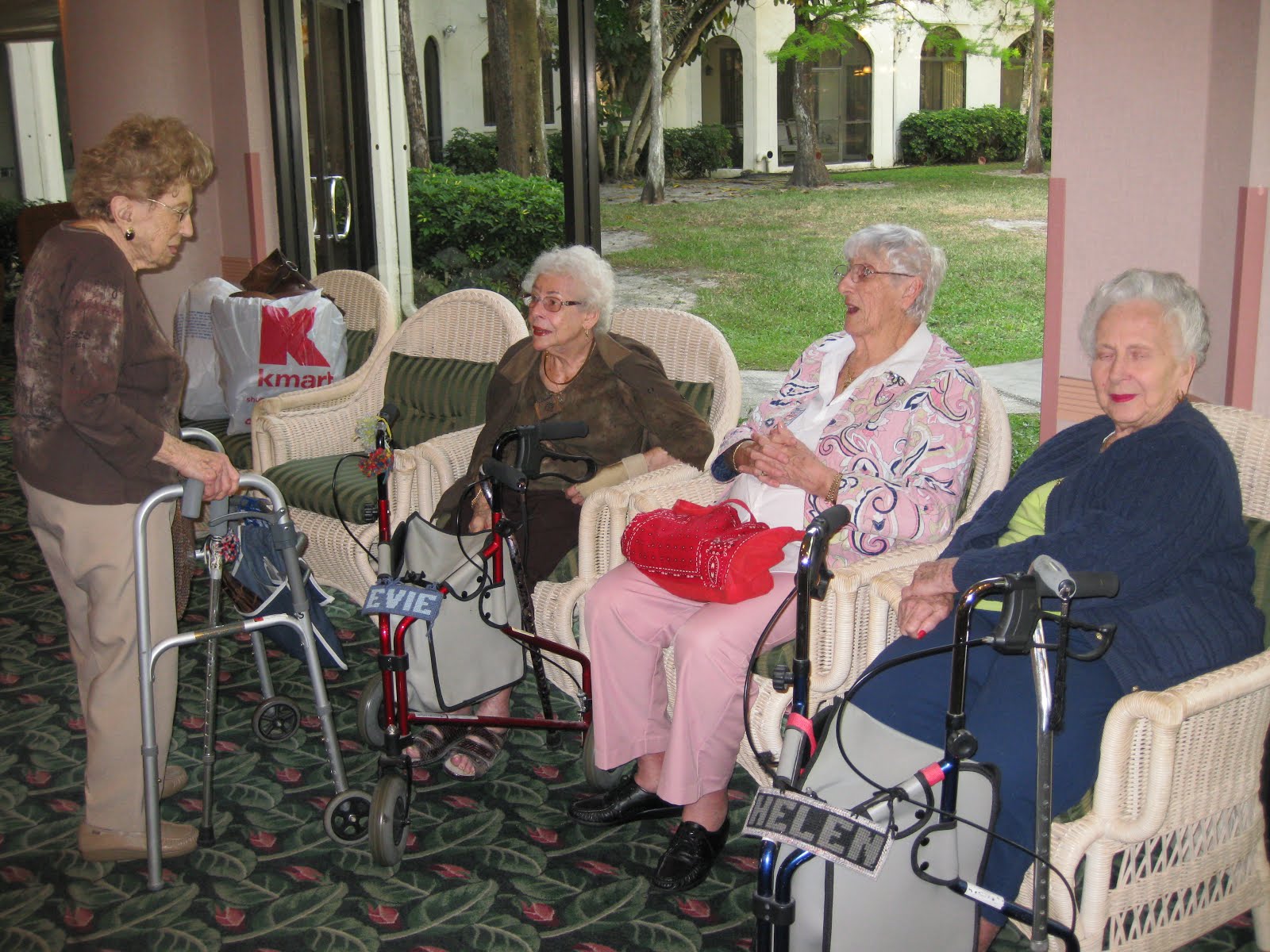
The Ladies of Forest Trace (Mom Standing)

Labels: , , , , , , , , , , , ,

Thursday, August 03, 2017

August 3, 2017--From Auschwitz: Der Oskar Ist Kaput

Last week, the New York Times published a story about a controversial exhibit of artifacts from Auschwitz, the Nazi Death camp where 1.1 million were slaughtered. It is controversial because to some this represents making a show of that evil place. The counter argument is that 72 years after Auschwitz was liberated, to many it is not even a memory. 

To remember, is to continue to resist. It is argued that visiting this exhibit, which will travel to 14 cites across Europe and North America, will anchor that unspeakable reality deep in peoples' consciousness.

Years ago, I wrote the following story as my effort, closer to home, to remember. The events I described actually occurred--

 Der Oskar Ist Kaput
In the 1950s in Brooklyn, every neighborhood had its “crazy” people.  During that time, that less diagnostic and sensitive era, distinctions between them were not drawn--being senile was being crazy; being retarded was being crazy; being disabled was thought of as crazy; and of course being crazy was being crazy.
During a simple walk to and from school I needed to run the gauntlet of this variety of crazy people—there was twelve-year-old Herbert Bender who today we would call mentally retarded; there was Mrs. Bronstein who we would now say has Alzheimer’s; there was Sonya Kloppman who had polio when she was twelve and was confined to an Iron Lung; and then there was old Mr. Karpovski, who we thought came from Poland and who lived alone in a cellar. 
All were out on the street every day except when it was raining or snowing, with the exception of Mr. Karpovski, who lurked in the driveway to his garage, arguing with himself even in the worst weather.  In fact, the more it stormed, the more he raged, swinging his arms and fists as if to attack himself, screaming and singing “Farblondzhet, Farblondzhet. Shteyt a boym; shteyt a boym,” against the elements.  He was by far the craziest and, I am ashamed now to confess, the most fun.
The neighborhood was a mix of two- and three-family houses with an occasional five-storey apartment house.  Those houses that were “detached,” and thus most desirable, stood on confining plots with less than ten feet separating them from their neighbor on one side and had just enough space on the other for a driveway that led to rickety garages.  When cars acquired their gaudy tail fins, and the extra breadth to accommodate them, these driveways and garages fell into disuse, or rather different forms of use, because the cars were either too wide to negotiate the driveways themselves or make the sharp turn required at the end to slip into the tight parking spaces. 
A matchbox rectangle of a dirt garden adorned the front and a slightly larger patch of earth in the rear.  It was hopeless to think of growing anything vibrant in either place.  Though some tried, especially those who came from rural Eastern European shtetls or Southern Italy, but even they needed to concede that the soil, such as it was in Brooklyn, was basically hard-as-rock clay, best suited to supporting cast concrete urns in which only hardy Chicks and Hens could grow or cement statuary of elves or, shamelessly, the occasional black-faced jockey.  
And each house had an elevated front porch or stoop where during hot pre-air-conditioned days families would set up chairs and tables and sit out all night to catch the occasional breeze.  Stoops were also good places to keep a close eye on the passing scene as well as to listen in on nearby conversations and, above all, an ideal setting from which to interfere in your neighbor’s business.
And then there were the ubiquitous empty lots.  The area was still not fully built up, and these untended spaces largely contained ragweed and debris.  From John Inusi the shoemaker, there was a mountain of leather shavings he heaped in the lot adjacent to his store; in another there were piles of bald and discarded rubber tires that were left over from the Second World War when they were rationed and the fathers were forced to drive on them until they became literally threadbare before tossing them in the lot.
There was teeming life of its own among the neighborhood’s children in these vacant lots and little used garage.  In these lots we fabricated huts from abandoned or stolen lumber, tin, and cardboard; and dug trenches and tunnels that resembled those of battlefields, which they periodically became when the Italian Ginny Gang from East 57th Street invaded the huts of the 56th Street Rockets and the Jewish defenders retreated to their underground redoubts.  And in the unused garages we set up improvised boxing rings where dreams of glory were forged—recall that at the time many of the boxing world champions were Jews; and an occasional drum set and bandstand so aspiring hep cats could live out their show business dreams—recall as well the Jewish jazz greats of the time that included Benny Goodman, Artie Shaw, and the amazing drum dervish Buddy Rich. 
And also in the alleys and spaces separating our houses as well as in the dank cellars and basement apartments in the three-family houses, lived and lurked the “crazy” people.  It was as if an inspired architect or city planner had designed an ideal place just for us and for them.
                                              *     *     *
 Herbert (Herbie) Bender lived with his parents right across the street in the second floor apartment, but in truth lived more in the lot next to his house.  The one with the piles of discarded tires.  They served as his schoolyard, more his Matterhorn.  From my bedroom window I could see him struggling every day to scale these mountains of tires.  Just as he would get close to the summit of the tallest mound he would invariably slip, catching a foot and come tumbling down, his fall softened, his fragile body protected by the rubber heap.  Undeterred, he would struggle back to his feet and then stuff the fingers of his right hand into his mouth, hooking them behind his lower jaw of teeth, and rock back and forth in a form of mock davening or perhaps actual prayer, all the while drooling on his wrist. 
He would again turn to confront his indomitable mountain and try again with the same result—tumbling down followed by righting himself, twisting his overalls into alignment, shoving his fingers deep into his mouth, and beginning his rhythmic rocking.  All day, every day.  Relentless and ritualistic, dressed always in those overalls and tattered sweater no matter the season or time a day. 
In the evening, when the street traffic had subsided, I would raise my bedroom window a few inches so I could also hear him.  He emitted a sound, not a coherent word, just a sound--a continuous breathless sighing or keening that felt as ancient as his rhythmic rocking.
One afternoon my mother caught me spying on Herbie, actually heard me laughing when he tumbled down yet again from near the peak of his tire mountain.  It was unusual for her to put her hands on me except lovingly, but this time she yanked me back from my perch at the window sill, and with both her hands gripping my shoulders, shaking me to focus my attention, she snapped, “He’s sick and you shouldn’t be making fun of him.  You should only know how lucky you are.  You should feel sorry for him and his mother.”  I thought I heard a sob, “You have no idea the burden they have.  Leave him alone,” her voice softened, “Please.  For me.” 
I tried very hard to heed my mother and ignore him but I continued to be fascinated by Herbie and occasionally risked the guilty pleasure of spying on what he was up to, to see if over time there would be any changes in his behavior.  But while over the years he swelled up to gargantuan size, nothing varied in his daily routine.  Until one day he was no longer there. 

I began to spend more and more of my time either on the stoop to see what had happened to Herbie or posted at my bedroom window on the lookout for his return.  But he never did.
Six months after he disappeared I asked my mother what had happened to him.  She told me that his father had become very ill and his mother was concerned about what would happen to Herbie after they were no longer able to take care of him. “So what,” I asked, “did they do?” 

“They put him in Kings County,” which I knew meant the local city hospital.   
“What will happen to him there?” 

“They will take good care of him for the rest of his life.” 

I thought then about what it would be like for him—would there be a place for him to be outside, clearly something he needed?  Would there be anything resembling the vacant lot and the mounds of tires that had been at the center of his life? 
So one day, in an attempt to find him, I walked over to the hospital and asked the guard where I might find him.  He wanted to know what was wrong with him. 
I said, “He’s crazy.”  ”Oh,” he said, “He must be over there with the other nuts,” pointing to a series of towering stone buildings about two blocks away.  Unusual looking structures, because at the end of each of the floors, there were caged-in balconies. 

I stared up at them and behind the bars on every floor saw men in pajamas and green bathrobes.  Many of them rocking back and forth just like Herbie. But there was no sign of him. 

But then looking up to the third floor I spotted Herbie, also in a cage, with boys of about his own age, all with the same large heads and vacant eyes.  He stood apart from them, though, still with his fingers in his mouth but this time not rocking back and forth.  Just looking mutely out at the sky. When I got home I told my mother about what I had found, reporting that Herbie didn’t look happy.  She told me again that his parents were doing the best they could for him and reminded me how lucky I was.  And how much she loved me.
                                                 *     *     *
 We also thought that Sonya Klopman was crazy.  Not because of the polio, but because of the way she acted after being put in the iron lung.  Always humming to herself, fogging up the little mirror by her face which was supposed to help her see who she was talking to, assuming she was talking at all, since all she ever seemed to do was hum and sing songs which none of us recognized or understood.  Like in some foreign language. 
Before Russia had the A-Bomb, polio was the scariest thing.  It seemed to kids during summers just when everyone was having a good time playing on the street or going to the movies.  Actually, after Sonya, who was only three years older than me, caught it, my mother wouldn’t let me go to the Rugby Theater any more since she said that’s where you catch polio.  You could be fine in the evening and then wake up the next morning unable to walk.  They would take you to the hospital and, if you didn’t die, you would come home in a few weeks in an iron lung.  It helped you breathe since not only were your legs paralyzed but also your lungs.  It also meant you couldn’t go to school any more or walk because your legs were all shriveled up.
Sonya had always been very serious, happiest when she was alone listening to the radio.  So we thought it wouldn’t be that bad for her being in the lung, as long as there wasn’t a power failure, because she could be wheeled over to where she had her radio and listen to her favorite shows.  Since she never joined any of the street games anyway, it wouldn’t be that much of a change for her.  Or so we naively thought. 

Because she was older than I and was so shy, I didn't become close to her; but after she got polio my mother made me go over to her house and sit with her.  We never talked.  I just sat near her, listening to the radio and the compressor in the iron lung, which made a sound like breathing, which I suppose it was.  
It was boring but since I wasn’t on any teams at the time and most of my friends were up in the mountains for the summer, to keep them away from the polio germs, it was all right.  One good thing, it must have been hot for her all closed in like she was and so her parents got her a big standing fan, which managed to cool me as well as Sonya.  And my mother said, in spite of my fear, that you couldn’t catch polio from someone who already had it.  She even suggested that as long as I would stay close to Sonya I would be safer than if I was on the street or at Coney Island, where being in the water with everyone was the most dangerous thing you could do.  
That’s when I began to pay attention to her humming and singing and thought maybe being in the lung was making her crazy, like Herbie who always hummed to himself.  I thought that maybe it had to do with having the compressor expand and contract her lungs and that what I thought humming might be the result of the machine breathing for her.  
It was the singing, though, that convinced me that Sonya was becoming crazy.  Because though she would listen to music on the radio, the Make Believe Ballroom for example, where Martin Block would play the newest popular songs, it sounded to me as if she was singing in another language.  But it was cool there, safe, and it made my mother happy; and so I went over to sit with her almost every day. 
Then September came, my friends returned from the Catskills, and school resumed.  No one else on the block got polio while they were away so we felt we had escaped for another year.  My routines began again and, since the weather changed with the new season, I didn’t see very much of Sonya.  She no longer was brought out onto her stoop, and I didn’t have time to go over there, what with my homework and sports teams. 
I stopped thinking about her until the following spring when my mother announced that she had a surprise for me—there was something Sonya would be doing at the school auditorium Saturday evening that we were invited to.  I thought that since the summer polio season was fast approaching, the school was doing one of their periodic presentations about hygiene and health, where a doctor or nurse would talk to us about how important it was to eat carrots or keep our fingernails clean, and that this time it would be about polio and what to do to avoid catching it.  That Sonya and maybe a few other kids in iron lungs would be wheeled onto the stage to scare us so we wouldn’t think about sneaking into the Rugby for a Saturday double feature.   My mother said I had to wear my white shirt, which was fine with me since it was Saturday night and on Saturdays she always tried to get me to look good.  She also wanted us to get there early so we could sit in the front of the auditorium. 

They did wheel Sonya onto the stage and set up a microphone right by where her head was sticking out of the iron lung.  I didn’t see any doctors or nurses, though, and was wondering why the school band was there.  Dr. Zeifert, the principal, came out and bent over so he could talk into Sonya’s mike.

The band began to tune up in the background and everyone in the auditorium became fidgety and began to squirm in their seats.  Then Dr. Zeifert, leaning too close to the microphone causing it to howl with feedback, announced that Sonya was going to sing an aria from some opera.  Everyone grew quiet and wondered what kind of singing she would be capable of with the iron lung breathing for her.
Softly at first and then more powerfully, she began-- 
L’amour est un oiseau rebelle 
Que nul ne peut apprivoiser 
Et c’est bien en vain qu’on l’appelle 
C’est lui qu’on vient de nous refuser
 
Sonya’s singing was as pure as that of the performers we would hear Saturday afternoons on the radio from the Metropolitan Opera.  My mother gripped my arm so hard that I was afraid it would turn black and blue.  She said it was the Habanera, her favorite aria, from Carmen. 

I could hear her beside me, crying softly.  And soon I too began to cry.  I didn’t then know why Sonya made everyone feel that way.  Maybe because it was the most beautiful thing any of us had ever heard.  Perhaps it was because of her remarkable achievement. 

Later that night, back at home, my mother said, Sonya was that oiseau rebelle, that rebellious bird. 
*     *     *
Mrs. Bronstein was also crazy.  She was very old and hated that we always seemed to organize our street games right in front of her house.  She spent nearly all day sitting on her stoop in a rocking chair and screamed at us whenever anyone managed to blast one well into the outfield during one of our endless spring and fall softball games. 

We laid out our baseball field using the cast iron manhole covers in the street, the sewers, for home plate and second base.  But since her house was right where first or third would be, depending on whether we set things up north to south or south to north (wind and sun location determined this), she was in one way or another very much in the field of play.  And crazy as she was, this made her even crazier. 

Things actually were at their worst when someone slammed a foul ball off the façade of her stoop or the ball fell into her front garden.  Whenever that happened, old as she was, she would pull herself out of her chair and race to get to it.  We almost always beat her to the ball and then play could resume; but occasionally, she was that lithe and spry, she would manage to scoop it up and run with it into the house.  That meant the game was over since we never had more than one baseball at a time—a new one cost $1.50 at the sporting goods store on Utica Avenue and we needed to take up a collection to round up enough to buy a replacement. 

She would manage to make us as crazy as we made her because whenever she would snatch our ball she would take it into her basement where she would cut off the leather cover with an Exacto Knife and then toss the naked ball and its slashed cover back out onto the street from her sunroom window. 
My mother forbid us to retaliate, saying we were wrong to make her so upset—she was old and lived alone—and, at least as significant, had heard that if we ever chased after her into her house, which we were considering, or did damage to her property, for this we actually had many specific plans, Mrs. Bronstein would call the police, and we knew what that would mean--minimally a ride in the back seat of the patrol car where one of the cops would beat us with a rubber hose or they would give us Juvenile Delinquent cards, which, though they were coveted by the Italian kids eager to display their emerging manhood, for Jews they represented an indelible lifelong stigma. 

This cat and mouse combat lasted for at least three years until Mrs. Bronstein, like Herbie, disappeared.  We heard that she went to live with her sister in New Jersey or out on Long Island with her daughter.  Others said that she must have died, but her house was still empty; no one else had moved in. So, what happened to her continued to be a neighborhood mystery. 

During winter street games were suspended for a few months.  Everything moved indoors where more and more we would sit in front of the newly arrived televisions.  
But then in the spring play resumed.  We set up our field and as in the past Mrs. Bronstein’s house served as one of our bases. Heshy and other adolescent sluggers once again hit foul balls onto her property.  But with her not there, it became routine to simply hop over her now overgrown hedge to recover it.  She was no longer a part of the game. 
One Sunday morning in late May, as we gathered to choose up sides and organize the day-long softball games (her driveway this time would be first base), her front screen door opened, and there was Mrs. Bronstein, as disheveled and untended as her hedges.
 
Though it was quite warm she was uncharacteristically bundled in winter sweaters and a scarf.  She was still thin but in no longer spry.  In fact she walked unsteadily, seemingly dragging her left leg behind her.  We also noticed that her left hand was snarled into a tight quivering fist, and it looked as if she had a twisted smile on her face. 


Most remarkably, we saw that she was wearing her slip, brassiere, and girdle on top of her skirt and sweater.  How crazy we thought. 
She fell back into her rocker and it began to move as if on its own.  Our game began, with considerably less enthusiasm than the days before.  Heshy particularly was most subdued.  Something had happened to his father, Mr. Perly, over the winter.  We didn’t know what, but he too had not been seen in months, and when he reappeared he had to use a cane and also dragged one of his legs. 

Since it was so hot we took frequent time outs to run to Krinski’s candy store to buy sodas.  It was unusual for Heshy to go for drinks—he was the biggest, most athletically adept, and thus exempt from having to do any errands.  But this time he was the first to get there and the first to return.  With two bottles of soda.  He put one down for himself by home plate, and brought the other one over to the stoop where Mrs. Bronstein sat rocking.  
*     *     *
But craziest of all by far was Mr. Karpovski.  Like Sonya he too did a lot of singing, also in another language, but this one we recognized—the same one our grandparents spoke. Yiddish.  His singing was nothing like Sonya’s.  While hers was gentle, he punctuated his songs with angry curses and spit them out in rages.
Oyfn veg shteyt a boym 
(By the wayside stands a bent tree) 
Shteyner af zayne beyner 
(Stones on his bones
Shteyt er ayngeboyn 
(All the birds have flown away) 
Lakhn zol er mit yashtherkes 
(He should laugh with lizards)

 
Mr. Karpovski lunged from his alley, as if at us, every time we walked back and forth to school, snorting his songs and epithets.  He was very large and muscular and so he frightened us.  But my mother assured me that he would not harm us, that he was really a gentle soul who had had a hard life, though he did not appear gentle to us as he charged at us, flailing his arms and tearing at himself.

 
As time went by and my mother proved to be right, we began to look forward to being “attacked” by him because we found that we could scare him more than he could us and that made him even crazier and more fun to perversely joust with.  We could make him dart across the street, run around in little circles, and then we would chase him back to his cellar apartment.
We also noticed that as we made him more agitated he would sing in bursts of phrases and, intermingled with them, we would hear him utter, in an almost inaudible tone, unusual for him, “Mein tochter, mein tochter. (My daughter, my daughter.”)  He as well seemed stuck on the Yiddish word for “destroyed”—kaput.  On certain afternoons it was as if that was the only thing he could say, “Kaput . . . kaput . . .  kaput . . . kaput” in long strings of sound, more like a moan than words or phrases.
 
It was also a time when Jews who had survived the concentration camps were making their way to America.  Including some members of my own family.  My Aunt Tanna’s apartment was a halfway house for cousins who had been liberated from concentration camps and then spent years waiting in other kinds of camps, DP camps for Displaced Persons, before being allowed to leave Europe for America.  They would arrive by boat at the Brooklyn Army Terminal where we would go to pick them up and bring them to Tanna’s apartment before they would, in a few weeks, go on to live with other relatives in New Jersey, Buffalo, or Cleveland. 
While these displaced relatives were living with Aunt Tanna and Uncle Eli, the rest of the family would visit to help them get used to being here, to show them they were welcome and safe in America.
 
I especially remember one cousin, Malkie, who was my age.  He and his parents had been in Auschwitz for the last six months of the war and had somehow managed to live long enough to be liberated.  Though they had spent time in DP camps, they still looked like the pictures of the human skeletons we had been seeing in Life magazine. Malkie was so thin that I thought his eyes might fall right out of his head and land on Aunt Tanna’s starched tablecloth.

 
He was most interested in the toys I would bring to him.  He would barely touch them but simply put them on the table in front of him and stare at them in such wonder that I thought he must have believed I had brought them from another planet.  He could sit there like that for hours and I would sit beside him, never exchanging a word, in large part because I did not speak any language he knew and he did not as yet know a word of English.

 
As he was fascinated by my toys, I was at least as fascinated by the number printed on the inside of his forearm.  His parents had them too, in the same place.  I knew that these were not put there for a good purpose, and thus tried not to stare.  But because Malkie couldn’t take his eyes off the toys, I was able to get at least some quick peeks at his arm.  There seemed to be six or seven numbers tattooed there, in what appeared to be a foreign-looking script; but I was pretty sure the first number was a 1.


I left one of my trucks for him to keep.  It was a dump truck made of wood with rubber wheels.  It was my favorite and I knew it was his as well.  But when we went over to Tanna’s a few days later, though they were still there, I didn’t find Malkie at the kitchen table.  My aunt said he had been upset, crying for the last two days and that maybe I could soothe whatever it was that was bothering him.  He was in my cousin Chuck’s room.

 
I found him at the desk.  He had placed the truck on the blotter and was sitting in the chair still staring at it, but this time while crying softly.  I asked as best I could what was the matter and in gasps, though his tears, he said to me “Der oskar ist kaput.  Der oskar ist kaput.”  I noticed that one of the wheels had broken off.  It was indeed kaput


A week later they moved to Trenton.   I never saw them again.  Malkie’s father worked for a time in his cousin’s glove factory, eventually started his own pocketbook plant, made a lot of money, and I learned that Malkie had become a doctor and was living in Florida.  He was now called Michael 
Some time later, I remembered his kaput oskar when I heard Mr. Karpovski sing about a Mamma weeping bitter tears:
Zogt di mame--nite, kind— 
(And momma says, “No child”) 
Tochter kaput, tochter kaput 
(My daughter is no more)
Un zi veynt mit trern . . . 
(And weeps bitter tears . . .)
 
And thus I began to see Mr. Karpovski in a different light.  I began to sense the meaning of the “hard life” my mother had mentioned and why we should stop tormenting him and driving him crazy.  That the way he was must also have had something to do with the war and the camps.  I was certain, because in the hot weather he would sometimes push up the arms of his sweater and I saw that he too had those numbers--1 8 4 8 7 9--with a small triangle tattooed beneath them.

 
We began to get comfortable with each other and rather than continuing to try to scare each other we began to look at each other, at first warily.  And after a time even began to exchange some words—Mr. Karpovski could in fact speak halting but good English.

 
Over the course of two months, in snippets, I learned the story of his life—at least the latter part of it.  He told me that he had a wife and daughter in Europe, in Poland.  He was a bookseller in Warsaw, specializing in English language books.  And that when the Nazis came they broke the windows in his store, took out all the books, and burned them in the street.  Later, I learned, he was taken away to a labor camp and was forced to work on the roads.  He didn’t see his family for many months and then he was sent to Auschwitz where miraculously he found his wife, Freida, and his daughter, Rifka. 
But soon after their reunion they killed his wife, he thought as either a part of a medical experiment or she was just, like thousands of others, routinely taken away and gassed. The Nazis, though, allowed Rifka and him to continue to live because they were still strong and could work.  He spat out what was written over the entrance to Auschwitz, “Arbeit Macht Frei, work makes one free.


And then one day he couldn’t find Rifka, his sheyner tochter.  In desperation, he ran all around the camp to try to locate her and was told that the SS guards had taken her to the far end of a field where there was a vegetable garden and some horses.  He was frantic because he knew that was also the place where they took girls and women to rape.

 
As he got nearer, he could see that was what was going on—seven Germans had their pants down around their ankles and were taking turns raping Rifka.  When he got to this part of the story, Mr. Karpovski spoke his words in a monotone of grief.


And then, he told me, they pulled the naked and bloodied Rifka to her feet and brought over four horses.  They quickly tied her arms and legs separately to each of them. 
 
       And then they whipped, all four at the same time.
As the animals ran apart, they tore off Rifka’s arms and legs. 
I
 wept with him as he sang once more, for the final time--
Zogt di mame—nite kind 
Un zi veynt mit trern. 


Labels: , , , , , ,

Monday, March 13, 2017

March 13, 2017--Ladies of Forest Trace: Not Resting

The Ladies are in a place of tranquility but they are not in repose.

I know this from my mother, who deserves to be at rest after more than 107 years of life. I discovered her state of agitation during a recent visit to Mt Lebanon Cemetery in Queens.

When I was a child we visited Mt. Lebanon regularly so that she could be with her parents and bring them news of the family and the world. We would sit together on the bench beside where her mother and father were and I would listen while she told them about Bertha's recovery from a stroke, Nina's trip to Israel, Eli's struggles with his creditors, Fanny's plans to move to Florida, news about Stalin, and how things were with my father.

About that, the state of her own marriage, she would whisper so I needed to lean close and strain to hear what she was reporting. Though I could not catch most of the words, I could tell from their tone and her trembling that things were not going well.

"He never . . . He always . . . ," she said and then tearfully would switch to Yiddish to protect me from being swept into her unhappiness. But from this and how she placed her arm around me and drew me close into the protective nest of her body, I knew her pain was real. And that to her I represented a sense of purpose. She was happy I was there with her, with the family.

More than sixty years later I again needed to be close to her and so, though I sat alone on that now crumbling bench, listening to the wind, I tried to pick up her emanations, the comfort she provided, and, on that chilly pre-spring afternoon, her still flickering warmth.


"The girls are so upset," she began. I could hear the pain in her voice.

"Tell me Mom."

"About him."

"Who?"

"Thump, Donald Thump."

I didn't correct her wonderful malaprops, which frequently revealed more than literal truth.

"You've been hearing about him?" I wasn't sure how information was acquired and shared by the Ladies now that they were no longer . . .

"All the terrible things he's doing. With immigrants--wasn't his own father an immigrant?--with minorities, with women, with health. And we are so afraid about Korea and Russia. Especially Russia. We know Russia. Two of the Ladies are from there and I was born in Poland, near the border. Russian Cossacks raided our village, Tulowice, when I was a little girl. My mother hid me and my sisters and brother in the root cellar below the floor of our log cabin. The evil things they did which I cannot tell you about."

"You can tell me, Mom. You can tell me anything."

"You're still young and I don't want to upset you. You should be enjoying life."

Only someone who lived to 107 would consider me to be young. It was this kind of affirmation that I loved and which I greedily still needed.

"You should have your rest," I said, reversing her lifelong admonition to me.

"As your father said, 'There's plenty of time for rest. Later, there's time for rest.'"

"Yes he always did say that. As I grow older I understand it more and more."

"Ruth, who marched so we could vote, the women, is so upset that a majority voted for him--I can't say his name--so many women that I am sure Wolf on TV is saying that if it wasn't for the women voting for him we would have Hillary. Not that she's such a bargain. But almost anything would be better. Even Mike Expense, the Vice President, who we all are hoping will become president. This person, Expense, who doesn't believe in women's health and is too religious for any of our tastes we are wishing for."

"I am hoping for the same thing. Maybe if there's an impeachment or . . ."

"We're both dreaming. The Republicans in Congress, who we know did not support him will keep him in office because he will sign anything they approve--health care, taxes, regulations, pollution and who knows what else."

"It's a long list."

"But, one of the girls, Rose reminds us things have been worse."

"How? He's been in office only two months, though it feels like years, so how can things already be worse?"

"She means in the past. When we and Negroes couldn't vote. They couldn't drink water here in Florida. They had their own colored fountains. We didn't have the Pill but we had world wars. We had Depression but didn't have Xanax for that." She paused to let me know she meant that to be funny. So I wouldn't worry more than I do about her mental capacities.

"And you are old enough to remember the gas chambers. We had family who survived Auschwitz. Cousin Malkie and her family who lived with Aunt Tanna and Uncle Eli when they escaped and came to Brooklyn. You heard those stories when you were seven years old. I tried to protect you from them but you insisted you wanted to know about the world. Even at its most evil. So I let you sit with us at the kitchen table while Malkie and her son, whose name I forgot but whose haunted look I will always remember, told us about the nightmare."

"I remember that. I also wanted to see the tattoos on their arms. I didn't want to be shielded from the worst that life could bring. But I know you felt otherwise and wanted me to have nothing but a happy childhood. One time you told me that was in part because of all the children who were forced to suffer. You wanted me to live for myself but also when I was old enough to try to do things that would make less fortunate children's lives better."

Recalling that I began softly to cry.

"I bring this up," she said, "because I want to remind you that Rose is right. Too many things were worse in the past. Not quite as much so for those who were blessed to be born here or came to America as hopeful immigrants and refugees. We survived and over time many things did get to be better."

"You always say this," I said, knowing I had come to Mt. Lebanon in large part to have her remind and reassure me about that.

"Of course, things here could get worse but worse than Pearl Harbor? Worse than the Cold War? The Depression? The lynchings? I could say more but I know you have to rush away."

"I have a little more time," I said, feeling a bit better, though not yet assured or optimistic, "So tell me whatever else is on your mind and making you and the Ladies so restless."

"This isn't enough?"

"But I thought you brought up the War and women to remind me not to get too overwrought with what is happening?"

"That's my attention. But, yes, there is something else that is very disturbing to us."

"Please tell me."

"You know your history better than we do so I'm sure you have examples."

"Of what?"

"About what I am going to tell you."

"Sorry."

"And it's not all his fault. Though he is the beneficiary of it."

"You're starting to lose me."

"The hate." I waited but she didn't continue.

"The hate?"

"I'll give you a for-instance. When they talk about health there is so much resentment, so much hate for poor and elderly people who will have it taken away from them. They talk as if it's about how much it costs the government but what we really hear is how much the Republicans--and it is them--feel it is people's fault that they are poor and need help. They say they are making the wrong choices about how they spend their money--as if they had so much. Did we hear this correctly--sometimes communications to where we are are not so good--that someone in Congress, Jascha Heifetz, said that if people had enough money to have a telephone . . ."

"Jason Chaffetz, from Utah."

"I don't have my hearing aids with me. But that's him. He said if they have money for those phones they could give them up and use the money to buy health insurance."

"I did hear that. He really did say that."

"In the meantime if so many millions lose insurance how many will die from that? Who was it who talked about death panels? This is like that. Worse."

"Congresswoman Michele Bachmann."

"Who was also running for president. But all this meanness and resentment about struggling people--about children and old people--is very sad and tells us what these Washington people really think. They are so full of anger and resentment and this makes it acceptable for him to say the ugly things he has for years been saying. About Obama, about women, about Negroes, about Mexicans. And what's really worse when he talks this way is that many of the people who support him, who are filled with fear and hate, want to hear this. They give him encouragement and permission to say the ugliest things. They cheer loudest when he does."

"There has been hate and fear at other times in our history, that's true. About the Irish and Italian and Jewish immigrants. And obviously black people. You experienced that when you were a young girl and woman. People are this way when there are hard economic times. And when . . ."

"I'm sorry to interrupt but whatever was or has been is no excuse."

"I agree."

"About that, by now, we should know better."

To that I had nothing to say.

"We're all gone now," my mother whispered, "There is no room left here for anyone else. All the places are filled. Everyone from the family is here. And the Ladies are scattered like leaves. Ruth to her daughter in New Jersey. It's so cold there. Ruth was always shivering. And Rose next to her beloved father also in Queens. In Mt. Hebron. Adele, poor thing, is by herself. She lost all her family in Russia and never married. Never had children or grandchildren. I love her so much. How she made such a good life for herself. The first woman to become a school principal in Brooklyn."

"She was remarkable," I said.

"I could talk all day, but I know it must be getting dark and they close the gates soon. And you don't like to drive after the sun is down. You were such a good driver," I noted the past tense, "When you would take me to the doctor or out for Chinese, I felt so secure. And now . . ." Her words trailed off. Her breathing slowed. I didn't want her to strain herself.

It was time for me to go. I was feeling better. If not about the state of the world about her and how loved and safe she still made me feel.

"And remember, as I always say, be sure to wear your sweater."

It was as if I could see her smiling.


Labels: , , , , , , , , , , , ,

Monday, October 10, 2016

October 10, 2016--Bar Mitzvah Boy

I'm taking a day off from Trump-Clinton 24/7.

*  *  *
So--
Even casual readers of Behind know my mother died last year at 107 plus three days. I am sure I am deluding myself when I think I can equal or outdo that. But 110 or more feels within reach.

I know . . .

But, when I read that Yisrael Kristal waited 100 years before being bar mitvahed at 113, since I also have not been ritualistically admitted to the Jewish version of adulthood (that lack I have been told is obvious), I thought there was no rush to find a rabbi willing to take on someone incorrigibly like me if I want to fill that gap in my Jewish resumé.

But then I read, also in the New York Times, that new studies of aging are coming to conclude that 115 years is looking like the ceiling for human life expectancy. Some, including me, have been thinking that with modern medicine there is no limit to how old we can get. What kind of life one would have at 130 is another matter.

A little thrown off my pins by these findings, I did a little quick calculating and, considering my age, I thought I had better get on with my Torah training if I want to be alive for the blessed event. I also thought to turn to Mr. Kristal's life story to guide me.

His life turns out to be so unique, so incredible that I can barely find anything specific to steer me but inspiration.

At 113, the world's oldest man according to the Guiness Book of World Records, he was born in 1903 in the small Polish village of Malenie--as it turns out not far from where my mother was born just five years later. Since World War I was raging when he was 13 he could not be Bar Mitzvahed at the traditional age.

After the war, with an uncle, he moved to Lodz and opened a candy store. In 1939 Lodz was overrun by the Nazis and his wife and two small children were killed. Five years later, with his second wife he was sent to Auschwitz and somehow managed to survive, the only member of his extended family to do so. When the camp was liberated he weighed just 82 pounds.

He emigrated to Israel, married, and raised another family. He now has two surviving children, nine grandchildren, and 30 great-grandchildren. Most of them were at his Bar Mitzvah. He is reported by them to retain most of his capacities.

Looking around at the family who gathered for his bar mitzvah, one of his granddaughters said, "All these people from one person. Imagine how many rooms could be filled if six million had lived."

His daughter, Kristal Kuperstoch say her father has prayed every morning for the past 100 years and attributed his longevity to that and his diet--he eats modestly but when he does, almost every day, he has a helping of pickled herring. Until his late 80s he also had a taste for wine and beer.

The herring and beer sound pretty good to me.

Bar Mitzvah Boy Yisrael Kristal

Labels: , , , , , , , , ,