Wednesday, July 03, 2019

July 3, 2019--Tale of Two Cemeteries (Part 1)

Mt. Lebanon

Shuttling between two cemeteries is the way I spent a significant part of my childhood.  One was Mt. Hebron, my father’s family’s place of final rest; the other, my mother’s family plot at Mt. Lebanon.  Just three miles apart, in the borough of Queens.  It felt like being pressed between two grim pincers.

My mother’s family, the Munyas, arrived in America in about 1912 from a shtetl in central Poland, Tulowice.  Her father, Laibusya Munya, was a paymaster in a forest.  This was a job for Jews—they were trusted with the money but not the physical labor of cutting down trees.  That was for the goyim

Grandpa Laibusya travelled to Warsaw each week to pick up zloties and brought them back to the forest to pay the men who cut down the trees and schlepped the logs to the river. With his wife, Frimet, my eventual grandmother, he lived in a log house with his six children, including my infant mother.  When the pogroms became more frequent and bloody, he began to make plans to leave. As with so many before him, he went first on his own to the New World, established himself as a baker on the Lower Eastside, saved money by existing on rye bread, and then when he saved enough sent for the rest of the family.  They settled within a community of other Polish Jews, most of whom came from the same part of the Pale of Settlement.

They moved from apartment to apartment whenever the landlord raised the rent, but once they were all huddled safely in America, they found a more permanent place to live (a rent controlled third-floor walkup in Bensonhurst, Brooklyn), a store for groceries (Beckman’s, down the block), a butcher (Fleishman’s, next to Beckman’s), a fruit store (Willy’s, across Church Avenue), and of at least equal importance, they formed a burial society—a Landsmanshaftn, or a hometown association.  There was no time to waste—as my grandfather would say in Yiddish, one never knew when having a plot would come in handy.  

And through the years it turned out to be as he predicted--before I was of legal age more family members resided in Mt. Lebanon than Bensonhurst. 

Even before finding suitable burial sites, the members of the Landsmanshaftn elected officers—a president, vice president, secretary, and especially a treasurer.  Especially, since the treasurer was responsible for what little money there was—money to pay the cemetery the annual maintenance fee and to write checks for the “perpetual care” for the grass around and on the graves. Also, the treasurer, because of these fiduciary responsibilities, was the only one who was compensated.  At first five dollars a year.  And thus it was a coveted honor and contested fiercely, particularly as time went by and the annual stipend was raised to $25. Real money when a dollar was still a dollar.

The Tulowice Landsmanshaftn somehow managed to strike a good deal with Mt. Lebanon in spite of great demand-side pressure: Jews were arriving in New York in such numbers during the first two decades of the twentieth century, and dying at such a rate thanks in part to the unchecked diseases, that more and more dairy farms in Queens were being converted into cemeteries and plots were gobbled up as fast as pastures could be converted to graves.  

Mt. Lebanon was established in 1919.  Perfect timing for the Tulowicians who were able to get in on the ground floor during the year of the most virulent and deadly flu epidemic.  They were able to buy a reasonably contiguous cluster of thirty or so plots in a desirable, hilly, shady corner.  It came with a pine tree and a view of the new Interboro Parkway.  As evidence of how desirable a location, Richard Tucker, the famous cantor turned Metropolitan Opera star came to occupy a nearby plot of his own as did Nathan Handworker, founder of Nathan’s Famous in Coney Island.  So the family was in good company and assured of eternal upward mobility. 

Exactly what they had come to America for. The streets may not have been paved with gold, but to forever be across from the “biggest” tenor and the hot dog king showed that they had “arrived.”


Concluded Tomorrow


Labels: , , , , , , , ,

Monday, June 11, 2018

June 11, 2018--Ladies of Forest Trace: President Grump

The phone rang as we were in the midst of preparing dinner. 

"Who would call us at this time?" I asked. "Anyone who knows us knows we have dinner about this time."

"Maybe it's a robocall," Rona said. "Check the caller ID."

I did and said, "It's from an unfamiliar area code--123."

"Pick it up. Maybe an actual person is placing the call. Not a computer. We've had an increase in the number we've been receiving. Maybe you can get them to take us off their caller list."

"Forget that," I mumbled. I was just about ready to add the spice mix to the vegetarian chili that was simmering on the stove. 

Rona said, "I thought no area codes are allowed to start with a 1."

"With telemarketing and hacking," I said, "I assume anything goes. So maybe I shouldn't answer it. We don't want to get drawn into anything that will take over our computer or phone."

"Now you have me curious," Rona said, "I wouldn't worry too much about that. I'll add the spices. You answer the phone. Let's see what this is."

"You would think I have all day." On the phone it was a woman's voice that sounded vaguely familiar."

"Who is this?" I asked tentatively.

"Have I changed that much in three years?"

"Who is it?" Rona mouthed.

Shrugging, I shook my head.

"Well, in fact I do have all day," the caller chuckled.

"Tell me what this is about. We're in the middle of preparing dinner. Chili." I was poised to hit the phone's Off button.

"How can I be at rest while that Grump is making himself a king?"

"Is this . . . ?" I began to tremble.

"Who else calls you when you're hiding in Maine?"

"We're not hiding . . . " I couldn't catch my breath but finally said, "Mom?"

"This is not the time to be hiding away. It wasn't easy, but if I could get permission to call you between now and November the least you can do is put down your potholder."

"Is it really . . .?"

"The girls and the people who run this place are very concerned with what is happening."

"In Maine?" I didn't know what to say. My heart was thumping and I thought I was about to pass out or have a stroke. 

I collapsed in a chair and Rona rushed over to see if I needed help. I signaled that I was OK. Just overwhelmed with emotion.

I mouthed, "I think it's my mother."

"How can that be?" Rona said so loud that my mother or whoever was on the phone could hear her.

"Tell my darling I love her and not to worry about me. They take very good care of us here. Even better than Forest Trace. Especially the food. Last night we had flanken with horseradish. It was delicious, I could chew it, and best of all it didn't give me gas."

Rona reached for the phone but I pulled it away. So she ran into the living room and snatched the other one from its cradle.

"Mom?"

"It's so good to hear your voice. I miss you every day."

"I think about you all the time. What an inspiration you have been and continue to be. So now you're here to . . . ?"

"Help with the election. We don't have newspapers or cable so I can't listen to Wolf or read Maureen Shroud. It's been difficult to keep up with the news. But we do know who was elected and can't believe what his people are doing to our  country. The same country that rescued so many of my family who fled the pogroms before the Nazis took over. Today, Grump would want to arrest us and send us back to Auschwitz."

"It isn't that bad," I said, and then after a pause added, "Yet."

"That's what they said in Germany. Things are bad but we will be safe. All we have to do is not make trouble. We're Germans, yes Jews, but we have always lived side-by-side with gentiles and they won't allow the worst to happen." She took a deep breath and said, "And then the worst happened. More than the worst."

"And so?"

"So, we have to make trouble. That's why I got permission to call. To make sure you and your friends--not just your Jewish friends--make trouble."

"Which means?"

"Working every day to make sure good people get elected. If he wins in November I fear for the future. It will say the American people agree with what he has been doing. What a message that will be to the world. And how it would encourage him to continue doing all the things he is doing. What will this mean to young people? I was a teacher and a mother all my life. My heart breaks when I think about what the future will be like for young people. They will lose hope. For the young, that would be the worst thing. Not to look forward to the future."

"That would be a tragedy," I agreed, "But young people are activated and it seems are eager to vote in November."

"They didn't vote two years ago. Not enough of them. They wanted Burning Sanders and when they couldn't have him they didn't vote. And what about women? I remember when we couldn't vote. I was 12 years old when they passed the Amendment. My sisters were suffragettes. They marched and marched and marched. In the heat and the rain and the snow. But now too many women didn't vote for the first woman running for president. Hillary. Not my favorite but better than him, no?"

"Much better," Rona said, "Especially as we see what he is doing. At least with her things wouldn't be this bad. But more than 50 percent of white women voted for Trump. So it was white women and young people more than anyone else who helped elect him. But we are organizing and demonstrating. Just last week we did well in primary voting in California."

"I hadn't heard about that," my mother said, "That is good news but unless Democrats won by big numbers it may not be good enough. And when I think about the demonstrations I am not impressed. How long has he been in office?"

"About a year and a half."

"And what did you have? Two marches? One right after he was sworn in, the Pussy Cat march (I'm old fashioned and hated the name), but it still was good and then there was the one organized by the Florida children after 17 of their friends were killed. Also very good. But I didn't make all this effort to be able to talk with you to pretend to feel good about two marches."

"What would have made you feel good?" I asked.

"A march every week or at least every month. That would be at least 18 marches already. I know the news people would stop talking about it but if it went on and on they would have to pay attention and it could make a difference. It would keep the drum drumming  It would also show that people, including young people, care about the future of America and the world. Their country, their world. Not mine and too soon not yours.

"What do you mean 'too soon'"? I asked, fearing she knew something I didn't.

"Time. Time is marching even if Americans aren't. Time doesn't need to do much or really anything to keep moving along. Time and tide. Look out your window up there and pay attention to the tide."

I glanced at Johns Bay and was about to ask about the tide since it ebbs and flows, first north and then it swings around to the south. I wasn't sure why this was significant to her. But before I could enquire, she told us she needed to pass the phone to one of the Forest Trace ladies who was waiting in line. She promised, until November, to try to call every few weeks. Maybe, she said, on her birthday, June 28th, when if she were still here she would be 110. Not, she said, that they make a big fuss there about birthdays. Or that 110, considering where she is now, is a big deal.

But before yielding the phone, she asked "Doesn't chili give you gas?"

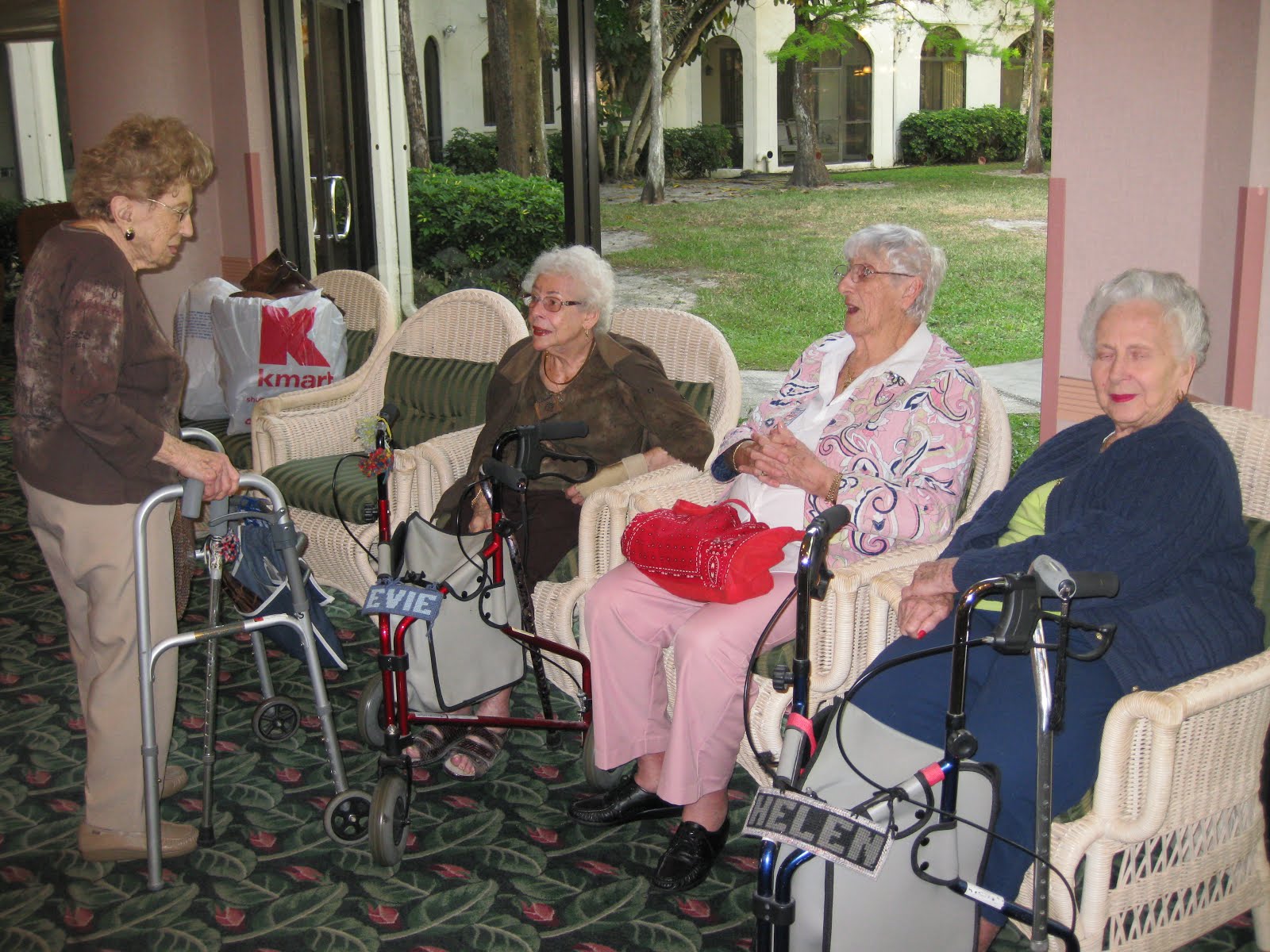
The Ladies of Forest Trace (Mom Standing)

Labels: , , , , , , , , , , , ,

Monday, October 10, 2016

October 10, 2016--Bar Mitzvah Boy

I'm taking a day off from Trump-Clinton 24/7.

*  *  *
So--
Even casual readers of Behind know my mother died last year at 107 plus three days. I am sure I am deluding myself when I think I can equal or outdo that. But 110 or more feels within reach.

I know . . .

But, when I read that Yisrael Kristal waited 100 years before being bar mitvahed at 113, since I also have not been ritualistically admitted to the Jewish version of adulthood (that lack I have been told is obvious), I thought there was no rush to find a rabbi willing to take on someone incorrigibly like me if I want to fill that gap in my Jewish resumé.

But then I read, also in the New York Times, that new studies of aging are coming to conclude that 115 years is looking like the ceiling for human life expectancy. Some, including me, have been thinking that with modern medicine there is no limit to how old we can get. What kind of life one would have at 130 is another matter.

A little thrown off my pins by these findings, I did a little quick calculating and, considering my age, I thought I had better get on with my Torah training if I want to be alive for the blessed event. I also thought to turn to Mr. Kristal's life story to guide me.

His life turns out to be so unique, so incredible that I can barely find anything specific to steer me but inspiration.

At 113, the world's oldest man according to the Guiness Book of World Records, he was born in 1903 in the small Polish village of Malenie--as it turns out not far from where my mother was born just five years later. Since World War I was raging when he was 13 he could not be Bar Mitzvahed at the traditional age.

After the war, with an uncle, he moved to Lodz and opened a candy store. In 1939 Lodz was overrun by the Nazis and his wife and two small children were killed. Five years later, with his second wife he was sent to Auschwitz and somehow managed to survive, the only member of his extended family to do so. When the camp was liberated he weighed just 82 pounds.

He emigrated to Israel, married, and raised another family. He now has two surviving children, nine grandchildren, and 30 great-grandchildren. Most of them were at his Bar Mitzvah. He is reported by them to retain most of his capacities.

Looking around at the family who gathered for his bar mitzvah, one of his granddaughters said, "All these people from one person. Imagine how many rooms could be filled if six million had lived."

His daughter, Kristal Kuperstoch say her father has prayed every morning for the past 100 years and attributed his longevity to that and his diet--he eats modestly but when he does, almost every day, he has a helping of pickled herring. Until his late 80s he also had a taste for wine and beer.

The herring and beer sound pretty good to me.

Bar Mitzvah Boy Yisrael Kristal

Labels: , , , , , , , , ,

Tuesday, June 24, 2014

June 24, 2014--Cousin Henry-Hank-Henri

Cousin Hank ran out of lives on Sunday and his funeral is this morning.

He faced death so many times, including over the years being placed in hospice care but then reviving, that we came to take for granted every time he was sent to the ICU that this was just another example of Hank being Henry.

When he first joined the family, marrying Cousin Nina, he was introduced to us as Hank, a familiar form of his real name, Henry. But years later, when I came to know he was in fact Henri, these name variations made perfect sense. They were just another iteration of Jewish immigrant life--get anglicized so one could try to "pass," avoid quotas, maybe get into college, attempt to slip through life unscathed, and, if possible, eek out some measure of happiness.

Henry-Hank-Henri managed to achieve all of this while growing more in love with Nina over nearly 65 years.

To me, coming of age in post-World War Two Brooklyn, he was the only family exotic.

There were members of the family who came from Europe--my mother included--but they were Middle-European shtetl Jews, and we lived in a neighborhood among so many others that neither their Yiddishkeit, foods, customs, nor consciousness seemed out of the ordinary. Indeed, they and the lives they led were the ordinary.

Henry-Hank-Henri was to me anything but ordinary.

His English was German inflected, not Polish-Russian-polyglot English. He was from Austria, not an obliterated village "near Warsaw." He drank espresso black, smoked unfiltered French cigarettes, and during the din of family gatherings remained non-judgementally detached, puffing and sipping, taking it all in as if we were the exotics.

For a kid dreaming of getting away, of making something different of my life, I was not thinking about wandering around in the Pale of Settlement searching for my Polish-village roots but wanted something cosmopolitan. Not that I at the time knew what cosmopolitan was, but Henry-Hank-Henri had the aura of that difference and I spent a lot of time studying him.

Secretly, I tried black coffee (hated it) and, with candy cigarettes, practiced holding them between my second and third fingers as Henri did. I also took to ordering Compari and Soda--or as he would ask for it, "Compari-Soda," as an homage to him.

Sad to say, the last time we were together, for the first time I asked him questions about his earlier life, a life up to then I had only imagined and shaped for my own transgressive purposes.

What he shared did not diminish my own version of his life and genealogy.

He indeed was Henri.

Labels: , , , , , , , , ,

Wednesday, January 01, 2014

January 1, 2014--My Father's Son

There is a story my Aunt Madeline took delight in telling. It was about something that happened twenty years after her brother, my father and my mother retired and moved to Florida.

Every six months Madeline would call to tell it to me yet one more time. I enjoyed hearing it again and again and took pleasure in her unrestrained joy when she recounting it.
You remember your cousin Irving? The dentist from Jersey City? He called all excited to tell me about something that happened on a visit to New York City.
"You'll never guess who I saw," he said.
"Who?" I asked.
"Your brother. David." 
"Where?" I asked, very confused. "Were you in Florida?" 
"Like I told you," Irving said, "I was in the city." 
"New York City?" 
"Yes." 
"That can't be," I told him, "He's lived in Florida. For twenty years."
"Maybe he's here for a visit." 
"I would know it if he was here. He's not here." I could hear he was becoming annoyed with me. 
"But," Cousin Irving insisted, "I saw him. In Greenwich Village. Walking along the park."
"You're wrong!" I yelled at him. You know me, I'm not shy about expressing my opinions.
"Well, I did see him in New York. And you know what's most amazing? I haven't run into him in more than twenty years, right?"
"Whatever you say," I said. "But," to humor him, I asked, "What's so amazing?" 
"Though I haven't seen him in twenty years, he looks exactly the same."
Aunt Madeline and I always laughed at this because, as she told him, "You didn't see Dave, you saw his son Steven who lives in the Village and looks just like him. I mean, he looks like how Dave looked twenty years ago."

Madeline long ago departed but I was reminded of this story the other day when I caught an unexpected image of myself reflected in a store window on Sixth Avenue. What struck me was that after twenty years, I now look just like my father did the year before he died.

Then about three years ago, visiting my 103-year-old mother, as she is inclined to do these days, we were talking about the past. It was and is for her the most vibrant time of her life.

She suggested we look at old family photographs. This gives her great pleasure. She has them loose in neatly-labelled boxes, not arranged in chronological albums. So a formal picture of her parents as bride and groom in late 19th century Poland is as likely to be found among photos from Passover dinner five years ago, or of me as a six-year-old, or Cousin Chuck at 12 on Brighton Beach showing off his Charles-Atlas-toned body.

Falling out of the box was a picture of a bearded, patriarchal figure clearly from the Old Country. "Who is that?" Rona asked. "I don't remember seeing him before."

"I don't know," my mother said, testing her memory. "He looks familiar, but . . ." I could sense her becoming frustrated at what she took as more evidence of her decline.

"I think maybe it's your father's uncle. He was a very learned man. Almost a rabbi."

"One thing, though," Rona said, "He looks just like Dad did."

"And Steven," my mother said, smiling at me.

Indeed he did, I thought. Not a surprise, but--

Last winter, two years later, we were back in Florida, again in my mother's living room, again listening to her stories from the Old Days, and again going through fading photographs.

On my lap I had the same box in which there were pictures of adolescent Chuck and her parents' wedding portrait.

"Let me take another look at Steven's great-great Uncle," Rona asked. "The one who looks so much like dad."

"And Steven," my mother recalled, with her cognitive powers intact.

"Where is it?" I asked, rummaging among the pictures of past Passovers and cousins' weddings and bar mitzvahs. "I'm sure it was in this box two years ago."

"How could it be missing?" Rona said, beginning to get annoyed at my inability to find it. I suspected wondering about the state of my own decline.

"Here. You look." I thrust the box over to Rona, who was curled up on the sofa.

Systematically she took each of the dozens of photographs out of the box and, while she was searching, stacked them in what appeared to be some kind of order.

"I can't seem to find them either," she confessed. "Whatever could have happened to them?"

"It's happening to everything here," my mother said. "Nothing is not where it's supposed to be. And everything is missing."

"No, it's not Mom," I said, reaching across to take her hand. "Everything is still in place. You're very careful about that. The apartment is perfect." And indeed it is.

Mystified, Rona put the newly-organized photos back in the box. "It's the strangest thing," she said to herself.

I  thought--are we losing the past? My father. Aunt Madeline. Cousin Chuck. My great-great uncle. The list is lengthening.

That's what time does, I rued. The circle is closing. Would I be next?

After a moment of sadness, I consoled myself by recalling that the image in the Sixth Avenue store window where I caught a glimpse of myself looking like my father did a year before he died was fully two years ago.

Labels: , , , , , , , , , ,