June 1, 2015--Remapping
Over breakfast at Balthazar late last week with a well-travelled friend, despite our attempt to be optimistic about things, he couldn't resist asking what I thought was happening in the Middle East.
"You need to bring that up while I'm still enjoying my scone?" I said as playfully as I could.
"Well, in fact there may be things to feel good about."
"Really?" I was skeptical.
"Put in perspective."
"In perspective?" I was still skeptical.
"Very long term perspective."
"Again, really? How does that work?"
"Maybe what's happening has to happen. If we think about the long sweep of history, I mean."
Beginning to get was he was suggesting, I said, "I guess you could push me to make a very-guardedly optimistic case for the region if you gave me maybe a 100-year time frame to project things onto."
"Look," he said, "I'm British and am old enough to have seen massive changes in our position in the world. I had family members who worked for the Colonial Service in South Asia. When India was in effect a British colony. Some of of the change was bloody others more peaceful."
"More than 'in effect,'" I said. "Look, you're as old as I am--and that's pretty old--and though I don't remember from personal history about the changes in your empire as the result of the American Revolution, they were profound."
"Very amusing," he said, "The very old business."
"The results of the Revolution changed the map for a large part of the Western Hemisphere. And led to even more change when France made its Louisiana Territory available for purchase."
"And later you follows grabbed from Mexico a large part of what is now the American West. California very much included."
"Yes as a result of the Mexican War during the 1840s and don't forget ten years or so after that the Gadsden Purchase which allowed us to flesh out our southwestern border. And then later still there was the bargain-basement purchase from Russia of Alaska."
"So project onto that what is going on right now in the Middle East."
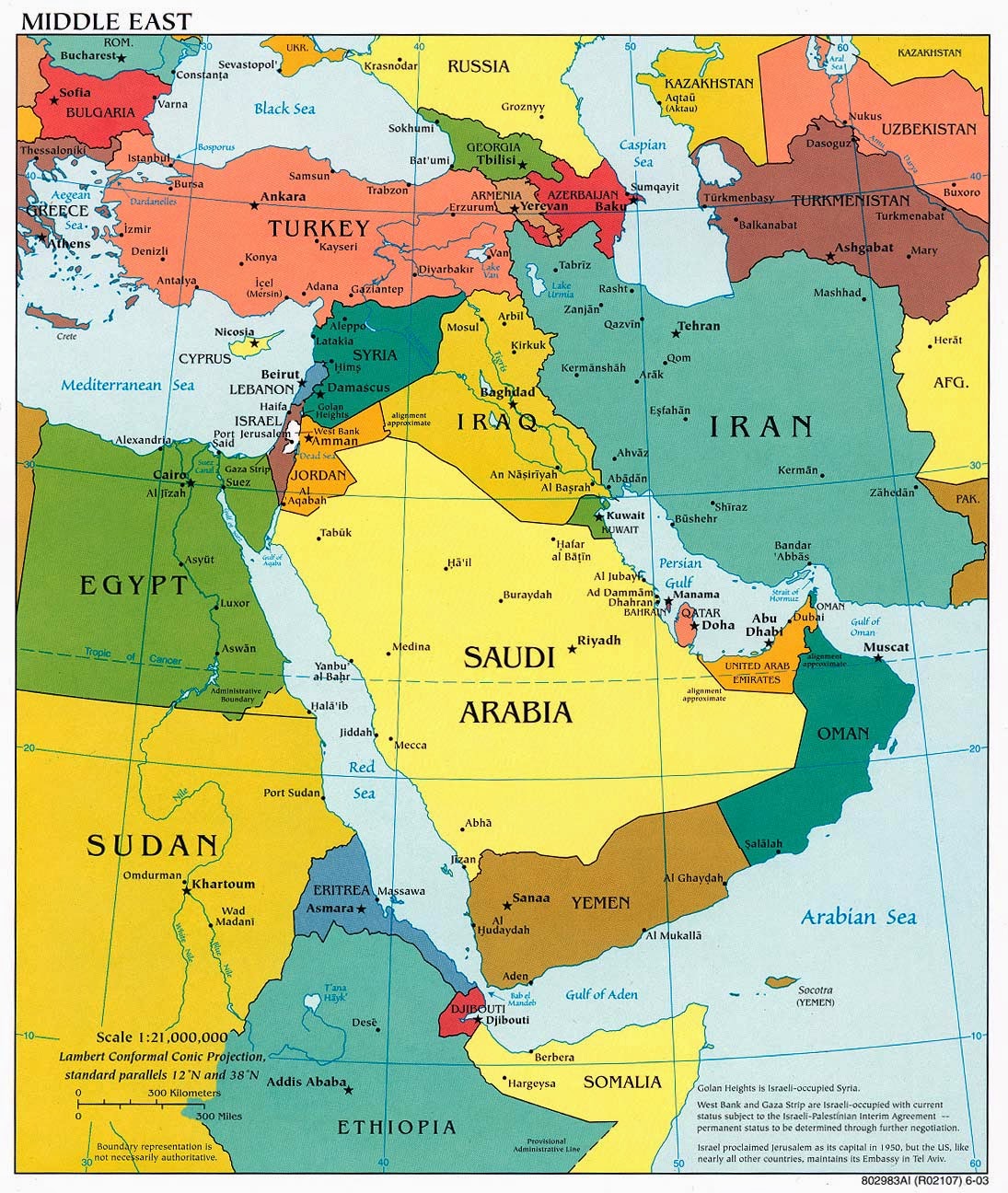
"For some years I've been thinking about that and writing about it on my blog--how if one looks at the map of the current Middle East, Africa, and parts of Asia for that matter, we see the remnants of big-power colonial domination and the national borders that were imposed on Arab people, as well as Persians, Jews, Turks, and others after, for example, the First World War. Newly constituted or created countries that still exist. On paper at least. Countries without borders that take history or culture or religion into consideration. So, once the colonial powers backed off--and that includes us in the U.S.--things began to unravel."
"That's an understatement," my friend said.
"So perhaps what we're seeing is a remapping. Is that your optimistic scenario?"
"For me as well very-guardedly optimistic. Yes. That's what I'm thinking."
"I've been thinking and saying that too. How what we are seeing is an assertion on the ground of various Islamic factions seeking violently to settle scores and slough off the boundaries that they have been forced to live with by the Western powers. Borders that ignored culture. And, through the support and cynical use of dictators such as Saddam Hussein, the Shah of Iran, and the Saudi royal family, among others, attempted to tamp down and contain nationalistic strivings and the natural forces of history."
"So in your remapping scenario," my British friend said, sipping his morning tea, "you agree that this is something that has to happen? That's inevitable?"
"Yes. In history, there has been a lot of remapping. That which is the result of warfare where the victors impose new boundaries. The American, French, and Russian Revolutions are examples as is the fall of the Ottoman Empire during World War I."
"Other examples are the result of the invasions of exploding empires--the Roman Empire and Islamic Caliphate that dominated most of north Africa and western Europe. And of course our British Empire. The one where the sun never set."
"We could go on. The point being that what gets left behind or imposed as the result of these powerfully aggressive movements result in unnatural affiliations where people of very different backgrounds are forced to think about themselves as Iraqis or Syrians or Libyans. Big picture--there is no such thing as an Iraqi. Nationalities of this kind have been constructed by conquerers. This goes against the history of these peoples where they think about themselves as Sunnis or Shia or Kurds, not Iraqis. And as a result, what we have wrought are powder kegs throughout the region waiting for some spark to ignite them. And we're seeing those sparks all over the world. Very much including the emergence of ISIS."
"Thus my optimistic thought," my friend said. "As I said, perhaps there has to be this movement toward the reestablishment of cultural borders. Maybe even a few that are fluid since some of the people who live in the region are nomadic. Also, in some cases this may not even involve the concept of 'country' or 'nation.' And this of course doesn't mean that peace will break out. There will still be disputes and incursions but hopefully not at the level of all-out warfare."
"Sounds good to me, though, if you're right, I won't be around to see it."
"There you go again about being old. In the meantime, can I treat you to another cup of coffee and maybe some toast?"

"You need to bring that up while I'm still enjoying my scone?" I said as playfully as I could.
"Well, in fact there may be things to feel good about."
"Really?" I was skeptical.
"Put in perspective."
"In perspective?" I was still skeptical.
"Very long term perspective."
"Again, really? How does that work?"
"Maybe what's happening has to happen. If we think about the long sweep of history, I mean."
Beginning to get was he was suggesting, I said, "I guess you could push me to make a very-guardedly optimistic case for the region if you gave me maybe a 100-year time frame to project things onto."
"Look," he said, "I'm British and am old enough to have seen massive changes in our position in the world. I had family members who worked for the Colonial Service in South Asia. When India was in effect a British colony. Some of of the change was bloody others more peaceful."
"More than 'in effect,'" I said. "Look, you're as old as I am--and that's pretty old--and though I don't remember from personal history about the changes in your empire as the result of the American Revolution, they were profound."
"Very amusing," he said, "The very old business."
"The results of the Revolution changed the map for a large part of the Western Hemisphere. And led to even more change when France made its Louisiana Territory available for purchase."
"And later you follows grabbed from Mexico a large part of what is now the American West. California very much included."
"Yes as a result of the Mexican War during the 1840s and don't forget ten years or so after that the Gadsden Purchase which allowed us to flesh out our southwestern border. And then later still there was the bargain-basement purchase from Russia of Alaska."
"So project onto that what is going on right now in the Middle East."
"For some years I've been thinking about that and writing about it on my blog--how if one looks at the map of the current Middle East, Africa, and parts of Asia for that matter, we see the remnants of big-power colonial domination and the national borders that were imposed on Arab people, as well as Persians, Jews, Turks, and others after, for example, the First World War. Newly constituted or created countries that still exist. On paper at least. Countries without borders that take history or culture or religion into consideration. So, once the colonial powers backed off--and that includes us in the U.S.--things began to unravel."
"That's an understatement," my friend said.
"So perhaps what we're seeing is a remapping. Is that your optimistic scenario?"
"For me as well very-guardedly optimistic. Yes. That's what I'm thinking."
"I've been thinking and saying that too. How what we are seeing is an assertion on the ground of various Islamic factions seeking violently to settle scores and slough off the boundaries that they have been forced to live with by the Western powers. Borders that ignored culture. And, through the support and cynical use of dictators such as Saddam Hussein, the Shah of Iran, and the Saudi royal family, among others, attempted to tamp down and contain nationalistic strivings and the natural forces of history."
"So in your remapping scenario," my British friend said, sipping his morning tea, "you agree that this is something that has to happen? That's inevitable?"
"Yes. In history, there has been a lot of remapping. That which is the result of warfare where the victors impose new boundaries. The American, French, and Russian Revolutions are examples as is the fall of the Ottoman Empire during World War I."
"Other examples are the result of the invasions of exploding empires--the Roman Empire and Islamic Caliphate that dominated most of north Africa and western Europe. And of course our British Empire. The one where the sun never set."
"We could go on. The point being that what gets left behind or imposed as the result of these powerfully aggressive movements result in unnatural affiliations where people of very different backgrounds are forced to think about themselves as Iraqis or Syrians or Libyans. Big picture--there is no such thing as an Iraqi. Nationalities of this kind have been constructed by conquerers. This goes against the history of these peoples where they think about themselves as Sunnis or Shia or Kurds, not Iraqis. And as a result, what we have wrought are powder kegs throughout the region waiting for some spark to ignite them. And we're seeing those sparks all over the world. Very much including the emergence of ISIS."
"Thus my optimistic thought," my friend said. "As I said, perhaps there has to be this movement toward the reestablishment of cultural borders. Maybe even a few that are fluid since some of the people who live in the region are nomadic. Also, in some cases this may not even involve the concept of 'country' or 'nation.' And this of course doesn't mean that peace will break out. There will still be disputes and incursions but hopefully not at the level of all-out warfare."
"Sounds good to me, though, if you're right, I won't be around to see it."
"There you go again about being old. In the meantime, can I treat you to another cup of coffee and maybe some toast?"
Labels: British Empire, Caliphate, Iran, Iraq, ISIS, Libya, Middle East, Ottoman Empire, Persia, Saudi Arabia, Syria, World War I
posted by Steven Zwerling at
5:31 AM
0 Comments