Wednesday, April 11, 2018

April 11, 2018--Anti-Intellectualism

In my frustrating attempts to understand the America in which we are living, I suppose Donald Trump's America, struggling to understand why at least 35 percent of Americans support him with enthusiasm, no matter what he says or does, no matter how much he lies and makes a mockery of civility and shreds our traditional ways of conducting ourselves domestically and in the world, I turned again to one of my college professor's, Richard Hofstadter's, most enduring works--Anti-Intellectualism In American Life.

In it he argues that anti-intellectualism is one of the unintended consequences of the expansion of pubic education and the resulting democratization of knowledge. He sees this woven into our cultural fabric, one result of our evangelical Protestant heritage that valued belief more than intellectual rigor.

No wonder that after Trump was elected sales of Anti-Intellectualism briefly became a bestseller. It should be required reading. I know, you want me to say, "Assuming his 35 percent read!"

Reading through it again, I came upon this from the chapter, "The Rise of the Expert." How many in the public had become disenchanted with President Woodrow Wilson's inability at the end of the First World War to take progressive action and how, as a result, during the mid 1930s, President Franklin Roosevelt was careful not to overpromise or include too many "experts" in his cabinet or to lead newly enacted social programs.

"Keep the whole thing pretty quiet," he counseled one member of his Brain Trust. Hofstadter wrote--
The public had turned on the intellectuals as the prophets of false and needless reforms. As architects of the administrative state, as supporters of the War, even as ur-Bolsheviks; the intellectuals [had] turned on America as a nation of boobs, Babbits, and fanatics.
Rings familiar. 

And here I thought pseudo-intellectual Steve Bannon and his alt-right minions came up with this business about the administrative state on their own. Now I realize his and their ideas are not only half baked but also not original.


Richard Hofstadter

Labels: , , , , , ,

Wednesday, April 05, 2017

April 5, 2017--25th Amendment

Monday on Morning Joe, Joe and Mika reviewed the storm of tweets that poured forth on Saturday and Sunday from Donald Trump.

They were clearly dismayed.

Usually, Trump's weekend tweets appear only on Saturday mornings when his family handlers, daughter Ivanka and son-in-law Jared Kushner, practicing Jews, are observing Shabbas. On that day orthodox Jews are forbidden to work and this even includes turning on electrial devices such as stoves, TVs, and smart phones.

Knowing this, it is during this window when he is not under surveillance that Trump as the bad boy he is is at his most uncensored and outrageous. But he goes silent when Ivanka and Jared are again wired up or, if he does tweet any more, knowing they are monitoring him, he is more restrained.

But last weekend, perhaps in part because Jared as quasi Secretary of State was secretly flying off for a visit to Iraq, he published perhaps a dozen tweets. As Joe and Mika reviewed them on air, their dismay turned to horror.

"Who is this person?" Joe asked rhetorically, "I thought we knew him." Mika shrugged and smiled. They thought they knew him from more than a year of having him as a constant presence on their program. He would call in most mornings and they would keep him talking often for up to a commercial-free hour. They rode his wave of popularity as he rode theirs. His poll numbers rose as did their ratings. More viewers tuned into Morning Joe than all other cable shows other than the preposterous and inane Fox & Friends.

An early Saturday morning tweet asked--
When will Sleepy Eyes Chuck Todd and @NBCNews start talking about the Obama SURVEILLANCE SCANDAL and stop with the Fake Trump/Russian story?
Not exactly a haiku. And, as Joe and Mika noted, the more things capitalized the more agitated the Commander in Chief.

Then they pointed out, "Sleepy Eyes" is not one of Trump's best sobriquets. It doesn't compare with "Crooked Hillary," "Little Marco," "Lyin' Ted," or for Elisabeth Warren, "Pocahontas."

Another email, a non sequitur asked--
It is the same Fake News Media that said there is "no path to victory for Trump" that is now pushing the phony Russia story. A total scam!
And, still obsessed with Hillary (he can't get over the fact that she beat him by almost 3.0 million popular votes)--
Did Hillary Clinton ever apologize for receiving answers to the debate? Just asking!
For the uninitiated, the "answers" he referred to are actually questions that CNN reporters prepared to pose to Clinton during one of her debates with Bernie Sanders. They were passed along to her campaign by Donna Brazil who was vice president of the Democratic National Committee and a CNN contributor. She subsequently lost both jobs.

At that point, Mika Brzezinski, in visible pain, as if to herself, mumbled, "24th Amendment."

Joe corrected her, "You mean the 25th."

"You think it's time . . . ?"

"I'm beginning to think maybe . . ."

Having depressed themselves they stared blankly into the camera for what felt like an endless five minutes.

To review--the 25th Amendment, which was ratified in 1967, spells out presidential succession. The amendment was needed since the original Constitution was ambiguous about who would become president if the chief executive died or was otherwise incapacitated. In the original document it was not clear if the Vice President was to be the successor. So that needed straightening out.

Also, there was insufficient guidance about what would happen if the president were alive but disabled by, say, a stroke or mental breakdown and how that would be determined. They took great care about this as the amenders did not want to encourage coup d'etats based on false diagnoses.

It is this latter circumstance that is addressed in Section 4 and was alluded to by Mika and Joe.

In its entirety, it reads--
Section 4. Whenever the Vice President and a majority of either the principal officers of the executive departments [Cabinet members] or of such other body as Congress may by law provide, transmit to the President pro tempore of the Senate and the Speaker of the House of Representatives their written declaration that the President is unable to discharge the powers and duties of his office, the Vice President shall immediately assume the powers and duties of the office as Acting President.
This has never happened, but if the amendment had existed during Woodrow Wilson's presidency, it would not have been possible, when he had a massive stroke early in his second term, for his wife, hiding the extent of his disabilities, for all intents and purposes, to serve as acting president for his remaining three years. Section 4 would have been invoked and the VP would have assumed the presidency.

And during Richard Nixon's final days in office, with the 25th Amendment in place, with the president substantially incapacitated because of the drip, drip, drip of Watergate, because he was so out of rational control, a number of his senior advisers thought seriously about enforcing Section 4.

Though they did not do that, he thankfully resigned, but before he did so, among themselves they agreed to tell the Joint Chiefs of Staff that if Nixon late one night, while reeling and raging from too much alcohol, transmitted the nuclear codes that would send nuclear missiles and bombers on a preemptive strike against the Soviet Union, that they should risk treason and not comply.

We are currently not at that point, perhaps, hopefully, far from it; but Joe and Mika spoke the words of deep concern and none of their guests demurred.

But then, a day or two later, from this current scandal that keeps on giving, we learned about Susan Rice's alleged role in "unmasking" Trump aides and secret meetings with the Russians in the Seychelles prior to the new administration taking office to establish a "back channel" connection between Trump and Putin.

Myself, I prefer Claire Danes and Homeland.

It's only an hour an episode and it's fiction. Though by the day it is feeling more and more like reality.

Claire Danes


Labels: , , , , , , , , , , , , ,

Wednesday, February 03, 2016

February 3, 2016--In the Spirit of Nelson Mandela

The Board of trustees of Amherst College voted last week to retire its traditional mascot--Lord Jeff. Actually, to kill him off.

"Lord Jeff" has been the affectionate name for Lord Jeffery Amherst, a British commander during the French and Indian War. It is after him that the town of Amherst, Massachusetts, is named, and then after the town Amherst College.

This is a critical distinction since protestors want to get rid of just the mascot, not the name of the college itself. In a clever have-it-both-way move, they say that the college's name can remain because it was not named after Sir Jeffrey but after the town of Amherst. And this will mean that the value of an "Amherst" degree will be preserved.

No one ever said that Amherst students don't put first thing first.

Lord Jeffery was a heroic warrior, but he is also known as an advocate of white racism, among other heinous things he arranged for the distribution of smallpox-infected blankets to Indians. As he put it, "to extirpate this execrable race."

As an offshoot to the Black Lives Matter movement, students at some elite colleges have been pressing administers and trustees to eliminate any evidence of racism--current examples but more usually from the past.

At Princeton, for example, student protestors are demanding that white supremacist and former Princeton and U.S. president Woodrow Wilson's name be taken down from various campus facilities and academic programs such as the Woodrow Wilson School of Public and International Affairs.

At Amherst, the focus thus far seems to be on the college's mascot.

Lord Jeff (On the Left)
Not to be outdone, an activated group of students at Oxford University's Oriel College are demanding that statues of Cecil Rhodes be taken down and that all traces of one of its most successful graduates and benefactors be obliterated. Including the most prestigious of academic fellowships, the Rhodes Scholarship. Thus far there have been about 8,000 Rhodes scholars, including Bill Clinton.

After graduating, Rhodes moved to South Africa where he founded the De Beers diamond empire. In the process, it is claimed by a recent doctoral student, Brian Kwoba, that Rhodes was responsible for "stealing land, massacring tens of thousands of black Africans, imposing a regime of unspeakable labor exploitation in the diamond mines, and devising pro-apartheid policies."

All legitimate and serious charges.

But when thinking about Lord Jeff and especially Cecil Rhodes--about what I would recommend--I was reminded of an experience I had in South Africa in 1995, one year after Nelson Mandela had been released from prison and became the country's first feely-elected, black president.

I was a guest at a debate in the SA Parliament about one aspect of the legacy of apartheid. There was a movement among many newly-elected legislators to remove all statuary and portraits of apertheid-era presidents and political and military leaders such as Jan Smuts, Pieter Botha, and Willem de Klerk.

Mandela was present and listened silently for more than an hour as the arguments pro and con were passionately presented. It was clear that a sizable majority were prepared to vote for the removal of these reminders of the ugly past.

At that point President Mandela, still in physical pain from his long captivity, rose slowly from his chair and all members present turned toward him in silence.

Quietly, Mandela presented the case for leaving all the memorials intact.

"They are a part of our history," he said. "One doesn't legislate the elimination of history, no matter how painful. In fact, it is more important to remember the pain and suffering than our recent liberation. So we will never forget."

At first a few and than the overwhelming majority of those present on the floor nodded and murmured in agreement. And as a result, the paintings and statues were left in place. And today, years after Mandela's death they remain where they were originally placed. To assure that over the generations no one forgets.

Jan Smuts

Labels: , , , , , ,

Tuesday, November 24, 2015

November 24, 2015--The Woodrow Wilson Memorial Bridge

There is a move afoot on the campus of Princeton University to take Woodrow Wilson's name off campus facilities  and academic programs such as the residential complex, Wilson College and the prestigious Woodrow Wilson School of Public and International Affairs.

This because Wilson, who served as Princeton's president from 1902 to 1910 before becoming Governor of New Jersey and than the 28th president of the United States, was an unrepentant racist.

Among other things, he said--

To an African-American leader that "segregation is not humiliating, but a benefit, and ought to be so regarded by you."

And, he wrote about "a great Ku Klux Klan," that came into being to rid whites of "the intolerable burden of governments sustained by the votes of ignorant Negroes."

Regarding Princeton itself, during Wilson's tenure as president, no blacks were admitted. But this is only part of the Princeton story--this Ivy institution did not enroll African Americans until 1940, fully 30 years after Wilson stepped down as president. So there is a lot to criticize and atone for.

As a footnote, Jews were not welcomed until about the same time and even in my day, under pressure from my father who was prestige- and assimilation-oriented, I applied and was somehow admitted. I was subsequently told by a prominent alum that there were no eating clubs on campus that welcomed Jews and so, if he had advice to offer, I should . . .

Which I did and went to Columbia instead, which by then, having shed its Jewish quota, begrudgingly admitted and made sort of welcome my kind.

So I can understand the pressure minority Princeton students are putting on the administration to take down Wilson's name. In a throwback to the 1960s, to get their way, a group last week occupied the president's office.

The faculty now has promised to consider these demands and, knowing faculty as I so well do, I feel certain the outcome is inevitable.

The Princeton situation may turn out to be just prologue.

Looking at the history of American presidents who proceeded Wilson, fully 12 of them were more than racist--they owned slaves.

George Washington owned 250-350, Jefferson 200 (including Sally Hemmings), Madison more than 100, Monroe 75, Jackson about 200, Van Buren "just" one, Tyler 70, Polk 25, Taylor 150, Johnson (Lincoln's vice president) 8, and Grant (Lincoln's favorite general) enslaved 5.

If Wilson's name is to come off one of Princeton's student residence halls, shouldn't we also change the name of the Woodrow Wilson Memorial Bridge that crosses the Potomac outside Washington, DC? And what about the 13 American cities named for Jefferson? Or the names of James Madison University and Madison, Wisconsin?

What about those 21 counties in as many states named for Andrew Jackson, who, recall, owned about 200 slaves?

And then there is our nation's Capitol itself. It is named for our first president who owned at least 250 human beings. Is this acceptable with today's racial consciousness?

What then might be a politically correct new name for Washington? There is also a movement there to change the name of their football team--from the Redskins to . . .?

I welcome suggestions.


Labels: , , , , , , , , , ,

Monday, February 23, 2015

February 23, 2015--Lines In the Sand

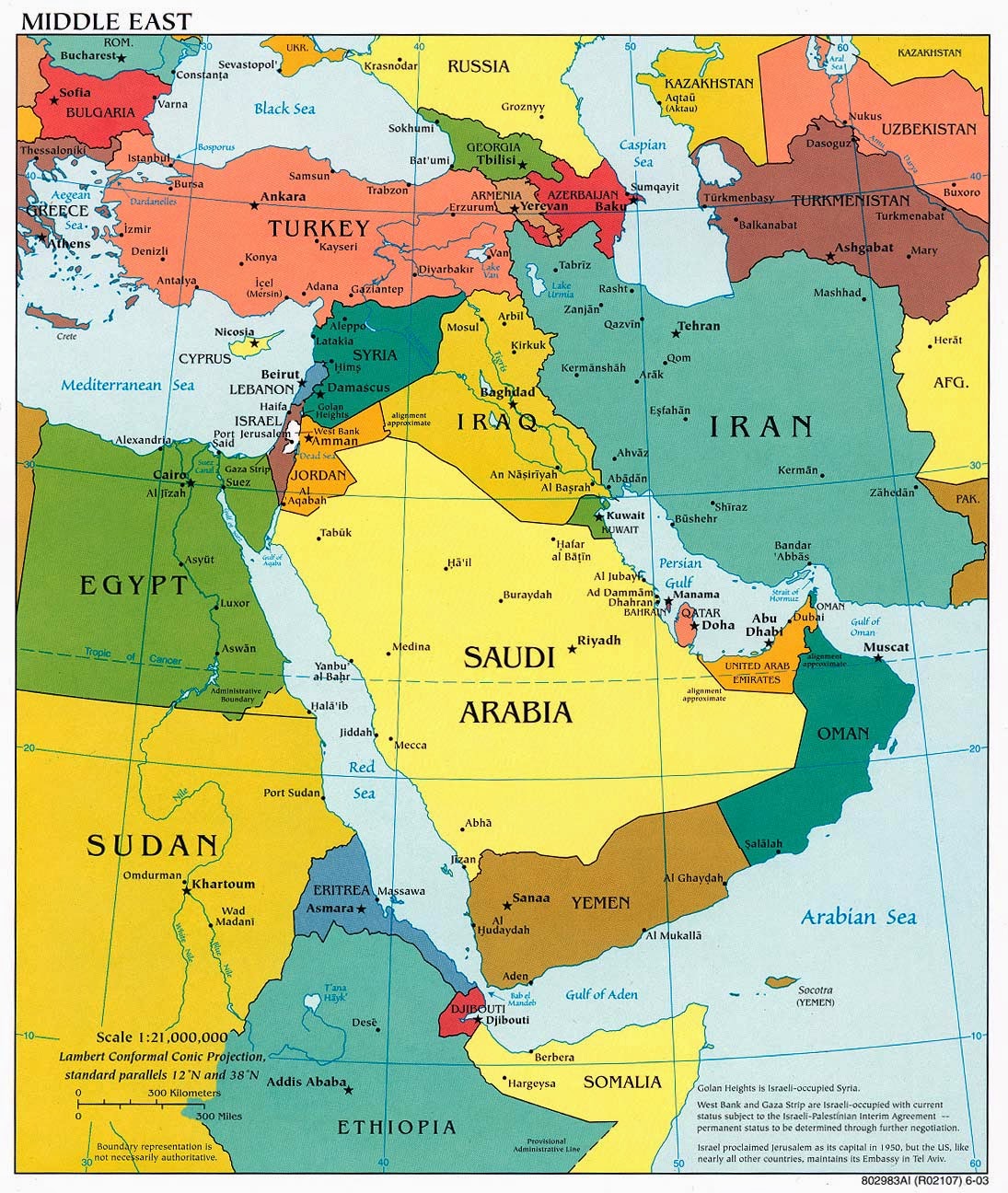
At the end of the First World War, a territorial plan devised by Sir Mark Sykes of Great Britain and Francois Georges-Picot of France established spheres of influence in the Middle East for the victorious European powers. Some compared this to drawing lines in the sand.

Prior to the War, most parts of the region were under the control of the Ottoman Empire. This included all of present-day Turkey, much of North Africa, and virtually all of the Middle East with the notable exceptions of Arabia, today's Saudi Arabia, and Persia, today's Iran.

The Syke's-Picot secret agreement became the blueprint for the dismemberment of the Ottoman Empire after its defeat in the War-to-End-All-Wars. The Great Powers, particularly France and Britain, with the assent of Russia, carved up the former Ottoman territory, creating modern Turkey and the countries that make up the contemporary Middle East, and assigned to themselves mandates and colonial oversight for what became Iraq, Jordan, Syria, and Palestine among other newly established countries.

(The U.S. President Woodrow Wilson was more interested in the establishment of the League of Nations and so effectively kept hands off as the region was carved up and parceled out.)


Based on Sykes-Picot, the Treaty of Paris assigned the blue regions to French authority, the red to British, and the green to Russian.

The more delineated map of the Middle East which was derived from the Sykes-Picot accord is the one we live with today. Take special note of those countries that were assigned straight-line borders. It is particularly revealing that some of the countries that are most in turmoil and include restive populations,  jihadists, and other groups of terrorists, are those with these kind of linear borders that do not take geography, culture, or religion into consideration--Syria, Sudan, Egypt, Yemen, Lebanon, Jordan, Iraq, and of course Israel.

Thus, "Iraq" should probably be deconstructed into at least three countries with cultural borders, including Kurdistan, and "Libya" into at least that many. The region, and the world would be much more peaceful if those who met in Paris in 1919 would have established borders that took history, religion, and tribal identity into consideration.


One might counter that there are straight line borders in the United States. Many. In fact, two of our states are virtual rectangles (Colorado and Wyoming), and four meet at the Four Corners (Colorado, Utah, Arizona, and New Mexico), but with the exception of the genocidal  example of what we did to our Native populations, territories that became states were not that culturally diverse and applied for statehood, staking out and suggesting their own borders. These borders for the most part were as viable as others that used rivers and mountain ranges as natural ways to divide and assign territory.


Labels: , , , , , , , , , , , , ,

Monday, October 07, 2013

October 7, 2013--Peacemakers, 1919

If you've been following this, you know about my obsession with geography.

Specifically, how leaders of the great powers at the end of the First World War redrew the map of the world and, ignoring history, religion, culture, and tradition, created more new countries than any tyrant or conqueror at any previous time in history.

And, you know, this has not been just an idle curiosity of mine, but grows out of an interest in the contemporary world and the problems the leaders of England, France, Italy, and the United States in 1919 bequeathed to us.

Also, I have been commenting here how that map is now in an accelerated way being undone, redrawn by seeming chaos in the Middle East, Africa, Asia Minor and even in some parts of South and Southeast Asia.

I was reminded again about this ongoing interest and the consequences while reading A. Scott Berg's recent, rather decent biography of Woodrow Wilson, Wilson.

Wilson, obsessed by the notion of a League of Nations, which he envisioned giving voice to and representing the interests of peoples whose national aspirations had been subsumed by the colonial reach of England, France, Italy, and Japan, a League of all countries that would stand for self-determination and the protection of human rights for all peoples worldwide.

He was thwarted by partisan politics back in the United States where Congress never voted to endorse the League and, as a result, as Wilson foresaw, the world inexorably drifted toward a second cataclysmic world war.

In Wilson there is a vivid picture of how the leaders of the Big Four powers in Paris in 1919 literally redrew the map of much of the world, insensitive to issues of culture, history, and national aspiration, focusing instead on their own geopolitical territorial self-interest.

Prime Ministers Georges Clemenceau of France, Lloyd George of England, Vittorio Orlando of Italy, and American President Woodrow Wilson.

Here from Berg--

The Big Four often worked from a map in the [French] President's room, one too large for any table to accommodate. Whenever it was needed, they spread it on the floor. One morning Dr. Grayson [Wilson's personal physician] entered the salon, only to find the four most powerful men in the world on their hands and knees, studying the chart. "It had every appearance," noted Grayson, "of four boys playing some kind of game." 
In the spring of 1919, that quadrumvirate on the floor erased more boundaries and created more new nations than had ever been drawn at a single time. And whenever Clemenceau and Lloyd George fell into another argument, scrapping over patches of Asia Minor, Wilson reminded them that they were engaged in the "bargaining away of peoples. . ."  
While the United States had no direct interest in most of the territorial settlements, Wilson continued to involve himself as the others tore at the Habsberg Empire. Austria and Hungary (then in the midst of a series of revolutions) would be divided into two separate landlocked countries, neither of which would ever be powerful enough to rise to any significant stature. The Treaty sanctioned a union of Czechs and Slovaks into a sovereign independent state. Similarly, the Independent Kingdoms of Serbia and Montenegro joined the State of Slovenes, Croats, and Serbs as well as much of Dalmatia and Bosnia and Herzgovina to form Yugoslavia. Parts of the Habsburg Empire--Bessarabia, Bukovina, and Transylvania--joined the Kingdom of Romania. 
The Ottoman Empire offered a map with more blank space on which to draw. Out of secret treaties and mandates and assurances to Arab leaders, new nations would be built in the sand. They proved problematic because they too bundled diversified populations, often with ancient ethnic and religious differences. Tensions naturally rose in the area as each of these disparate peoples sought self-government and independence while they were in conflict among themselves and well as with their mandatories.

Four boys playing some kind of game, indeed.

Labels: , , , , , , , , , , , , , ,

Friday, August 16, 2013

August 16, 2013--Arab Winter

Fridays in August should be times for languor and light spiritedness. Pass by this then if you want to protect your tranquility, but I cannot resist saying a few words about the escalating crises in the Middle East.

With a state of emergency declared in Egypt--after hundreds there were slaughtered by the military in an attempt to take the country back from the democratically-elected leadership of the Muslim Brotherhood--with continued unrest in Bahrain; democracy under threat in Tunisia, Iraq, Libya, and possibly even Turkey; and an all-out civil war raging in Syria, what ever became of the hope engendered by the Arab Spring that commenced in Tunisia more than two years ago?  The hope that authoritarian leaders from Muammar al-Gaddafi in Libya to Hosni Mubarak in Egypt would topple one-by-one and liberal democracies would take their places?


Isn't this what Barack Obama early in his presidency in a speech in Cairo saw to be the strategic opportunity in the region? And wasn't it for this that he was awarded a preemptive Nobel Peace Prize?

But now we have this--a tectonic nightmare of old authoritarian regimes overthrown and supplanted by radical leaders, many of whom either have ties to al Qaeda or tolerate their presence. Who foresaw that this would be the last gasp of 19th century colonialism and the dawn of a complicated new day in the Muslim world? 

Actually, many did who knew anything about the history of the Arab lands and the contesting forces active in every country throughout the region.

Does anyone doubt that events in Egypt will lead to a civil war there at least as ugly as the one underway in Syria? With the military government so casual about murdering hundreds of protesters isn't it inevitable that this will not suppress the opponents of military rule but motivate and inspire them to become more aggressive, ultimately take up arms, and prevail?

Is there any doubt that at some point in the not distant future we will see similar situations in Jordan and even Saudi Arabia where corrupt monarchies currently rule?

Then what we will have? A region in full turmoil with access to oil severely restricted. What will then be the consequences for the global economy? 

The ideals espoused by Woodrow Wilson, Franklin Roosevelt, George W. Bush, and Barack Obama in historical perspective look naive. 

Not everyone wants a government similar to ours (in fact, a majority of Americans themselves aren't too happy with the state of our own current government), not every country (especially those with arbitrary borders drawn up by the West after the First World War) is culturally set up to embrace democracy. And when they do fight for and achieve the right to vote--with our endorsement--they elect leaders from Hamas, Hezbollah, and the Muslim Brotherhood. 

This is just another sad example of unintended consequences, of the danger of getting what one wishes for.

Labels: , , , , , , , , , , , , , , , ,