Tuesday, November 13, 2018

November 13, 2018--Pour It On Mr. President

I know this sounds counterintuitive but I welcome the appointment of Matt (The Hulk) Whittaker to be acting attorney general.

I love the idea that he is totally unqualified to hold that office for even a day. I love the fact that he is somehow implicated in a scheme to defraud clients who were paying a company for which he was an official a fee to secure patents they never received. (Sound familiar?) I especially love that he has been a flunky for Trump for at least two years and seems eager to do his bidding, including and perhaps especially shutting down the Mueller investigation. 

I love this since even firing the special counsel will not thwart the investigation, only further sully Whitaker and Trump by piling on additional counts of obstruction of justice. With Democrats about to control the House, this guarantees that Mueller's report in one way or another will become public and lead to Trump's impeachment. If the Pentagon Papers leaked out so will the ultimate Mueller report. 

And I love the fact that Trump is in open warfare with journalists, acting like a bully and in the case of black women exposing his deep racism. Wouldn't it be great, I am thinking if he would ban a few more from the White House.

To keep his opposition motivated, the worse the better.

On the international front, I like the way Trump behaved over the weekend in France at the gathering of world leaders to mark the 100th anniversary of the end of the First World War.

It was perfect that he arrived late and left early. (As did his best friend and handler, Vladimir Putin.) Since the gathering was not about him, he saw no purpose in being there and was not shy about letting everyone take note of his petulance. 

I can't tell you, though, how happy I am that he did come to Paris and am overjoyed that he didn't show up for a memorial gathering at a cemetery for American soldiers killed in action, claiming that since it was drizzling he would have to be driven to the site rather than helicoptered in and that it was too foggy even for that.

I suspect that the real reason Trump skipped the ceremony was because if he got wet his orange-dyed face might run. Also, in his twisted cosmology, as a perverse commander-in-chief, he deems men killed in action "losers," not unlike John McCain was a loser because he was captured. He likes only winners such as himself who couldn't hold onto the House of Representatives. 

I do not need to speculate what veterans might be feeling about this draft dodger who didn't serve in Vietnam because he got five deferments and allegedly had a bone spur in one of his feet. But if as a result fewer vets vote for him in 2020, so much the better.

Do not worry that the alliances he is undermining can never be reestablished. Quite the contrary. Our true allies know the problem is Trump, not America nor the American people. Days after he is defeated two years from now French, German, and English leaders will be be on the first flight out to meet with the president-elect to begin the reconciliation process.

The more Trump does things of this kind the better it is. And so I say, bring it on. 

Please Mister President, keep up your outrageous behavior because the more you do things of this kind the more likely it is that you will not be reelected. Keep up the hissy fits and white supremacist talk because the more you behave this way the more likely you lose.

That's the next prize to keep eyes on. We did good work last week in regard to the House and local elections around the country, but that was the intermediate prize. The big one is now teed up.

Acting Attorney General Matt Whitaker
This is my 3,500 blog posting. The first one appeared August 26, 2005.


Labels: , , , , , , , ,

Thursday, June 16, 2016

June 16, 2016--Orlando and Trump's America

In a dark column two days ago in the New York Times, Roger Cohen writes--
Omar Mateen, the Florida shooter who had pledged allegiance to the Islamic State, just ushered Donald Trump to the White House, Britain out of the European Union, Marine Le Pen to the French presidency, and the world into a downward spiral of escalating violence. . .
Like the 19-year-old Bosnian Serb nationalist whose bullets ignited World War I, Mateen has set a spark to a time of inflammable anger.
Cohen continues--
Of course these somber imaginings may prove to be no more than that. But there is no question that the largest mass shooting in American history comes at a time of particular unease. In both the United States and Europe, political and economic frustrations have produced a groundswell against the status quo and an apparent readiness to make a leap in the dark. Washington and Brussels have become bywords for paralysis.
Anyone doubting this only needs to replay the video of President Obama's reaction. He wasn't reading from a teleprompter, but he might as well have been.

After seven and a half years in office and with all the violence from Newtown, Connecticut to San Bernardino, California, he is out of gas. Out of outrage. Out of motivation to one more time prod Congress to do something to control assault weapons. "Paralysis" captures it.

So we're left with Donald Trump to articulate what many Americans feel--enough is enough.

Even if he has no better chance to do anything more than Obama or Hillary Clinton, he is the channel through which so much anger, fear, and rage is being ventilated.

And do we not assume that ISIS and its spawn want Donald Trump to become our president? It would help confirm their heinous anti-Western ideology to have an angry xenophobe as our leader.

So expect additional massacres between now and November. Two or three more and Cohen's dystopian vision may well metastasize into our reality.

Breaking News--Or if Trump strikes a deal with the NRA to ban guns sales to those on the FBI watch list or the government's no-fly list. The NRA seems eager to talk with him about that. It is in each of their own self-interest. Just when you thought . . .

Labels: , , , , , , , , , ,

Thursday, May 26, 2016

May 27, 2016--World War III

In their now daily barrage of anti-Trump articles, the New York Times, on Tuesday finally went all the way--

After helping for months to fuel the belief that a Trump presidency would lead to fascism, one of their columnists, Eduardo Porter, more than implied that if Trump is elected World War III will be one possible result.

In, "We've Seen the Trump Phenomenon Before," he suggests in a subtle way that social and economic conditions are now similar to those that pertained during the years leading up to the outbreak of global warfare in 1914 and 1941. World Wars I and II.

It is worth reading the entire piece, but here is a flavor of the analysis--
Mr. Trump perhaps can best be understood as the face of a broader global dynamic: the resistance to policies that encourage global competition and open borders to people who have lived too long on the losing side. 
The world's "golden age" of globalization around the turn of the 19th century into the 20th was capped by what came to be known as the Great War. [World War I] The discontent bred of the worldwide economic devastation of the 1930s ended in another war. [World War II]
Porter then cites Harold James, an expert on European history at the Woodrow Wilson School of Public and International affairs--
Backlashes against globalization promoted a zero-sum-game: To protect ourselves, we must do so at the expense of somebody else. It increases nationalism and the willingness to go to war.
Connecting these two dots to the current situation (third dot?) where Trump in his heated nationalism and critique of globalization appeals to "his" people who have lived too long on the losing side and are motivated to see in globalization a zero-sum-game that still has them losing to various somebodies. In Trump's view mainly illegal immigrants.

Porter concludes--

"We shouldn't try to stop globalization, even if we could. But if we don't do a better job managing a changing world economy, it seems clear that it will end badly again."

Should I say fro him, "in World War III"?

Labels: , , , , , , , ,

Monday, June 01, 2015

June 1, 2015--Remapping

Over breakfast at Balthazar late last week with a well-travelled friend, despite our attempt to be optimistic about things, he couldn't resist asking what I thought was happening in the Middle East.

"You need to bring that up while I'm still enjoying my scone?" I said as playfully as I could.

"Well, in fact there may be things to feel good about."

"Really?" I was skeptical.

"Put in perspective."

"In perspective?" I was still skeptical.

"Very long term perspective."

"Again, really? How does that work?"

"Maybe what's happening has to happen. If we think about the long sweep of history, I mean."

Beginning to get was he was suggesting, I said, "I guess you could push me to make a very-guardedly optimistic case for the region if you gave me maybe a 100-year time frame to project things onto."

"Look," he said, "I'm British and am old enough to have seen massive changes in our position in the world. I had family members who worked for the Colonial Service in South Asia. When India was in effect a British colony. Some of of the change was bloody others more peaceful."

"More than 'in effect,'" I said. "Look, you're as old as I am--and that's pretty old--and though I don't remember from personal history about the changes in your empire as the result of the American Revolution, they were profound."

"Very amusing," he said, "The  very old business."

"The results of the Revolution changed the map for a large part of the Western Hemisphere. And led to even more change when France made its Louisiana Territory available for purchase."

"And later you follows grabbed from Mexico a large part of what is now the American West. California very much included."

"Yes as a result of the Mexican War during the 1840s and don't forget ten years or so after that the Gadsden Purchase which allowed us to flesh out our southwestern border. And then later still there was the bargain-basement purchase from Russia of Alaska."

"So project onto that what is going on right now in the Middle East."

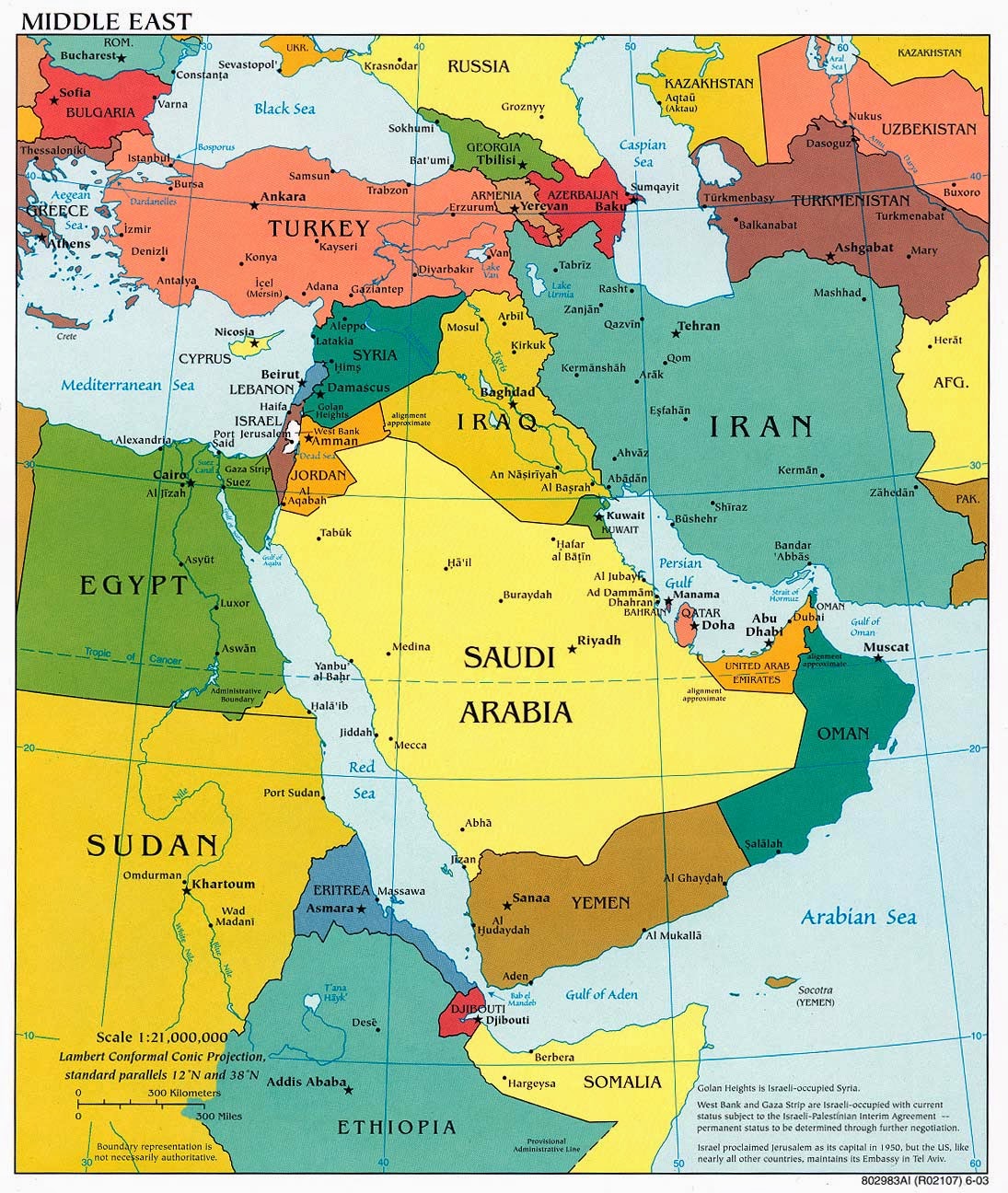
"For some years I've been thinking about that and writing about it on my blog--how if one looks at the map of the current Middle East, Africa, and parts of Asia for that matter, we see the remnants of big-power colonial domination and the national borders that were imposed on Arab people, as well as Persians, Jews, Turks, and others after, for example, the First World War. Newly constituted or created countries that still exist. On paper at least. Countries without borders that take history or culture or religion into consideration. So, once the colonial powers backed off--and that includes us in the U.S.--things began to unravel."

"That's an understatement," my friend said.

"So perhaps what we're seeing is a remapping. Is that your optimistic scenario?"

"For me as well very-guardedly optimistic. Yes. That's what I'm thinking."

"I've been thinking and saying that too. How what we are seeing is an assertion on the ground of various Islamic factions seeking violently to settle scores and slough off the boundaries that they have been forced to live with by the Western powers. Borders that ignored culture. And, through the support and cynical use of dictators such as Saddam Hussein, the Shah of Iran, and the Saudi royal family, among others, attempted to tamp down and contain nationalistic strivings and the natural forces of history."

"So in your remapping scenario," my British friend said, sipping his morning tea, "you agree that this is something that has to happen? That's inevitable?"

"Yes. In history, there has been a lot of remapping. That which is the result of warfare where the victors impose new boundaries. The American, French, and Russian Revolutions are examples as is the fall of the Ottoman Empire during World War I."

"Other examples are the result of the invasions of exploding empires--the Roman Empire and Islamic Caliphate that dominated most of north Africa and western Europe. And of course our British Empire. The one where the sun never set."

"We could go on. The point being that what gets left behind or imposed as the result of these powerfully aggressive movements result in unnatural affiliations where people of very different backgrounds are forced to think about themselves as Iraqis or Syrians or Libyans. Big picture--there is no such thing as an Iraqi. Nationalities of this kind have been constructed by conquerers. This goes against the history of these peoples where they think about themselves as Sunnis or Shia or Kurds, not Iraqis. And as a result, what we have wrought are powder kegs throughout the region waiting for some spark to ignite them. And we're seeing those sparks all over the world. Very much including the emergence of ISIS."

"Thus my optimistic thought," my friend said. "As I said, perhaps there has to be this movement toward the reestablishment of cultural borders. Maybe even a few that are fluid since some of the people who live in the region are nomadic. Also, in some cases this may not even involve the concept of 'country' or 'nation.' And this of course doesn't mean that peace will break out. There will still be disputes and incursions but hopefully not at the level of all-out warfare."

"Sounds good to me, though, if you're right, I won't be around to see it."

"There you go again about being old. In the meantime, can I treat you to another cup of coffee and maybe some toast?"


Labels: , , , , , , , , , , ,

Monday, February 23, 2015

February 23, 2015--Lines In the Sand

At the end of the First World War, a territorial plan devised by Sir Mark Sykes of Great Britain and Francois Georges-Picot of France established spheres of influence in the Middle East for the victorious European powers. Some compared this to drawing lines in the sand.

Prior to the War, most parts of the region were under the control of the Ottoman Empire. This included all of present-day Turkey, much of North Africa, and virtually all of the Middle East with the notable exceptions of Arabia, today's Saudi Arabia, and Persia, today's Iran.

The Syke's-Picot secret agreement became the blueprint for the dismemberment of the Ottoman Empire after its defeat in the War-to-End-All-Wars. The Great Powers, particularly France and Britain, with the assent of Russia, carved up the former Ottoman territory, creating modern Turkey and the countries that make up the contemporary Middle East, and assigned to themselves mandates and colonial oversight for what became Iraq, Jordan, Syria, and Palestine among other newly established countries.

(The U.S. President Woodrow Wilson was more interested in the establishment of the League of Nations and so effectively kept hands off as the region was carved up and parceled out.)


Based on Sykes-Picot, the Treaty of Paris assigned the blue regions to French authority, the red to British, and the green to Russian.

The more delineated map of the Middle East which was derived from the Sykes-Picot accord is the one we live with today. Take special note of those countries that were assigned straight-line borders. It is particularly revealing that some of the countries that are most in turmoil and include restive populations,  jihadists, and other groups of terrorists, are those with these kind of linear borders that do not take geography, culture, or religion into consideration--Syria, Sudan, Egypt, Yemen, Lebanon, Jordan, Iraq, and of course Israel.

Thus, "Iraq" should probably be deconstructed into at least three countries with cultural borders, including Kurdistan, and "Libya" into at least that many. The region, and the world would be much more peaceful if those who met in Paris in 1919 would have established borders that took history, religion, and tribal identity into consideration.


One might counter that there are straight line borders in the United States. Many. In fact, two of our states are virtual rectangles (Colorado and Wyoming), and four meet at the Four Corners (Colorado, Utah, Arizona, and New Mexico), but with the exception of the genocidal  example of what we did to our Native populations, territories that became states were not that culturally diverse and applied for statehood, staking out and suggesting their own borders. These borders for the most part were as viable as others that used rivers and mountain ranges as natural ways to divide and assign territory.


Labels: , , , , , , , , , , , , ,

Friday, February 13, 2015

February 13, 2015--Best of Behind: The Middle East? Hands Off

This seemed pertinent in June 2014 when it originally appeared and feels even more so today as President Obama is asking Congress to retrospectively authorize military strikes against ISIS Islamists and many in the House and Senate are pushing back against what some feel is the next step to our getting more directly involved in Syria and northern Iraq where ISIS poses an existential threat--

As President Obama feels the pressure to provide military assistance to the collapsing regime in Iraq, he and we should step back and review the last 2,500 years of history. Just a few pertinent highlights!

The major lesson is that no outside power, from Alexander the Great of Macedonia to the French and British imperialists, from the Soviet Union and now the United States, no one has been able to impose their will on the region.

All interventions, all attempts to subjugate proud and defiant peoples have failed. And worse--have reverberated back disastrously on the invaders, colonizers, and occupiers.

After 330 BC Alexander never recovered; the British and French colonial powers after the First World War never recovered; the Soviet Union collapsed and never recovered; and the United States lost treasure, power, and influence in the region and I suspect will also not recover.

So what to do now?

The right answer is nothing.

We should get out of the way and allow the people living there figure out their own futures, very much including their own borders.

If we could impose a sane and just plan of our own that would endure, I would consider supporting it. But the long reach of history teaches that any attempt to do so is doomed to fail and, worse, will only make things worse.

Look at the current situation in Iraq. The Sunni jihadists have already overrun a third of the country, a country that was arbitrarily constructed at the end of WW I. From the videos showing ISIS's triumphant advance, while the so-called Iraqi army discards its uniforms and attempts to blend in with the benighted civilian population, we see the invaders already in possession of American military equipment that also was abandoned by the Iraqi army.

This was reminiscent of the experience in Afghanistan where the U.S., still entangled in the Cold War, armed the Mujahideen who were fighting the invading Soviets and, after defeating them (which contributed to the collapse of the Soviet Union), morphed into the Taliban which proceeded to overthrow the Afghan government and then turned its weapons, the ones we supplied, on us when we invaded at the end of 2001. And does anyone doubt that as soon as we finish leaving Afghanistan the Taliban will once again take over?

Sounds like current-day Iraq to me.

Seven years ago, presidential candidate Joe Biden was ridiculed when he said that Iraq should be allowed to devolve into three countries--Shiite in the south, Sunni in the middle, and Turkistan in the north.

He was right.

In fact, he could have advocated similar things for the rest of the region, from at least Tunisia in the west to Afghanistan and Pakistan in the east.

Few of the countries in that geographic span have cultural borders--Iran (formerly Persia) and Egypt are perhaps the exceptions--but rather ones drawn for them by various conquerers and occupiers.

For centuries, for their own strategic and economic purposes, dominant Western powers have attempted to contain and control the essentially tribal people who live in this vast region. Since the end of the Second World War, country-by-country this has been unraveling. And at an accelerated pace for the past four or five years. Recall the Arab Spring of 2010.

The emergence of jihadist and terrorist groups--ISIS is just the most recent example--feels especially threatening to our national interest. But it may be more dangerous to attempt to continue to contain these aspirations and energies than let to them play out.

The genie of various forms of liberation cannot be stuffed back in the bottle. It is much too late for that.

It may be less risky to step back and allow these contesting forces to work things out. We may not like this idea or the potential outcomes; but, in reality, do we realistically have the ability and resources to impose an alternative scenario?

Do we see ourselves intervening on the side of the Shia-dominated government in Iraq allied with Iran's Revolutionary Guard? As unlikely, even as preposterous as this may sound, it is being seriously discussed.

Frightening as that prospect is--very much including the blow to our national ego--it represents another reason to back off. If there is to be fighting, and of course there is and will be, at least it will be focused within the region, internecine, and less directed toward us. That could be truly in our national interest.

Labels: , , , , , , , , , , , ,

Monday, October 20, 2014

October 20, 2014--Operation Hesitation

I am pleased to report that I will now be able to sleep through the night because our current military operation in Iraq-Syria at last has an official name--Operation Inherent Resolve. 

Since Desert Shield (our war with Iraq to expel Saddam's army from Kuwait), Desert Storm (George H.W. Bush's war with Iraq), and Iraqi Freedom (George the Son's preemptive invasion of Iraq to finish the job he felt Daddy left unresolved)--I've been curious why our wars need names.

What's wrong with World War I, World War II, or the Korean War? Did our war in Vietnam have or need a name other than the Vietnam War? These seem descriptive enough.

Yes, various operations in wars since at least WW II had names--Overlord is perhaps best known. It was the code name for the allied invasion of Normandy, culminating on D-Day, June 6, 1944.

In truth the invasion didn't need a code name. Everyone who cared knew forces for a massive invasion were gathering in England. And no one was fooled by wondering what this Overlord was about. The Nazis knew the allies were coming. The most important thing they didn't know was where the cross-Channel invasion would occur, and having a code name didn't do anything to help hide the specifics of the plan. For some reason Eisenhower must have liked the feudal sound of Overlord. Perhaps that's how he regarded himself.

Come to think of it, why was June 6th called D-Day? Wiki says all invasion have d-days with the "d" standing for day or date. Get it? Nothing special.

But in regard to Operation Inherent Resolve, according to the New York Times, for three months the Pentagon has been hassled by the press to come up with a name for the bombings and drone attacks we have been inflicting on the Islamic State (or ISIS or ISIL).

Secrecy is not an issue otherwise the Pentagon wouldn't have shared the eventual code name with the waiting world--
The name Inherent Resolve is intended to reflect the unwavering resolve and deep commitment of the U.S. and partner nations in the region and around the globe to eliminate the terrorist group ISIL and the threat they pose to Iraq, the region and the wider international community.
There was no concurrent mention of the fact that one key "partner nation," Turkey, geographically in the middle of the fighting, has thus far not only refused to become involved but has impeded our efforts, in effect holding us up for ransom--there will be no Turkish involvement, they say, until the U.S. agrees to directly support rebels fighting to overthrow Syrian president Bashar al-Assad.

Under pressure from the press I can just imagine the high-level discussions that went on for three months in the Pentagon and White House Situation Room while struggling to come up with an appropriate name for the operation.

"How about Operation Isolation?" the Chairman of the Joint Chiefs of Staff offered, all puffed up.

"I like that sir," his adjunct chimed in. "It's clever. Even includes a pun. ISIL, isolation. If I may say so, sir, very clever."

"This is a nasty business. No place for puns," growled the Chief of Naval Operations. "My boys are flying dangerous missions and--"

"Sorry to interrupt Chief," the Army Chief of Staff interjected, "But that's boys and girls." He sat back in his leather chair, self-satisfied, smiling.

"Correction accepted," conceded the Chief of Naval Operations. "We do have some wonderful gals flying those planes. Lives at risk. Just like the boys. Times have changed"

"How about Operation Hesitation," chuckled the Commandant of the Marine Corps. His colleagues glared at him. "You know, the CIC [Commander in Chief] was hesitant to get involved with those ISIS-ISIL folks. It's another quagmire. We all know that. he got beat up in the press pretty bad for indecision. Had to have those fellas' heads cut off before he got his ass in gear." No one made eye contact.

"Not that I blame him. Been there, done that. So maybe for once we should come up with one of these names--why we even need them I'll never know--that tells it like it is. Operation Hesitation could be the first." He puffed on his unlit pipe.

"Yeah, and we should have called Iraqi Freedom Operation Slam-Dunk," said the Vice Chair, all agitated.

"Or," offered the Commandant of the Coast Guard, "Operation Preemption," getting in on the act.

"Let's get serious guys. That's not going to fly," the Chairman admonished his colleagues, "We have to come up with something he'll go for. That suits him. You know, something academic sounding. A name with class." He rolled his eyes, feeling he had more important things to do.

"I have it," exclaimed the Chief of the National Guard, "How about Operation Enduring Resolve?"

"Huh?"

"I'm liking this," the naval commandant said, "The resolve part especially. Very Marine. Like Sempre Fi, but in English. Like it. Licking it."

"Your boys aren't even involved," the Chief of Naval Operations pointed, "No boots on the ground this time around. At least that's what he said. Just Mark's flyboys and my guys. And by guys I mean guys and gals of course." He winked.

"But I'm not liking the enduring business," the Chairman said, "Feels ominous to me. If I take your meaning it sounds like we'll be at this forever. I mean, if it's enduring. I'm not sure we'll be able to sell that."

"Good point. So how about inherent?" the Chief asked, "We want to indicate we're taking this seriously, that it's not going to be a slam-dunk. Going to take some time."

They all seemed to like that.

"I'll pass it along," the Chairman said, "Let's run it up the flagpole and see if it flies."

The rest is history. Or will be history.


Labels: , , , , , , , , , , , , ,

Wednesday, June 25, 2014

June 25, 2014--Sunnistan

I know next to nothing but for years knew that as soon as the U.S. withdrew its troops from "Iraq" there would be civil war and eventually--actually soon--there will be at least three countries replacing "Iraq."

"Iraq" is in quotes to suggest that it is a geopolitical fiction. It is no more a culturally-consistent country than Syria or Jordan, current-day Lebanon or Israel. The list goes on. All were creations of European and American victors at the end of World War I.

I know next to nothing about the situation in strife-torn Syria, but for at least two years, from casually reading the New York Times and other sources, I knew that the chaos in Syria and northwestern "Iraq" was an incubator for extravagantly jihadist factions. I had never heard of ISIS (and it appears that neither did most of our leaders), but I knew thousands of youthful militants (including many from the United States and Western Europe) were streaming to Syria to be trained to join the fray and to become suicide bombers.

Again I know next to nothing, but knew that the so-called border between Syria and "Iraq" was porous and in danger of being obliterated and that a new country would emerge that will likely in the future be known as Sunnistan. As there will be a Shiastan (allied with Iran) and of course a Kurdistan.

So if I, knowing so little, knew this much where have our leaders been?

Since Syria was the place where this toxic mix was being compounded, why didn't the Obama administration agree to directly help the moderate forces who were struggling to overthrow Bashar al-Assad as well as fend off the most violent of the jihadists?

It may not have worked (what does in that region?) but wasn't it at least worth a try? Now, we have to reengage in "Iraq" to save some bits and pieces of stability from the mess George W. Bush and his handlers brought about by their invasion and occupation.

We spent $1.7 trillion (with a T) in Iraq and one would think that would at least have bought us a functioning intelligence network that would have warned us about what was bubbling in Sunnistan.

Or, for $2.50 a day, the administration could have picked up the Times at the corner newsstand and known from its coverage what was happening.

In case they didn't want to spend all that money on the Times, they could have for free checked the ISIS website regularly where, without spin, they openly publish their agenda and flaunt their achievements. One can also consult their annual reports. Yes, like a corporation or national state they issue them!

Among these "achievements," again reported yesterday in the Times, is the capture and control of all roads that connect Syria with "Iraq" and "Iraq" with Jordan.

So, in effect, Sunnistan now exists.

Labels: , , , , , , , , , , , , , , , ,

Thursday, June 12, 2014

June 12, 2014--Where's Saddam?

Here's a multiple choice question for you now that Sunni militants in Iraq have stormed and taken control of Mosul, Iraq's second largest city, and Tikrit, only 60 miles from Baghdad. This after overrunning and seizing Fallujah six months ago.

In these cities the black flag of the jihadi group, The Islamic State of Iraq, flies over public buildings. The lawless border between Syria and western Iraq is virtually obliterated, and these al-Qaeda linked factions are on their way to redraw the map of this region so that it reverts to the nation states that existed until the end of the First World War when lines were drawn in the sand to carve out European and American spheres of influence.

The Iraq police force and army that we spent hundreds of billions training so that the Iraqi government could protect all citizens and the country from just this sort of internal, virtual civil war are in various states of collapse, with soldiers and police deserting in droves, shedding their uniforms and abandoning their weapons in attempts to blend into the civilian population.

With the current situation as dire as it is, and only promising to worsen, here is the question--

With things as unravelled as they appear to be, what would you prefer:

(a)  The United States should not have withdrawn its combat forces and should have committed to remaining in Iraq indefinitely as we are in Korea and Germany.

(b) We should intervene directly in Syria, including arming the rebels and, if necessary, placing American boots on the ground, since most of the jihadists in Iraq were trained, armed, and launched from Syria.

(c) We should exhume Saddam Hussein, revive him, and place him and his repressive henchmen back in power.

(d) If none of the above, what?

I'm inclined to (c). You?

And, while struggling to answer the question, we should again remind ourselves that this dangerous mess is the true legacy of George W. Bush and his neo-con and congressional enablers.

Labels: , , , , , , , , , ,

Monday, October 07, 2013

October 7, 2013--Peacemakers, 1919

If you've been following this, you know about my obsession with geography.

Specifically, how leaders of the great powers at the end of the First World War redrew the map of the world and, ignoring history, religion, culture, and tradition, created more new countries than any tyrant or conqueror at any previous time in history.

And, you know, this has not been just an idle curiosity of mine, but grows out of an interest in the contemporary world and the problems the leaders of England, France, Italy, and the United States in 1919 bequeathed to us.

Also, I have been commenting here how that map is now in an accelerated way being undone, redrawn by seeming chaos in the Middle East, Africa, Asia Minor and even in some parts of South and Southeast Asia.

I was reminded again about this ongoing interest and the consequences while reading A. Scott Berg's recent, rather decent biography of Woodrow Wilson, Wilson.

Wilson, obsessed by the notion of a League of Nations, which he envisioned giving voice to and representing the interests of peoples whose national aspirations had been subsumed by the colonial reach of England, France, Italy, and Japan, a League of all countries that would stand for self-determination and the protection of human rights for all peoples worldwide.

He was thwarted by partisan politics back in the United States where Congress never voted to endorse the League and, as a result, as Wilson foresaw, the world inexorably drifted toward a second cataclysmic world war.

In Wilson there is a vivid picture of how the leaders of the Big Four powers in Paris in 1919 literally redrew the map of much of the world, insensitive to issues of culture, history, and national aspiration, focusing instead on their own geopolitical territorial self-interest.

Prime Ministers Georges Clemenceau of France, Lloyd George of England, Vittorio Orlando of Italy, and American President Woodrow Wilson.

Here from Berg--

The Big Four often worked from a map in the [French] President's room, one too large for any table to accommodate. Whenever it was needed, they spread it on the floor. One morning Dr. Grayson [Wilson's personal physician] entered the salon, only to find the four most powerful men in the world on their hands and knees, studying the chart. "It had every appearance," noted Grayson, "of four boys playing some kind of game." 
In the spring of 1919, that quadrumvirate on the floor erased more boundaries and created more new nations than had ever been drawn at a single time. And whenever Clemenceau and Lloyd George fell into another argument, scrapping over patches of Asia Minor, Wilson reminded them that they were engaged in the "bargaining away of peoples. . ."  
While the United States had no direct interest in most of the territorial settlements, Wilson continued to involve himself as the others tore at the Habsberg Empire. Austria and Hungary (then in the midst of a series of revolutions) would be divided into two separate landlocked countries, neither of which would ever be powerful enough to rise to any significant stature. The Treaty sanctioned a union of Czechs and Slovaks into a sovereign independent state. Similarly, the Independent Kingdoms of Serbia and Montenegro joined the State of Slovenes, Croats, and Serbs as well as much of Dalmatia and Bosnia and Herzgovina to form Yugoslavia. Parts of the Habsburg Empire--Bessarabia, Bukovina, and Transylvania--joined the Kingdom of Romania. 
The Ottoman Empire offered a map with more blank space on which to draw. Out of secret treaties and mandates and assurances to Arab leaders, new nations would be built in the sand. They proved problematic because they too bundled diversified populations, often with ancient ethnic and religious differences. Tensions naturally rose in the area as each of these disparate peoples sought self-government and independence while they were in conflict among themselves and well as with their mandatories.

Four boys playing some kind of game, indeed.

Labels: , , , , , , , , , , , , , ,