Tuesday, May 23, 2017

May 23, 2017--Trump On the World Stage

Tell the truth--weren't you, like me, expecting, even hoping to see President Trump stumble on the world stage? While in the Middle East, while with the Pope in Rome, while meeting in Sicily with European counterparts at the G-7 summit?

Weakened at home as criminal investigations swirl around him, if he made a fool of himself, if he insulted Islamic leaders, made a botch of talks with the Israelis, again insulted Chancellor Angela Merkel, and said something inappropriate to the new president of France, in the aggregate, if his trip turned out to be a political disaster, it would move him one step closer to impeachment or resignation.

But, four days into his nine-day trip, from all reports, even from media sources that are not well disposed to him, he appears to be staying on script and, remarkably, actually saying a number of things that make sense. Or at least are worth putting on the table.

Before an assemblage of more than three dozen presidents of Sunni Arab nations, carefully avoiding the phrase "radical Islamic terrorists," Trump drew a distinction between ISIS fighters and the peaceful citizens of Islamic nations--
This is not a battle between different faiths, different sects, or different civilizations. This is a battle between barbaric criminals who seek to obliterate human life and decent people, all in the name of religion, people that want to protect life and want to protect their religion. This is a battle between good and evil.
These comments were met with enthusiastic applause.

He continued, saying he wanted "partners not perfection" and that it was up to Muslim leaders to expunge extremists from their midst--
Drive them out. Drive them out of your places of worship. Drive them out of your communities. Drive them out of your holy land. And drive them out of earth.
This was a play to engage Sunni leaders in contrast to President Obama's alleged desire to strike deals with Shia-dominated countries such as Iran.

One could delete references to Obama and still make the case that a focus on Sunnis, the vast majority in the region, makes more sense. Including as part of an attempt to broker movement toward a two-state solution in Israel, something Trump spoke about yesterday when he told Benjamin Netanyahu that he heard from Sunni Arab leaders while in Saudi Arabia that if this were to happen they would consider expanding relations with Israel. Something that is occurring in private as power shifts across the Middle East.

It was also noted that Air Force One's direct flight from Riyadh to Tel Aviv is the first time there has been such a flight. Whoever added that to Trump's agenda (likely Jared Kushner) deserves praise. Gestures and symbols go a long way in that fraught region.


Labels: , , , , , , , , ,

Monday, April 25, 2016

April 25, 2016--Dateline: The Rest of the World

While waiting for election returns from Pennsylvania, Connecticut, and Maryland, and Prince's autopsy findings, a new Cold War is breaking out. This time not only with Russia but also China. And, who knows, maybe with Saudi Arabia.

Vladimir Putin's Russia is beginning to sound and look like the old Soviet Union with economic dislocation fueling an aggressive foreign policy to both reannimate dreams of a restored Imperial Russia and as a chauvinistic distraction for the Russian people who will soon likely be needing to line up for hours to buy a loaf of bread or a liter of vodka. But while in line they will have their nationalistic dreams to sustain them.

Circuses but no bread.

Rather than acting like a European partner, which we saw signs of for a decade or so, Putin is leading Russia's military buildup and deploying forces on numerous fronts in an attempt to secure what it sees as its sphere of influence and to provide opportunities to flex military muscle in order to poke the US and Western Europeans in the eye, partly as a response to the economic sanctions we and our European allies have imposed on Russia in retaliation for its expansionist moves in Ukraine.

And, while they're at it, they've taken to buzzing U.S. warships in open waters

Under Putin's leadership they have of course reannexed Crimea, threatened various parties in the Balkans, and have become actively involved in Syria, deploying an entirely new mix of smart weapons whose existence has caught Western observes by surprise.

What happened to all those clunky Soviet tanks and misfiring missiles? Clearly once again avoiding CIA detection, right under the noses of our various surveillance agencies, the Russians seemingly overnight on the ground and in the skies in Syria are putting on display a whole range of new, sophisticated 21st century weapons systems.

So much for recent efforts under Barack Obama and Hillary Clinton to "reset" relations with Putin and Russia. He and Obama can't even talk to each other. Even Stalin and Roosevelt got along better!

Meanwhile, in Asia, also with thoughts about a restored Dynasty, President Xi Jinping of China, also in part to distract the Chinese people from a cooling economy and to deflect thoughts from rampant governmental and corporate corruption (which directly involves his own family), Xi has been investing heavily in modernizing and rapidly expanding China's military capacities and reach.

New fighter jets, aircraft carriers, and a modern submarine fleet are among recent acquisitions. In addition, as an extension of its imperial moves in the South China Sea, encroaching on what we impotently claim to be international waters, and pushing toward South Korean and Japanese waters, under Xi, China is creating a series of new islands which already include air strips and naval facilities. We talk and talk and threaten and threaten while China dredges and dredges and builds and builds.

Perhaps most ominous is Russia's and China's moves to modernize their nuclear weapons. Making warheads smaller and smaller so that they can be mounted on advanced intercontinental missiles with vastly increased capacities to avoid detection. In retaliation, the Obama administration, has quietly begun to do the same for our aging nuclear weapons and delivery systems.

Ironically, Barak Obama who came to office proclaiming that nuclear disarmament was his highest priority, and thus quickly received the Noble Peace Prize, is leaving office engaged in a restored full-tilt nuclear arms race with Russia and China.

And also while we have been obsessing about our presidential election and other entertainments, in response to the bold nuclear deal we struck with Iran, Saudi Arabia is talking quietly, in response to that, of developing its own nuclear weapons.

Sic transit . . .

Labels: , , , , , , , , , , , ,

Monday, June 01, 2015

June 1, 2015--Remapping

Over breakfast at Balthazar late last week with a well-travelled friend, despite our attempt to be optimistic about things, he couldn't resist asking what I thought was happening in the Middle East.

"You need to bring that up while I'm still enjoying my scone?" I said as playfully as I could.

"Well, in fact there may be things to feel good about."

"Really?" I was skeptical.

"Put in perspective."

"In perspective?" I was still skeptical.

"Very long term perspective."

"Again, really? How does that work?"

"Maybe what's happening has to happen. If we think about the long sweep of history, I mean."

Beginning to get was he was suggesting, I said, "I guess you could push me to make a very-guardedly optimistic case for the region if you gave me maybe a 100-year time frame to project things onto."

"Look," he said, "I'm British and am old enough to have seen massive changes in our position in the world. I had family members who worked for the Colonial Service in South Asia. When India was in effect a British colony. Some of of the change was bloody others more peaceful."

"More than 'in effect,'" I said. "Look, you're as old as I am--and that's pretty old--and though I don't remember from personal history about the changes in your empire as the result of the American Revolution, they were profound."

"Very amusing," he said, "The  very old business."

"The results of the Revolution changed the map for a large part of the Western Hemisphere. And led to even more change when France made its Louisiana Territory available for purchase."

"And later you follows grabbed from Mexico a large part of what is now the American West. California very much included."

"Yes as a result of the Mexican War during the 1840s and don't forget ten years or so after that the Gadsden Purchase which allowed us to flesh out our southwestern border. And then later still there was the bargain-basement purchase from Russia of Alaska."

"So project onto that what is going on right now in the Middle East."

"For some years I've been thinking about that and writing about it on my blog--how if one looks at the map of the current Middle East, Africa, and parts of Asia for that matter, we see the remnants of big-power colonial domination and the national borders that were imposed on Arab people, as well as Persians, Jews, Turks, and others after, for example, the First World War. Newly constituted or created countries that still exist. On paper at least. Countries without borders that take history or culture or religion into consideration. So, once the colonial powers backed off--and that includes us in the U.S.--things began to unravel."

"That's an understatement," my friend said.

"So perhaps what we're seeing is a remapping. Is that your optimistic scenario?"

"For me as well very-guardedly optimistic. Yes. That's what I'm thinking."

"I've been thinking and saying that too. How what we are seeing is an assertion on the ground of various Islamic factions seeking violently to settle scores and slough off the boundaries that they have been forced to live with by the Western powers. Borders that ignored culture. And, through the support and cynical use of dictators such as Saddam Hussein, the Shah of Iran, and the Saudi royal family, among others, attempted to tamp down and contain nationalistic strivings and the natural forces of history."

"So in your remapping scenario," my British friend said, sipping his morning tea, "you agree that this is something that has to happen? That's inevitable?"

"Yes. In history, there has been a lot of remapping. That which is the result of warfare where the victors impose new boundaries. The American, French, and Russian Revolutions are examples as is the fall of the Ottoman Empire during World War I."

"Other examples are the result of the invasions of exploding empires--the Roman Empire and Islamic Caliphate that dominated most of north Africa and western Europe. And of course our British Empire. The one where the sun never set."

"We could go on. The point being that what gets left behind or imposed as the result of these powerfully aggressive movements result in unnatural affiliations where people of very different backgrounds are forced to think about themselves as Iraqis or Syrians or Libyans. Big picture--there is no such thing as an Iraqi. Nationalities of this kind have been constructed by conquerers. This goes against the history of these peoples where they think about themselves as Sunnis or Shia or Kurds, not Iraqis. And as a result, what we have wrought are powder kegs throughout the region waiting for some spark to ignite them. And we're seeing those sparks all over the world. Very much including the emergence of ISIS."

"Thus my optimistic thought," my friend said. "As I said, perhaps there has to be this movement toward the reestablishment of cultural borders. Maybe even a few that are fluid since some of the people who live in the region are nomadic. Also, in some cases this may not even involve the concept of 'country' or 'nation.' And this of course doesn't mean that peace will break out. There will still be disputes and incursions but hopefully not at the level of all-out warfare."

"Sounds good to me, though, if you're right, I won't be around to see it."

"There you go again about being old. In the meantime, can I treat you to another cup of coffee and maybe some toast?"


Labels: , , , , , , , , , , ,

Thursday, May 21, 2015

May 21, 2105--Riyadh, Saudi Arabia: Help Wanted. Must Be Willing to Travel

Though oil prices have declined precipitously during the the past year, things appear to still be looking good for our former-best-friends in Saudi Arabia.

There are numerous unfilled openings for well-paying jobs across many sectors.

Including for executioners.

According to the New York Times, there are so many waiting to be beheaded (or be-handed) that on the Ministry of Civil Service's website the Saudi government is advertising for up to eight executioners.

No special skills are required nor any particular kind of educational background. Just the ability to "carry out the death sentence according to Islamic Shariah after it is ordered by a legal ruling."

Candidates, though, must be able to handle a heavy workload since there apparently is a huge backlog of murderers and those convicted of other major crimes who need to be beheaded plus many others, thieves, who are waiting to have their hands chopped off.

But it appears that there is a shortage of experienced swordsmen in many regions of Saudi Arabia and so it may be some time before all eight positions are filled. In the meantime, those on Saudi Death Row are piling up. Last Sunday, a man convicted of a drug offense was publicly beheaded, making him the 85th person executed thus far this year. According to Human Rights Watch during all of last year "only" 88 were beheaded. So you can see what executioners there are facing.

In the past, the execution business was a father-son profession, with the job passed down from generation to generation. This appears to be less true today; and of course, to alleviate the shortage, it is not likely that fathers will pass down the sword to their daughters. Among other things, how would they be able to get from assignment to assignment since women in Saudi Arabia are not permitted to drive. Thus the public job posting.

On the website there is no mention of how much the jobs pay. Traditionally, since even in Saudi Arabia these are not full-time jobs, these swordsmen typically work as guards for members of the royal family and then do their beheadings on the side, apparently receiving a bonus of at least $1,000 per. How much they get for amputating hands is not known.

But I have a solution for the hard-pressed Saudis--perhaps they should consider subcontracting with ISIS. It appears that they have no shortage of members experienced in beheadings.


Labels: , , , ,

Monday, February 23, 2015

February 23, 2015--Lines In the Sand

At the end of the First World War, a territorial plan devised by Sir Mark Sykes of Great Britain and Francois Georges-Picot of France established spheres of influence in the Middle East for the victorious European powers. Some compared this to drawing lines in the sand.

Prior to the War, most parts of the region were under the control of the Ottoman Empire. This included all of present-day Turkey, much of North Africa, and virtually all of the Middle East with the notable exceptions of Arabia, today's Saudi Arabia, and Persia, today's Iran.

The Syke's-Picot secret agreement became the blueprint for the dismemberment of the Ottoman Empire after its defeat in the War-to-End-All-Wars. The Great Powers, particularly France and Britain, with the assent of Russia, carved up the former Ottoman territory, creating modern Turkey and the countries that make up the contemporary Middle East, and assigned to themselves mandates and colonial oversight for what became Iraq, Jordan, Syria, and Palestine among other newly established countries.

(The U.S. President Woodrow Wilson was more interested in the establishment of the League of Nations and so effectively kept hands off as the region was carved up and parceled out.)


Based on Sykes-Picot, the Treaty of Paris assigned the blue regions to French authority, the red to British, and the green to Russian.

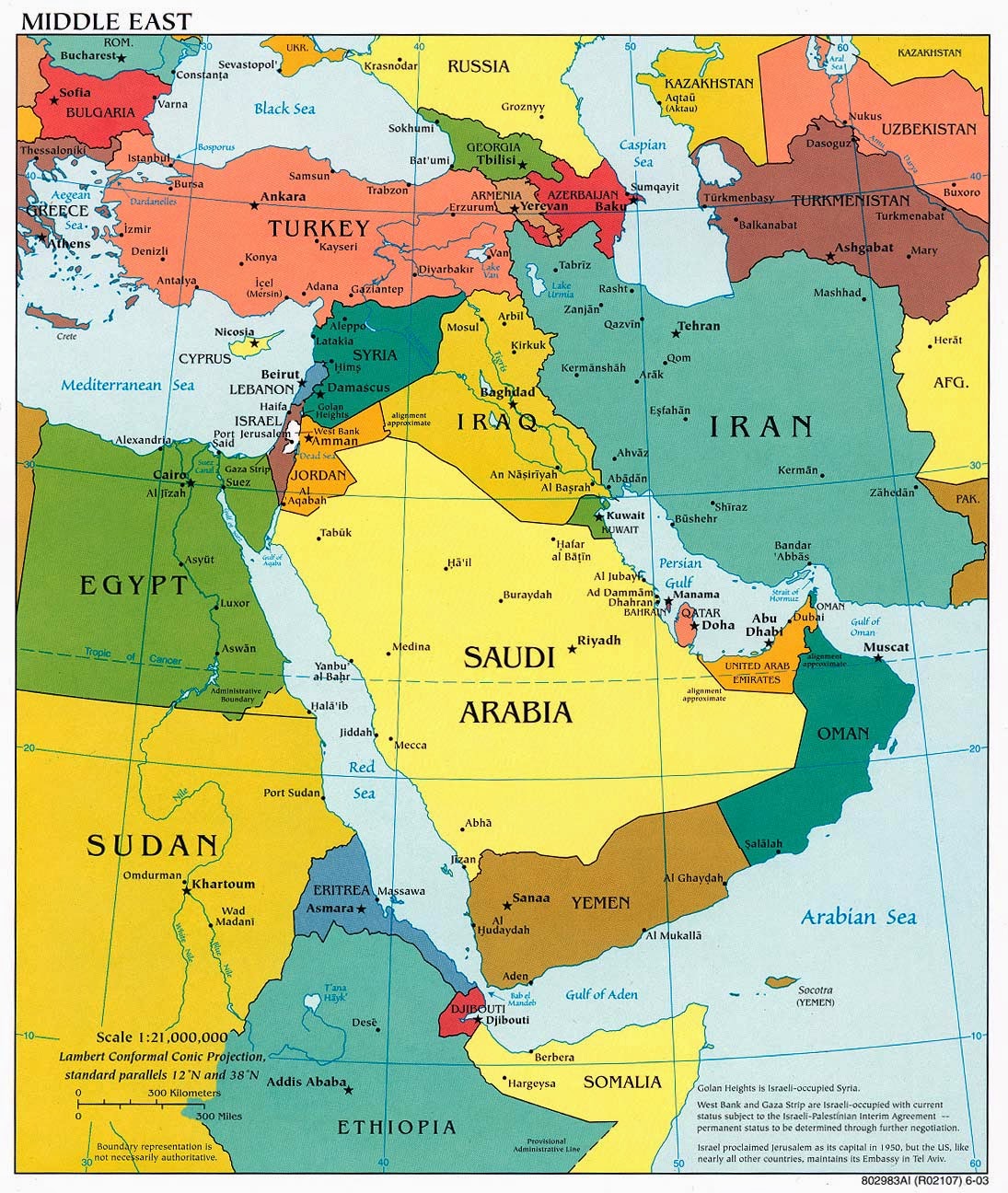
The more delineated map of the Middle East which was derived from the Sykes-Picot accord is the one we live with today. Take special note of those countries that were assigned straight-line borders. It is particularly revealing that some of the countries that are most in turmoil and include restive populations,  jihadists, and other groups of terrorists, are those with these kind of linear borders that do not take geography, culture, or religion into consideration--Syria, Sudan, Egypt, Yemen, Lebanon, Jordan, Iraq, and of course Israel.

Thus, "Iraq" should probably be deconstructed into at least three countries with cultural borders, including Kurdistan, and "Libya" into at least that many. The region, and the world would be much more peaceful if those who met in Paris in 1919 would have established borders that took history, religion, and tribal identity into consideration.


One might counter that there are straight line borders in the United States. Many. In fact, two of our states are virtual rectangles (Colorado and Wyoming), and four meet at the Four Corners (Colorado, Utah, Arizona, and New Mexico), but with the exception of the genocidal  example of what we did to our Native populations, territories that became states were not that culturally diverse and applied for statehood, staking out and suggesting their own borders. These borders for the most part were as viable as others that used rivers and mountain ranges as natural ways to divide and assign territory.


Labels: , , , , , , , , , , , , ,

Monday, January 12, 2015

January 12, 2105--1,000 Lashes

Meanwhile, in Saudi Arabia, one of our closest allies, a blogger was sentenced recently to a fine of more than $250,000, 10 years in jail, and 1,000 lashes to be administered with a cane in public over several months.

His "crime," starting a bog called Free Saudi Liberals, which in itself was enough to bring him to the attention of the country's religious establishment. Specifically, he was charged with "cybercrime," "insulting Islam," and "disobeying his father." Probably, if he had obeyed his father, they would be giving him only 500 lashes.

This punishment was considered so out of line that the United States, through the State Department, took the very rare step of criticizing the world's largest exporter of oil and one of the few Arab countries joining us in the battle against ISIS.

Saudi Arabia, recall, is really a theocracy. The House of Saud, which operates as an absolute monarchy, to get away with that and to secure the hundreds of billions of petro-dollars that flow to them, has an ongoing deal with some of the most fanatical of Islamic factions--the Wahhabis (the same group that was responsible for 9/11)--to allow the Sauds to rule in return for diverting other billions to the Wahhabi leadership and allowing them to be in charge of spiritual, judicial, and cultural life in the kingdom. Thus, the suppression and punishment of blogger Raif Badawi.

According the Amnesty International, the Saudis have already begun to administer the flogging--the first 50 lashes were carried out recently.

One glimmer of humanity--according to an article in the New York Times, Human Rights Watch reports that in Saudi Arabia floggers are supposed to distribute the lashes from the top of the back to the back of the legs without breaking the skin.

Nine-fifty to go.


Labels: , , , , , , , , , , ,

Monday, August 25, 2014

August 25, 2014--Rona al-Assad

Just between us do we think Egypt is a better place since Hosni Mubarak was ousted? What about Libya? Muammar Gadaffi is gone but what has taken his place? Chaos and civil war.


And would Jordan be an open society if King Abdullah were overthrown, or would Saudi Arabia suddenly become democratic with women allowed to drive without the Saud-family absolute monarchy in iron-fisted control? And we know what would result if and when Bashar al-Assad is killed or chased into luxurious exile.
       

Then, there is Rona's favorite example--Iraq.

For a moment it felt good to see Saddam Hussein captured and even executed, but what is his legacy? More civil war and unrelenting brutality and killings. She quipped some time ago, even before ISIS invaded and took control of a central swarth of Iraq, declaring a caliphate, that it's too bad Saddam is dead because in order to keep Iraq from splintering we need a tyrant to keep a lid on things. Sure Iraqi Shiites not a part of the Sunni ruling elite would again be discriminated against, and often worse, but compared to the number of killings and executions and beheadings currently going on, Saddam's rule seems benevolent.

So it is not entirely surprising that officials from governments in one way or another involved with Iraq and Syria would be wondering out loud if it might be a good idea to encourage and enable Bashar al-Assad to defeat the militants operating from within Syria, jihadists who are leading the effort to overthrow him as well as crossing back and forth across the Syria-Iraq border in order, day-by-day, to take control of much of Iraq and Syria, the heart of their new caliphate.

Rather than calling for his ouster, perhaps, based on the Libya-Egypt-Iraq experience, it may be in the best interest of Western parties to see al-Assad triumph and in control again of all of his country. Most of the killings would then stop, perhaps some rebuilding would occur, and minimally our interests would, in their own hypocritical and tortured way, be protected.

In that region the old status quo had many advantages.

Speaking the unspeakable, in Britain, a former foreign secretary and defense secretary suggested that though Bashar al-Assad is "unsavory," he should be used against the even greater evil, ISIS.

As reported in the New York Times, former secretary Malcom Rifkind said the beheading of journalist James Foley (by a Brit) required a forceful response from the West. The militants "need to be eliminated and we should not be squeamish about how we do it."

Speaking the language of realpolitik, he went on, "Sometimes you have to develop relationships with people who are extremely nasty in order to get rid of people who are even nastier."

Rona couldn't have said it better.

Understandably, the current foreign secretary rejected the idea out of hand. In polite society one does not speak so frankly. Especially not in public.


Labels: , , , , , , , , , , , , , , , ,

Friday, June 20, 2014

June 20, 2014--Persia

I am having second thoughts about our working in tandem with Iran to push back against the jihadist ISIS forces that are threatening to fully overrun Iraq and implement a holocaust against Shiite Iraqis and impose sharia law. They are already massacring thousands in parts of Iraq they have seized

These really are bad people. Even Al-Qaeda has renounced them as too violent. When you have Al-Qaeda pronouncing you to be too violent that qualifies as violent.

Already openly engaged in talks with Iran about its nuclear program, something that would have been difficult to imagine just a year ago when the drumbeat in Israel and among militarists in our own country were pressing the Obama administration to bomb, bomb, bomb Iran; as ISIS fighters stormed across northern and central Iraq, the US and Iran, again openly, began to talk about the possibility of coming to the assistance of the Iraqi government, as ineffective and exclusionary as it is, because the prospect of ISIS controlling most of the country, and the region that includes Syria, was too apocalyptic to contemplate.

There are at least three possible scenarios for the tormented Middle East--

Perhaps most likely is decades of interminable warfare ranging from small scale internecine civil wars between ethnic, tribal, and religious rivals to region-wide strife. Libya is an example of the former while what we are now seeing across Syria and Iraq is characteristic of the latter, with ISIS already proclaiming that what they are up to is not just the imposition of sharia law but the reestablishment of the Caliphate of the 7th through 15th centuries.

Second is the reemergence of a class of local tyrants who can, through force and terror, suppress the aspirations of the region's fractious peoples. Saddam Hussein in Iran, Hosni Mubarak in Egypt, the Shah and ayatollahs in Iran, the royal family in Saudi Arabia, Muammar Gaddafi in Libya, and currently Bashar al-Assad in Syria are all examples of leaders who were or have been for decades successful at keeping the lid on discontent and political rivals.

Third, though ultimately unlikely, is the scenario I have been reconsidering--the emergence with subtle U.S. support--of three or four regional powers that reassert their historic leadership roles across the region.

Egypt would need to see its revolution concluded to again play its dominant role among Arabs. Turkey would have to see it influence spread among moderate Muslims. Saudi Arabia would have to open its society further and come to play a greater regional role. And Iran would have to again become Persia.

Some have argued, for example, that Iran's nuclear aspirations have less to do with developing atomic weapons to use against Israel than an expression of national pride. For a people with an ancient and proud history to see itself overshadowed by the Saudis and Israelis is deeply humiliating. To again be able to play an influential role in the region might satisfy those national ambitions.

Of course the likelihood of any progressive scenario advancing is remote. The Sunnis and Shia have been murderous rivals since the death of the Prophet 1,400 years ago and Sunni Saudi Arabia and Shia Iran eye each other venomously.

But perhaps our trying to find a way to bring Iran into the family of moderate nations is worth a try. Everything else seems too depressing to think about 24 hours before the summer solstice.

Labels: , , , , , , , , , ,

Wednesday, November 20, 2013

November 20, 2013--Bomb, Bomb, Bomb . . . Bomb Iran

Here's what has me worried--

As dramatically weakened Barack Obama confronts three more years of his presidency, with the unlikelihood of anything, anything being approved by Congress (it will get even worse after Republican victories in the upcoming midterm elections), as with other presidents who had second-term problems, he will likely be tempted to do something dramatic in foreign affairs where as commander in chief he has considerable independent authority and the ability to act without congressional approval.

This is not in itself a bad thing--plagued by sex scandals, Bill Clinton almost pulled off an historic deal between the Israelis and Palestinians; Ronald Reagan negotiated significant disarmament agreements with the Soviets; and even Richard Nixon made progress in Eastern Europe and the Middle East.

But then there is the wag-the-dog problem--the temptation to get involved in overseas adventures to distract the public or repair tarnished presidential reputations. If was thought, for example, that to change the subject from Monica Lewinski and her blue dress, Clinton was itching to go to war in the Balkans.

Obama is on the ropes. The botched rollout of the Affordable Care Act is just the most recent in a string of failures that has ruined his political reputation and seen his approval ratings sink to George W. Bush levels.

On that list of failures and blunders is his now infamous pledge to draw a red line in Syria--if Bashar al-Assad crossed it and used chemical weapons against the rebels, Obama forcefully stated, the United States would take military action against the regime.

Assad did cross that red line and Obama backed down. He ordered lots os saber rattling but no intervention. The situation was saved by Russian President Putin who put pressure on his Syrian allies to give up their WMD program, which they are proceeding to do under UN supervision.

This failure to follow through has ruined Obama's reputation in that region.

Not only do the Israelis distrust him--if he failed to act in Syria what is his word worth when it comes to Iran where he has drawn another redline about Iran's nuclear capabilities?--now our other allies, the Saudis, Turkey, and Jordan, wonder if we will come to their assistance if the Iranians develop nuclear weapons or there are threats to their survival.

Clearly Obama wants to make a deal with the new, seemingly more moderate Iranian leaders. In fact, an initial, interim agreement may be struck as early as this week. This is not just a good thing for Obama's political reputation but a good thing in itself. We have to find a way to pull back from the brink. If Iran goes nuclear, it is virtually certain that the Saudis, Egyptians, and Turks will as well. This is not a part of the world where we want to see a nuclear arms race.

But beyond diplomacy, with Israeli Prime Minister Netanyahu marshaling local as well as U.S. congressional opposition to any deal with Iran, threatening to take unilateral military action against Iran's nuclear facilities, the political pressure on Obama--at this vulnerable time in his presidency--is almost beyond calculation.

The temptation to show that his word is good--especially when it comes to staking out positions in the world where there are threats to our allies and to our own security--may impel President Obama to want to show some muscle.

He hasn't done very much of that with Congress and other than killing Osama bin Ladin and numerous al Qaeda leaders with drones (which is generally commendable), Obama has been a disengaged, passive leader more including to deliver speeches than exert forceful leadership.

One place where he can take a form of forceful action is in Iran where he can join the Israelis in bombing their uranium enrichment facilities in an attempt to set back their nuclear clock.

This could in time be necessary. But diplomacy may now be working and it will require considerable courage from Obama to fend off pressure from Israel and Congress to keep talking and dealing with the Iranians.

Labels: , , , , , , , , , , , , , , , , ,

Friday, August 16, 2013

August 16, 2013--Arab Winter

Fridays in August should be times for languor and light spiritedness. Pass by this then if you want to protect your tranquility, but I cannot resist saying a few words about the escalating crises in the Middle East.

With a state of emergency declared in Egypt--after hundreds there were slaughtered by the military in an attempt to take the country back from the democratically-elected leadership of the Muslim Brotherhood--with continued unrest in Bahrain; democracy under threat in Tunisia, Iraq, Libya, and possibly even Turkey; and an all-out civil war raging in Syria, what ever became of the hope engendered by the Arab Spring that commenced in Tunisia more than two years ago?  The hope that authoritarian leaders from Muammar al-Gaddafi in Libya to Hosni Mubarak in Egypt would topple one-by-one and liberal democracies would take their places?


Isn't this what Barack Obama early in his presidency in a speech in Cairo saw to be the strategic opportunity in the region? And wasn't it for this that he was awarded a preemptive Nobel Peace Prize?

But now we have this--a tectonic nightmare of old authoritarian regimes overthrown and supplanted by radical leaders, many of whom either have ties to al Qaeda or tolerate their presence. Who foresaw that this would be the last gasp of 19th century colonialism and the dawn of a complicated new day in the Muslim world? 

Actually, many did who knew anything about the history of the Arab lands and the contesting forces active in every country throughout the region.

Does anyone doubt that events in Egypt will lead to a civil war there at least as ugly as the one underway in Syria? With the military government so casual about murdering hundreds of protesters isn't it inevitable that this will not suppress the opponents of military rule but motivate and inspire them to become more aggressive, ultimately take up arms, and prevail?

Is there any doubt that at some point in the not distant future we will see similar situations in Jordan and even Saudi Arabia where corrupt monarchies currently rule?

Then what we will have? A region in full turmoil with access to oil severely restricted. What will then be the consequences for the global economy? 

The ideals espoused by Woodrow Wilson, Franklin Roosevelt, George W. Bush, and Barack Obama in historical perspective look naive. 

Not everyone wants a government similar to ours (in fact, a majority of Americans themselves aren't too happy with the state of our own current government), not every country (especially those with arbitrary borders drawn up by the West after the First World War) is culturally set up to embrace democracy. And when they do fight for and achieve the right to vote--with our endorsement--they elect leaders from Hamas, Hezbollah, and the Muslim Brotherhood. 

This is just another sad example of unintended consequences, of the danger of getting what one wishes for.

Labels: , , , , , , , , , , , , , , , ,